
How to Teach Cellular Respiration: A Step-by-Step Guide for Educators - Mastering Complex Biological Concepts in the Classroom
Teaching cellular respiration can be challenging for many science educators. This complex biological process requires clear explanations and engaging activities to help students understand how cells convert food into energy. Effective cellular respiration instruction combines visual models, hands-on experiments, and real-world connections to make abstract concepts concrete for students.

Breaking down this process into digestible steps helps students grasp the relationship between the air they breathe, the food they eat, and the energy their bodies produce. Many teachers find success using analogies that compare cellular respiration to everyday experiences, like burning fuel in a car engine. Interactive demonstrations showing how oxygen and glucose interact create memorable learning moments that stick with students long after the lesson ends.
Key Takeaways
Visual models and analogies simplify the complex stages of cellular respiration for better student comprehension.
Comparing photosynthesis with cellular respiration helps students understand these complementary processes in nature.
Hands-on experiments measuring CO2 production or temperature changes provide concrete evidence of cellular respiration in action.
Understanding Cellular Respiration
Cellular respiration is the process that cells use to convert nutrients into energy. This fundamental biochemical pathway occurs in all living organisms and provides the necessary energy for cellular functions.
Fundamentals of ATP and Energy Conversion
ATP (adenosine triphosphate) is the primary energy currency of cells. It stores energy in its chemical bonds that can be quickly released when needed for cellular activities.
When ATP breaks down to ADP (adenosine diphosphate), it releases energy that powers cellular work. This conversion is similar to how a battery powers a device.
The mitochondria, often called the "powerhouse of the cell," is where most ATP production occurs. These specialized organelles have an inner and outer membrane that create compartments for different stages of respiration.
Cells can produce ATP through several pathways. These include glycolysis, the citric acid cycle, and electron transport chain.
Roles and Processes in Cellular Respiration
Cellular respiration begins with glycolysis, which occurs in the cytoplasm. This process breaks down glucose into pyruvate and produces a small amount of ATP.
After glycolysis, pyruvate enters the mitochondria where it undergoes oxidation. This step connects glycolysis to the citric acid cycle.
The citric acid cycle (also called the Krebs cycle) generates electron carriers that feed into the electron transport chain. This occurs in the mitochondrial matrix.
The electron transport chain, located in the inner mitochondrial membrane, produces most of the ATP. It uses oxygen as the final electron acceptor, which explains why we need to breathe.
Water and carbon dioxide are produced as waste products. The carbon dioxide is expelled through respiration in humans and animals.
The Role of Glucose and Oxygen in Respiration
Glucose and oxygen serve as the fundamental inputs for cellular respiration, working together to produce the energy cells need to function. These molecules interact through specific pathways to transform chemical energy into ATP, the usable form of energy for cellular activities.
Glucose Metabolism
Glucose is the primary fuel molecule in cellular respiration. This six-carbon sugar enters the cell through special transport proteins in the cell membrane.
Once inside, glucose undergoes glycolysis in the cytoplasm, where it splits into two pyruvate molecules. This process yields a small amount of ATP and NADH (an energy carrier).
In eukaryotic cells, pyruvate then enters the mitochondria. Here it transforms into acetyl-CoA before entering the Krebs cycle (also called the citric acid cycle).
The Krebs cycle breaks down acetyl-CoA completely, releasing carbon dioxide and producing more energy carriers (NADH and FADH₂). These carriers are crucial for the next stage of respiration.
Oxygen's Vital Part in Energy Production
Oxygen acts as the final electron acceptor in the electron transport chain (ETC), making it essential for aerobic respiration.
Without oxygen, the ETC would stop functioning, causing electron carriers to remain in their reduced state. This would halt the Krebs cycle and significantly reduce ATP production.
When oxygen is available, electrons flow through the ETC proteins embedded in the inner mitochondrial membrane. This movement generates a proton gradient across the membrane.
The proton gradient drives ATP synthase, an enzyme that produces most of the ATP in respiration. A single glucose molecule can yield up to 36 ATP molecules through this aerobic process.
Oxygen combines with electrons and hydrogen ions at the end of the ETC to form water, completing the respiratory process and preventing the buildup of toxic compounds in the cell.
Key Stages of Cellular Respiration
Cellular respiration occurs in three main stages, each with specific reactions that release energy from glucose molecules to produce ATP for the cell.
Glycolysis Explained
Glycolysis is the first stage of cellular respiration that occurs in the cytoplasm of all cells. During this process, one glucose molecule (6 carbon atoms) is split into two pyruvate molecules (3 carbon atoms each).
This stage requires no oxygen and produces a small amount of energy - just 2 ATP molecules per glucose. It also generates 2 NADH molecules by transferring electrons from glucose to NAD+.
Glycolysis involves ten distinct chemical reactions divided into two phases. The first phase uses 2 ATP molecules to activate glucose, while the second phase generates 4 ATP molecules, resulting in a net gain of 2 ATP.
The pyruvate molecules produced will either enter the next stage of cellular respiration or, in the absence of oxygen, undergo fermentation.
The Citric Acid Cycle
The citric acid cycle (also called the Krebs cycle) takes place in the mitochondrial matrix. Before entering this cycle, pyruvate from glycolysis is converted to acetyl-CoA, releasing one carbon atom as CO₂.
Each glucose molecule produces two acetyl-CoA molecules that enter the cycle separately. These molecules combine with oxaloacetate to form citric acid, giving the cycle its name.
During one complete turn of the cycle, the following occurs:
2 carbon atoms enter as acetyl-CoA
2 carbon atoms leave as CO₂
3 NAD+ are reduced to NADH
1 FAD is reduced to FADH₂
1 ATP (or GTP) is produced
This cycle is remarkable because it completely oxidizes the original glucose molecule, capturing its energy in electron carriers (NADH and FADH₂).
Electron Transport and ATP Synthase
The electron transport chain and ATP synthase work together in the inner mitochondrial membrane to produce most of the cell's ATP.
NADH and FADH₂ from earlier stages deliver electrons to the transport chain, which consists of four protein complexes. As electrons move through these complexes, they release energy that pumps hydrogen ions (H+) into the intermembrane space.
This creates a concentration gradient of H+ ions. ATP synthase uses this gradient in a process called chemiosmosis. As ions flow back through ATP synthase, they power the production of ATP from ADP and phosphate.
For each glucose molecule:
NADH contributes to producing about 2.5 ATP each
FADH₂ contributes to producing about 1.5 ATP each
The entire process yields approximately 30-32 ATP molecules
This final stage requires oxygen, which serves as the final electron acceptor and combines with hydrogen to form water.
Aerobic vs. Anaerobic Respiration
Cellular respiration occurs through two main pathways that differ in their oxygen requirements and energy yields. These processes provide essential energy for cells but operate under different conditions and with varying efficiency.
Aerobic Cellular Respiration and Its Efficiency
Aerobic respiration requires oxygen molecules to generate energy efficiently. This process occurs in the mitochondria of cells and produces significant amounts of ATP (adenosine triphosphate).
The complete breakdown of glucose through aerobic pathways yields about 36-38 ATP molecules per glucose molecule. This high energy yield makes aerobic respiration the preferred method for most organisms.
During exercise, muscle cells rely on aerobic respiration when adequate oxygen is available. This is why endurance athletes focus on improving their oxygen uptake capacity.
The efficiency of aerobic respiration comes from its complete breakdown of glucose into carbon dioxide and water, capturing most of the available energy.
Anaerobic Processes and Their Applications
Anaerobic respiration occurs without oxygen and includes fermentation pathways like lactic acid and alcohol fermentation. These processes generate only 2 ATP molecules per glucose molecule.
Muscle cells switch to anaerobic processes during intense exercise when oxygen supply cannot meet demand. This results in lactic acid buildup, causing the burning sensation in muscles during strenuous activity.
Despite lower efficiency, anaerobic processes are crucial for survival in oxygen-limited environments. Many microorganisms rely exclusively on these pathways.
Some beneficial applications of anaerobic processes include food production (yogurt, cheese, bread) and biofuel generation. These practical uses highlight the importance of understanding both respiratory pathways.
Pedagogical Techniques for Teaching Cellular Respiration
Teaching cellular respiration effectively requires diverse approaches that engage students on multiple levels. These techniques help make complex biochemical processes more accessible and memorable.
Classroom Activities for Engaging Students
Role-playing exercises can transform abstract cellular processes into tangible experiences. Students can act as glucose molecules, oxygen, or organelles to physically demonstrate how cells extract energy. This kinesthetic approach helps visual learners understand catabolic reactions.
Think-Pair-Share discussions encourage critical thinking about cellular respiration's role in different tissues. Students first consider a question individually, then discuss with a partner, and finally share with the class.
Concept mapping helps students visualize connections between glycolysis, the Krebs cycle, and electron transport chain. Have students create maps showing how these processes relate to each other within cells.
Comparison tables that contrast cellular respiration with photosynthesis highlight the complementary nature of anabolic and catabolic reactions in living systems.
Lab Experiments for Hands-On Learning
Respirometer experiments allow students to measure oxygen consumption in germinating seeds or small invertebrates. This demonstrates how metabolic rates vary under different conditions.
Safety must be emphasized when handling lab equipment and biological materials. Provide clear protocols and supervision when students work with living tissues.
Fermentation investigations using yeast can demonstrate anaerobic respiration. Students can test how different variables affect the rate of CO₂ production.
Microscope observations of mitochondria in stained cell samples help students connect organelles to their functions. Prepared slides of tissues with high energy needs (like muscle) show abundance of mitochondria.
Colorimetric assays using indicators like bromothymol blue demonstrate CO₂ production during respiration. Students can compare respiration rates between active and dormant organisms.
Visual Aids and Multimedia Resources
3D models of mitochondria help students visualize the organelle's structure where cellular respiration occurs. Physical models they can manipulate enhance understanding of compartmentalization.
Animated videos showing electron flow through the transport chain make abstract concepts more concrete. These videos can pause at key moments for discussion about energy transfer.
Interactive simulations allow students to manipulate variables and observe how they affect ATP production in cells. This helps them understand control mechanisms in cellular respiration.
Infographics and flowcharts provide visual representations of complex biochemical pathways. Color-coding can distinguish between glycolysis, Krebs cycle, and electron transport chain.
Augmented reality apps let students explore cellular structures and pathways in 3D space. These tools make invisible cellular processes visible and interactive.
Understanding Respiration at the Organism Level
Respiration at the organism level involves complex systems that facilitate gas exchange between the body and environment. These systems directly support cellular respiration by delivering oxygen and removing carbon dioxide.
Gas Exchange Systems in the Human Body
The human respiratory system starts with the nose and mouth, where air enters the body. This air travels through the pharynx and larynx into the trachea.
The trachea branches into two bronchi, one leading to each lung. Inside the lungs, bronchi divide into smaller bronchioles.
At the end of bronchioles are tiny air sacs called alveoli. These microscopic structures are where gas exchange actually happens.
Alveoli are surrounded by tiny blood vessels called capillaries. The walls of both alveoli and capillaries are just one cell thick, allowing gases to pass through easily.
Oxygen moves from the alveoli into the bloodstream, where it attaches to hemoglobin in red blood cells. Carbon dioxide moves in the opposite direction, from the blood into the alveoli to be exhaled.
Linking Cellular Respiration to Breathing
Breathing and cellular respiration form a continuous cycle in the body. When cells break down carbohydrates during cellular respiration, they consume oxygen and produce carbon dioxide.
This carbon dioxide builds up in tissues and enters the bloodstream. Specialized receptors detect rising carbon dioxide levels and signal the brain to increase breathing rate.
Faster breathing brings in more oxygen and expels more carbon dioxide. This process maintains the proper balance of gases in the body.
The rate of breathing adjusts automatically based on the body's needs. During exercise, cells require more oxygen to produce energy, so breathing becomes deeper and more frequent.
Without this coordinated gas exchange system, cells would quickly run out of oxygen and cellular respiration would stop.
Comparing Cellular Respiration and Photosynthesis
Understanding the relationship between cellular respiration and photosynthesis helps students grasp how energy flows through living systems. These processes form a biological cycle that sustains life on Earth through the exchange of oxygen, carbon dioxide, and energy-rich molecules.
Energy Transformation in Photosynthesis
Photosynthesis captures light energy and converts it into chemical energy stored in carbohydrates. Plants use sunlight, carbon dioxide, and water to produce glucose and oxygen through this process.
The equation for photosynthesis can be written as: 6CO₂ + 6H₂O + light energy → C₆H₁₂O₆ + 6O₂
This process occurs in chloroplasts and involves two main stages: light-dependent reactions and the Calvin cycle.
During light-dependent reactions, water molecules split, releasing oxygen as a byproduct. The energy captured from sunlight is stored temporarily in ATP and NADPH.
The Calvin cycle uses this stored energy to fix carbon dioxide into glucose. This glucose serves as an energy-rich molecule that plants can use or convert to other carbohydrates.
The Symbiotic Relationship Between Processes
Cellular respiration and photosynthesis work together in a perfect balance. The products of one process become the reactants for the other.
Oxygen released during photosynthesis becomes available for cellular respiration in all aerobic organisms. Similarly, the carbon dioxide produced during respiration provides a necessary ingredient for photosynthesis.
The equation shows this relationship clearly:
Photosynthesis: 6CO₂ + 6H₂O → C₆H₁₂O₆ + 6O₂
Cellular Respiration: C₆H₁₂O₆ + 6O₂ → 6CO₂ + 6H₂O + ATP
This cycle maintains atmospheric gas levels and energy flow throughout the biosphere. Without photosynthesis, cellular respiration could not continue indefinitely as oxygen would be depleted.
The ATP used by plants at night comes from cellular respiration of the glucose created during daylight through photosynthesis, completing the energy cycle.
Frequently Asked Questions
Educators often have specific questions about teaching cellular respiration effectively. These answers provide practical guidance for classroom implementation across various grade levels and learning styles.
What interactive activities can effectively engage students in learning cellular respiration?
Role-playing activities work well for cellular respiration. Students can act as different molecules moving through the process. Each student represents glucose, oxygen, or ATP molecules.
Modeling with Play-Doh or clay helps students create 3D representations of the cellular respiration process. This hands-on approach reinforces the concept of molecule transformation.
Digital simulations allow students to manipulate variables and observe outcomes. Many free online tools show how changing oxygen levels affects ATP production.
Laboratory experiments using respirometers give students real data to analyze. Measuring oxygen consumption in germinating seeds creates a concrete connection to the concept.
How can one simplify the concept of cellular respiration for younger students?
Use food analogies to explain cellular respiration. Compare glucose to a candy bar that contains energy the cell "eats" to power itself.
Create simple metaphors like comparing mitochondria to tiny power plants. This helps younger students visualize the process without complex biochemistry.
Focus on the basic input-output relationship. Emphasize that cells take in food and oxygen and produce energy and carbon dioxide.
Use colorful diagrams with minimal text. Visual representations help younger students grasp the concept without getting overwhelmed by terminology.
Which teaching methods are most successful in explaining the phases of cellular respiration?
Sequential graphic organizers help students understand the step-by-step nature of cellular respiration. These visual tools show how each phase connects to the next.
Mnemonic devices aid memory of the key phases. "Going Places Takes Carbohydrates" can help remember Glycolysis, Pyruvate processing, TCA cycle, and Electron Transport Chain.
Conceptual chunking breaks down complex processes into manageable parts. Teach each phase separately before connecting them into the complete process.
Comparison charts highlight differences between aerobic and anaerobic respiration. This method helps students understand why aerobic respiration produces more ATP.
What are effective classroom strategies for teaching cellular respiration in high school?
Case studies connecting cellular respiration to real-world scenarios engage high school students. Examples include athletic performance, metabolic disorders, or cellular adaptations.
Inquiry-based investigations allow students to design experiments testing factors affecting respiration rates. This promotes critical thinking about scientific processes.
Multimedia presentations incorporating videos of cellular processes help visual learners. Animation brings microscopic cellular activities to life.
Concept mapping encourages students to create visual representations showing relationships between respiration components. This develops higher-order thinking skills.
How can educators integrate the topic of photosynthesis with cellular respiration in their lesson plans?
Cycle diagrams clearly show the relationship between both processes. Visual representations help students see how the products of one process become the reactants of the other.
Comparative tables highlight similarities and differences between photosynthesis and cellular respiration. This helps students understand their complementary nature.
Plant experiments demonstrate both processes occurring in the same organism. Growing plants under different conditions shows the balance between these processes.
Ecosystem modeling activities show energy flow through living systems. Students can track carbon atoms as they move between photosynthesis and cellular respiration.
Can you suggest any comprehensive lesson plans that focus on cellular respiration for middle school educators?
A "Cell Energy Week" plan works well for middle schools. Day one introduces energy concepts, day two covers glycolysis, day three explores the Krebs cycle, day four examines electron transport, and day five connects to human health.
Station-based learning allows students to rotate through different aspects of cellular respiration. Stations might include microscope observations, modeling activities, and digital simulations.
Project-based approaches can focus on designing a cell energy poster. Students research and illustrate the process, creating accurate scientific artwork with proper labeling.
Interactive notebook activities help students organize information systematically. Guided notes, diagrams, and reflection questions provide structure for learning complex concepts.


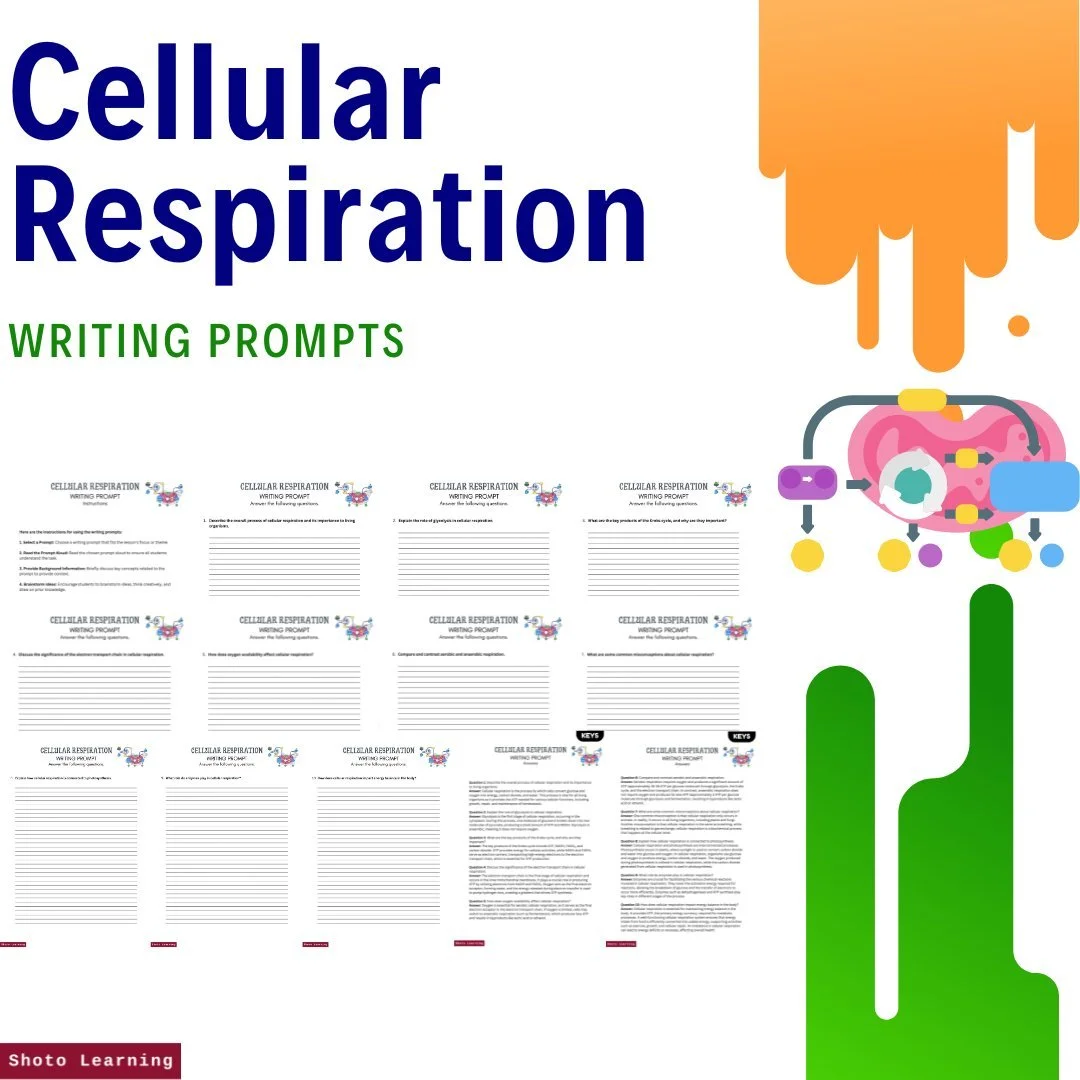


The Complete Cellular Respiration Bundle is the ultimate resource for teaching and learning about cellular respiration! This all-inclusive bundle contains over 20 engaging and educational worksheets, activities, and assessments that cover every aspect of cellular respiration, from glycolysis to the electron transport chain. Perfect for middle school and high school biology students, this bundle includes everything teachers need to create comprehensive lessons, reinforce key concepts, and assess student understanding. Each resource comes with an answer key for easy grading and self-assessment.
Included Worksheets and Resources:
Free ABC Order Worksheet: Organize important terms related to cellular respiration in alphabetical order.
Free Label the Parts Worksheet: Label key parts of the cellular respiration process with or without a word box.
Free Cellular Respiration Poster: A visual aid for the classroom to support student learning.
Plus:
Assignments: 10 detailed assignments on cellular respiration, each with answers included.
Bingo: A fun, educational bingo game with cellular respiration keywords.
Crossword: 20 questions and clues to reinforce cellular respiration vocabulary.
Cryptogram: Solve a hidden message on cellular respiration using three different key codes.
Debates: 10 debate questions and answers to promote critical thinking and discussion.
Experiment: A hands-on activity for students to explore cellular respiration in a real-world setting.
Fill-in-the-Blank: 20 questions with answers for a quick review of key terms and processes.
Flashcards: 20 keywords and definitions for students to practice vocabulary.
Lesson Plan: A comprehensive cellular respiration lesson plan with objectives, materials, and assessments.
Matching: 10 matching questions on key terms and processes.
Missing Letters: 20 holiday-themed keywords with missing letters, for vocabulary reinforcement.
Multiple Choice: 20 questions to assess understanding of cellular respiration concepts.
PowerPoint: A 13-slide presentation with detailed speech notes, available for purchase and free on YouTube.
Questions & Answers: A worksheet with key questions and answers on cellular respiration.
Reading Comprehension: Activities designed to improve understanding of the cellular respiration process.
Scramble: 30 scrambled terms for students to solve.
Test: A 45-minute test to evaluate student knowledge, with answer key included.
True or False: 20 true/false questions to reinforce learning, with answers.
Word Search: A 30-word search puzzle to strengthen terminology understanding.
Writing Prompts: Engaging prompts to inspire critical thinking and writing on cellular respiration.
Key Features:
Over 20 Resources covering all aspects of cellular respiration.
Answer Key Included for all worksheets, quizzes, and assessments.
Engaging and Interactive activities to cater to different learning styles.
Designed for Middle and High School students studying biology.
Diverse Formats such as crosswords, flashcards, bingo, experiments, and debates engage all learners.
Comprehensive Coverage: From beginner to advanced concepts, this bundle covers all stages of cellular respiration.
How to Use It:
Lesson Planning: Use the lesson plan and PowerPoint to structure your classroom sessions on cellular respiration.
Review and Reinforcement: Assign worksheets, including the fill-in-the-blank, crossword, and flashcards, to help students reinforce their understanding.
Classroom Activities: Engage students with bingo, debates, and experiments for hands-on learning.
Assessment: Utilize the test, true or false worksheet, and multiple-choice questions to assess student knowledge.
Homework: Assign tasks such as the scramble, matching, and reading comprehension worksheets for homework or extra practice.
This Complete Cellular Respiration Bundle equips teachers with everything they need to successfully teach cellular respiration, making science education both fun and informative!
133 pages
Order your copy today!