
Earth from Space: Understanding Our Planet Through the Cosmos
Introduction to Earth from Space
Earth from space offers a unique perspective that reveals the planet's fascinating features and intricate systems. Teaching students about Earth from this vantage point not only enhances their understanding of geography and science but also fosters a deep appreciation for our planet. This blog provides effective strategies for educators to teach about Earth from space.
Establish a Solid Foundation
Start with the basics of our planet. Discuss Earth's size, shape, and its distance from the sun to provide context for students. Understanding these fundamentals is crucial for grasping why Earth appears as it does from space and how it interacts within our solar system.
Utilize Visual Aids
Visual aids are vital when teaching about Earth from space. Incorporate stunning images and videos captured by satellites and the International Space Station (ISS). Simulated flyovers of different regions can significantly enhance students' comprehension of Earth's geography, weather patterns, and ecosystems. These visual elements create an engaging learning experience and help students visualize concepts more clearly.
Highlight Key Earth Features
Focus on specific features of Earth that can be observed from space, such as:
Oceans: Discuss their role in climate regulation and biodiversity.
Mountains: Explore how they influence weather patterns and ecosystems.
Weather Patterns: Examine how satellite data helps us understand atmospheric phenomena.
By concentrating on these elements, students can learn how they interact with each other and impact life on Earth.
Incorporate Interactive Tools
Leverage interactive tools like Google Earth to allow students to explore various parts of the planet. This platform enables them to zoom in, rotate the Earth, and even examine other celestial bodies within our solar system. Interactive learning not only captures students’ attention but also fosters a deeper understanding of Earth's geographical complexities.
Connect Learning to Real-World Applications
Emphasize the real-world implications of studying Earth from space. Discuss how satellite technology aids in:
Weather Prediction: Understanding meteorological patterns and forecasting.
Natural Disaster Monitoring: Tracking events like hurricanes and wildfires.
Climate Change Studies: Analyzing trends and developing solutions.
Connecting classroom learning to practical applications helps students recognize the significance of Earth science in their daily lives and future careers.
Conclusion
Teaching about Earth from space is an exciting and enriching way to engage students with their planet. By using visual aids, focusing on essential features, and linking lessons to real-world applications, educators can cultivate a profound appreciation for Earth's beauty and complexity. This approach not only enhances knowledge but also inspires the next generation to protect and cherish our home.
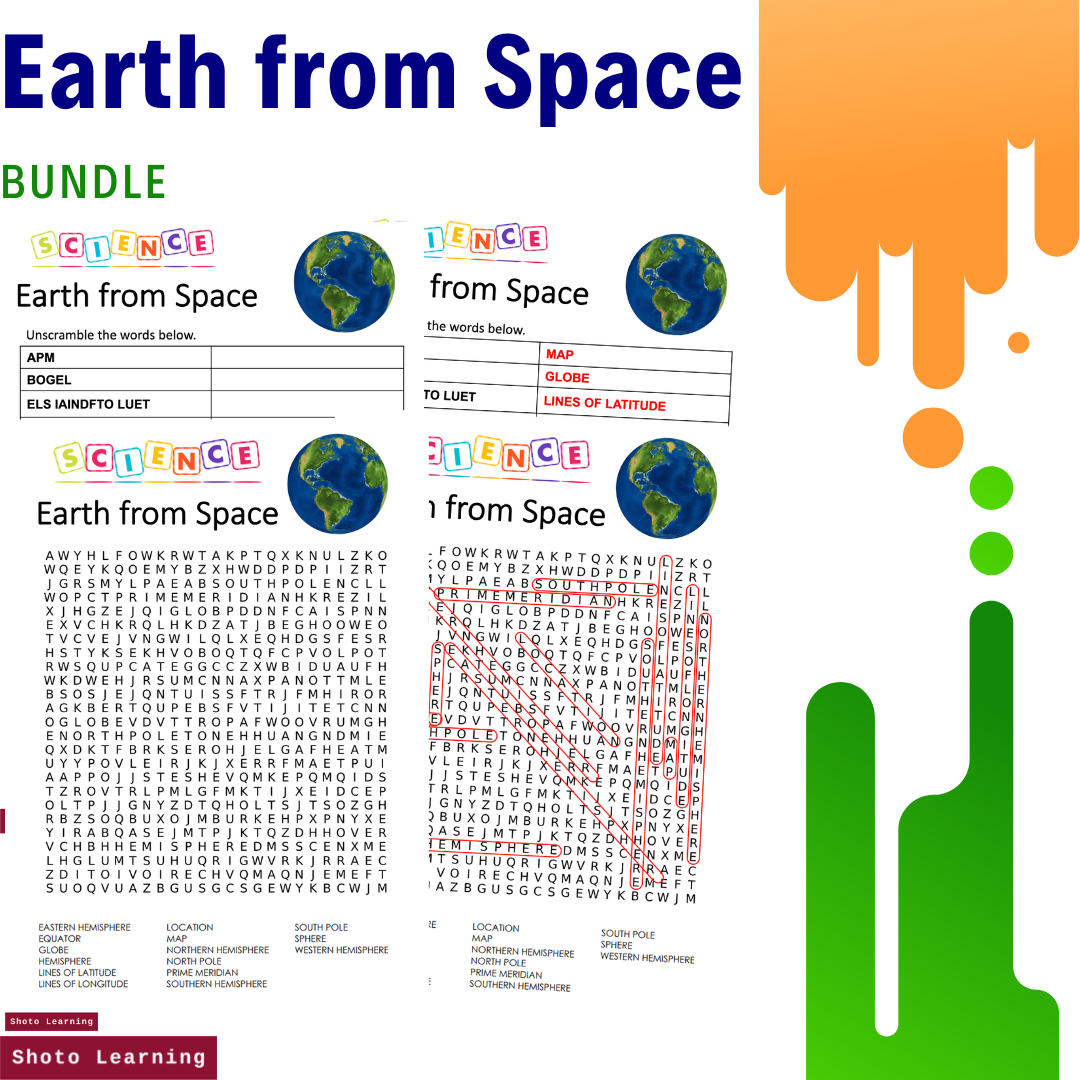
Do you want to learn more about Earth science and have some fun while doing it? Check out the Earth From Space Science Activity - Word Find and Unscramble Game Vocabulary! With this fun game, you can explore the intriguing world of Earth science while looking for hidden and scrambled words. See how many of the Earth science terms and definitions you can find!
EARTH FROM SPACE - WORD FIND & UNSCRAMBLE WORDS
Worksheet for a Science Game featuring Earth from Space words. Find the 15 hidden words and unscramble them.
When teaching a unit on Earth from space, this is a great resource for early finishers or as a take-home game.
The vocabulary words covered include:
Eastern Hemisphere, Equator, Globe, Hemisphere, Lines of Latitude, Lines of Longitude, Location, Map, North Pole, Northern Hemisphere, Prime Meridian, South Pole, Southern Hemisphere, Sphere, Western Hemisphere.
Solution included.
Let’s be friends!
Blog ★ Pinterest ★ Facebook ★ Instagram ★ YouTube
Happy teaching!