
Engaging Strategies for Teaching Mitosis: Simplifying Cell Division for Students
Introduction to Mitosis
Mitosis is a crucial biological process where a single cell divides to produce two identical daughter cells. This mechanism plays an essential role in growth, tissue repair, and cellular regeneration in living organisms. However, teaching mitosis can be challenging for educators and students alike. In this blog, we’ll explore engaging strategies and activities that can simplify the teaching of mitosis and enhance student understanding.
1. Start with the Basics of Cell Biology
Before delving into the intricacies of mitosis, it’s vital to establish a solid foundation in cell biology. Ensure your students are familiar with the structure and function of cells, the different cell types, and the cell cycle's various phases. This foundational knowledge will make understanding mitosis much easier.
2. Utilize Visual Aids to Enhance Understanding
Mitosis involves multiple phases that can confuse students. To clarify these concepts, employ visual aids such as diagrams, videos, and animations. Interactive models, like 3D cell structures, can also be highly effective in illustrating the different stages of mitosis. Engaging visuals can transform complex ideas into understandable concepts.
3. Incorporate Hands-On Activities for Active Learning
Engage your students with hands-on activities that promote active learning. Encourage them to build models of cells, color diagrams, or observe slides of cells under a microscope. These practical experiences allow students to visualize the stages of mitosis and solidify their understanding of the process.
4. Foster Peer-to-Peer Learning
Promote collaboration by encouraging students to work in pairs or small groups on mitosis-related activities. This peer-to-peer learning approach enhances communication skills and teamwork while providing support for students who may struggle with the material. Collaborative learning can make challenging concepts more accessible and enjoyable.
5. Provide Real-World Examples of Mitosis in Action
Help students grasp the significance of mitosis by providing real-world examples. Discuss scenarios such as the regeneration of liver cells or plant growth. By linking the concept of mitosis to everyday life, students can appreciate its importance in maintaining healthy tissues and organs.
6. Use Analogies to Simplify Complex Concepts
Mitosis can be a daunting topic, particularly for younger learners. To facilitate understanding, use relatable analogies. For example, compare the process of mitosis to baking a cake, where each ingredient represents a stage in cell division. Analogies can make abstract concepts more tangible and easier to comprehend.
7. Summarize and Review Key Concepts
At the end of each class, take time to summarize the key points covered during the lesson. Review the different stages of mitosis and encourage students to ask questions. This reinforcement not only solidifies their understanding but also addresses any uncertainties they may have.
Conclusion
Teaching mitosis effectively requires a blend of strategies, including visual aids, hands-on activities, real-world examples, and analogies. By incorporating these techniques into your teaching approach, you can help students grasp the intricacies of mitosis and appreciate its significance in living organisms. Empower your students to master this fundamental concept in biology and enhance their overall learning experience.

Enhance your understanding of mitosis with our comprehensive Mitosis Worksheet Bundle. Designed to cater to various learning styles, this bundle offers a diverse range of activities to deepen your knowledge of cell division.
Explore mitosis concepts through:
Assignments: Embark on 10 stimulating assignments covering diverse topics, encouraging critical thinking and practical application of knowledge.
Debate: Engage in thought-provoking discussions about mitosis-related topics.
Fill in the Blank: Reinforce your understanding through interactive fill-in-the-blank exercises.
Free ABC Order: Reinforce language skills with alphabetical arrangement.
Free Cut and Paste: Dive into hands-on learning to reinforce comprehension.
Free Flipbook: Visualize mitosis stages with our interactive flipbook.
Free Poster: Access a free poster containing essential mitosis information.
Free Storyboard: Expand your knowledge and memory skills with our storyboard activity.
Matching: Test your knowledge and memory skills with matching exercises.
Multiple Choice: Assess your understanding with multiple-choice quizzes.
Questions and Answers: Expand your knowledge with curated questions and answers.
Reading Comprehension: Sharpen reading skills with engaging passages, perfect for students and educators alike.
Test (45 Minutes): Evaluate your comprehension with a comprehensive 45-minute test.
True or False: Challenge your understanding with true or false statements about mitosis.
Writing Prompts: Stimulate critical thinking with mitosis-themed writing prompts.
Whether you're a student looking to reinforce your learning or an educator seeking engaging resources for your classroom, our Mitosis Worksheet Bundle is your ultimate companion for mastering cell division concepts. Embark on an enriching learning journey and unlock the mysteries of mitosis today!
81 pages
Don't miss out; order yours today!

Dive deep into the fascinating world of mitosis with our comprehensive Mitosis Mastery Bundle! This bundle is designed to engage learners of all levels with a variety of interactive activities and resources to solidify their understanding of cellular division.
Included in this bundle:
PowerPoint Presentation: A visually captivating presentation to guide learners through the stages and processes of mitosis.
45-Minute Test: Assess understanding with a thoughtfully crafted test covering key concepts of mitosis.
Lesson Plan: Dive deep with our detailed lesson plan, complete with engaging activities and discussion topics.
Reading Comprehension: Sharpen reading skills with engaging passages, perfect for students and educators alike.
Mitosis Bingo: A fun and educational twist on the classic game, reinforcing mitosis terminology and stages.
Mitosis Crossword: Challenge comprehension with a crossword puzzle focusing on mitosis vocabulary.
Mitosis Word Search: Reinforce terminology playfully with a mitosis-themed word search.
Mitosis Cryptogram: Exercise critical thinking skills by decoding mitosis-related messages.
True or False Quiz: Test knowledge with a quick true or false quiz on mitosis facts.
Matching Activity: Match key terms with their definitions to reinforce understanding.
Missing Letters Worksheet: Fill in the missing letters to complete mitosis-related terms.
Scramble Game: Unscramble the letters to reveal mitosis-related words.
Free Bonus Materials:
ABC Order Worksheet: Practice alphabetizing mitosis-related terms.
Cut and Paste Activity: Engage kinesthetic learners with a hands-on activity to sequence mitosis stages.
Flipbook Template: Create an interactive flipbook illustrating the stages of mitosis.
Poster: Decorate your learning space with a visually appealing mitosis poster.
Storyboard Template: Encourage creativity with a storyboard template for illustrating the process of mitosis.
With answers included for all activities, this bundle offers educators a convenient and comprehensive resource for teaching mitosis effectively. Whether used in the classroom or for independent study, the Mitosis Mastery Bundle promises to make learning about cellular division both engaging and memorable.
95 pages
Don't miss out, order yours today!

Embark on an exciting journey through the world of cell division with our Mitosis Game Bundle! This comprehensive collection of interactive games is designed to make learning about mitosis engaging and enjoyable for learners of all ages.
Unlock the mysteries of mitosis through a variety of fun activities, including:
Bingo: Test your knowledge with an entertaining game of mitosis-themed bingo.
Crossword: Challenge yourself with puzzles that reinforce mitosis vocabulary and concepts.
Cryptogram: Decode secret messages related to cell division and mitosis.
Free ABC Order: Reinforce language skills by arranging mitosis-related terms in alphabetical order.
Free Cut and Paste: Engage in hands-on learning activities to reinforce comprehension of mitosis processes.
Free Flipbook: Visualize the stages of mitosis with our interactive flipbook.
Free Poster: Access a free poster containing essential information about mitosis.
Free Storyboard: Expand your knowledge and memory skills with interactive storytelling.
Matching: Test your memory and knowledge with fun matching games.
Missing Letters: Fill in the blanks to complete mitosis-related terms and phrases.
Scramble: Unscramble letters to reveal mitosis-related words and concepts.
Word Search: Have fun while reinforcing mitosis vocabulary with entertaining word search puzzles.
Whether you're a student looking to supplement your biology studies or an educator seeking engaging resources for your classroom, our Mitosis Game Bundle has something for everyone. Join the fun and unlock the secrets of cell division today!
53 pages
Don't miss out; order yours today!

Challenge your students' organization skills with our "Mitosis Alphabetical Challenge" worksheet set! This comprehensive set includes two randomized worksheets featuring 21 mitosis-related keywords each, prompting students to arrange the terms in alphabetical order.
Key Features:
Alphabetical Organization: Encourage students to alphabetize mitosis-related terms, enhancing their vocabulary and organization skills.
Randomized Worksheets: Each worksheet presents the 21 keywords in a different order, offering variety and preventing predictability.
Answer Key Included: Facilitate easy grading and self-assessment with the included answer key, providing immediate feedback to students.
Printable Format: Accessible as downloadable PDF files, these worksheets can be conveniently printed for classroom use or distributed digitally for remote learning.
Versatile Use: Suitable for individual practice, homework assignments, or as a supplementary activity during mitosis lessons, offering flexibility in educational settings.
How to Use ABC Order Worksheets:
Cut out the words provided at the bottom of the worksheet.
Arrange the words in alphabetical order from A to Z.
Paste the words in the correct order in the blank spaces provided.
Double-check the order to ensure it follows the alphabet.
For extra practice, read the words aloud in their new order.
These steps help reinforce alphabetical order skills while providing a fun and interactive learning experience!
Empower your students to master alphabetical organization while reinforcing mitosis terminology with our "Mitosis Alphabetical Challenge" worksheet set. Transform learning into an engaging and interactive experience with this essential resource!
Don't miss out, order yours today!

Explore the fascinating process of plant cell mitosis with our engaging cut and paste activity! This interactive resource allows students to delve into the stages of mitosis in plant cells by cutting out and arranging each phase in sequential order.
Key Features:
Hands-On Learning: Encourage active engagement and understanding as students physically manipulate the stages of plant cell mitosis.
Sequential Arrangement: Guide students through the correct sequence of mitotic phases, including prophase, metaphase, anaphase, and telophase.
Visual Representation: Enhance comprehension with visual aids depicting each phase of mitosis, facilitating a deeper understanding of cellular processes.
Interactive and Fun: Transform learning into an enjoyable experience with this interactive activity, ideal for classrooms, homeschooling, or enrichment programs.
Reinforcement of Concepts: Solidify knowledge of plant cell mitosis as students cut out, arrange, and paste each phase, reinforcing their understanding of this fundamental biological process.
Immerse students in the captivating world of plant cell mitosis with our "Plant Cell Mitosis Cut and Paste Activity." Foster hands-on learning, promote comprehension, and ignite curiosity about the wonders of cellular division!
Download your free copy today!

Dive into the dynamic process of cell division with our Activity Mitosis Flipbook. This engaging resource offers an interactive exploration of mitosis, spanning key stages from prophase to cytokinesis, all within the palm of your hand.
Key Features:
Visual Learning: Immerse yourself in the captivating visuals of mitosis, as each page vividly illustrates a distinct phase of the process, including prophase, metaphase, anaphase, telophase, and cytokinesis.
Step-by-Step Progression: Follow the sequential progression of mitosis as you flip through the pages, gaining a comprehensive understanding of each stage's unique characteristics and events.
Interactive Engagement: Interact with the flipbook to actively engage with the content, facilitating kinesthetic learning and enhancing retention of mitosis concepts.
Convenient PDF Format: Accessible in PDF format, this flipbook can be easily downloaded, viewed, and printed, making it suitable for both classroom instruction and independent study sessions.
Educational Resource: Whether you're a student exploring cellular biology or an educator seeking a hands-on teaching tool, this flipbook serves as an invaluable educational resource for grasping the intricacies of mitosis.
Embark on a journey through the fascinating world of cell division with our Activity Mitosis Flipbook. Enhance your understanding of mitosis and bring its stages to life with this interactive and informative resource. Download your flipbook today and unlock a new dimension of learning in cellular biology!
6 pages
Download your free Flipbook today!

Dive into the captivating world of cell division with our "Unveiling Mitosis" poster! This informative poster provides a comprehensive visual depiction of the intricate process of mitosis, showcasing each stage with clarity and detail.
Key Features:
Visual Representation: It illustrates the step-by-step progression of mitosis, from prophase to telophase, offering a clear understanding of each stage.
Educational Content: Accompanied by concise explanations of mitosis stages and key concepts, enriching students' knowledge and comprehension.
Vibrant Design: Engaging graphics and colors capture attention and enhance retention, making learning about mitosis a visually stimulating experience.
Printable PDF Format: Accessible as a downloadable PDF file, this poster can be conveniently printed in various sizes for display in classrooms or inclusion in educational materials.
Suitable for Various Settings: Ideal for biology classrooms, science labs, or educational institutions, it serves as a valuable learning resource for students of all ages.
Unravel the mysteries of mitosis and enrich your understanding of cell biology with our "Unveiling Mitosis" poster. Elevate your learning environment and inspire curiosity about the fascinating process of cell division!
Download your free poster today!

Embark on a visual journey through the captivating process of mitosis with our comprehensive storyboard! This meticulously crafted PDF storyboard provides a detailed exploration of the phases of mitosis, guiding viewers through each stage of this essential cellular process.
Key Features:
Introduction to Mitosis: Dive into the fascinating world of cell division with an engaging introduction to mitosis, setting the stage for an enlightening exploration of its phases.
Sequential Ordering: Challenge your understanding of mitosis by ordering the numbered phases in the provided space, ensuring comprehension of the sequence of events.
Descriptive Narratives: Gain valuable insights into each stage of mitosis with concise and informative descriptions accompanying the illustrations, elucidating the key molecular and cellular events.
Educational Resource: Ideal for educators, students, and enthusiasts alike, this storyboard serves as a valuable educational tool for learning and teaching about mitosis.
Printable PDF Format: Accessible as a downloadable PDF file, this storyboard can be conveniently printed for display in classrooms, laboratories, or study spaces, facilitating interactive learning experiences.
Immerse yourself in the dynamic process of cell division and deepen your understanding of mitosis with our "Mitosis Storyboard" PDF. Embark on a visual voyage through the phases of mitosis and unlock the mysteries of cellular reproduction!
Don't miss out, order yours today!

Embark on a fascinating journey through the intricate process of cell reproduction with our comprehensive PowerPoint presentation titled "Cell Reproduction: Mitosis." This meticulously crafted presentation encompasses 16 slides packed with visually captivating graphics, detailed explanations, and insightful insights into the stages of mitosis.
Key Features:
Comprehensive Coverage: Delve into the world of mitosis with in-depth coverage of each stage, from interphase to cytokinesis, providing a comprehensive understanding of the cellular division process.
Visual Appeal: Immerse yourself in vibrant visuals and diagrams that illustrate the complexities of mitosis, making the learning experience engaging and memorable.
Detailed Explanations: Benefit from detailed explanations accompanying each slide, offering clear insights into the key concepts and mechanisms involved in mitotic cell division.
Speech PDF Included: Receive a complimentary PDF containing a professionally written speech script, allowing you to present the material with confidence and clarity.
Free Access on YouTube: Access the full presentation for free on our YouTube channel, enabling convenient viewing and sharing with colleagues, students, or anyone interested in biology.
How to Use This Presentation:
Watch the Video: View the free video on YouTube by following the link provided in the description.
Follow Along with the Speech: Use the copy of the speech to follow along or take notes as you watch the presentation.
Print the PDF: Print the included PDF to have a handy reference or to use as a worksheet during the presentation.
Engage and Interact: Pause the video at key points to discuss or reflect on the content with your audience.
Unlock the secrets of cellular reproduction and enhance your understanding of mitosis with our comprehensive PowerPoint presentation. Whether you're a student, educator, or biology enthusiast, this resource is an invaluable tool for exploring the wonders of cellular division. Watch the presentation on YouTube today and embark on a captivating journey through the world of mitosis!
View on Youtube
18 pages
Don't miss out, order yours today!

Embark on a captivating journey into the world of cell division with our comprehensive PowerPoint presentation titled "MITOSIS: Science Presentation." This meticulously crafted product delves deep into the intricacies of mitosis, offering a detailed exploration of its stages and significance in the realm of biology.
Key Features:
Comprehensive Content: Unravel the complexities of mitosis through a meticulously curated presentation covering its stages, functions, and importance in both unicellular and multicellular organisms.
Visual Clarity: Engage with visually captivating slides that illustrate each stage of mitosis with clarity and precision, making complex concepts easily understandable.
Accompanying Speech: Enhance your learning experience with a professionally written speech provided in PDF format, guiding you through the presentation with clarity and insight.
Free Access on YouTube: Enjoy the convenience of accessing the PowerPoint presentation for free on our YouTube channel, allowing you to learn at your own pace and share insights with others.
Educational Resource: Whether you're a student seeking to deepen your understanding of cell division or an educator looking for engaging teaching materials, this product serves as an invaluable educational resource.
Explore the wonders of mitosis and unlock the secrets of cellular reproduction with our "MITOSIS: Science Presentation." Download the PDF and watch the presentation on YouTube today to embark on an illuminating journey through one of biology's most fascinating processes!
View on Youtube
14 pages
Don't miss out, order yours today!

Delve into the intricate process of cell division with our comprehensive PowerPoint presentation on mitosis. This visually engaging and informative resource contains 22 meticulously crafted slides, providing an in-depth exploration of each stage of mitosis and its significance in biology.
Key Features:
Thorough Coverage: Understand the different stages of mitosis and their importance in cell division.
Visual Clarity: Identify the key structures and events during each mitosis stage through clear and concise visuals.
Educational Objectives: Evaluate the significance of mitosis in the context of the cell cycle and overall cellular function.
Speech Copy Included: Accompanying the presentation is a detailed speech script, ensuring a seamless delivery of the content.
Accessible on YouTube: Access the presentation for free on YouTube, allowing for convenient viewing and sharing.
How to Use This Presentation:
Watch the Video: View the free video on YouTube by following the link provided in the description.
Follow Along with the Speech: Use the copy of the speech to follow along or take notes as you watch the presentation.
Print the PDF: Print the included PDF to have a handy reference or to use as a worksheet during the presentation.
Engage and Interact: Pause the video at key points to discuss or reflect on the content with your audience.
Embark on a journey to unravel the mysteries of mitosis and gain a deeper understanding of this fundamental biological process. Whether you're a student, educator, or biology enthusiast, this PowerPoint presentation is your ultimate guide to exploring the wonders of cell division.
Unlock the secrets of mitosis today and elevate your understanding of cellular biology!
View on Youtube
Don't miss out; order yours today!

Ignite curiosity and deepen understanding with our "Exploring Mitosis" writing prompts worksheet! This engaging resource features 10 thought-provoking questions about mitosis, each accompanied by detailed answers, designed to inspire critical thinking and stimulate creative expression.
Key Features:
Diverse Prompts: Explore a range of mitosis-related topics, from the significance of cell division to the consequences of errors in mitosis.
Comprehensive Coverage: Covering essential mitosis concepts, processes, and applications, this worksheet offers a comprehensive exploration of cellular division.
Stimulate Creativity: Encourage students to think critically and express their ideas through written responses, fostering creativity and analytical skills.
Detailed Answers: Each question is paired with a detailed answer, providing valuable insights and explanations to enhance comprehension.
Printable Format: Accessible as a downloadable PDF file, this worksheet can be conveniently printed for individual or classroom use.
Versatile Learning Tool: Ideal for students, educators, and enthusiasts alike, this worksheet serves as an invaluable resource for writing practice, review, or assessment.
How to Use It:
Read Each Prompt: Begin by reading through all 10 writing prompts provided.
Choose a Prompt: Select one prompt that interests you the most.
Write a Response: Spend 10-15 minutes writing a response to your chosen prompt. Aim to be creative and detailed.
Check the Answers: After writing, refer to the provided answers to see possible ways to approach the prompt.
Compare and Reflect: Compare your response with the answers. Note any similarities or differences.
Revise if Desired: Use the answers to refine your writing if you wish.
Repeat: Choose a new prompt and repeat the process for additional practice.
Inspire inquiry and promote deep learning with our "Exploring Mitosis" writing prompts worksheet. Encourage critical thinking, spark curiosity, and delve into the fascinating world of cellular division!
12 pages
Don't miss out, order yours today!

Embark on a captivating journey through the world of cell division with our "Mitosis Quest" word search puzzle worksheet! Featuring 30 carefully selected keywords related to mitosis, this engaging resource offers a thrilling challenge for students as they seek to uncover the hidden terms.
Key Features:
Extensive Vocabulary: Explore 30 essential keywords about mitosis, including stages, structures, and key concepts.
Brain-Stimulating Fun: Stimulate critical thinking and cognitive skills as students hunt for the hidden words within the grid.
Educational Reinforcement: Reinforce learning of mitosis concepts entertainingly and interactively.
Answer Key Included: Ensure accuracy and facilitate easy grading with the included answer key, allowing for seamless assessment.
Versatile Application: Suitable for classroom use, homework assignments, or enrichment activities, providing flexibility in educational settings.
How to Use It
Review the List: Check the list of words at the bottom of the worksheet.
Find the Words: Search for each word in the grid of letters. Words may be arranged horizontally, vertically, or diagonally.
Circle or Highlight: Mark each word you find by circling or highlighting it.
Check Off: Cross off the words found on the list to keep track of which ones are still missing.
Complete the Search: Continue until all words from the list are located.
Engage students in a thrilling quest to uncover the secrets of mitosis with our captivating Word Search Puzzle Worksheet. It's an ideal tool for reinforcing learning and sparking curiosity in the fascinating world of cell biology!
Don't miss out; order yours today!

Test your knowledge of mitosis with our "Mitosis True or False Challenge" worksheet! This engaging resource features 20 carefully crafted statements about mitosis, each followed by a true or false option, providing an interactive way to assess and reinforce your understanding of cellular division.
Key Features:
Comprehensive Coverage: This worksheet offers a comprehensive review of cellular division, covering essential mitosis concepts, phases, and processes.
Varied Question Types: Explore a range of true or false statements, challenging your comprehension and critical thinking skills.
Instant Feedback: Use the included answer key to check your understanding and receive immediate feedback, allowing for self-assessment and correction.
Printable Format: Accessible as a downloadable PDF file, this worksheet can be conveniently printed for individual or classroom use.
Versatile Learning Tool: Ideal for students, educators, and enthusiasts alike, this worksheet serves as an invaluable study aid, review resource, or assessment tool.
How to Use It
Read Each Statement: Carefully read each statement on the worksheet.
Determine True or False: Decide if the statement is true or false based on what you know or have learned.
Circle Your Answer: Circle "True" if the statement is correct, or "False" if it is not.
Review Your Answers: Check your answers to make sure you have circled the correct options.
Discuss (Optional): If working in a group or with a teacher, discuss any statements you found challenging.
Put your mitosis knowledge to the test and sharpen your understanding with our "Mitosis True or False Challenge" worksheet. Engage in interactive learning, reinforce key concepts, and master the intricacies of cellular division!
Don't miss out, order yours today!

Dive into the intricacies of mitosis with our Comprehensive Mitosis Test, designed to evaluate your knowledge and comprehension of this fundamental biological process. This expertly crafted test encompasses key features of mitosis, offering a thorough examination of your understanding within a concise 45-minute timeframe.
Key Features:
Comprehensive Coverage: Our test covers all phases of mitosis, including prophase, metaphase, anaphase, and telophase, ensuring a comprehensive assessment of your knowledge.
Multiple Question Formats: Explore various question formats, including multiple-choice, true/false, short answer, and diagram analysis, mirroring the diversity of mitosis-related inquiries.
Challenging Questions: Encounter thought-provoking questions that delve into the core concepts of mitosis, challenging your analytical skills and critical thinking abilities.
Clear Answer Key: Receive a clear and concise answer key alongside the test, providing detailed explanations for each question to aid in understanding and self-assessment.
PDF Format: Conveniently access the test and answer key in PDF format, allowing for easy printing, sharing, and digital use across devices.
How to Use It
Preparation: Ensure students have their test materials, including pencils, erasers, and other necessary items.
Instructions: Briefly explain the test format and any specific instructions provided on the worksheet.
Timing: Allocate 45 minutes for students to complete the test. Use a timer to keep track.
Completion: Instruct students to read each question carefully and answer as thoroughly as possible within the given time.
Review: After the test, collect worksheets and review answers to assess understanding.
Elevate your understanding of mitosis and assess your proficiency with our Comprehensive Mitosis Test. Whether you're a student seeking to reinforce your knowledge or an educator in search of a comprehensive assessment tool, this test is an invaluable resource for mastering the complexities of cellular division. Download your copy today and embark on a journey of discovery through the fascinating world of mitosis!
7 pages
Don't miss out, order yours today!

Unleash the frenzy of mitosis with our "Mitosis Madness" scramble worksheet! Packed with 30 crucial keywords related to cell division, this dynamic resource challenges students to unscramble terms and solidify their understanding of mitosis.
Key Features:
Brain-Teasing Fun: Stimulate critical thinking and problem-solving skills as students decipher scrambled mitosis-related keywords.
Comprehensive Coverage: Cover essential mitosis terminology, stages, and concepts across 30 challenging scrambles, ensuring thorough learning.
Educational Reinforcement: Reinforce understanding of mitosis engagingly and interactively, promoting retention and comprehension.
Answer Key Included: Facilitate easy grading and ensure accuracy with the included answer key, streamlining assessment.
Flexible Application: Suitable for individual or group activities, homework assignments, or review sessions, providing versatility in educational settings.
How to Use This Worksheet:
Read the instructions: Review the scrambled words in the worksheet. Each word is mixed up and needs to be rearranged correctly.
Find the Key Answer: Use the word box to help you find the correct spelling of each scrambled word.
Unscramble the Words: Write the unscrambled words next to their corresponding scrambled version.
Check Your Answers: Compare your answers with the key provided to ensure accuracy.
Optional Challenge: Make it a game by setting a timer for added excitement. See how quickly you can unscramble all the words!
Feel free to adjust the timer based on your skill level or the difficulty of the worksheet. Enjoy the challenge!
Transform learning into an exhilarating adventure with our "Mitosis Madness" scramble worksheet. Inspire curiosity, foster engagement, and empower students to conquer the complexities of cell division with this captivating educational resource!
Don't miss out, order yours today!

Dive deep into the fascinating world of cell division with our "Mitosis Mastery" reading comprehension guide. This comprehensive resource provides a detailed exploration of mitosis, covering its stages, importance in living organisms, regulation mechanisms, and implications for health and disease.
Key Features:
In-depth Coverage: Gain a thorough understanding of mitosis through detailed explanations of its stages, processes, and significance in biological systems.
Engaging Content: Immerse yourself in captivating passages that unravel the complexities of mitosis, fostering comprehension and retention.
Thought-Provoking Questions: Test your knowledge and critical thinking skills with five thought-provoking questions that reinforce key concepts and encourage deeper exploration.
Educational Resource: Whether you're a student seeking to enhance your understanding of cell biology or an educator looking for effective teaching materials, our reading comprehension guide is a valuable resource for learning and instruction.
Accessible Language: Written in clear and accessible language, our guide is suitable for learners of all levels, making complex scientific concepts easily understandable.
How to Use It:
In-Class Activity: Integrate the worksheet into your cell biology lesson. Students read the passage and answer questions individually or in groups to enhance their understanding of mitosis.
Homework Assignment: Assign the worksheet for students to complete at home, providing them an opportunity to review and reflect on mitosis concepts at their own pace.
Study Aid: Use the worksheet as a review tool for students preparing for exams or quizzes on mitosis, reinforcing key concepts and aiding in comprehension.
Help students master the stages of mitosis with this clear and focused reading comprehension worksheet!
Order your copy today!

Deepen your understanding of mitosis with our "Mitosis Mastery" question and answer worksheet! This comprehensive resource features 20 meticulously crafted questions paired with detailed answers, designed to test and reinforce your knowledge of key concepts and stages of mitosis.
Key Features:
Comprehensive Coverage: Covering essential mitosis terminology, phases, and processes, this worksheet provides a thorough review of cellular division.
Detailed Explanations: Each question is accompanied by a detailed answer, providing valuable insights and explanations to deepen your understanding of mitosis.
Instant Feedback: Check your understanding and receive immediate feedback with the included answer key, allowing for self-assessment and correction.
Printable Format: Accessible as a downloadable PDF file, this worksheet can be conveniently printed for individual or classroom use.
Versatile Learning Tool: Ideal for students, educators, and enthusiasts alike, this worksheet serves as an invaluable study aid, review resource, or assessment tool.
Empower yourself with comprehensive knowledge of mitosis concepts with our "Mitosis Mastery" question and answer worksheet. Test your understanding, reinforce key concepts, and excel in your comprehension of this fundamental biological process!
6 pages
Don't miss out; order yours today!

Enhance your understanding of mitosis with our "Mastering Mitosis" multiple choice questions worksheet! This comprehensive resource features 20 thought-provoking questions, each with multiple choice answers, designed to test and reinforce your knowledge of key concepts and stages of mitosis.
Key Features:
Comprehensive Coverage: Covering essential mitosis terminology, phases, and processes, this worksheet provides a thorough review of cellular division.
Varied Question Types: Explore a diverse range of multiple choice questions, challenging your comprehension and critical thinking skills.
Instant Feedback: Use the included answer key to check your understanding and receive immediate feedback, allowing for self-assessment and correction.
Printable Format: Accessible as a downloadable PDF file, this worksheet can be conveniently printed for individual or classroom use.
Versatile Learning Tool: Ideal for students, educators, and enthusiasts alike, this worksheet serves as an invaluable study aid, review resource, or assessment tool.
How to Use This Worksheet
Read Each Question Carefully: Ensure you understand what is being asked.
Select the Best Answer: Circle or highlight the letter (A, B, C, or D) that corresponds to the correct choice.
Check Your Answers: If provided, use the answer key to review your responses.
Review Mistakes: Understand any incorrect answers by reviewing the relevant material.
Discuss: Use this worksheet to spark discussion in groups or class for a deeper understanding.
Elevate your mastery of mitosis concepts with our "Mastering Mitosis" multiple choice questions worksheet. Test your knowledge, reinforce key concepts, and excel in your understanding of this fundamental biological process!
Order your copy today!
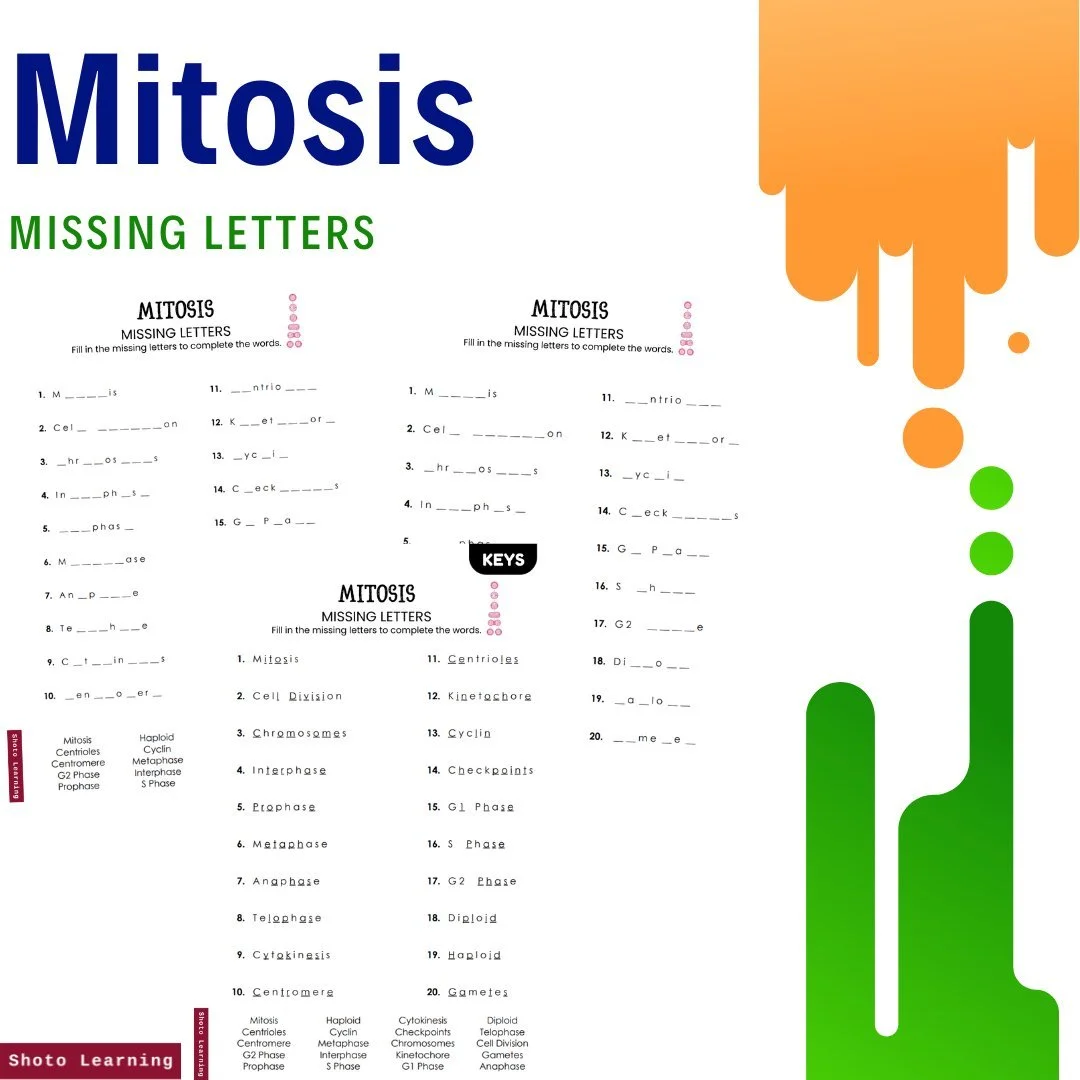
Unravel the mystery of mitosis with our "Mitosis Mystery" missing letter worksheet! This engaging activity challenges students to fill in the missing letters of 20 key mitosis-related terms, revealing essential concepts and stages of cell division.
Key Features:
Critical Thinking Exercise: Encourage critical thinking and problem-solving skills as students deduce the missing letters to complete the terms.
Comprehensive Coverage: Covering crucial mitosis terminology and processes, this worksheet ensures a thorough understanding of cell division.
Two Versions Available: Choose between two versions of the worksheet—one with a word box (hint) to assist students, and another without, for a more advanced challenge.
Answer Key Included: Facilitate easy grading and self-assessment with the included answer key, allowing for quick verification of correct answers.
Printable PDF Format: Accessible as a downloadable PDF file, this worksheet can be conveniently printed for classroom use or distributed digitally for remote learning.
How to Use It:
Select Your Worksheet: Choose the version with or without a word bank, based on your preference.
Identify Missing Letters: Examine each keyword and fill in the blanks with the appropriate missing letters.
Refer to the Word Bank (if needed): Use the word bank for hints if using the easier version.
Check Your Answers: Review your completed answers to ensure accuracy.
Reinforce Learning: Use the worksheet as a study tool to deepen your understanding.
Turn mitosis learning into an exciting adventure with our "Mitosis Mystery" missing letter worksheet. Challenge students to uncover the secrets of cell division and deepen their understanding of this fundamental biological process!
Don't miss out, order yours today!

Dive into the intricacies of cell division with our "Mitosis Matching Mastery" set of 3 worksheets in PDF! Each worksheet features 10 meticulously crafted questions and answers, challenging students to match key mitosis-related terms and concepts with their corresponding descriptions.
Key Features:
Comprehensive Content: Covering essential mitosis terminology, stages, and processes, these worksheets provide a thorough understanding of cell division.
Interactive Learning: Engage students in an interactive matching activity that promotes critical thinking and reinforces learning.
Varied Questions: Each worksheet offers a diverse range of questions, ensuring a well-rounded review of mitosis concepts.
Answer Key Included: Facilitate easy assessment and self-checking with the included answer key for each worksheet.
PDF Format: Accessible as a downloadable PDF file, these worksheets can be conveniently printed for classroom use or distributed digitally for remote learning.
How to Use This Worksheet:
Read the Instructions: Review the directions at the top of the worksheet.
Match the Pairs: Draw a line connecting each item in the left column to its corresponding match in the right column.
Check Answers: Verify the matches by reviewing the provided answer key or discussing with a partner.
Review and Reflect: Discuss the correct answers and understand any mistakes.
Enhance your students' mastery of mitosis concepts with our "Mitosis Matching Mastery" set of 3 worksheets PDF. Empower them to excel in their biology studies with this comprehensive and engaging educational resource!
6 pages
Don't miss out; order yours today!

Unlock the secrets of cellular division with our "Mitosis Mastery" lesson plan, designed to demystify the intricate process of mitosis and ignite a passion for cellular biology in students of all ages. Dive deep into the stages of mitosis, from prophase to telophase, and explore the significance of this fundamental process in the growth, development, and maintenance of living organisms.
Key Features:
Structured Framework: Our lesson plan provides a well-organized framework for educators to deliver engaging and informative lessons on mitosis.
Hands-On Learning: Engage students in interactive activities, including microscope observations and interactive simulations, to enhance understanding and retention.
Stimulating Discussions: Facilitate thought-provoking discussions that encourage students to apply their knowledge of mitosis to real-world scenarios and biological phenomena.
Comprehensive Materials: Utilize worksheets, handouts, and optional extension projects to cater to diverse learning styles and interests.
Educational Versatility: Suitable for a range of educational settings, including traditional classrooms, homeschool environments, and online learning platforms.
How to Use This Lesson Plan:
Review Objectives: Begin by reviewing the lesson objectives and outcomes to understand the focus and goals.
Prepare Materials: Gather all required materials, including handouts, worksheets, and any multimedia resources.
Introduce Topic: Start with a brief introduction to the topic to engage students and set the context.
Follow the Steps: Teach each section as outlined, incorporating suggested activities, discussions, and questions.
Monitor and Adapt: Observe student engagement and understanding; adapt the lesson pace and methods as needed.
Assess Understanding: Use the provided assessment tools to evaluate student comprehension and provide feedback.
Wrap-Up: Summarize key points and provide closure with a reflective activity or homework assignment.
Whether you're a seasoned biology teacher seeking to enhance your curriculum or a curious learner eager to unravel the mysteries of the cell, "Mitosis Mastery" is your gateway to a captivating journey through the microscopic world of cellular division. Empower your students to become mitosis experts and inspire a lifelong appreciation for the marvels of biology with our dynamic and engaging lesson plan.
Order your copy today!

Unlock the secrets of cell division with our "Mastering Mitosis" flashcards PDF! This comprehensive set of 20 flashcards is meticulously designed to aid students in mastering the key concepts and stages of mitosis, making it an essential study tool for biology enthusiasts.
Key Features:
Concise and Informative: Each flashcard presents essential information on mitosis, including stages, structures, and key terminology, clearly and concisely.
Visual Aid: Visual representations and diagrams accompany the text, enhancing understanding and retention of mitosis processes.
Portable Learning: Accessible as a PDF file, these flashcards can be easily downloaded and printed for on-the-go studying or digital use on tablets and computers.
Versatile Use: Perfect for individual study sessions, group review activities, or as a handy reference during lectures and discussions.
Comprehensive Coverage: Covering all aspects of mitosis, these flashcards ensure a thorough understanding of this fundamental biological process.
How to Use the Flashcards:
Print and Cut: Print the flashcards on thick paper or cardstock for durability. Cut along the dotted lines to separate each card.
Review Individually: Read each flashcard's keyword and outline to familiarize yourself with the key concepts.
Group Discussion: Use the flashcards in a group setting to encourage discussion on each keyword. Take turns explaining the outline to reinforce understanding.
Quiz Yourself: Cover the outline on each flashcard and try to recall the details based on the keyword.
Pair and Share: Work with a partner to quiz each other. One reads the keyword, and the other provides details from memory.
Create Mind Maps: Use the flashcards as a starting point for creating mind maps that connect related topics.
Daily Review: Spend a few minutes each day going through a few flashcards to reinforce learning and memory retention.
Teach Back: Use the flashcards to teach the concept to someone else. Explaining the outline in your own words enhances understanding.
Random Pick: Shuffle the flashcards and pick one at random. Discuss or write a summary of the topic based on the keyword and outline.
Speed Round: Set a timer and see how quickly you can go through all the flashcards, recalling key points from the outlines.
Group Sorting: Organize the flashcards into related categories or themes to see connections between topics.
These methods will help enhance learning and retention of the keywords on the flashcards.
Equip yourself with the ultimate study companion for mastering mitosis—our "Mastering Mitosis" flashcards PDF. Empower yourself with knowledge and excel in your biology studies with this indispensable resource!
6 pages
Don't miss out; order yours today!

Enhance your understanding of mitosis with our "Mastering Mitosis" fill in the blank worksheet! Featuring 20 carefully crafted questions, this worksheet challenges students to fill in the missing pieces and reinforce their knowledge of key concepts and stages of mitosis.
Key Features:
Comprehensive Coverage: Covering essential mitosis terminology, stages, and processes, this worksheet provides a thorough review of cell division.
Interactive Learning: Engage students in active learning as they fill in the blanks to complete each question, promoting retention and understanding.
Answer Key Included: Ensure accuracy and facilitate self-assessment with the included answer key, providing immediate feedback to students.
Printable Format: Accessible as a downloadable PDF file, this worksheet can be easily printed for classroom use or distributed digitally for remote learning.
Versatile Use: Suitable for individual study, homework assignments, review sessions, or classroom activities, offering flexibility in educational settings.
How to Use This Fill-in-the-Blank Worksheet:
Read Each Statement Carefully: Review each question or statement provided in the worksheet.
Use the Word Box: Refer to the word box at the end of each page to find the correct term or phrase that completes each blank.
Fill in the Blanks: Write the appropriate word or phrase from the word box in each blank space to complete the statements accurately.
Check Your Answers: After completing all the blanks, compare your answers with the answer key to see how well you understood the material.
Review and Learn: Revisit any incorrect answers and review the related topic to reinforce your understanding.
This worksheet is perfect for reinforcing key concepts and can be used for self-study, classroom review, or homework.
Empower your students to master mitosis concepts with our "Mastering Mitosis" fill in the blank worksheet. Transform learning into an interactive and engaging experience while reinforcing knowledge of this fundamental biological process!
Don't miss out, order yours today!

Unleash the wonders of cell division with our "Mitosis Mastery Kit," featuring five captivating experiments designed for home exploration. Dive into the intricate process of mitosis as you embark on a journey of scientific discovery right from your own home.
Key Features:
Onion Root Tip Cell Mitosis Observation: Explore mitosis up close with onion root tip cells under a microscope, observing each stage from interphase to telophase.
Plant Growth Observation: Monitor plant growth and witness mitosis in action as you track the development of a potted plant over several days.
Cell Division Model: Create a visual representation of mitosis using Play-Doh or modeling clay, demonstrating each stage of cell division with precision.
Mitosis Simulation with Beads: Engage in a hands-on activity using pipe cleaners and beads to simulate the movement of chromosomes during mitosis.
Mitosis Flipbook: Bring mitosis to life with a creative flipbook, illustrating each stage of cell division through colorful drawings and animations.
How to Use It:
Gather Materials: Collect all items listed for each experiment.
Follow Instructions: Perform the experiments using the provided step-by-step directions.
Observe and Record: Document your observations and results.
Discuss Results: Analyze and discuss the findings based on the guide’s explanations.
Perfect for students, educators, and curious learners of all ages, our "Mitosis Mastery Kit" offers an immersive learning experience that combines fun with scientific exploration. Unlock the secrets of cell division and deepen your understanding of mitosis with this comprehensive kit.
Order your copy today!

Ignite lively discussions and critical thinking with our "Mitosis Matters" debate worksheets! This comprehensive set of 10 worksheets provides thought-provoking debate questions related to mitosis, along with included answers to guide discussions and deepen understanding.
Key Features:
Varied Topics: These worksheets offer diverse debate topics covering a range of mitosis-related themes, from its role in growth to its implications in genetic engineering.
Stimulating Questions: Challenge students to explore complex issues surrounding mitosis, foster analytical skills, and promote nuanced understanding.
Answer Key Included: Facilitate productive debates and ensure accuracy with the included answers, providing guidance and reference points for students.
Classroom-Tested: Designed for classroom use, these worksheets encourage active engagement and collaborative learning among students.
Printable PDF Format: Accessible as downloadable PDF files, these worksheets can be easily printed for distribution or shared digitally for remote learning.
How to Use the Debate Worksheet:
Choose a Debate Topic: Select a debate topic provided on the worksheet that interests you or aligns with your lesson objectives.
State Your Position: Write down whether you agree or disagree with the chosen topic under "My Position."
List Supporting Points: Identify and note down three points that support your position under "Points that support my position."
Consider Opposing Points: Write three points that oppose your position under "Points that go against my position." This helps in understanding the other side of the argument.
Develop Counterarguments: Use "I could argue that" to think of counterarguments to the opposing points you listed.
Identify Weaknesses: Reflect on "Possible weaknesses in my argument" to anticipate any flaws or gaps in your reasoning.
Review and Practice: Use the provided answers to review possible arguments and practice debating with a partner or group.
Prepare for the Debate: Use your completed worksheet as a guide to structure your arguments and rebuttals for an upcoming debate.
These worksheets help students critically analyze different perspectives and build strong, persuasive arguments.
Empower your students to delve into the depths of mitosis with our "Mitosis Matters" debate worksheets. Encourage critical thinking, nurture discussion skills, and foster a deeper appreciation for the complexities of cell division!
12 pages
Don't miss out; order yours today!
Dive deep into the fascinating world of mitosis with our comprehensive Mitosis Mastery Bundle. Packed with engaging activities and resources, this bundle is designed to enhance your understanding of cell division like never before.
Unlock the secrets of mitosis with:
Assignments: Embark on 10 stimulating assignments covering diverse topics, encouraging critical thinking and practical application of knowledge.
Bingo: Test your knowledge with 30 unique bingo cards.
Crossword: Challenge yourself with mitosis-themed crossword puzzles.
Cryptogram: Decode hidden messages related to mitosis.
Debate: Engage in stimulating discussions about mitosis concepts.
Experiments: Explore hands-on experiments illustrating fundamental principles across various disciplines, fostering deeper understanding and engagement.
Fill in the Blank: Reinforce your understanding through interactive fill-in-the-blank exercises.
Flashcards: Access key terms and concepts quickly for quick review.
Free ABC Order: Reinforce language skills with alphabetical arrangement.
Free Cut and Paste: Hands-on learning to reinforce comprehension.
Free Flipbook: Explore mitosis stages visually.
Free Poster: Get a free poster showcasing essential information.
Free Storyboard: Expand knowledge and memory skills.
Lesson Plan: Dive deep with our detailed lesson plan, complete with engaging activities and discussion topics.
Matching: Test your knowledge and memory skills with matching activities.
Missing Letters: Fill in the missing letters to complete mitosis-related words.
Multiple Choice: Test your understanding with multiple-choice quizzes.
PowerPoint: Access a visually engaging PowerPoint presentation on mitosis.
Questions and Answers: Expand your knowledge with curated questions and answers.
Reading Comprehension: Sharpen reading skills with engaging passages, perfect for students and educators alike.
Scramble: Unscramble mitosis-related terms and concepts.
Test (45 Minutes): Assess your understanding with a comprehensive 45-minute test.
True or False: Challenge yourself with true or false statements about mitosis.
Word Search: Have fun while reinforcing mitosis vocabulary.
Writing Prompts: Stimulate critical thinking with mitosis-themed writing prompts.
Embark on an immersive learning journey and master mitosis concepts with our comprehensive bundle. Whether you're a student, educator, or biology enthusiast, this bundle has everything you need to deepen your understanding of cell division.
152 pages
Don't miss out; order yours today!