
Understanding Newton’s Laws of Motion: A Comprehensive Guide for Educators
Introduction to Newton’s Laws of Motion
Newton's Laws of Motion are critical principles in physics that describe the relationship between a body and the forces acting upon it. Formulated by Sir Isaac Newton in the 17th century, these laws form the foundation for classical mechanics and help explain how objects behave in motion. Understanding these laws is essential for students as they offer insights into the physical world around them.
The Three Laws of Motion Explained
1. Newton's First Law of Motion: The Law of Inertia
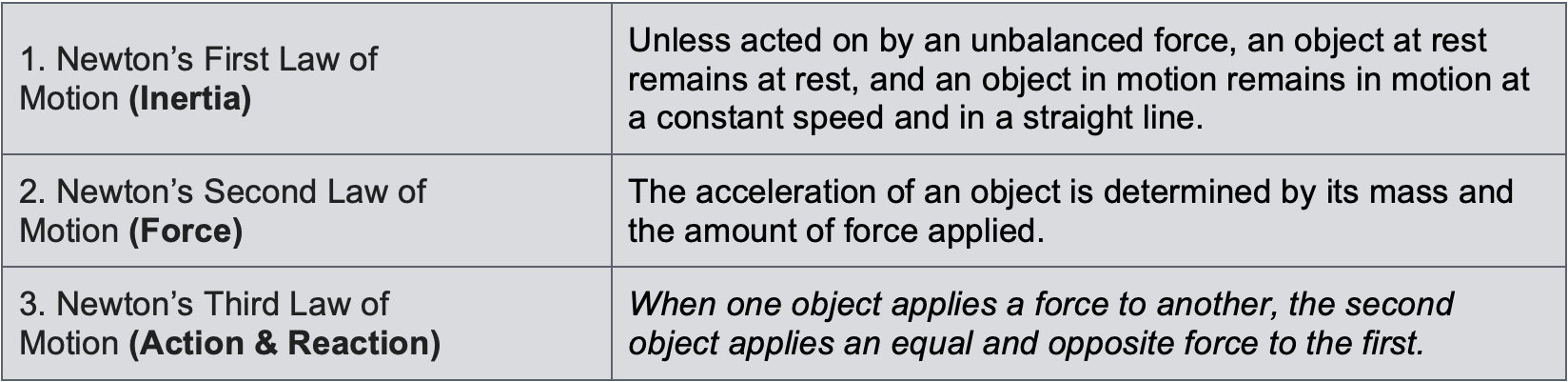
Newton's First Law states that an object at rest will remain at rest, and an object in motion will continue in motion at a constant velocity, unless acted upon by a net external force. This principle, known as inertia, illustrates the tendency of objects to resist changes in their state of motion.
2. Newton's Second Law of Motion: The Law of Acceleration
The Second Law establishes that the acceleration of an object is directly proportional to the net force acting on it and inversely proportional to its mass. This can be expressed with the formula F = ma, where F is the force, m is the mass, and a is the acceleration. This law helps students understand how forces influence motion.
3. Newton's Third Law of Motion: The Law of Action and Reaction
Newton's Third Law asserts that for every action, there is an equal and opposite reaction. This means that when one object exerts a force on another, the second object exerts an equal force in the opposite direction. This principle is vital in understanding interactions between objects.
Engaging Strategies for Teaching Newton's Laws of Motion
Use Real-Life Examples
To help students grasp each law, provide relatable real-life examples:
First Law: A book resting on a table remains stationary until a force (like a push) is applied.
Second Law: A car accelerates on a highway as the driver presses the gas pedal, illustrating how force and mass affect motion.
Third Law: When a balloon is inflated and released, the air rushing out creates an opposite reaction that propels the balloon forward.
Incorporate Interactive Activities
Engaging students with hands-on experiments can deepen their understanding of motion:
Ramp Experiments: Set up a ramp and have students roll different objects down it to observe how mass and height impact speed and distance traveled.
Action-Reaction Demonstrations: Use simple materials, like toy cars and springs, to showcase how action and reaction forces work.
Connect to Everyday Life
Make the laws of motion relevant to students’ lives:
Discuss how seat belts protect passengers in cars based on the First Law of Motion.
Explain how rockets launch into space utilizing the Third Law of Motion.
Utilize Technology and Online Resources
Incorporate technology into your lessons to visualize concepts better:
Use online simulations and interactive physics software to demonstrate Newton's Laws of Motion. These resources allow students to experiment with variables and see real-time results.
Conclusion
Teaching Newton's Laws of Motion may initially seem challenging, but with the right strategies and resources, it can become an engaging and enjoyable topic for students. By utilizing real-life examples, interactive activities, and technology, educators can foster a deeper understanding of these fundamental principles of physics. Embrace the challenge, and watch your students develop a newfound appreciation for the laws that govern motion!
Related products:
Complete Bundle: Comprehensive collection for Newton's Laws of Motion, including games and worksheets.
Game Bundle: Interactive games reinforcing key concepts.
Worksheet Bundle: Engaging worksheets strengthening skills in various subjects.
Bingo: Exciting game matching motion-related terms and concepts.
Crossword: Expand knowledge and critical thinking.
Cryptogram: Decode encrypted messages for problem-solving.
Debate: Foster critical thinking and communication skills.
Fill in the Blank: Sharpen critical thinking and comprehension.
Flash Cards: Access key terms and concepts quickly.
Free ABC Order: Reinforce language skills with alphabetical arrangement.
Free Maze: Sharpen problem-solving skills.
Free Poster: Get a free poster showcasing essential information.
Matching: Test knowledge and memory skills.
Missing Letters: Enhance spelling and vocabulary.
Multiple Choice: Assess comprehension and knowledge.
PowerPoint: Improve your understanding.
Q&A: Interactive resource for learning.
Scramble: Unscramble words in a fun twist.
Spin Wheel: Spin the wheel of knowledge!
Test 45 Minutes: Assess your knowledge in 45 minutes.
True or False: Challenge critical thinking.
Word Search: Engage in a word search adventure.
Writing Prompts: Ignite creativity and reflection.