
Teaching Reflection and Refraction in Elementary Science: Activities and Strategies
Reflection and Refraction: Understanding Light with Elementary Students
Reflection and refraction are key concepts in understanding light behavior, which is essential for students exploring natural phenomena such as image formation, rainbows, and lenses. This guide provides teachers with effective methods, activities, and assessment ideas for teaching these concepts to elementary students.
Introducing Reflection and Refraction
1. Begin with the Basics of Light: Start with a foundational understanding of light. Discuss light’s speed, how it travels in straight lines, and its behavior as it meets different materials. Demonstrating how light requires a source and receiver prepares students for more complex ideas.
2. Defining Reflection and Refraction:
Reflection: When light bounces off a surface, such as a mirror, it changes direction. Everyday examples, like mirror reflections, help solidify this concept.
Refraction: When light passes through substances like water or glass, it bends. Using examples, such as a straw appearing bent in a glass of water, can help make this concept tangible.
Engaging Hands-On Activities for Reflection and Refraction
1. Mirror Play: Exploring Reflection Provide each student with a handheld mirror. Have them experiment by adjusting the mirror angles and observing the changes in the reflected image. Encourage students to sketch diagrams of their mirror’s angles and the resulting reflections.
2. Water Refraction with a Straw or Pencil Using a clear glass filled with water, place a pencil or straw inside and observe the "bent" appearance when viewed from the side. This demonstration shows how light bending in water creates the illusion of a broken or angled object, a clear example of refraction.
3. Rainbow Prism Experiment Use a glass prism to split white light into a spectrum of colors. Let students observe how light refracts at different angles to create a rainbow effect. This is a fun and visual way to show how wavelengths of light bend variably.
4. Flashlight Maze for Reflection and Light Paths Set up a simple maze with cardboard walls and use a flashlight to navigate. This hands-on activity demonstrates how light travels in straight lines, can be reflected, and may be blocked by objects, reinforcing the concept of light’s directional behavior.
Assessment and Evaluation Techniques
1. Diagrams and Written Reflections Assign tasks where students draw diagrams and answer questions on reflection and refraction. This written component encourages students to articulate their understanding in their own words.
2. Observational Experiments and Demonstrations Conduct classroom experiments or demonstrations to assess comprehension. Engage students with questions during observations to evaluate their grasp of the concepts.
3. Oral Presentations with Visuals Have students share their understanding of reflection and refraction in short presentations. This can reinforce learning, as they describe examples and use visuals to explain their understanding.
Conclusion
Teaching reflection and refraction is most effective when using hands-on experiments and relatable examples. By integrating real-life scenarios, engaging activities, and thorough assessments, elementary science teachers can help students develop a strong foundation in the principles of light, preparing them to appreciate the complexities of the physical world.

Do you want to teach your students about the science of reflection and refraction in a fun and engaging way? Then this Reflection and Refraction Science Activity Bundle is for you! This set contains an educational word find and scramble game about reflection and refraction. It allows students to interact with the science of reflection and refraction. This bundle is an excellent way to pique your students' interest in the science of reflection and refraction. Purchase the bundle today to keep your students engaged and motivated as they learn!
REFLECTION & REFRACTION - WORD FIND & UNSCRAMBLE WORDS
Worksheet with words related to science reflection and refraction. To find and unscramble the 21 hidden words.
When teaching a unit on reflection and refraction, this is a good resource for early finishers or as a take-home game.
The vocabulary words covered include:
Absorb, Bend, Color Spectrum, Dull, Energy, Fraction, Lens, Light Energy, Medium, Mirror, Prism, Ray, Reflect, Reflection, Refract, Refraction, Scattered, Shiny, Solar Panel, Surface, Transmit.
Solution included.
Let’s be friends!
Blog ★ Pinterest ★ Facebook ★ Instagram ★ YouTube
Happy teaching!

From the basics to more complex concepts, this reflection and refraction science activity word find a game is sure to educate and entertain. The puzzle features various words and clues related to reflection and refraction. With this educational game, your child will have an enjoyable time uncovering the answers and learning more about light science.
REFLECTION & REFRACTION - WORD FIND
Game Puzzle Worksheet - featuring a word search of different reflection and refraction energy vocabulary words. To find the 21 hidden words, puzzlers must look in all directions, including backward and diagonally.
A good resource for early finishers or as a take-home game when teaching a unit on reflection and refraction.
The vocabulary words that are covered are:
Absorb, Bend, Color Spectrum, Dull, Energy, Fraction, Lens, Light Energy, Medium, Mirror, Prism, Ray, Reflect, Reflection, Refract, Refraction, Scattered, Shiny, Solar Panel, Surface, Transmit.
Solution included.
Let’s be friends!
Blog ★ Pinterest ★ Facebook ★ Instagram ★ Youtube
Happy teaching!
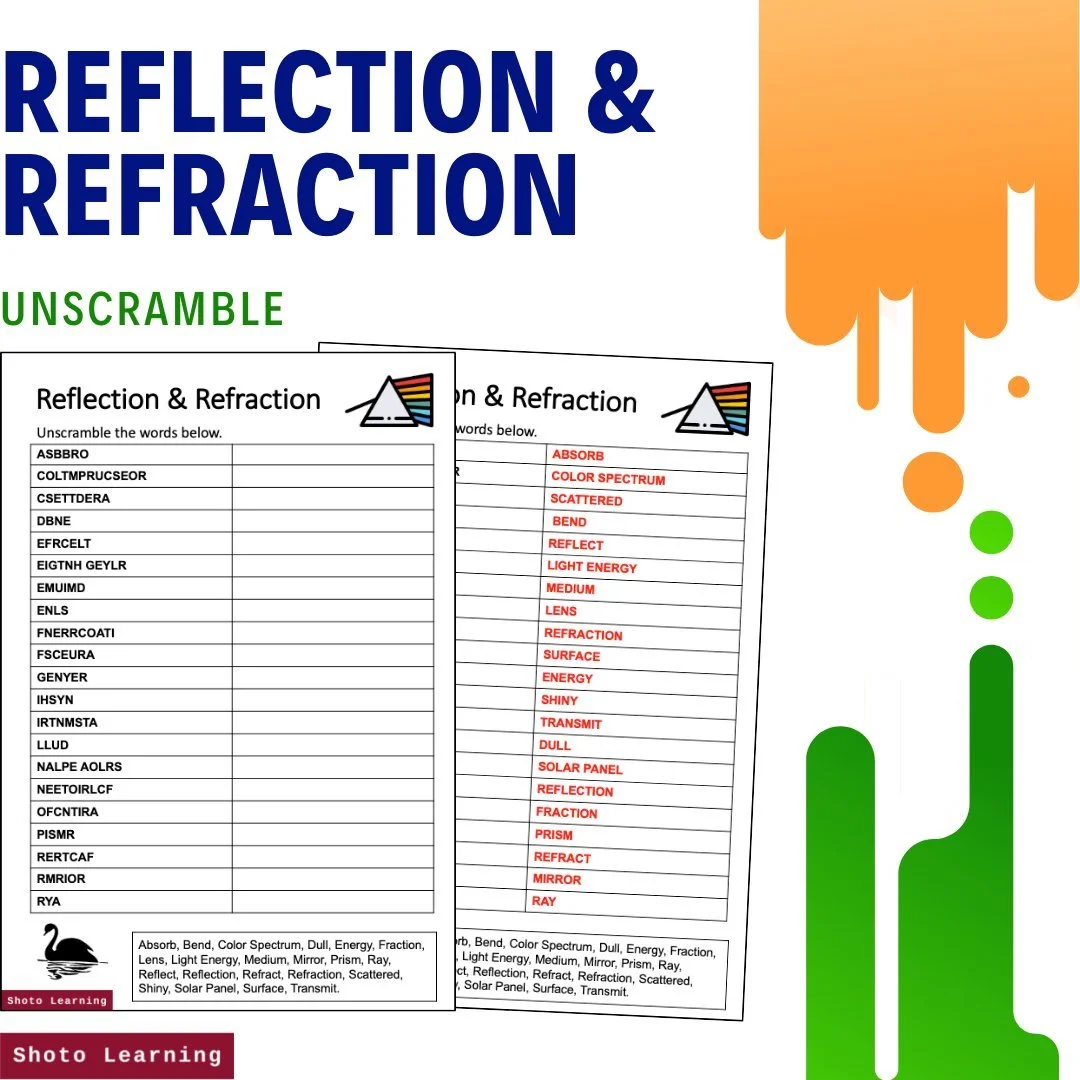
Challenge your knowledge of light and sound waves with this fun reflection and refraction word scramble! Unscramble 21 science terms related to the behavior of light, including "Absorb," "Lens," "Prism," and more. Perfect for reinforcing vocabulary and understanding key concepts of reflection and refraction.
Key Features:
Engaging Word Scramble: Unscramble 21 science terms related to reflection and refraction.
Interactive Learning: Reinforce vocabulary and concepts of light behavior.
Versatile Use: Ideal for classroom activities, homework, or science review.
Comprehensive Vocabulary: Terms like "Absorb," "Ray," "Mirror," and "Transmit."
Solution Included: An answer key for easy reference.
How to Use:
Print and hand out the word scramble for individual or group work.
Encourage students to unscramble the words and discuss the science concepts.
Use it as a fun activity for review or homework.
Order today and boost your students’ understanding of reflection and refraction!