
Addition 0 to 5: Engaging Strategies to Build Early Math Skills in Young Learners
Learning addition from 0 to 5 is a key step for young children starting their math journey. These early math skills set the stage for understanding more difficult concepts later on. Using engaging and simple strategies makes it easier for kids to grasp basic addition and feel confident in using numbers.
Teachers and parents can help children build strong math foundations through games, real-life scenarios, and hands-on activities. These tools not only help with memorization but also keep children interested and motivated as they learn to add.
Key Takeaways
Simple strategies make learning addition from 0 to 5 easier.
Interactive activities support fact fluency and engagement.
Real-world practice helps connect addition to everyday life.
Foundations of Addition from 0 to 5
Learning addition from 0 to 5 means children must first understand what numbers are and how they work. Counting, recognizing each number, and seeing how numbers fit together help form a strong base for math in kindergarten and first grade.
Understanding Number Sense
Number sense means knowing what numbers mean and how they relate to each other. Young children develop number sense by seeing and working with numbers in different ways. For example, they might use objects like blocks, fingers, or counters.
Children learn that the number “3” can be shown as three dots, three blocks, or three fingers. This connection between numbers and real-life items is important. With good number sense, students can quickly see the difference between a group of two items and a group of five.
Teachers often use simple games or visual aids to grow number sense in early learners. Matching numbers to groups of items or using number lines helps children see how numbers build upon each other.
Exploring Numbers 0–5
The numbers 0, 1, 2, 3, 4, and 5 form the building blocks for early addition. Each number has its own shape, value, and role in math. Children should learn to identify, count, and write each number clearly.
A table of numbers 0–5 with their corresponding words and visual dots can help:

Using number cards, connecting cubes, and drawings makes learning about each number more concrete. Visuals and repeated practice allow children to gain confidence with these numbers.
The Role of Counting in Basic Addition
Counting is a key skill for basic addition in kindergarten and first grade. It helps children understand that adding means “putting together.” For example, if they count two blocks and then add three more, they can count all the blocks to find the total.
Simple activities like counting out loud, counting objects, or jumping on a number line help children practice. Teachers might guide students to count on from a number, like “start at two and count three more: two, three, four, five.”
Children need to count reliably without skipping numbers. Success in counting supports their ability to add numbers from 0 to 5 and builds their math skills for future learning.
Core Strategies for Teaching Addition
Teaching addition to young children works best with clear, step-by-step methods. Focusing on real-world examples, hands-on materials, and visual aids helps children build a strong math foundation.
Counting On and Number Relationships
Counting on means starting with one number and counting forward to find a sum. For example, for 3 + 2, students should start at 3 and count up two more (4, 5). This simple strategy helps children move away from counting all the objects each time.
Understanding number relationships is also important. If students know that 2 + 3 equals 5, they can then see patterns in other addition problems. Teachers can make use of number lines and ten frames to highlight how numbers relate to each other.
Regular practice with counting on helps students solve addition quickly, instead of relying on memorization. Combining number relationships with counting on builds confidence and problem-solving skills.
Composing and Decomposing Numbers
Composing numbers means putting parts together to make a whole. For example, 2 and 3 can be combined to make 5. Decomposing means breaking a number into different parts, such as turning 5 into 2 and 3.
Teaching these concepts helps children see that numbers can be made and broken in many ways. It also gives them flexibility in solving problems when they add. Small group activities where students build numbers using counters or draw quick sketches work well for this topic.
Teachers might use activities like "How many ways can you make 4?" to show the different combinations. Practicing these skills helps students understand the structure of numbers and supports mental math.
Using Manipulatives and Visuals
Hands-on math tools, or manipulatives, make addition clearer for young learners. Common manipulatives include counting bears, cubes, buttons, or coins. These objects help children see and feel numbers as they add.
Visuals, such as ten frames, dot cards, or simple drawing models, show how numbers come together. Using visuals alongside manipulatives helps students connect concrete objects with numbers and symbols.
Teachers can use a table to show combinations:

This shows all the ways to make sums from 0 to 5. Consistent use of manipulatives and visuals helps children understand addition and remember how numbers work together.
Developing Addition Fact Fluency for 0–5
Students learning to add numbers from 0 to 5 build important skills for later math success. Fluency with these basic addition facts supports quick thinking and helps with more complex math in the future.
Building Automaticity with Basic Addition Facts
Automaticity means students can recall facts instantly without needing to stop and think each time. To develop this, they benefit from repeated and varied practice. Teachers can use flashcards, interactive games, and timed drills to keep students engaged and motivated.
Fact families are especially helpful. For example, knowing that 2 + 3 = 5 also teaches that 3 + 2 = 5. These patterns make facts easier to remember.
A simple table shows all combinations for 0–5:
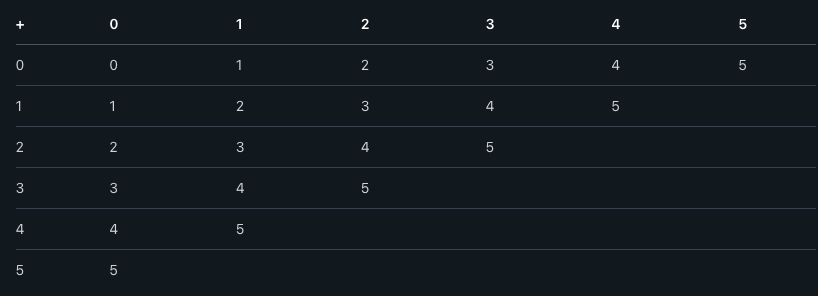
Practicing patterns in this table helps students see relationships faster. Quick recall leads to better confidence and less frustration.
Mental Math and Problem-Solving Skills
Mental math strategies help students think about numbers in flexible ways. They might use counting on fingers, picturing objects, or making a group of 5 and adding more. These techniques make math feel less intimidating and more manageable.
Problem-solving skills grow as students connect facts to real-life situations. Simple word problems such as “If you have 2 apples and get 3 more, how many do you have now?” encourage kids to use addition facts they know.
Teachers can ask students to explain their thinking or show more than one way to solve an equation. This practice deepens understanding and supports future math learning. When students feel comfortable solving problems in their heads, they become more independent learners.
Interactive Games and Activities
Children learn addition best when they are actively involved. Using hands-on games, visual tools, and routine activities helps to make early math skills clear and memorable.
Math Stations and Workstations
Math stations offer students a chance to learn addition through small group work. Each station can focus on a specific concept, such as combining objects to total numbers from 0 to 5.
Teachers can set up workstations with counters, number cards, and small objects. For example, one station may ask students to add 2 red blocks and 3 blue blocks together. Another station may give picture cards showing different groups, and students have to count and record the total.
Example station rotation:
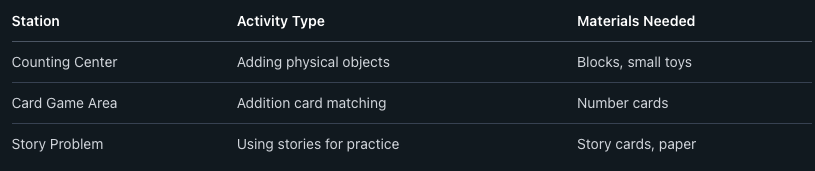
Workstations let students learn at their own pace while practicing addition in a low-pressure setting. Teachers can rotate pairs or small groups so everyone gets to try each activity.
Shake and Spill Activities
Shake and spill is a tactile way for children to see addition in action. Students use a small cup filled with two colors of counters (such as red and yellow). After shaking, they spill the counters, sort them by color, and count each group to find the sum.
For example, a child might shake and spill 5 counters and find 2 red and 3 yellow. They then state, “2 plus 3 equals 5.” This helps them understand that numbers can be split and added in different ways.
A basic step-by-step guide:
Place a set number (up to 5) of two-color counters in a cup.
Shake and spill onto the table.
Separate colors and count each group.
Record or say the addition sentence.
Repeating this activity uses repetition and visual feedback to reinforce addition facts for numbers 0 to 5.
Utilizing Flashcards
Flashcards are a direct and effective method for practicing early addition facts. Each flashcard displays a simple addition problem, like 2 + 1. Teachers or students read the card, solve the problem, and then check the answer on the back.
Flashcards are flexible for group games, pair work, or independent study. For variety, students can play matching games, sort cards by sums, or race to solve a set within a time limit.
Sample flashcard practice ideas:
Timed addition drills for quick recall
Memory matching: Pair problems to answers
Sorting challenges: Group flashcards by sum (0–5)
Using flashcards daily helps make addition facts familiar and easy to remember.
Incorporating Anchor Charts and Graphics
Anchor charts are large posters created with students and displayed in the classroom. An anchor chart for addition 0 to 5 might show combinations like 0 + 5, 1 + 4, and 2 + 3, often paired with illustrations, objects, or number lines.
Charts help students see patterns and relationships. Teachers can use colors or drawings to highlight different ways numbers add up to 5.
Other graphics like ten frames or pictorial representations make abstract ideas concrete. Showing five apples split between two plates, for example, helps children picture number bonds and part-whole relationships.
Having these visuals in the classroom gives students a quick reference and supports understanding through repeated exposure.
Connecting Addition to Broader Math Concepts
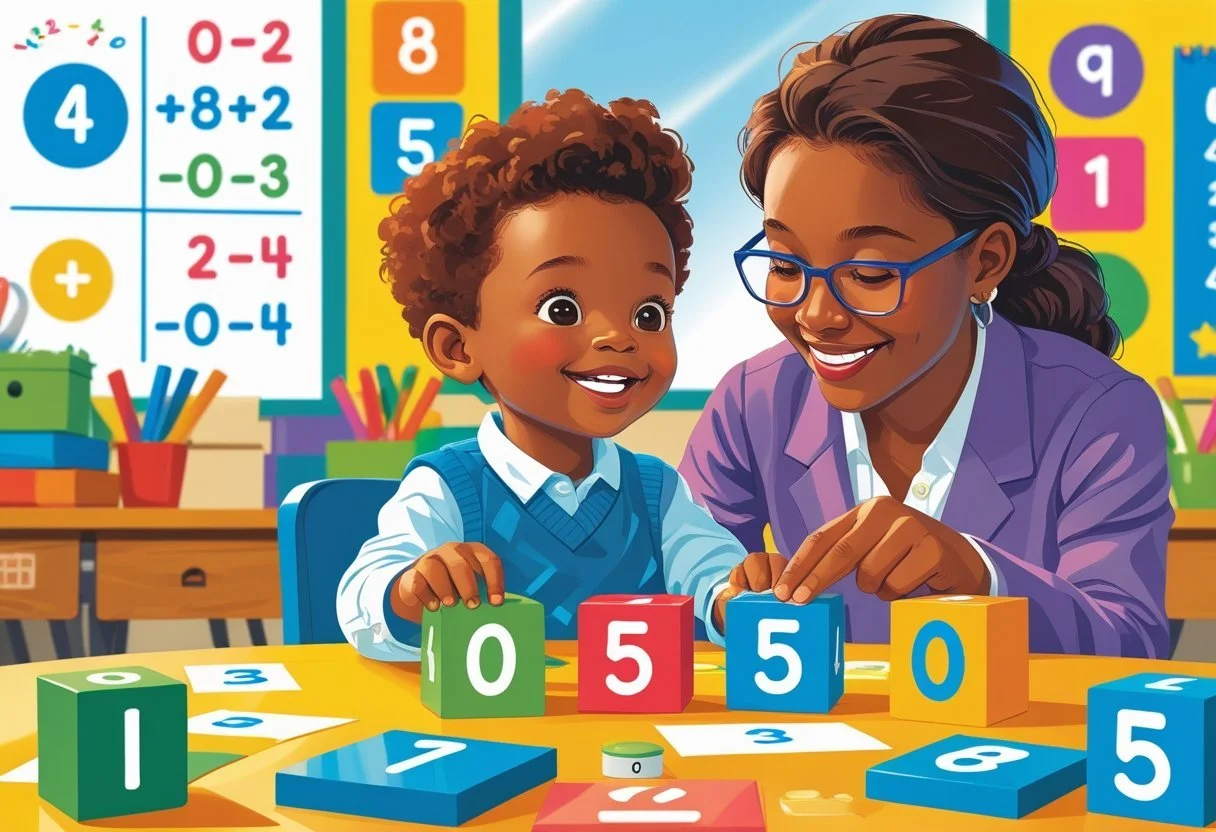
Building addition skills helps students understand other math ideas such as fact families, doubles facts, and the link between addition and subtraction. These connections create a strong base for future topics like “make a ten” and “friends of ten.”
Introduction to Fact Families and Doubles Facts
Fact families are groups of numbers that are related through both addition and subtraction. For example, the fact family for 2, 3, and 5 includes these equations:

Understanding fact families helps students realize how numbers connect in multiple ways.
Doubles facts, like 2 + 2 or 4 + 4, are simple sums where the same number is added together. Memorizing these makes it easier for students to solve larger problems, especially when working with “make a ten” strategies.
Teachers often use doubles facts as a shortcut. If students know 2 + 2 = 4, they can figure out 2 + 3 by adding one more.
Addition and Subtraction Relationships
Learning addition and subtraction together highlights their relationship. Students see that subtraction undoes addition, and this understanding helps them solve problems with missing numbers.
When exploring the “friends of ten,” students practice finding pairs of numbers that add up to ten, like 6 + 4 or 8 + 2. These pairs become important in mental math and making ten strategies.
Teachers use number sentences to show how addition and subtraction are related. For example, 4 + 1 = 5 and 5 - 1 = 4 both use the same numbers, showing this connection in a clear way.
Implementing Independent Practice and Assessment
Teachers need reliable ways to help students practice addition skills on their own while checking their progress. Using organized materials and lessons keeps students engaged and supports growth in basic math facts.
Recording Sheets and Tracking Progress
A recording sheet is a simple but important tool. Each student uses a sheet to write down their answers as they practice addition problems with numbers 0 to 5.
Teachers can design recording sheets as tables, such as:

These sheets help students stay organized. They also let teachers quickly review and mark progress for each child. Tracking can be done weekly to spot students' strengths and areas needing support.
Short checklists can also be used to track which problems each student can answer quickly and correctly. Keeping records in simple folders helps teachers compare results over time.
Designing Effective Math Lessons
Effective math lessons focus on short, repeated practice. Students get a set of addition problems to solve without direct help, such as through worksheets, math centers, or digital platforms.
A lesson might start with a quick review and then give students time for independent practice. Afterward, they complete their recording sheets to show what they learned. Lessons should include different activities like flashcards, games, and timed drills to keep students interested.
Teachers check students’ recording sheets to see which basic math facts need more review. Feedback is given so students know where they are doing well and what they should work on next. Lessons are adjusted based on this information to support steady progress.
Real-World Applications and Extension Activities
Young learners understand addition best when they make connections to real-life situations. Activities using everyday objects, simple word problems, and hands-on methods help children use their addition skills outside the classroom.
Solving Word Problems
Word problems help students link math to real-world settings. For example, a teacher might ask, "If you have 2 apples and get 3 more, how many do you have?" This helps students practice addition from 0 to 5 using familiar objects.
Teachers can use these strategies:
Read the problem together.
Highlight key numbers and words.
Draw pictures or use counters to show each part of the problem.
Encourage students to explain their thinking out loud.
Creating a table can organize different combinations students might solve:
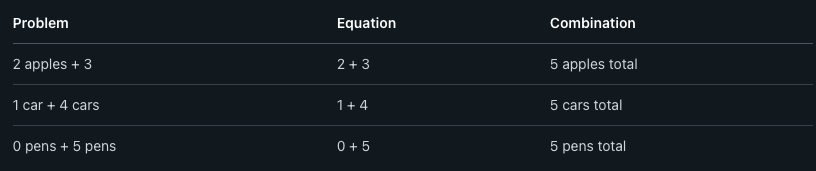
These activities support understanding and build problem-solving confidence.
Encouraging Problem-Solving in Daily Life
Daily life offers many chances to practice addition in small ways. Parents and teachers can point out real scenarios, such as, "You put 1 sock in the basket and then 2 more. How many socks in all?"
Children can count toys, snacks, or steps as they go about their day. This helps them practice different addition combinations up to 5 while thinking about math in context.
Teachers may suggest simple games like "Find All the Ways to Make 5" using buttons, coins, or blocks. Kids enjoy joining pairs or groups of items to see all the possible ways to combine numbers and reach a sum.
Using addition strategies in everyday life encourages children to problem-solve, ask questions, and see math as part of their world.
Frequently Asked Questions
Teaching addition from 0 to 5 can be more effective when using hands-on activities, visuals, and real-life examples. Students often benefit from repetitive practice and games that make learning feel like play.
What engaging activities can help teach addition within the range of 0 to 5?
Children often enjoy using counting bears, blocks, or buttons to model addition problems. Simple board games, card games, or rolling dice add fun while practicing math facts. Drawing pictures or using number lines also helps students understand how numbers combine.
How can I make learning addition appealing to students in early grades?
Bright visuals, songs, and movement can keep children interested. Morning math routines with stories or themed activities make math time something students look forward to. Including familiar objects, like snacks or toys, can make abstract concepts clear.
What are some effective strategies for teaching addition to grade 1 students?
Teachers often use story problems where students act out scenarios. Math centers with puzzles or manipulatives support independent learning. Repeating activities in new ways—such as using different materials or settings—helps solidify skills.
Can you suggest fun ways to introduce addition skills to kindergarteners?
Teachers can introduce addition with simple songs or finger plays. Sorting and counting together, like making small groups of fruit pieces, makes the concept real. Matching games with cards featuring dots or numbers are also popular and effective.
What are the best practices for teaching early math addition concepts?
Consistent use of visual aids and hands-on manipulatives is key. Allowing children to explain their thinking encourages deeper understanding. Frequent, short practice sessions fit well with young students' attention spans.
How do you differentiate addition instruction for grades K-2?
Teachers provide extra support or more challenging problems based on each child's needs. Using small groups allows for tailored instruction. Some students may use pictures or objects, while others quickly move to mental math or written equations.


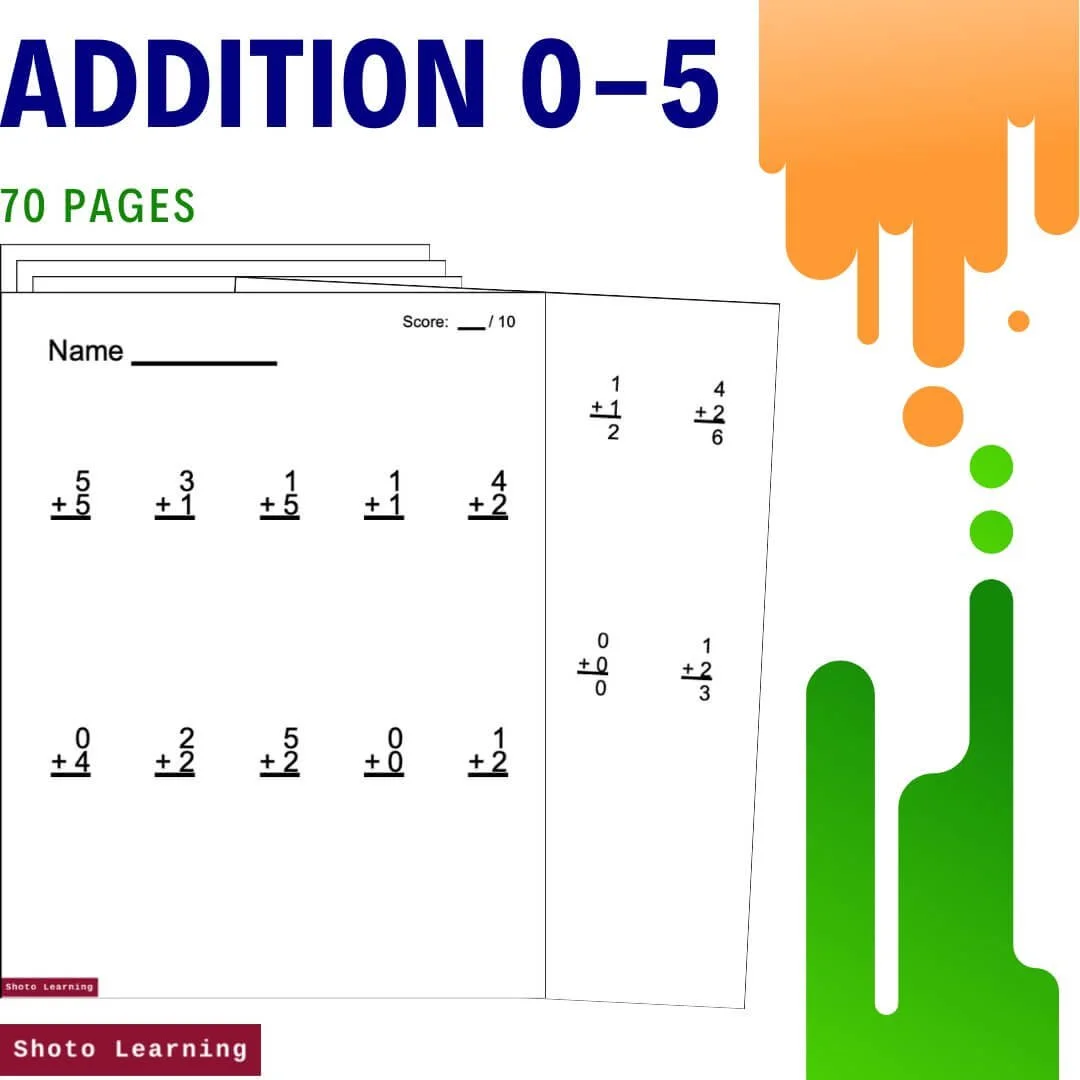


Single Digit Addition Worksheets 0-5
Straightforward and simple for beginners! Get your students to use their fingers to solve the maths problem. Numbers added together are between 0-5 and the answers are not greater than 10.
10 Horizontal Math Practice Problems Per Page - 1 Page
Answers included.
We also have:
Addition Worksheets – 12 Pages
Addition Worksheets – 20 Pages
Addition Worksheets – 30 Pages
Addition Worksheets – 40 Pages
Addition Worksheets – 50 Pages
Addition Worksheets – 60 Pages
Addition Worksheets – 70 Pages
Addition Worksheets – 80 Pages
Addition Worksheets – 90 Pages
Addition Worksheets – 100 Pages