
Engaging Students with DNA: Fun and Interactive Ways to Teach Genetics and Molecular Biology
Introduction to DNA: The Blueprint of Life
What is DNA?
DNA, or Deoxyribonucleic Acid, is the fundamental molecule that carries genetic information in all living organisms. It acts as a blueprint for the development, growth, functioning, and reproduction of life. Understanding DNA is crucial across various scientific fields, including genetics, molecular biology, biotechnology, and medicine. In this blog, we’ll explore engaging and interactive ways to teach DNA to your students, making complex concepts accessible and enjoyable.
Understanding the Structure of DNA
The Building Blocks of Life
DNA consists of units called nucleotides, each composed of a sugar molecule, a phosphate group, and a nitrogenous base. The four nitrogenous bases—adenine (A), thymine (T), guanine (G), and cytosine (C)—pair specifically (A with T and G with C) to form the double helix structure of DNA. Understanding this structure is foundational for students studying genetics.
The Process of DNA Replication
How Cells Copy Their DNA
DNA replication is a vital process in which cells create exact copies of their DNA. This process is essential for cell division and the reproduction of living organisms. Engaging students in understanding this process can be achieved through simple animations or models that illustrate the steps involved in DNA replication.
Protein Synthesis: From Genes to Proteins
The Role of DNA in Protein Creation
Protein synthesis is the process where cells utilize DNA instructions to produce proteins, crucial for cell structure and function. Teaching students about transcription and translation can be made fun by using interactive simulations or games that demonstrate how genes translate into proteins.
Exploring Mutations: Changes in DNA
The Impact of Genetic Mutations
Mutations are alterations in the DNA sequence that can occur naturally or be induced by environmental factors like radiation or chemicals. While some mutations are harmless, others can lead to serious genetic disorders or diseases, including cancer. Discussing real-life examples of mutations can help students understand their implications in genetics and health.
Hands-On Activity: DNA Extraction
Extracting DNA from Fruits
Conducting a hands-on DNA extraction experiment using strawberries or other fruits allows students to visualize and understand DNA's physical structure. This fun activity fosters curiosity and provides a practical understanding of genetic material.
Building a DNA Model
Visualizing DNA Structure
Creating a DNA model using everyday materials such as candy, pipe cleaners, or beads is a great way to help students grasp DNA's structure. This activity can reinforce concepts of nucleotides, sugars, phosphates, and nitrogenous bases while encouraging creativity.
Understanding DNA Fingerprinting
Applications of DNA in Forensics
Teach students about DNA fingerprinting, a powerful technique for identifying individuals based on unique DNA sequences. Discuss its applications in forensic science, paternity testing, and medical research, highlighting the real-world relevance of DNA studies.
The Role of Genetic Engineering
Manipulating DNA for Change
Genetic engineering involves manipulating DNA to produce desired traits in organisms. Discuss its applications in agriculture, medicine, and biotechnology, emphasizing how DNA technology is shaping our world.
Ethical Implications of DNA Research
Navigating DNA and Society
Engage students in discussions about the ethical and social implications of DNA research. Topics like genetic discrimination, privacy concerns, and informed consent are crucial in today's society, encouraging students to think critically about the impact of genetic technologies.
Conclusion: Making DNA Exciting for Students
Teaching DNA can be an exciting journey for both educators and students. By incorporating hands-on activities, interactive models, and real-world examples, students can grasp the importance of DNA in genetics, molecular biology, and beyond. These engaging methods not only enhance learning but also inspire the next generation of scientists.

Delve into the intricate world of DNA Structure and Replication with our comprehensive worksheet bundle, packed with a diverse range of activities to deepen understanding and reinforce learning. From debates to multiple-choice quizzes, this bundle offers a variety of resources to cater to different learning styles and preferences.
Key Features:
Assignments: Engage in 10 challenging assignments exploring DNA structure and replication, prompting critical thinking and application of knowledge.
Debate: Engage in thought-provoking debates on topics related to DNA structure and replication, encouraging critical thinking and discussion.
Fill in the Blank: Reinforce key concepts and terminology with fill-in-the-blank exercises that challenge students' comprehension.
ABC Order: Practice alphabetizing DNA-related terms with a free ABC order activity, enhancing organizational skills.
Posters: Access three free posters that visually depict key aspects of DNA structure and replication, serving as valuable reference materials.
Worksheets: Utilize free worksheets to reinforce learning through various exercises and activities, including matching, true or false statements, and writing prompts.
Matching: Strengthen understanding by matching DNA-related terms and concepts with their corresponding definitions.
Multiple Choice: Assess comprehension with multiple-choice quizzes covering a range of topics related to DNA structure and replication.
Questions and Answers: Clarify doubts and deepen understanding through question-and-answer sessions focused on DNA structure and replication.
Reading Comprehension: Dive into captivating passages unraveling DNA's mysteries, covering its double helix structure, replication intricacies, and genetic inheritance.
Test: Evaluate knowledge retention and understanding with a timed test designed to assess proficiency within a 45-minute timeframe.
True or False: Test understanding with true or false statements related to DNA structure and replication, reinforcing key concepts.
Writing Prompts: Explore creative writing prompts inspired by DNA structure and replication, fostering critical thinking and expression.
With a variety of engaging activities and resources, our DNA Structure and Replication Worksheet Bundle offers a comprehensive and immersive learning experience for students of all levels. Unlock the mysteries of DNA and master this fascinating subject matter.
84 pages
Don't miss out, order yours today!

Discover the fascinating world of DNA Structure and Replication with our compact yet comprehensive bundle. Packed with essential resources, this bundle offers a diverse array of activities to deepen understanding and reinforce key concepts.
Key Features:
PowerPoint Presentation: Gain insights into DNA structure and replication through a detailed and visually engaging PowerPoint presentation.
Test (45 Minutes): Assess your knowledge and understanding of DNA structure and replication with a timed test designed to challenge your proficiency within 45 minutes.
Bingo: Play a fun game of bingo featuring DNA-related terms and concepts, perfect for reinforcing learning in a group setting.
Crossword: Test your knowledge with a crossword puzzle that challenges your understanding of DNA terminology and processes.
Word Search: Search for DNA-related terms in a word search puzzle, enhancing vocabulary and pattern recognition skills.
Cryptogram: Decode hidden messages related to DNA structure and replication, adding a fun and challenging twist to learning.
Lesson Plan: Dive deep into sensory exploration with our detailed lesson plan, complete with engaging activities and discussion topics.
True or False: Test your understanding with true or false statements related to DNA structure and replication, reinforcing key concepts.
Matching: Strengthen understanding by matching DNA-related terms and concepts with their corresponding definitions, promoting memory retention and comprehension.
Missing Letters: Complete words related to DNA structure and replication by filling in missing letters, enhancing spelling and vocabulary skills.
Reading Comprehension: Dive into captivating passages unraveling DNA's mysteries, covering its double helix structure, replication intricacies, and genetic inheritance.
Scramble: Unscramble letters to form DNA-related words, promoting problem-solving and vocabulary skills.
Free ABC Order: Practice alphabetizing DNA-related terms with a free activity sheet, perfect for reinforcing organizational skills.
Free Flashcards: Access free flashcards featuring essential information about DNA structure and replication, ideal for quick review and study sessions.
Free Posters: Download three free posters that visually depict key aspects of DNA structure and replication, serving as valuable reference materials.
Free Worksheet: Utilize a free worksheet to reinforce learning through various exercises and activities.
With this compact bundle, you'll have everything you need to embark on a journey of discovery and mastery of DNA structure and replication. Whether you're a student, educator, or DNA enthusiast, this bundle is your essential companion for unlocking the secrets of DNA.
Pages: 91 pages
Don't miss out, order yours today!

Embark on a thrilling journey into the world of DNA Structure and Replication with our comprehensive game bundle, designed to engage and educate players of all ages. From classic games like bingo and crossword puzzles to brain-teasing challenges like cryptograms and word searches, this bundle offers a diverse array of activities to make learning DNA fun and exciting.
Key Features:
Bingo: Play bingo with DNA-related terms and concepts, adding an element of competition and excitement to the learning experience.
Crossword: Challenge your knowledge with crossword puzzles featuring DNA terminology and processes, stimulating critical thinking and problem-solving skills.
Cryptogram: Decode hidden messages related to DNA structure and replication, putting your decoding skills to the test.
ABC Order: Practice alphabetizing DNA-related terms with a free ABC order activity, enhancing organizational skills.
Flashcards: Review essential information on DNA structure and replication with flashcards, perfect for reinforcing learning on the go.
Posters: Access three free posters that visually depict key aspects of DNA structure and replication, serving as valuable reference materials.
Worksheets: Utilize free worksheets to reinforce learning through various exercises and activities, including matching, missing letters, and scramble challenges.
Matching: Strengthen understanding by matching DNA-related terms and concepts with their corresponding definitions, promoting memory retention and comprehension.
Word Search: Search for DNA-related terms in word search puzzles, enhancing vocabulary and pattern recognition skills.
With a wide range of engaging games and challenges, our DNA Discovery Game Bundle offers an immersive and entertaining way to learn about DNA structure and replication. Whether you're a student, educator, or DNA enthusiast, this bundle is sure to make learning DNA an enjoyable experience.
Pages: 54 pages
Don't miss out, order yours today!

Delve into the intricate world of DNA structure with our comprehensive worksheet! Designed to enhance your understanding of DNA anatomy, this worksheet features two engaging exercises to challenge your knowledge and reinforce key concepts. In Exercise 1, you'll identify the indicated structures within the DNA molecule, sharpening your ability to recognize essential components. Then, in Exercise 2, you'll evaluate statements about DNA and mark an "X" to denote whether each expression is true or false, honing your analytical skills. With detailed answers included, this worksheet serves as an invaluable resource for students, educators, and enthusiasts alike, offering an enriching learning experience in genetics.
Key Features:
Exercise 1: Identify the Indicated Structures - Test your ability to recognize essential components of the DNA molecule through targeted identification exercises.
Exercise 2: True or False Statements - Evaluate statements about DNA and mark an "X" to denote whether each expression is true or false, enhancing analytical thinking and comprehension.
Comprehensive Coverage: Explore key concepts in DNA structure, including nucleotide components, base pairing, and molecular arrangements.
Answers Included: Access detailed answers for both exercises, providing clarity and reinforcement of correct responses.
Suitable for All Levels: Whether you're a beginner seeking foundational knowledge or an advanced learner aiming to deepen your understanding, this worksheet accommodates learners of all levels and backgrounds.
Printable Format: Conveniently access the worksheet in printable PDF format for offline use, allowing flexible study and review.
Ideal for Review and Assessment: Use the worksheet as a standalone exercise, homework assignment, quiz, or study aid to reinforce classroom learning or independent study efforts.
Engaging and Interactive: Stimulate active learning and critical thinking with interactive exercises that promote engagement and retention of genetic principles.
Embark on a journey of discovery and mastery in DNA structure with our comprehensive worksheet – where learning meets engagement, and understanding flourishes!
Don't miss out, order yours today!

Embark on an enlightening journey into the intricate process of DNA replication with our captivating poster! This educational masterpiece meticulously details the stages of DNA replication, providing a comprehensive understanding of the molecular mechanisms at play. Explore the key features of each stage, including:
Strand Separation: Witness the mesmerizing separation and unwinding of the DNA double helix, as hydrogen bonds between complementary bases are disrupted, paving the way for replication.
Complementation: Delve into the elegant dance of unbound nucleotides, aligning with exposed bases on each DNA strand in perfect harmony, adhering to the principles of complementarity.
Formation of New Strands: Marvel at the miraculous synthesis of two complementary DNA strands, as nucleotides are seamlessly assembled along the template strands, ensuring faithful replication.
Two DNA Molecules: Behold the culmination of the replication process, as two identical DNA molecules emerge, poised and prepared for cellular division, ensuring the faithful transmission of genetic information.
With stunning visuals and concise explanations, this poster serves as an invaluable educational tool for students, educators, and enthusiasts alike, offering a captivating exploration of DNA replication from start to finish. Hang it proudly in classrooms, laboratories, or study spaces, and embark on a visual odyssey through the remarkable world of DNA replication.
Don't miss out, download yours today!

Journey into the fascinating realm of DNA with our captivating poster! This visually stunning masterpiece offers a comprehensive exploration of the fundamental components that constitute DNA, the molecule of life. Embark on a voyage through the intricate world of genetics as you uncover the following key elements highlighted on the poster:
DNA Molecule: Delve into the structure and function of DNA, a complex molecule found within the cells of all living organisms. Learn how DNA serves as the repository of genetic information, encoding the instructions necessary for the development, growth, and functionality of organisms.
Nucleotides: Discover the foundational building blocks of DNA known as nucleotides. Explore how the unique sequence of nucleotides along DNA strands forms the genetic code, providing the blueprint for the diversity of life on Earth.
Chromosomes: Unravel the organization and significance of chromosomes, elongated, coiled structures that house DNA molecules within the cell's nucleus. Gain insight into how chromosomes serve as the carriers of genetic information, transferring hereditary traits from parents to offspring.
Human Chromosome Count: Explore the intricacies of human genetics as you learn about the 46 DNA molecules present in human cells, organized into 23 pairs of chromosomes. Understand how the arrangement of chromosomes within the nucleus contributes to the regulation of cellular processes and the inheritance of traits.
With captivating visuals and concise explanations, this poster serves as an invaluable educational tool for students, educators, and enthusiasts seeking to deepen their understanding of DNA and genetics. Hang it proudly in classrooms, laboratories, or study spaces, and embark on an enlightening journey through the remarkable world of DNA and its fundamental components.
Don't miss out, order yours today!

Dive into the intricate world of DNA components with our captivating poster! This educational masterpiece meticulously details the foundational elements of DNA, providing a comprehensive understanding of its molecular structure. Explore the key components highlighted on the poster:
Deoxyribose: Discover the role of deoxyribose, a five-carbon sugar, in the DNA backbone. Learn how it distinguishes itself from ribose and contributes to the structural integrity of the double helix.
Phosphate Group: Uncover the significance of the phosphate group, consisting of a phosphorus atom and four oxygen atoms. Understand its role in linking nucleotides together and providing essential structural support to the DNA molecule.
Adenine: Explore adenine, a nitrogenous base with two fused rings classified as a purine. Learn how it consistently forms base pairs with thymine through the formation of two hydrogen bonds, contributing to the stability of the DNA molecule.
Thymine: Delve into thymine, a single-ring pyrimidine nitrogenous base, and its specific pairing with adenine through the formation of two hydrogen bonds. Understand its role in maintaining the complementary nature of DNA strands.
Guanine: Unravel the mysteries of guanine, another purine nitrogenous base with two fused rings. Discover how it consistently pairs with cytosine through the formation of three hydrogen bonds, ensuring the fidelity of DNA replication and transcription.
Cytosine: Explore cytosine, a single-ring pyrimidine nitrogenous base, and its unique pairing with guanine through the formation of three hydrogen bonds. Learn about its role in maintaining the genetic code and regulating gene expression.
With stunning visuals and concise explanations, this poster serves as an invaluable educational tool for students, educators, and enthusiasts alike, offering a captivating exploration of DNA components and their crucial role in the foundation of life. Hang it proudly in classrooms, laboratories, or study spaces, and embark on a visual journey through the remarkable world of DNA.
Don't miss out, order yours today!

Sharpen your genetic vocabulary skills with our DNA Alphabetical Order Worksheet! Designed for students, educators, and biology enthusiasts, this worksheet presents 21 essential keywords related to DNA structure and replication. Challenge yourself to arrange terms like "base pair," "double helix," "replication," and more in alphabetical order. This activity reinforces your understanding of DNA concepts and enhances your alphabetizing abilities. Whether you're learning in the classroom, at home, or on the go, this worksheet provides an engaging and educational way to delve into genetics.
Key Features:
Alphabetical Challenge: Arrange 21 DNA-related keywords in alphabetical order, reinforcing vocabulary retention.
Educational and Interactive: Combine learning with hands-on practice, making it an ideal tool for reinforcing lessons or independent study.
Comprehensive Content: Cover essential DNA structure and replication terms, providing a holistic understanding of genetic concepts.
Skill Development: Hone alphabetizing skills while expanding knowledge of genetic terminology.
Suitable for All Ages: Suitable for students of various age groups and proficiency levels, catering to diverse learning needs.
Printable and Portable: Print out the worksheet for offline use or access it digitally for convenient learning anywhere, anytime.
Ideal for Classroom and Home Use: Use in the classroom as a supplemental activity or as assigned homework to reinforce learning at home.
Quick and Easy Setup: No preparation is required – simply print and distribute for instant engagement.
Answer Key Included: Easily verify answers and track progress with the included answer key for quick reference.
Encourages Attention to Detail: Develops attention to detail and organization skills, essential for academic success in biology and beyond.
Challenge yourself to organize the genetic vocabulary precisely and accurately using our DNA Alphabetical Order Worksheet – where learning meets orderliness!
Don't miss out, order yours today!

Dive into the fascinating world of DNA components with our comprehensive set of flashcards! Designed to enhance your understanding of the molecules that form the basis of life, these flashcards cover eight essential components of DNA. Each flashcard features a key term related to DNA structure and function, providing a concise definition and essential information to reinforce your knowledge. Whether you're a student studying genetics, a biology enthusiast, or an educator looking for engaging teaching materials, these flashcards are an invaluable resource for mastering DNA components.
Key Features:
Eight Essential Components: Explore the fundamental building blocks of DNA, including DNA itself, the cell, deoxyribose, the phosphate group, and the nitrogenous bases adenine, thymine, guanine, and cytosine.
Concise Definitions: Each flashcard provides a clear and concise definition of the featured term, ensuring a thorough understanding of its significance in DNA structure and function.
Visual Representation: Enhance learning and retention with visually appealing graphics that complement each flashcard, providing a visual aid to reinforce key concepts.
Portable and Convenient: Take your study materials with you wherever you go! These flashcards are compact and easy to carry, allowing for convenient study sessions on the go.
Versatile Use: Whether you're studying solo, reviewing with a study group, or preparing for an exam, these flashcards are versatile study tools suitable for a variety of learning environments.
Comprehensive Coverage: Covering a range of DNA components, these flashcards provide a well-rounded overview of the molecules that make up the genetic material of living organisms.
Durable Construction: Printed on high-quality cardstock, these flashcards are built to last, ensuring durability through repeated use.
Ideal for All Learners: Suitable for students of all levels, these flashcards cater to diverse learning styles and preferences, making them an accessible and effective study aid for anyone interested in DNA components.
How to Use the Flashcards:
Print and Cut: Print the flashcards on thick paper or cardstock for durability. Cut along the dotted lines to separate each card.
Review Individually: Read each flashcard's keyword and outline to familiarize yourself with the key concepts.
Group Discussion: Use the flashcards in a group setting to encourage discussion on each keyword. Take turns explaining the outline to reinforce understanding.
Quiz Yourself: Cover the outline on each flashcard and try to recall the details based on the keyword.
Pair and Share: Work with a partner to quiz each other. One reads the keyword, and the other provides details from memory.
Create Mind Maps: Use the flashcards as a starting point for creating mind maps that connect related topics.
Daily Review: Spend a few minutes each day going through a few flashcards to reinforce learning and memory retention.
Teach Back: Use the flashcards to teach the concept to someone else. Explaining the outline in your own words enhances understanding.
Random Pick: Shuffle the flashcards and pick one at random. Discuss or write a summary of the topic based on the keyword and outline.
Speed Round: Set a timer and see how quickly you can go through all the flashcards, recalling key points from the outlines.
Group Sorting: Organize the flashcards into related categories or themes to see connections between topics.
These methods will help enhance learning and retention of the keywords on the flashcards.
Master the molecules of life and deepen your understanding of DNA components with our comprehensive set of flashcards – where learning meets convenience, one card at a time!
Pages: 8 pages
Don't miss out, order yours today!
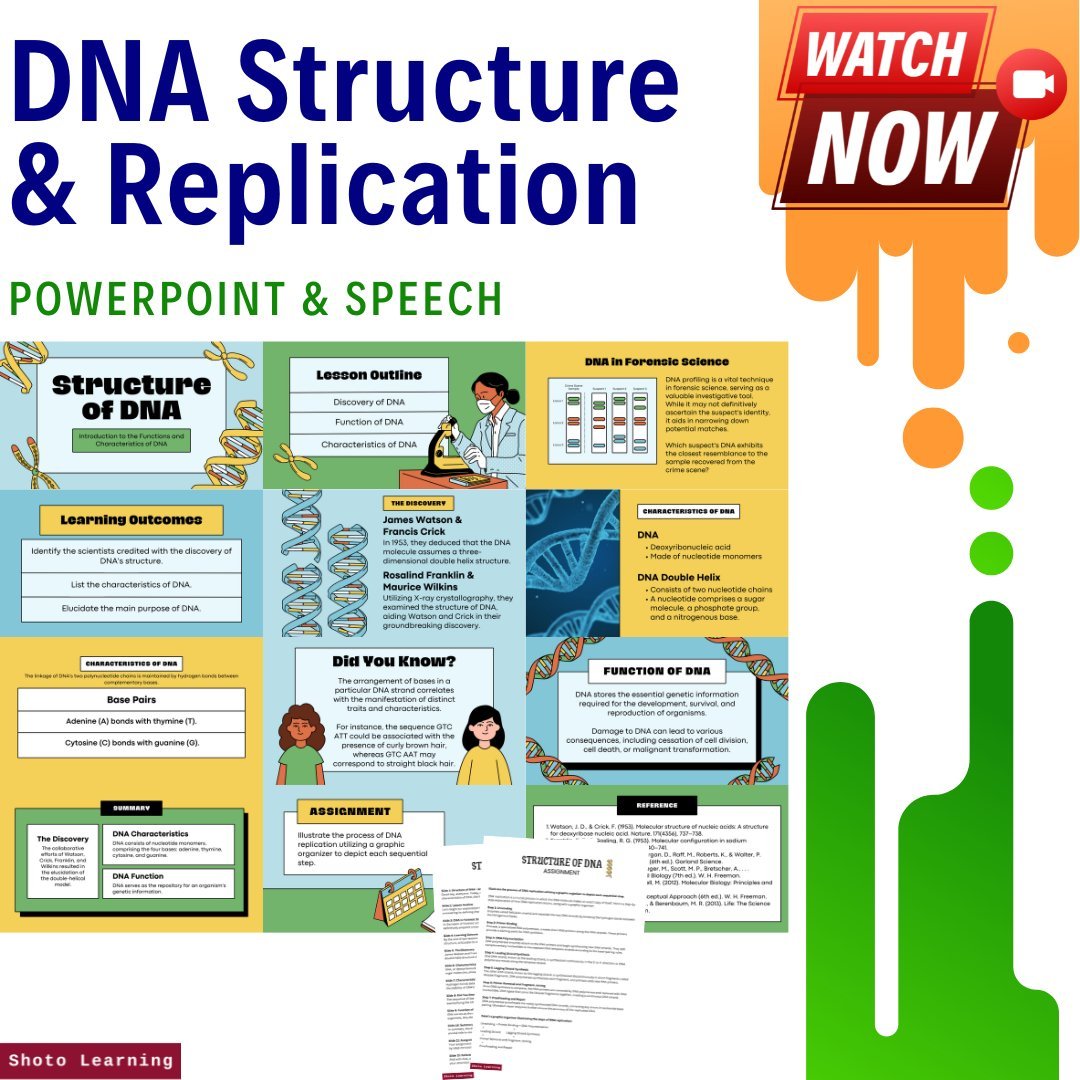
Embark on a captivating journey into the intricate world of DNA with our enlightening PowerPoint presentation, "Unveiling the Double Helix: Understanding the Structure of DNA." Delve deep into the discovery, function, and defining characteristics of this fundamental molecule of life.
Key Features:
Comprehensive Exploration: Explore the structure, function, and characteristics of DNA through engaging slides and informative content.
Historical Insights: Learn about the pioneering scientists behind the discovery of DNA's iconic double helix structure, including James Watson, Francis Crick, Rosalind Franklin, and Maurice Wilkins.
Forensic Applications: Discover how DNA fingerprinting is used in forensic science to identify suspects and narrow down possibilities.
Learning Outcomes: By the end of the presentation, understand the essential characteristics of DNA, its primary function as the repository of genetic information, and the significance of its structure in biological processes.
Interactive Assignments: Engage in assignments that deepen understanding, such as elucidating the process of DNA replication using graphic organizers.
Concise Summary: Summarize key points about DNA's structure, function, and importance in the biological realm, ensuring a comprehensive understanding of the topic.
References Included: Benefit from a curated list of references for further exploration and understanding of DNA's structure and function.
How to Use This Presentation:
Watch the Video: View the free video on YouTube by following the link provided in the description.
Follow Along with the Speech: Use the copy of the speech to follow along or take notes as you watch the presentation.
Print the PDF: Print the included PDF to have a handy reference or to use as a worksheet during the presentation.
Engage and Interact: Pause the video at key points to discuss or reflect on the content with your audience.
Perfect for educators, students, and anyone intrigued by the wonders of genetics, "Unveiling the Double Helix" offers an immersive exploration of the structure of DNA, shedding light on its significance in shaping life as we know it. Unlock the secrets of the double helix and gain a deeper appreciation for the building blocks of life.
View on YouTube
Pages: 14 pages
Don't miss out, order yours today!

Embark on an enlightening exploration of genetics with our captivating PowerPoint presentation, "Unraveling DNA: A Comprehensive Introduction to Genetics." Dive deep into the fundamental molecule that shapes life as we know it – DNA.
Key Features:
Fascinating Introduction: Join us on a journey into the intriguing realm of genetics, focusing specifically on DNA, the cornerstone of life's blueprint.
Visual Engagement: Delve into the captivating visuals illustrating the structure and function of DNA, making complex concepts easily comprehensible.
In-depth Coverage: Explore the intricacies of DNA, from its composition of nucleotides to its role in encoding genetic information and controlling traits.
Understanding DNA Structure: Gain insights into the unique structure of DNA, visualized as a twisted ladder or double helix, and comprehend its significance in storing and transmitting genetic instructions.
Deciphering the Genetic Code: Decode the genetic language of DNA, understanding how the four nucleotides – Adenine, Thymine, Cytosine, and Guanine – form the basis of the genetic code.
Exploring Genetic Traits: Discover how genes, composed of specific sequences of DNA, determine various traits and functions in living organisms, making each individual unique.
Interactive Learning: Engage with practice questions and examples to reinforce your understanding of DNA structure, function, and genetic inheritance.
Comprehensive References: Benefit from a curated list of references for further exploration and understanding of genetics and DNA.
How to Use This Presentation:
Watch the Video: View the free video on YouTube by following the link provided in the description.
Follow Along with the Speech: Use the copy of the speech to follow along or take notes as you watch the presentation.
Print the PDF: Print the included PDF to have a handy reference or to use as a worksheet during the presentation.
Engage and Interact: Pause the video at key points to discuss or reflect on the content with your audience.
Perfect for educators, students, and anyone intrigued by the wonders of genetics, "Unraveling DNA" offers an immersive journey into the foundation of life itself. Unlock the secrets of DNA and gain a deeper understanding of the fascinating world of genetics.
View on Youtube
Pages: 12 pages
Don't miss out, order yours today!

Embark on an enlightening journey into the world of genetics with our comprehensive PowerPoint presentation, "Deciphering DNA: Exploring the Essence of Life." Delve deep into the mysteries of DNA, uncovering its structure, function, and profound significance in every living organism.
Key Features:
Comprehensive Exploration: Explore the intricacies of DNA, from its fundamental structure to its role as the blueprint of life itself.
Clear Explanations: Understand the unique structure of DNA and how it governs the hereditary traits and cellular activities of all living organisms.
Visual Engagement: With visually captivating slides, grasp complex concepts with ease as you unravel the mysteries of DNA.
Interactive Learning: Dive into practice questions to reinforce your understanding and enhance your knowledge of DNA's complementary base pairing.
Expertly Crafted Speech: Accompanying the presentation is a meticulously crafted speech script, guiding you through each slide with clarity and precision.
How to Use This Presentation:
Watch the Video: View the free video on YouTube by following the link provided in the description.
Follow Along with the Speech: Use the copy of the speech to follow along or take notes as you watch the presentation.
Print the PDF: Print the included PDF to have a handy reference or to use as a worksheet during the presentation.
Engage and Interact: Pause the video at key points to discuss or reflect on the content with your audience.
Perfect for educators, students, and anyone intrigued by the wonders of genetics, "Deciphering DNA" offers a comprehensive and engaging exploration of the molecule that defines life itself. Unlock the secrets of DNA and embark on a journey of discovery like never before.
View on Youtube
Pages: 14 pages
Don't miss out, order yours today!
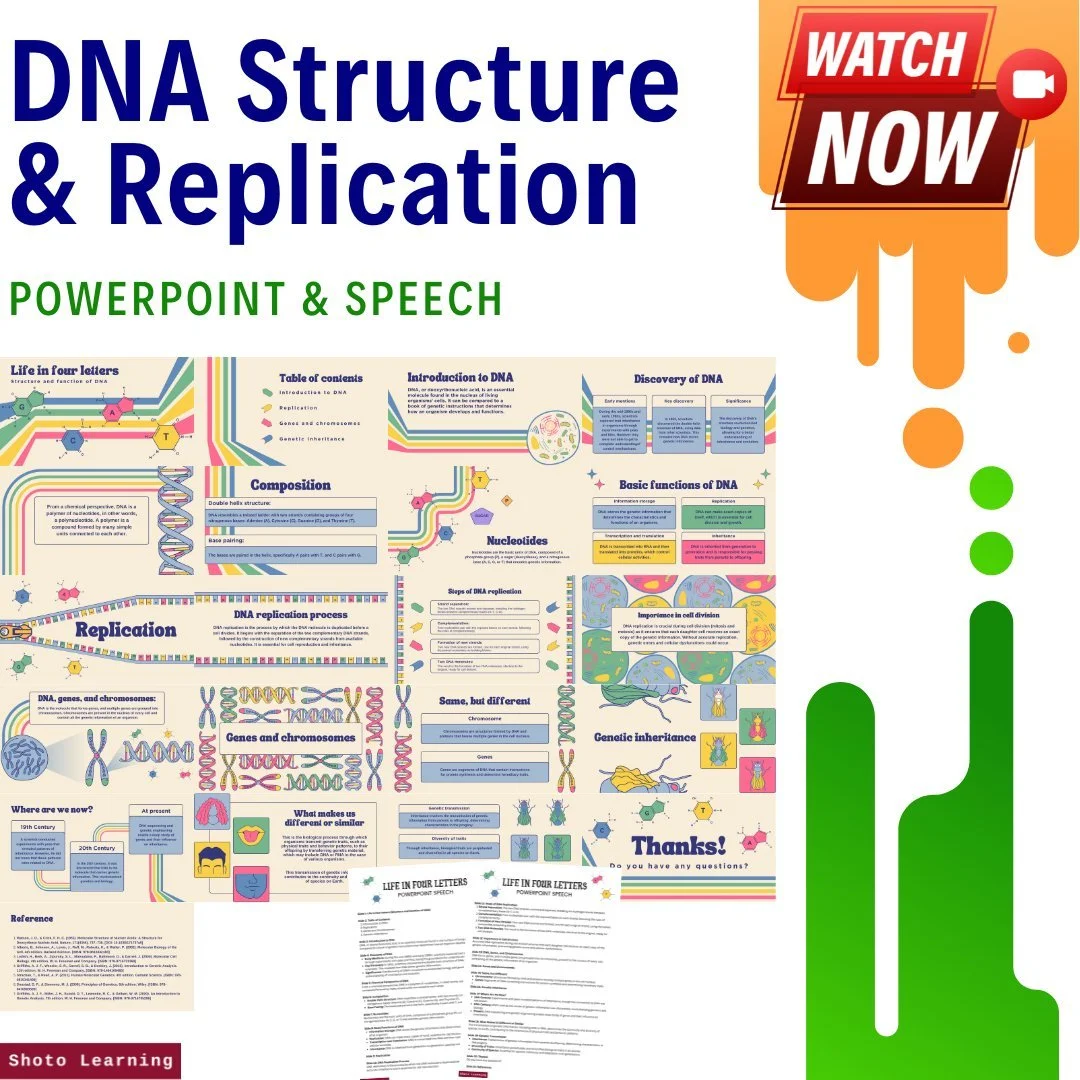
Unlock the mysteries of life with our comprehensive PowerPoint presentation, "DNA Decoded: Unraveling the Blueprint of Life." This expertly crafted presentation delves into the intricate structure and vital functions of DNA, the molecule that holds the key to heredity and genetic information.
Key Features:
In-Depth Exploration: Explore the journey of discovery from early experiments with peas to the groundbreaking revelation of DNA's double-helix structure in 1953.
Clear Explanations: Gain insights into the chemical composition of DNA, its role in storing genetic information, and its crucial functions in replication, transcription, and translation.
Visual Engagement: With visually engaging slides, this presentation covers essential topics such as genes, chromosomes, and genetic inheritance, making complex concepts easy to understand.
Comprehensive Coverage: Learn how DNA replication ensures accurate transmission of genetic material during cell division and discover the significance of genes and chromosomes in determining hereditary traits.
Historical Milestones to Modern Advancements: From historical milestones to modern advancements in DNA sequencing and genetic engineering, "DNA Decoded" provides a comprehensive overview of the past, present, and future of genetic research.
How to Use This Presentation:
Watch the Video: View the free video on YouTube by following the link provided in the description.
Follow Along with the Speech: Use the copy of the speech to follow along or take notes as you watch the presentation.
Print the PDF: Print the included PDF to have a handy reference or to use as a worksheet during the presentation.
Engage and Interact: Pause the video at key points to discuss or reflect on the content with your audience.
Perfect for educators, students, and anyone interested in unraveling the mysteries of life, this PowerPoint package is your ultimate guide to understanding the blueprint of life encoded in DNA.
View on Youtube
Pages: 23 pages
Don't miss out, order yours today!

Unlock the secrets of DNA with our "DNA Discovery: Structure & Replication Writing Prompts Worksheet," featuring key features to enhance your learning experience. Dive deep into the molecular realm with ten meticulously crafted writing prompts designed to illuminate the intricacies of DNA structure and replication.
Key Features:
Comprehensive Coverage: Explore every facet of DNA, from its iconic double helix structure to the intricacies of replication, through ten engaging prompts.
Critical Thinking: Stimulate critical thinking and analytical skills with prompts encouraging reflection and exploration of complex concepts.
Educator-Approved: Perfect for classrooms or self-study, this worksheet is designed by educators to align with curriculum standards and enhance learning outcomes.
Answers Included: Check your understanding and deepen comprehension with the provided answers for each prompt, ensuring clarity and confidence in your knowledge.
Accessible Format: A user-friendly layout and clear instructions make this worksheet suitable for students of all levels, whether studying independently or in a group setting.
How to Use It:
Read Each Prompt: Begin by reading through all 10 writing prompts provided.
Choose a Prompt: Select one prompt that interests you the most.
Write a Response: Spend 10-15 minutes writing a response to your chosen prompt. Aim to be creative and detailed.
Check the Answers: After writing, refer to the provided answers to see possible ways to approach the prompt.
Compare and Reflect: Compare your response with the answers. Note any similarities or differences.
Revise if Desired: Use the answers to refine your writing if you wish.
Repeat: Choose a new prompt and repeat the process for additional practice.
Uncover the mysteries of DNA and elevate your understanding with the "DNA Discovery: Structure & Replication Writing Prompts Worksheet" today!
Pages: 12 pages
Don't miss out, order yours today!

Dive into the captivating world of DNA with our DNA Explorer Word Search! Packed with 30 keywords related to DNA structure and replication, this word search puzzle offers an exciting and educational journey for biology enthusiasts, students, and curious minds alike. Embark on a quest to uncover terms like "double helix," "replication," "nucleotide," and more as you navigate through the grid. With its engaging format and informative content, this word search provides a fun and interactive way to reinforce your understanding of genetics while honing your problem-solving skills.
Key Features:
Comprehensive Coverage: Explore 30 essential keywords related to DNA structure and replication, covering key concepts and terminology.
Educational and Entertaining: Combine learning with entertainment, making it an ideal tool for classrooms, homeschooling, or personal enrichment.
Challenging Yet Accessible: Suitable for learners of all levels, offering a stimulating challenge without overwhelming complexity.
Interactive Learning: Stimulate critical thinking and concentration while fostering a deeper understanding of genetic principles.
Ideal for All Ages: Suitable for students, educators, biology enthusiasts, and anyone intrigued by the wonders of DNA.
Printable and Portable: Print out the word search puzzle for on-the-go learning or use it digitally for convenience.
Promotes Collaboration: Encourage teamwork and cooperation by solving the word search puzzle with friends, family, or classmates.
Answer Key Included: Easily check answers and track progress with the included answer key for quick reference.
Inspires Curiosity: Spark curiosity about DNA and genetics, fostering a lifelong appreciation for the marvels of life's building blocks.
How to Use It
Review the List: Check the list of words at the bottom of the worksheet.
Find the Words: Search for each word in the grid of letters. Words may be arranged horizontally, vertically, or diagonally.
Circle or Highlight: Mark each word you find by circling or highlighting it.
Check Off: Cross off the found words from the list to keep track of which ones are still missing.
Complete the Search: Continue until all words from the list are located.
Embark on a thrilling genetic adventure with our DNA Explorer Word Search - where discovery awaits with every word found!
Don't miss out, order yours today!

Dive into the intricate world of DNA with our DNA Truths: Structure and Replication True or False Worksheet! This engaging resource features 20 carefully crafted questions that will put your knowledge of DNA structure and replication to the test. From base pairing to replication mechanisms, each question presents a statement about DNA-related concepts, challenging you to determine whether it's true or false. Perfect for students, educators, or anyone interested in genetics, this worksheet offers an interactive way to reinforce learning and enhance understanding of DNA fundamentals.
Key Features:
Twenty True or False Questions: Explore essential topics in DNA structure and replication through a series of statements, covering nucleotides, enzymes, processes, and more.
Interactive Learning: Engage actively with the material as you assess the accuracy of each statement, promoting critical thinking and comprehension of genetic concepts.
Comprehensive Coverage: Encounter a variety of DNA-related concepts and principles, providing a well-rounded review experience.
Self-Assessment: Evaluate your understanding and track your progress by checking your answers against the provided answer key, ensuring accurate comprehension, and identifying areas for further study.
Suitable for All Learners: Whether you're reviewing for exams, conducting self-study, or supplementing classroom instruction, this worksheet accommodates learners of all levels and backgrounds.
Printable and Digital Formats: Access the worksheet in printable PDF format for convenient offline use or use it digitally for interactive learning on your device, offering flexibility and convenience.
Enhances Retention: Solidify your understanding of DNA structure and replication concepts through active engagement and application in a true or false format, reinforcing long-term retention.
Ideal for Review and Reinforcement: Use the worksheet as a standalone review tool, homework assignment, quiz, or study aid to reinforce classroom learning or independent study efforts, promoting mastery of genetic principles.
Promotes Critical Thinking: Stimulate critical thinking skills by analyzing statements, reasoning through options, and determining the accuracy of each statement based on knowledge and understanding of genetic concepts.
Convenient and Accessible: Enjoy the flexibility to study anytime, anywhere, at your own pace, with a convenient worksheet format that fits seamlessly into your learning routine, fostering an enriching educational experience.
How to Use It
Read Each Statement: Carefully read each statement on the worksheet.
Determine True or False: Decide if the statement is true or false based on what you know or have learned.
Circle Your Answer: Circle "True" if the statement is correct, or "False" if it is not.
Review Your Answers: Check your answers to make sure you have circled the correct options.
Discuss (Optional): If working in a group or with a teacher, discuss any statements you found challenging.
Put your DNA knowledge to the test and uncover the truth about DNA structure and replication with our DNA Truths: Structure and Replication True or False Worksheet – where learning meets engagement, one statement at a time!
Don't miss out, order yours today!

Unlock the secrets of DNA with our DNA Structure and Replication Mastery Test! Designed to assess your understanding of fundamental concepts in genetics, this comprehensive test offers a challenging yet rewarding examination of DNA structure, replication processes, and molecular biology principles. Whether you're a student preparing for exams, an educator assessing comprehension, or an enthusiast eager to test your genetic acumen, this test provides an invaluable opportunity to showcase your knowledge and deepen your understanding of DNA science.
Key Features:
Comprehensive Assessment: Put your knowledge to the test with a carefully curated mix of multiple-choice questions and short-answer questions covering essential topics in DNA structure and replication.
Rigorous Evaluation: Assess your comprehension and critical thinking skills through a variety of question formats, allowing for a thorough examination of genetic principles.
Detailed Answers: Gain insights into correct responses with comprehensive answers provided for each question, offering explanations and clarifications to reinforce understanding.
Varied Question Types: Encounter a diverse range of question formats, including multiple-choice questions that test recall and short-answer questions that assess analytical thinking and application of concepts.
Timed Assessment: Challenge yourself with a time-limited test format, simulating real exam conditions and enhancing focus and time management skills.
Suitable for All Levels: Whether you're a beginner seeking foundational knowledge or an advanced learner aiming to deepen your understanding, this test accommodates learners of all levels and backgrounds.
Printable Format: Access the test in printable PDF format for convenient offline use, allowing you to study and assess your knowledge anytime, anywhere.
Ideal for Review and Assessment: Use the test as a comprehensive review tool, assessment tool, or study aid to gauge understanding, identify areas for improvement, and track progress in mastering genetic concepts.
Educational Resource: Enhance your learning experience with a comprehensive test that challenges and inspires, fostering intellectual curiosity and promoting lifelong learning in genetics.
How to Use It
Preparation: Ensure students have their test materials, including pencils, erasers, and other necessary items.
Instructions: Briefly explain the test format and any specific instructions provided on the worksheet.
Timing: Allocate 45 minutes for students to complete the test. Use a timer to keep track.
Completion: Instruct students to read each question carefully and answer as thoroughly as possible within the given time.
Review: After the test, collect worksheets and review answers to assess understanding.
Embark on a journey of genetic discovery and mastery with our DNA Structure and Replication Mastery Test – where knowledge meets assessment, and learning thrives!
Pages: 6 pages
Don't miss out, order yours today!
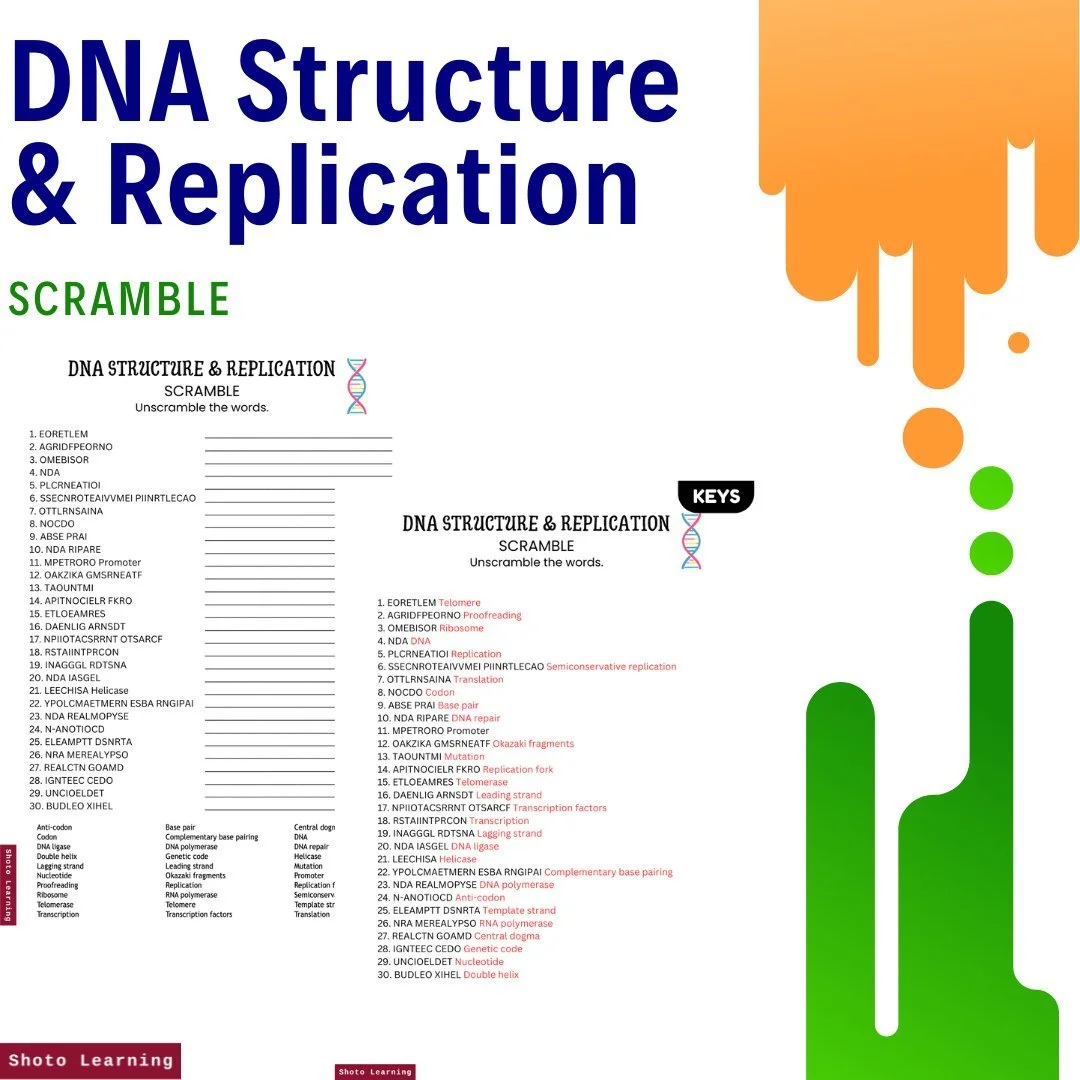
Unleash your inner scientist and embark on an exhilarating journey through the world of genetics with our DNA Unscramble Challenge! This brain-teasing puzzle game is designed to test your knowledge and problem-solving skills as you unravel the complexities of DNA structure and replication. With 30 scrambled keywords and their corresponding answers, this game offers a fun and educational experience for students, biology enthusiasts, and anyone fascinated by the mysteries of life at the molecular level.
Key Features:
Challenging Vocabulary: Decode and unscramble 30 essential terms related to DNA structure and replication, including nucleotide, genetic codes, and more.
Engaging Gameplay: Stimulate critical thinking and cognitive skills with a variety of scrambled word puzzles that require careful consideration and analysis.
Educational and Informative: Learn while you play, deepening your understanding of molecular biology concepts in an interactive and enjoyable way.
Reinforcement of Concepts: Solidify your knowledge of DNA by unscrambling keywords and matching them with their correct definitions or descriptions.
Versatile Usage: Ideal for individual study, classroom activities, science clubs, or family game nights, providing a versatile learning experience for players of all ages.
Printable and Portable: Print out the puzzle sheets for convenient offline play or use them digitally for virtual challenges wherever you go.
Answer Key Included: Easily check your solutions and track your progress with the included answer key, allowing for self-assessment and immediate feedback.
Promotes Persistence: Encourage perseverance and determination as you tackle each scrambled word, celebrating your victories as you conquer the challenge.
Inspires Curiosity: Spark curiosity about DNA and genetics, fostering a deeper appreciation for the intricate mechanisms that govern life on Earth.
How to Use This Worksheet:
Read the Instructions: Review the scrambled words in the worksheet. Each word is mixed up and needs to be rearranged correctly.
Find the Key Answer: Use the word box to help you find the correct spelling of each scrambled word.
Unscramble the Words: Write the unscrambled words next to their corresponding scrambled version.
Check Your Answers: Compare your answers with the key provided to ensure accuracy.
Optional Challenge: Make it a game by setting a timer for added excitement. See how quickly you can unscramble all the words!
Feel free to adjust the timer based on your skill level or the difficulty of the worksheet. Enjoy the challenge!
Unlock the secrets of DNA and master the art of decoding with our DNA Unscramble Challenge - where every solved word brings you closer to understanding the blueprint of life!
Don't miss out, order yours today!

Embark on a journey through the mysteries of DNA with our "DNA Explorer: Understanding DNA Structure & Replication - Reading Comprehension Guide." Delve into the intricate world of molecular biology as you explore the structure of DNA and the fascinating process of DNA replication.
Key Features:
Comprehensive Coverage: Gain a deep understanding of DNA structure and replication through clear and concise explanations.
Engaging Content: Immerse yourself in the captivating world of genetics with captivating text that simplifies complex concepts.
Interactive Learning: Test your knowledge and comprehension with five thought-provoking questions strategically placed throughout the guide.
Educational Resource: Perfect for students, educators, and enthusiasts alike, this guide provides essential insights into the fundamental principles of molecular biology.
Accessible Language: Written in accessible language suitable for learners at all levels, making complex concepts easily understandable.
How to Use It:
In-Class Activity: Integrate the worksheet into your lesson on DNA structure and replication. Have students read the passage and answer the questions individually or in pairs to deepen their understanding.
Homework Assignment: Use the worksheet as homework to allow students to review DNA concepts at their own pace and reinforce their learning.
Study Aid: Provide the worksheet as a review tool for students preparing for exams or quizzes on DNA, helping them consolidate their knowledge and test their comprehension.
Enhance your students' grasp of DNA structure and replication with this clear and concise reading comprehension worksheet!
Order your copy today!

Dive into the fascinating world of genetics with our DNA Structure and Replication Q&A Worksheet! This comprehensive resource features 20 thought-provoking questions and answers designed to enhance your understanding of DNA structure, replication processes, and key concepts in molecular biology. Whether you're a student, educator, or biology enthusiast, this worksheet offers an engaging and interactive way to test your knowledge, reinforce learning, and explore the intricate mechanisms of DNA.
Key Features:
Comprehensive Coverage: Explore essential topics in DNA structure and replication through 20 meticulously crafted questions and answers, covering nucleotides, base pairing, enzymes, replication mechanisms, and more.
Interactive Learning: Engage actively with the material as you navigate through a series of questions and discover the answers, promoting retention and comprehension of genetic concepts.
Self-Assessment: Evaluate your understanding and track your progress by checking your answers against the provided answer key, ensuring accurate comprehension and identifying areas for further study.
Suitable for All Learners: Whether you're reviewing for exams, conducting self-study, or supplementing classroom instruction, this worksheet accommodates learners of all levels and backgrounds.
Printable and Digital Formats: Access the worksheet in printable PDF format for convenient offline use or use it digitally for interactive learning on your device, offering flexibility and convenience.
Enhances Retention: Solidify your understanding of DNA structure and replication concepts through active engagement and application in a question-and-answer format, reinforcing long-term retention.
Ideal for Review and Reinforcement: Use the worksheet as a standalone review tool, homework assignment, quiz, or study aid to reinforce classroom learning or independent study efforts, promoting mastery of genetic principles.
Promotes Critical Thinking: Stimulate critical thinking skills by analyzing questions, reasoning through answers, and selecting the most appropriate responses based on knowledge and understanding of genetic concepts.
Convenient and Accessible: Enjoy the flexibility to study anytime, anywhere, at your own pace, with a convenient worksheet format that fits seamlessly into your learning routine, fostering an enriching educational experience.
How to Use It:
Read Each Question Carefully: Start by reading each question on the worksheet.
Write Your Answer: Provide a complete and clear answer in the space provided.
Review Your Responses: Double-check your answers for accuracy and completeness.
Discuss with a Partner (Optional): Pair up with a classmate to discuss your answers and gain different perspectives.
Submit for Feedback: Hand in the completed worksheet to the teacher for review and feedback.
Unlock the secrets of DNA and replication with our DNA Structure and Replication Q&A Worksheet – where learning meets engagement, one question at a time!
Pages: 6 pages
Don't miss out, order yours today!

Embark on a journey of genetic discovery with our DNA Structure and Replication Mastery Multiple Choice Worksheet! Designed for students, educators, and enthusiasts alike, this comprehensive worksheet features 20 thought-provoking questions covering key concepts in DNA structure and replication. Test your knowledge, reinforce your understanding, and hone your critical thinking skills as you navigate through a series of multiple-choice questions and uncover the fascinating intricacies of genetics.
Key Features:
Comprehensive Coverage: Explore essential topics in DNA structure and replication through 20 carefully crafted multiple-choice questions, covering nucleotides, base pairing, enzymes, replication processes, and more.
Interactive Learning: Engage actively with the material as you select the correct answer for each question, promoting retention and comprehension of genetic concepts.
Varied Question Types: Encounter a diverse range of question formats, including identifying enzymes, predicting outcomes of replication processes, interpreting genetic code, and understanding molecular mechanisms.
Self-Assessment: Evaluate your understanding and track your progress by checking your answers against the provided answer key, ensuring accurate comprehension, and identifying areas for further study.
Suitable for All Learners: Whether you're reviewing for exams, conducting self-study, or supplementing classroom instruction, this worksheet accommodates learners of all levels and backgrounds.
Printable and Digital Formats: Access the worksheet in printable PDF format for convenient offline use or use it digitally for interactive learning on your device, offering flexibility and convenience.
Enhances Retention: Solidify your understanding of DNA structure and replication concepts through active engagement and application in a multiple-choice format, reinforcing long-term retention.
Ideal for Review and Reinforcement: Use the worksheet as a standalone review tool, homework assignment, quiz, or study aid to reinforce classroom learning or independent study efforts, promoting mastery of genetic principles.
Promotes Critical Thinking: Stimulate critical thinking skills by analyzing options, reasoning through choices, and selecting the most appropriate answers based on knowledge and understanding of genetic concepts.
Convenient and Accessible: Enjoy the flexibility to study anytime, anywhere, at your own pace, with a convenient worksheet format that fits seamlessly into your learning routine, fostering an enriching educational experience.
How to Use This Worksheet
Read Each Question Carefully: Ensure you understand what is being asked.
Select the Best Answer: Circle or highlight the letter (A, B, C, or D) that corresponds to the correct choice.
Check Your Answers: If provided, use the answer key to review your responses.
Review Mistakes: Understand any incorrect answers by reviewing the relevant material.
Discuss: Use this worksheet to spark discussion in groups or class for a deeper understanding.
Unlock the secrets of DNA and replication with our DNA Structure and Replication Mastery Multiple Choice Worksheet – where learning meets engagement, one choice at a time!
Don't miss out; order yours today!

Embark on an exciting journey of discovery with our DNA Structure Mystery puzzle! Delve into the intricate world of genetics as you fill in the missing letters to reveal essential terms related to DNA structure and replication. Perfect for students, educators, and biology enthusiasts, this engaging activity challenges players to test their knowledge and problem-solving skills while reinforcing key concepts in molecular biology. With 20 carefully selected keywords and their corresponding missing letters, this puzzle offers a stimulating and educational experience for players of all ages.
Key Features:
Brain-Boosting Fun: Exercise your mind and sharpen your focus as you fill in the missing letters to uncover DNA-related terms.
Educational and Informative: Learn about DNA structure and replication while engaging in an interactive and entertaining puzzle-solving experience.
Reinforcement of Concepts: Solidify your understanding of molecular biology concepts by completing missing letters and matching them with their corresponding terms.
Versatile Usage: Suitable for individual study, classroom activities, science clubs, or family game nights, providing a versatile learning experience for players of all levels.
Stimulating Challenge: Test your vocabulary and recall skills as you decipher each term with only a few letters as clues.
Printable and Portable: Print out the puzzle sheet for convenient offline play or use it digitally for on-the-go challenges wherever you are.
Answer Key Included: Easily check your solutions and track your progress with the included answer key, allowing for self-assessment and immediate feedback.
Promotes Engagement: Encourage active participation and curiosity about DNA and genetics, fostering a deeper appreciation for the wonders of life at the molecular level.
How to Use It:
Select Your Worksheet: Choose the version with or without a word bank, based on your preference.
Identify Missing Letters: Examine each keyword and fill in the blanks with the appropriate missing letters.
Refer to the Word Bank (if needed): Use the word bank for hints if using the easier version.
Check Your Answers: Review your completed answers to ensure accuracy.
Reinforce Learning: Use the worksheet as a study tool to deepen your understanding.
Unravel the mysteries of DNA structure and replication with our DNA Structure Mystery puzzle - where every completed term brings you one step closer to unlocking the secrets of life!
Don't miss out, order yours today!
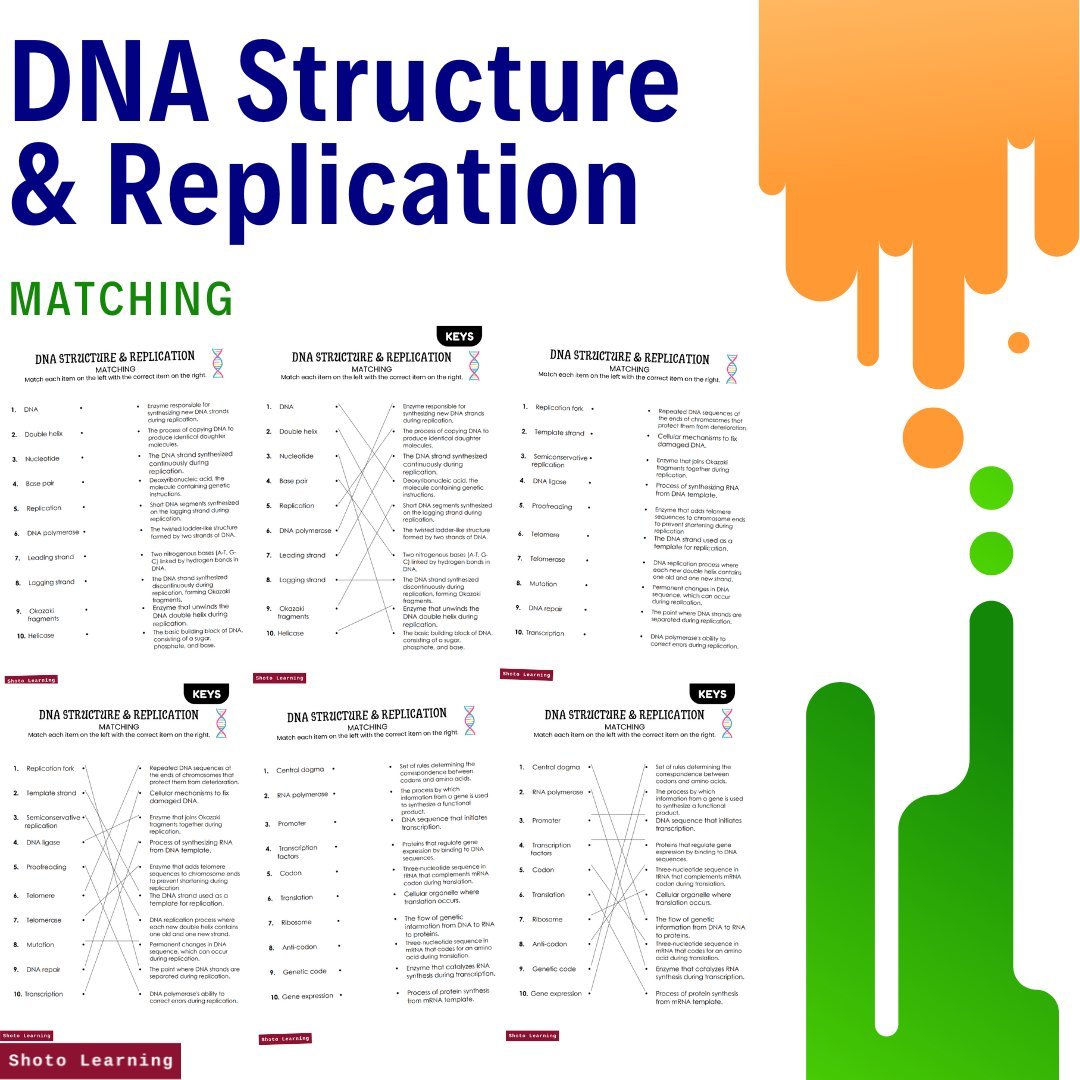
Explore the intricacies of DNA structure and replication with our DNA Match-Up Worksheet Set! This comprehensive set includes three engaging worksheets, each featuring 10 matching questions and answers related to the fascinating world of genetics. Challenge yourself to connect terms like "nucleotide" with its corresponding definition or "helicase" with its function in DNA replication. With a total of 30 matching opportunities across the set, learners can reinforce their understanding of key concepts while honing their critical thinking and problem-solving skills.
Key Features:
Three Unique Worksheets: Enjoy a variety of matching challenges with three distinct worksheets, providing ample practice and reinforcement.
Comprehensive Coverage: Cover essential DNA structure and replication terms, ensuring a thorough understanding of genetic concepts.
Interactive Learning: Engage in hands-on learning as you connect related terms and definitions, promoting deeper comprehension.
Skill Development: Develop critical thinking, memory, and problem-solving skills while mastering genetic vocabulary.
Suitable for All Learners: Suitable for students of all ages and proficiency levels, offering adaptable challenges for diverse learning needs.
Printable and Portable: Access worksheets digitally or print them out for convenient learning at home, in the classroom, or on the go.
Ideal for Individual or Group Use: Use independently for self-paced learning or facilitate group activities to encourage collaboration and discussion.
Quick and Easy Setup: No preparation is required – simply distribute the worksheets and let the matching fun begin!
Answer Keys Included: Easily check answers and track progress with included answer keys for each worksheet.
Encourages Retention: Reinforce the retention of genetic terminology and concepts through engaging in matching activities.
How to Use This Worksheet:
Read the Instructions: Review the directions at the top of the worksheet.
Match the Pairs: Draw a line connecting each item in the left column to its corresponding match in the right column.
Check Answers: Verify the matches by reviewing the provided answer key or discussing with a partner.
Review and Reflect: Discuss the correct answers and understand any mistakes.
Embark on a genetic adventure and solidify your understanding of DNA with our DNA Match-Up Worksheet Set – where learning comes to life through matching mastery!
Pages: 6 pages
Don't miss out, order yours today!

Explore the blueprint of life with our dynamic lesson plan, meticulously crafted to engage high school biology students in the intricacies of DNA structure and replication. Packed with key features, this resource ensures an immersive learning experience:
Thorough Content Coverage: Delve into the fundamental structure of DNA, from its iconic double helix to the composition of nucleotides. Students will grasp the significance of complementary base pairing and understand how DNA encodes genetic information.
Interactive Learning Activities: Foster student engagement with hands-on activities and visual aids that bring DNA to life. From modeling DNA strands to exploring base pairing through interactive exercises, students will gain a deep understanding of molecular biology concepts.
Comprehensive Replication Insights: Dive into the intricacies of DNA replication, uncovering the roles of essential enzymes like DNA polymerase and helicase. Students will explore the semi-conservative nature of replication and the mechanisms that ensure fidelity, solidifying their understanding of cellular processes.
Assessment Tools for Mastery: Assess student comprehension through thoughtfully designed worksheets and activities that reinforce key concepts. With built-in assessment opportunities, educators can track student progress and tailor instruction to meet individual learning needs.
Inspiring Future Scientists: Spark curiosity and inspire a lifelong passion for biology with engaging content that connects classroom learning to real-world applications. Our lesson plan empowers educators to cultivate the next generation of scientific innovators.
How to Use This Lesson Plan:
Review Objectives: Begin by reviewing the lesson objectives and outcomes to understand the focus and goals.
Prepare Materials: Gather all required materials, including handouts, worksheets, and any multimedia resources.
Introduce Topic: Start with a brief introduction to the topic to engage students and set the context.
Follow the Steps: Teach each section as outlined, incorporating suggested activities, discussions, and questions.
Monitor and Adapt: Observe student engagement and understanding; adapt the lesson pace and methods as needed.
Assess Understanding: Use the provided assessment tools to evaluate student comprehension and provide feedback.
Wrap-Up: Summarize key points and provide closure with a reflective activity or homework assignment.
Equip your classroom with the essential resources needed to unravel the mysteries of DNA. With our comprehensive lesson plan, educators can ignite curiosity, foster critical thinking, and lay the foundation for a deeper understanding of genetics and molecular biology.
Don't miss out; order yours today!

Delve into the fascinating realm of DNA structure and replication with our DNA Master Flashcards! This comprehensive set features 20 carefully curated flashcards, each highlighting a key term essential for understanding the intricacies of genetic code. From "double helix" to "mutation," each flashcard pairs the keyword with its concise and clear meaning, providing an efficient and effective study tool for students, educators, and biology enthusiasts alike.
Key Features:
Comprehensive Coverage: Explore 20 essential keywords related to DNA structure and replication, covering a wide range of genetic concepts.
Clear and Concise Definitions: Each flashcard presents a keyword paired with its meaning, ensuring easy comprehension and retention.
Portable Learning: Compact and portable, these flashcards are perfect for studying on the go, whether you're commuting, waiting in line, or taking a break between classes.
Visual Reinforcement: Reinforce understanding through visual association with each keyword, aiding memory recall and concept retention.
Suitable for All Learners: Whether you're a beginner or an advanced student, these flashcards cater to diverse learning needs and proficiency levels.
Interactive Study Tool: Use the flashcards individually for quick review or shuffle them for a randomized study session, enhancing engagement and knowledge retrieval.
Ideal for Various Learning Environments: Perfect for self-study, group study sessions, classroom activities, or as a supplement to textbooks and lectures.
Promotes Active Recall: Practice active recall by covering the meaning and testing your knowledge of each keyword, fostering deeper learning and understanding.
Reinforces Vocabulary: Expand your genetic vocabulary and terminology while reinforcing comprehension of DNA-related concepts.
Answer Key Included: Easily check your understanding with an included answer key for quick reference and self-assessment.
How to Use the Flashcards:
Print and Cut: Print the flashcards on thick paper or cardstock for durability. Cut along the dotted lines to separate each card.
Review Individually: Read each flashcard's keyword and outline to familiarize yourself with the key concepts.
Group Discussion: Use the flashcards in a group setting to encourage discussion on each keyword. Take turns explaining the outline to reinforce understanding.
Quiz Yourself: Cover the outline on each flashcard and try to recall the details based on the keyword.
Pair and Share: Work with a partner to quiz each other. One reads the keyword, and the other provides details from memory.
Create Mind Maps: Use the flashcards as a starting point for creating mind maps that connect related topics.
Daily Review: Spend a few minutes each day going through a few flashcards to reinforce learning and memory retention.
Teach Back: Use the flashcards to teach the concept to someone else. Explaining the outline in your own words enhances understanding.
Random Pick: Shuffle the flashcards and pick one at random. Discuss or write a summary of the topic based on the keyword and outline.
Speed Round: Set a timer and see how quickly you can go through all the flashcards, recalling key points from the outlines.
Group Sorting: Organize the flashcards into related categories or themes to see connections between topics.
These methods will help enhance learning and retention of the keywords on the flashcards.
Unlock the secrets of genetics and master DNA structure and replication with our DNA Master Flashcards – your ultimate study companion for genetic enlightenment!
Pages: 5 pages
Don't miss out, order yours today!

Master the fundamentals of DNA structure and replication with our comprehensive Fill in the Blank Worksheet! This educational resource is designed to reinforce your understanding of key concepts in genetics through 20 carefully crafted questions and answers. Whether you're a student, educator, or biology enthusiast, this worksheet offers an interactive way to test your knowledge and enhance your comprehension of DNA-related topics.
Key Features:
Comprehensive Coverage: Explore essential aspects of DNA structure and replication through 20 fill-in-the-blank questions covering nucleotides, base pairing, enzymes, replication processes, and more.
Interactive Learning: Engage actively with the material as you complete each question, reinforcing retention and understanding of genetic concepts.
Varied Question Types: Encounter a variety of question formats, including naming enzymes, completing sequences, identifying base pairs, and explaining processes, providing a well-rounded review experience.
Self-Assessment: Evaluate your comprehension and identify areas for further study by checking your answers against the included answer key.
Suitable for All Learners: Whether you're reviewing for exams, conducting self-study, or supplementing classroom instruction, this worksheet accommodates learners of all levels and backgrounds.
Printable and Digital Formats: Access the worksheet in printable PDF format for convenient offline use or use it digitally for interactive learning on your device.
Enhances Retention: Solidify your understanding of DNA structure and replication concepts through active recall and application in a fill-in-the-blank format.
Ideal for Review and Reinforcement: Use the worksheet as a standalone review tool, homework assignment, quiz, or study aid to reinforce classroom learning or independent study efforts.
Promotes Critical Thinking: Encourage critical thinking skills by requiring students to recall information and apply it in context to complete the blanks accurately.
Convenient and Accessible: Enjoy the flexibility to study anytime, anywhere, at your own pace, with a convenient worksheet format that fits seamlessly into your learning routine.
How to Use This Fill-in-the-Blank Worksheet:
Read Each Statement Carefully: Review each question or statement provided in the worksheet.
Use the Word Box: Refer to the word box at the end of each page to find the correct term or phrase that completes each blank.
Fill in the Blanks: Write the appropriate word or phrase from the word box in each blank space to complete the statements accurately.
Check Your Answers: After completing all the blanks, compare your answers with the answer key to see how well you understood the material.
Review and Learn: Revisit any incorrect answers and review the related topic to reinforce your understanding.
This worksheet is perfect for reinforcing key concepts and can be used for self-study, classroom review, or homework.
Embark on a journey of genetic discovery and mastery with our DNA Structure and Replication Fill in the Blank Worksheet – where learning meets engagement, one blank at a time!
Don't miss out, order yours today!
Dive into the fascinating world of DNA Structure and Replication with our comprehensive activity bundle, designed to engage and educate learners of all levels. This bundle includes a diverse array of resources to enhance understanding and retention, ensuring an enriching educational experience.
Key Features:
Assignments: Engage in 10 challenging assignments exploring DNA structure and replication, prompting critical thinking and application of knowledge.
Bingo: 30 bingo cards for a fun and interactive group activity, reinforcing key concepts related to DNA structure and replication.
Crossword: Challenge your knowledge with a crossword puzzle that tests your understanding of DNA terminology and processes.
Cryptogram: Decode hidden messages related to DNA structure and replication, adding an element of mystery to the learning experience.
Debate: Engage in lively debates on topics related to DNA structure and replication, fostering critical thinking and argumentation skills.
Experiments: Delve into hands-on experiments showcasing DNA's principles, from replication to genetic engineering, fostering a deeper understanding of molecular biology.
Fill in the Blank: Enhance comprehension with fill-in-the-blank exercises that reinforce key concepts and terminology.
Flash Cards: Reinforce learning on-the-go with flashcards featuring essential information about DNA structure and replication.
Lesson Plan: Dive deep into sensory exploration with our detailed lesson plan, complete with engaging activities and discussion topics.
ABC Order: Practice alphabetizing DNA-related terms with a free ABC order activity.
Posters: Access three free posters that visually depict key aspects of DNA structure and replication, perfect for classroom decoration or reference.
Worksheets: Utilize free worksheets to reinforce learning through various exercises and activities.
Matching: Strengthen understanding by matching DNA-related terms and concepts with their corresponding definitions.
Missing Letters: Complete words related to DNA structure and replication by filling in missing letters, promoting spelling and vocabulary skills.
Multiple Choice: Assess comprehension with multiple-choice questions that cover a range of topics related to DNA structure and replication.
PowerPoint: Access a comprehensive PowerPoint presentation that provides an in-depth overview of DNA structure and replication, complete with visuals and explanations.
Questions and Answers: Engage in question-and-answer sessions to clarify doubts and reinforce understanding.
Reading Comprehension: Dive into captivating passages unraveling DNA's mysteries, covering its double helix structure, replication intricacies, and genetic inheritance.
Scramble: Unscramble letters to form DNA-related words, promoting problem-solving and vocabulary skills.
Test: Complete a timed test to assess knowledge retention and understanding of DNA structure and replication within a 45-minute timeframe.
True or False: Test your understanding with true or false statements related to DNA structure and replication.
Word Search: Search for DNA-related terms in a word search puzzle, enhancing vocabulary and pattern recognition skills.
Writing Prompts: Explore creative writing prompts inspired by DNA structure and replication, encouraging critical thinking and expression.
With a wide range of engaging activities and resources, our DNA Structure and Replication Activity Bundle provides an immersive and comprehensive learning experience for students and educators alike. Unlock the secrets of DNA and deepen your understanding of this fascinating subject.
Pages: 147 pages
Don't miss out, order yours today!