
Introduction to the 5 Senses
Welcome to our in-depth guide on the 5 senses! In this blog post, we’ll explore the incredible world of sensory perception and provide essential insights for educators, parents, and curious minds. Understanding how our senses work enriches our daily experiences and helps us navigate the world around us. Join us on this journey to uncover the wonders of sight, hearing, taste, smell, and touch!
1. Understanding the 5 Senses
The 5 senses—sight, hearing, taste, smell, and touch—play a vital role in our interactions with the world. They enable us to gather information, make decisions, and connect with our surroundings. In this section, we’ll break down the science of sensory perception, highlighting the organs involved and the processes at play.
2. Sight: The World Through Our Eyes
Sight is one of the most important senses, allowing us to perceive the world visually. We’ll discuss the anatomy of the eyes and the mechanisms behind light and color perception. Engage students with hands-on activities and experiments that demonstrate how sight works, complemented by printable worksheets to reinforce learning.
3. Hearing: The Sounds Around Us
Explore the sense of hearing as we delve into the anatomy of the ear and the way sound is processed. Learn about different types of sounds, their characteristics, and how to help children recognize and differentiate between them. Interactive exercises and downloadable worksheets will enhance auditory skills and reinforce understanding.
4. Taste: Discovering Flavor
The sense of taste is essential for enjoying food and beverages. In this section, we’ll explain the role of taste buds in flavor detection and discuss the five basic tastes—sweet, salty, sour, bitter, and umami. Fun activities, such as blindfolded taste tests, will help children explore their taste preferences. Printable worksheets will further enhance their learning about taste and flavor perception.
5. Smell: The Power of Scents
Smell is a powerful sense linked to memory and emotion. We’ll explore the olfactory system and how different scents affect our feelings and recollections. Engage students with activities focused on identifying and categorizing scents, and utilize worksheets to reinforce olfactory learning and skills.
6. Touch: Exploring Tactile Sensations
The sense of touch connects us to the physical world. We’ll discuss how skin receptors help us perceive texture, pressure, temperature, and pain. Hands-on activities will enable children to explore various tactile sensations, and printable worksheets will support their understanding of touch.
Conclusion: Engaging with the 5 Senses
Congratulations! You’ve now gained a thorough understanding of the 5 senses and effective ways to teach this fascinating topic. By exploring the science behind sight, hearing, taste, smell, and touch, you can engage children with hands-on activities that foster a deeper appreciation for their senses. Learning about the senses not only enriches education but also nurtures empathy, creativity, and critical thinking skills.

Embark on an exciting journey of sensory exploration with our comprehensive "Sensory Bundle." This carefully curated collection of worksheets offers a diverse range of activities designed to enhance students' understanding of the fascinating realm of the five senses. From debates and experiments to fill in the blank exercises and writing prompts, this bundle provides a well-rounded approach to learning.
Key Features:
Assignments: Embark on 10 stimulating assignments covering diverse topics, encouraging critical thinking and practical application of knowledge.
Debates: Foster critical thinking and lively discussions with thought-provoking debates on controversial topics related to the five senses. Encourage students to explore multiple perspectives and develop their communication skills.
Fill in the Blank: Test students' comprehension and reinforce key concepts by challenging them to fill in missing words in sentences related to the five senses. This exercise promotes active recall and reinforces vocabulary retention.
Matching: Connect the dots between sensory terms and their corresponding definitions or illustrations through a stimulating matching activity. This exercise strengthens students' knowledge of vocabulary while promoting visual recognition.
Multiple Choice: Assess students' knowledge and comprehension with a range of multiple-choice questions that cover various topics related to the five senses. This format allows for effective evaluation and provides immediate feedback.
Question and Answers: Engage students in a dynamic question-and-answer session that reinforces their understanding of the concepts surrounding the five senses. Encourage active participation and peer-to-peer learning in a collaborative setting.
Reading Comprehension: Immerse yourself in captivating passages unveiling mysteries in various subjects, from intricate structures to complex processes, enriching comprehension and exploration.
Test 45 Mins: Assess students' knowledge and understanding of the five senses with a comprehensive 45-minute test. This evaluation tool covers a wide range of topics and provides a comprehensive assessment of students' grasp of the subject matter.
True or False: Challenge students' knowledge with true or false statements related to the five senses. This activity encourages critical thinking and requires students to carefully evaluate each statement before determining its validity.
Writing Prompts: Ignite students' creativity and critical thinking skills with thought-provoking writing prompts that prompt them to explore various topics related to the five senses. Encourage students to express their ideas and enhance their descriptive writing abilities.
The "Sensory Bundle" is a valuable resource for educators seeking to create a dynamic and engaging learning environment. Whether used as classroom activities, homework assignments, or assessment tools, this bundle provides a comprehensive and stimulating approach to learning about the five senses.
Order the "Sensory Bundle" today and empower your students to become true sensory explorers as they deepen their understanding of taste, smell, sight, hearing, and touch. Watch as their knowledge and appreciation for the remarkable world of the five senses grow, while they actively engage with the diverse range of activities provided in this comprehensive bundle.
59 pages
Don't miss out, order yours today!

Dive into the captivating world of the five senses with our comprehensive Explore the Senses Bundle. Perfect for educators and students alike, this bundle provides an array of interactive resources designed to deepen understanding and foster engagement.
Key Features:
PowerPoint Presentation: Illuminate the intricacies of the five senses with our visually rich and informative PowerPoint presentation, offering a comprehensive overview of sight, hearing, touch, taste, and smell.
Test (45 Minutes): Assess comprehension and retention with our carefully crafted test, covering essential concepts related to the five senses comprehensively.
Bingo: Make learning fun and interactive with our Explore the Senses Bingo game, ideal for reinforcing terminology and concepts in a dynamic classroom setting.
Crossword: Challenge your knowledge and expand your vocabulary with our Five Senses Crossword puzzle, offering an entertaining way to reinforce understanding.
Lesson Plan: Dive deep into sensory exploration with our detailed lesson plan, complete with engaging activities and discussion topics.
Word Search: Sharpen your observation skills while hunting for sensory-related terms in our engaging Word Search activity, designed to reinforce terminology and concepts.
Cryptogram: Decode the secrets of sensory perception with our Cryptogram puzzle, offering a stimulating twist on learning fundamental concepts.
True or False: Test your understanding of the five senses with our True or False activity, designed to challenge misconceptions and solidify knowledge.
Matching: Strengthen connections between sensory organs and their functions with our Matching activity, fostering a deeper understanding of sensory perception.
Missing Letters: Fill in the blanks and complete sensory-related terms with our Missing Letters exercise, perfect for reinforcing spelling and vocabulary.
Reading Comprehension: Immerse yourself in captivating passages unveiling mysteries in various subjects, from intricate structures to complex processes, enriching comprehension and exploration.
Scramble: Unscramble jumbled phrases related to the five senses with our engaging Scramble activity, promoting quick thinking and problem-solving skills.
Plus, enjoy these valuable bonuses included for free:
Free ABC Order: Practice alphabetizing sensory terms with our convenient ABC Order activity.
Free Worksheets: Reinforce learning with additional worksheets covering various aspects of the five senses.
With answers provided for all activities, this comprehensive bundle is your ultimate companion for exploring the fascinating realm of sensory perception. Empower learners to engage, learn, and test their knowledge with confidence. Embark on a journey of discovery today!
71 pages
Don't miss out, order yours today!

Immerse your students in an exciting world of sensory exploration with our "Sensory Adventures Worksheet Game Bundle." This comprehensive collection of worksheets combines educational activities with interactive games to reinforce vocabulary, promote critical thinking, and enhance understanding of the five senses.
Key Features:
Diverse Worksheet Activities: The bundle includes a variety of engaging activities to cater to different learning styles. From alphabetical order and crossword puzzles to word searches and scrambles, each worksheet offers a unique and enjoyable experience.
Vocabulary Reinforcement: Strengthen students' understanding of 5 senses terminology by providing opportunities to practice and internalize key vocabulary. Activities like ABC Order, Missing Letters, and Word Search encourage word recognition and spelling skills.
Critical Thinking Challenges: Encourage critical thinking and problem-solving skills with activities like Cryptogram and Spin Wheels. Students decode secret messages, make connections, and match concepts to enhance their cognitive abilities.
Interactive Learning: Transform learning into an exciting game with the 5 senses-themed Bingo activity. Students engage in a lively and interactive experience while reinforcing their knowledge of sensory concepts.
Customizable Difficulty Levels: Tailor the worksheets to suit the needs of your students. Adjust the difficulty level of the crossword puzzles, spin wheels, and other activities to accommodate various grade levels and abilities.
Comprehensive Coverage: The bundle covers a wide range of topics related to the five senses, ensuring a thorough exploration of sensory perception. From terminology and definitions to illustrations and jumbled words, students develop a comprehensive understanding of the subject.
Suitable for Various Learning Environments: Whether you're a teacher seeking classroom activities, a homeschooling parent looking for supplemental resources, or a tutor in need of engaging materials, this bundle is designed to adapt to diverse educational settings.
Turn learning into an adventurous journey with our "Sensory Adventures Worksheet Game Bundle." Reinforce vocabulary, promote critical thinking, and ignite a passion for the five senses. Engage your students in a fun and interactive exploration of sensory perception.
Order the "Sensory Adventures Worksheet Game Bundle" today and provide your students with a dynamic and immersive learning experience that will leave a lasting impression. Watch as their knowledge and enthusiasm for the five senses flourish through these engaging and interactive activities.
42 pages
Order your copy today!

Discover the magic of the five senses with our captivating collection of eight free basic worksheets. Designed to introduce young learners to the fascinating world of taste, smell, sight, hearing, and touch, these worksheets provide a solid foundation for understanding the importance and functions of each sense.
Key Features:
Engaging Activities: Our free basic worksheets offer a variety of engaging activities that cater to different learning styles. From coloring exercises to simple matching tasks and fill-in-the-blank questions, these worksheets are designed to capture the attention and curiosity of young learners.
Introduction to the Senses: Each worksheet focuses on one of the five senses, providing a clear and concise introduction to its role and significance in our daily lives. Students will learn about the basic functions and the organs associated with each sense.
Hands-on Learning: Our worksheets encourage hands-on learning experiences. Students will have the opportunity to actively engage their senses through practical activities, such as identifying and labeling body parts related to each sense or matching objects that evoke specific sensory responses.
Vocabulary Development: Expand young learners' vocabulary by introducing them to sensory-related terms and concepts. Each worksheet incorporates age-appropriate vocabulary that helps children describe and articulate their sensory experiences.
Visual Appeal: The worksheets feature colorful illustrations and visually appealing designs that captivate young minds. The visually stimulating layout enhances comprehension and makes the learning experience enjoyable.
Easy to Follow: Our worksheets are designed with simplicity in mind, making them accessible to young learners. Clear instructions and straightforward tasks ensure that students can work independently or with minimal guidance.
Skill Building: The worksheets promote essential skills, such as observation, critical thinking, and fine motor skills. Students will enhance their ability to identify and differentiate sensory stimuli, strengthen their cognitive abilities, and develop coordination through various activities.
Free Resource: Our basic worksheet collection is offered as a free resource to support educators, parents, and caregivers in providing meaningful and engaging learning experiences for young learners. Simply download and print the worksheets to start exploring the wonders of the five senses today.
Introduce the wonders of taste, smell, sight, hearing, and touch to young learners with our free basic worksheet collection. Nurture their curiosity, develop their vocabulary, and cultivate their understanding of the senses through these interactive and engaging activities. Download our free worksheets and embark on an exciting sensory journey with your students or children today!
Download your copy today!

Enhance vocabulary skills and alphabetical order mastery with our engaging 5 Senses ABC Order Worksheet! This educational resource offers a fun and interactive way for students to reinforce their understanding of the five senses while improving their alphabetization abilities.
Product Features:
Educational and Interactive: The 5 Senses ABC Order Worksheet provides an engaging activity that combines learning about the five senses with practicing alphabetical order.
Reinforce Vocabulary: Students will strengthen their knowledge of sight, sound, taste, touch, and smell as they alphabetize words related to each sense.
Varied Word Selection: The worksheet includes a diverse range of words associated with the five senses, ensuring a comprehensive learning experience.
Clear Instructions: The worksheet is accompanied by easy-to-understand instructions, making it suitable for independent work or classroom assignments.
Promotes Critical Thinking: Students will exercise their critical thinking skills as they determine the correct order of the words based on the alphabet.
Attractive Design: The worksheet features an appealing layout with colorful illustrations, making it visually engaging and motivating for students.
Suitable for Different Levels: The 5 Senses ABC Order Worksheet is designed to cater to various grade levels, providing flexibility for educators and homeschooling parents.
Printable and Ready to Use: Simply print out the worksheet, and it's ready for immediate use in the classroom, homeschooling environment, or as homework.
By practicing alphabetical order through the 5 Senses ABC Order Worksheet, students will not only enhance their organizational skills but also reinforce their understanding of the five senses and associated vocabulary.
Order the 5 Senses ABC Order Worksheet today and watch as students develop their alphabetization abilities while deepening their knowledge of sight, sound, taste, touch, and smell. It's an excellent addition to any lesson plan, promoting both language skills and sensory exploration.
Order your copy today!

Discover the incredible world of the five senses with our captivating and educational PowerPoint lecture. "Immerse Your Audience" takes you on a journey through taste, smell, sight, hearing, and touch, unraveling the mysteries behind our perception and providing valuable insights into how we experience the world around us.
Key Features:
Comprehensive Exploration: Delve into each sense as our expert presenter guides you through the intricate workings of taste, smell, sight, hearing, and touch. Gain a deeper understanding of the unique role each sense plays in shaping our experiences.
Engaging Visuals: Immerse yourself in a visually stunning presentation that brings the senses to life. Engaging graphics, diagrams, and imagery enhance the learning experience, making complex concepts easy to grasp.
Interactive Learning: Participate in thought-provoking activities and discussions designed to actively engage your senses. Test your knowledge with quizzes and reflection exercises that encourage active learning and reinforce understanding.
Expert Insights: Benefit from the expertise of our knowledgeable presenter, who shares fascinating facts, real-life examples, and practical applications of the five senses. Gain valuable insights into how the senses impact our daily lives.
Suitable for All: This lecture is tailored for learners of all ages, including primary school students, educators, and anyone with a curious mind. The content is presented in a clear and accessible manner, making it suitable for self-paced learning or as a teaching resource.
Access: Enjoy the convenience of accessing this captivating lecture. Whether you're a student seeking to expand your knowledge or an educator searching for engaging teaching materials, "Unlocking the Wonders" provides an invaluable resource at no cost.
Immerse yourself in the captivating world of the five senses and unlock the wonders of perception. Gain a deeper appreciation for the beauty and complexity of taste, smell, sight, hearing, and touch. Expand your knowledge, ignite your curiosity, and embark on a journey of discovery with our PowerPoint lecture.
Don't miss out on this opportunity to explore the extraordinary realm of the senses. Download "Immerse Your Audience" today and embark on an educational adventure that will leave you with a newfound appreciation for the sensory marvels that shape our lives.
View on Youtube
Includes: PowerPoint and Speech
Order your copy today!

Dive into the captivating realm of the five senses with our immersive and comprehensive 45-minute test. The "Sense Mastery Challenge" is designed to assess your knowledge and understanding of taste, smell, sight, hearing, and touch in an engaging and interactive way.
Key Features:
Comprehensive Assessment: Put your knowledge to the test with a range of carefully crafted questions that cover various aspects of the five senses. From basic concepts to intricate workings, this test will evaluate your mastery of the subject.
Time-Efficient Format: Experience the thrill of the "Sense Mastery Challenge" within a 45-minute timeframe. This condensed format allows you to complete the test efficiently, making it ideal for quick assessments or self-paced learning.
Varied Question Types: Encounter multiple-choice, true or false, and fill-in-the-blanks questions that cater to different learning styles. This diverse range of question types ensures a well-rounded assessment of your understanding.
Knowledge Reinforcement: By taking the "Sense Mastery Challenge," you'll reinforce your knowledge and solidify your grasp of the five senses. It serves as a valuable tool for self-assessment or as a classroom resource for educators seeking to gauge their students' comprehension.
Clear Answer Key: With an easily accessible answer key provided, you can review your responses and identify areas for improvement. This feature promotes a reflective learning experience and allows you to track your progress.
Suitable for All Learners: Whether you're a student, educator, or simply someone curious about the wonders of the senses, the "Sense Mastery Challenge" accommodates learners of all backgrounds and ages. It serves as an excellent resource for classroom instruction, homeschooling, or individual exploration.
How to Use It
Preparation: Ensure students have their test materials, including pencils, erasers, and other necessary items.
Instructions: Briefly explain the test format and any specific instructions provided on the worksheet.
Timing: Allocate 45 minutes for students to complete the test. Use a timer to keep track.
Completion: Instruct students to read each question carefully and answer as thoroughly as possible within the given time.
Review: After the test, collect worksheets and review answers to assess understanding.
Embark on a journey of discovery and put your knowledge of the five senses to the test. With the "Sense Mastery Challenge," you'll gain valuable insights into how taste, smell, sight, hearing, and touch shape our perception of the world.
Don't miss this opportunity to showcase your expertise and uncover areas for further growth. Challenge yourself with the "Sense Mastery Challenge" and unlock a deeper understanding of the magnificent sensory system that enriches our lives.
Order the "Sense Mastery Challenge" today and embark on an exciting assessment adventure that will elevate your knowledge of the five senses to new heights.

Embark on an immersive journey through the world of sensory perception with our "SenseQuest: Exploring the Five Senses - Reading Comprehension Guide." Delve into the intricacies of sight, hearing, taste, smell, and touch as you unravel the mysteries of how we experience the world around us.
Key Features:
Comprehensive Coverage: Gain a deep understanding of the five senses through clear and concise explanations.
Engaging Content: Immerse yourself in captivating text that simplifies complex concepts, making learning both enjoyable and informative.
Interactive Learning: Test your knowledge and comprehension with five thought-provoking questions strategically placed throughout the guide.
Educational Resource: Perfect for students, educators, and lifelong learners alike, this guide provides essential insights into the fundamental principles of sensory perception.
Accessible Language: Written in accessible language suitable for learners at all levels, making complex concepts easily understandable.
How to Use It:
In-Class Activity: Use the worksheet during a lesson on the five senses. Have students read the passage and answer the questions individually or in pairs to reinforce their understanding of sensory perception.
Homework Assignment: Assign the worksheet for homework to allow students to review and reflect on the five senses at their own pace.
Study Aid: Use the worksheet as a study tool to help students prepare for tests or quizzes on the five senses, aiding in their comprehension and retention of the material.
Provide a comprehensive overview of the five senses with this engaging and informative reading comprehension worksheet!
Order your copy today!

Ignite curiosity and engage young learners with our "Sensory Adventure: Exploring the Five Senses" lesson plan. Key features include:
Interactive Exploration: Dive into hands-on activities designed to stimulate each of the five senses—sight, hearing, taste, smell, and touch—allowing students to actively experience and understand the world around them.
Multisensory Activities: From tasting different flavors to feeling various textures, students participate in a variety of sensory experiences that cater to diverse learning styles and preferences.
Group Collaboration: Foster teamwork and communication skills through group discussions where students share their observations, insights, and discoveries with their peers.
Aligned with Curriculum Standards: Our lesson plan aligns with elementary school curriculum standards, seamlessly integrating into existing science or interdisciplinary units.
Flexible Implementation: With detailed instructions and suggested materials provided, educators have the flexibility to adapt the lesson plan to suit their classroom environment and time constraints.
How to Use This Lesson Plan:
Review Objectives: Begin by reviewing the lesson objectives and outcomes to understand the focus and goals.
Prepare Materials: Gather all required materials, including handouts, worksheets, and any multimedia resources.
Introduce Topic: Start with a brief introduction to the topic to engage students and set the context.
Follow the Steps: Teach each section as outlined, incorporating suggested activities, discussions, and questions.
Monitor and Adapt: Observe student engagement and understanding; adapt the lesson pace and methods as needed.
Assess Understanding: Use the provided assessment tools to evaluate student comprehension and provide feedback.
Wrap-Up: Summarize key points and provide closure with a reflective activity or homework assignment.
Designed for grades 3-5, "Sensory Adventure" offers a comprehensive and immersive learning experience that inspires wonder, curiosity, and a deeper understanding of the fascinating world of the five senses.
Order your copy today!
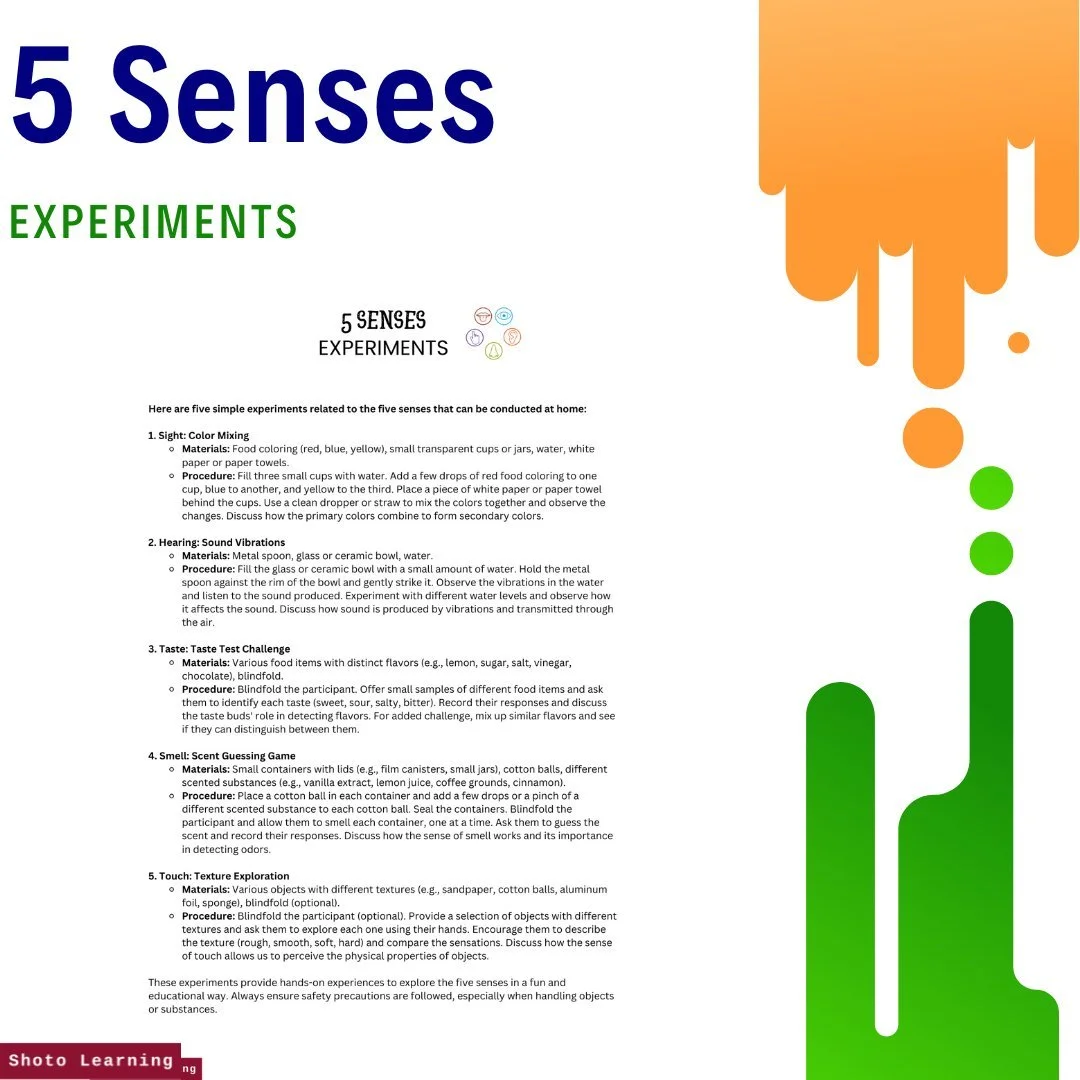
Unleash your curiosity and explore the wonders of the five senses with our "SenseLab Explorer: Home Experiments on the Five Senses" kit. Dive into a world of sensory exploration as you conduct five engaging experiments designed to stimulate your sight, hearing, taste, smell, and touch.
Key Features:
Sight: Color Mixing - Witness the magic of color as you experiment with primary and secondary hues.
Hearing: Sound Vibrations - Discover the science of sound as you observe vibrations in water and listen to their musical notes.
Taste: Taste Test Challenge - Put your taste buds to the test and identify various flavors in a blindfolded taste challenge.
Smell: Scent Guessing Game - Engage your olfactory senses and guess the scents of different aromatic substances.
Touch: Texture Exploration - Explore the tactile world around you and discern the textures of various objects through hands-on exploration.
How to Use It:
Gather Materials: Collect all items listed for each experiment.
Follow Instructions: Perform the experiments using the provided step-by-step directions.
Observe and Record: Document your observations and results.
Discuss Results: Analyze and discuss the findings based on the guide’s explanations.
Perfect for curious minds of all ages, our SenseLab Explorer kit includes all the materials and instructions needed to conduct these exciting experiments safely and effectively at home. Embark on a journey of sensory discovery and uncover the secrets of perception today!
Order your copy today!

Embark on a captivating journey through the realm of the senses with our comprehensive assignment bundle! Designed to deepen understanding and foster curiosity, this collection features 10 thought-provoking assignment questions and detailed answers covering the intricacies of sight, hearing, taste, smell, and touch.
Key Features:
Comprehensive Coverage: Dive into fundamental concepts of the 5 senses with 10 engaging assignments, exploring topics such as sensory anatomy, sensory perception, and sensory integration.
Interactive Learning: Challenge yourself with a diverse range of assignment questions, prompting critical thinking and application of knowledge to real-world scenarios.
Clear Explanations: Access detailed answers to all 10 assignments, providing clear explanations and insights into complex sensory phenomena, facilitating comprehension reinforcement.
Versatile Use: Suitable for classroom use, homeschooling, or individual study, these assignments offer flexible options for educators and learners to integrate into their curriculum or learning routine.
Enhanced Understanding: Gain a deeper appreciation for the intricacies of the senses and their role in shaping our perception of the world, fostering a lifelong curiosity for sensory exploration.
How to Use It:
Review the Assignments: Read through each of the 10 assignments to familiarize yourself with the topics related to the 5 senses.
Complete the Questions: Answer the questions to assess and apply your understanding of sensory perception and its functions.
Check Answers: Use the provided answers to review your responses and clarify any misconceptions.
Discuss and Reflect: Discuss the concepts with peers or reflect on the material to deepen your comprehension.
Apply Knowledge: Relate what you've learned to real-life examples and scenarios involving the 5 senses.
This set of assignments provides a comprehensive approach to understanding the 5 senses, with varied question formats to enhance learning and engagement.
Order your copy today!

Unleash your creativity and embark on a sensory journey with our "Sensory Writing Prompts" collection. This captivating set of 10 prompts is designed to inspire vivid and immersive descriptions of the five senses: taste, smell, sight, hearing, and touch. Immerse yourself in the world of sensory experiences and unlock the power of descriptive writing.
Key Features:
Stimulating Prompts: Delve into 10 carefully crafted writing prompts that will ignite your imagination and engage your senses. Each prompt focuses on a different aspect of the five senses, encouraging you to explore and describe the richness of sensory experiences.
Multisensory Exploration: Experience a diverse range of writing exercises that invite you to vividly capture the taste of flavors, the aroma of scents, the visuals of scenes, the sounds of environments, and the textures of objects. These prompts provide a well-rounded exploration of the senses.
Inspire Descriptive Writing: Develop your descriptive writing skills as you articulate intricate details and create immersive worlds through your words. The prompts provide a creative platform to enhance your ability to convey sensory experiences effectively.
Personal Reflection: The prompts encourage personal reflection, allowing you to draw upon your own memories and experiences to enrich your writing. Unleash your unique perspectives and infuse your words with authenticity and emotion.
Expand Writing Repertoire: Challenge yourself to step out of your comfort zone and explore new genres, styles, and literary techniques. These prompts serve as a springboard for experimentation and growth in your writing journey.
Suitable for All Writers: Whether you're a seasoned writer seeking inspiration, a student looking to sharpen your descriptive skills, or a beginner exploring the art of creative writing, "Sensory Writing Prompts" accommodates writers of all levels and ages.
Versatile Usage: Use these prompts for personal writing exercises, journaling, creative writing workshops, classroom activities, or writing clubs. They are adaptable to various learning environments and can be customized to suit your specific needs.
Transport your readers to captivating sensory landscapes, evoke emotions, and bring your writing to life with our "Sensory Writing Prompts" collection. Unleash your creativity, refine your descriptive prowess, and immerse yourself in the power of sensory language.
Order "Sensory Writing Prompts: Ignite Your Creativity with 10 Captivating Exercises on the Five Senses" today and embark on a writing adventure that will transform your words into vibrant sensory experiences. Let your imagination soar and watch your writing come alive with vivid descriptions and engaging narratives.
Order your copy today!

Take a captivating journey through the wonders of the five senses with our interactive question and answer resource. "Journey Through the Senses" provides a collection of ten engaging and thought-provoking questions designed to test your knowledge and deepen your understanding of taste, smell, sight, hearing, and touch.
Key Features:
Concise and Informative: Dive into the world of the senses with ten carefully crafted questions that cover the essential aspects of each sense. Gain key insights into how our senses work and their significance in our daily lives.
Interactive Learning: Challenge yourself with a series of short questions that encourage active learning and critical thinking. Test your knowledge, recall key facts, and expand your understanding of the senses through this engaging format.
Comprehensive Coverage: Explore various aspects of the five senses, including their functions, related body parts, and their role in perceiving the world around us. Each question is designed to provide a well-rounded understanding of the topic.
Quick and Accessible: Enjoy the convenience of learning on the go with this concise resource. The short questions and answers format allows for quick learning sessions, making it ideal for busy individuals seeking to expand their knowledge in bite-sized portions.
Suitable for All: Whether you're a student eager to explore the intricacies of the senses or an educator searching for engaging learning materials, "Journey Through the Senses" caters to a wide range of learners. It is designed to be accessible and informative for all age groups.
Perfect for Review and Assessment: Utilize this resource as a review tool or assessment resource to gauge your understanding of the five senses. It can be used individually or in a classroom setting to reinforce learning outcomes.
Embark on an educational adventure and deepen your understanding of the captivating world of the five senses. With "Journey Through the Senses," you can expand your knowledge, reinforce key concepts, and appreciate the marvelous ways in which our senses shape our perception of the world.
Don't miss out on this opportunity to enhance your understanding of taste, smell, sight, hearing, and touch. Immerse yourself in the captivating realm of the senses and unlock a new level of appreciation for the wonders of human perception.
Order "Journey Through the Senses" today and embark on a captivating learning experience that will leave you with a profound understanding of the intricate workings of our sensory system.

Introduce your primary school students to an engaging and interactive way of learning about the five senses with "The Sensory Senses" set. This comprehensive product includes two sets of 10 multiple-choice questions, designed to test and reinforce knowledge on taste, smell, sight, hearing, and touch. With this product, students can participate in a fun and educational quiz format, enhancing their understanding of the fascinating world of the senses.
Key Features:
Two Sets of 10 Multiple Choice Questions: Each set contains 10 thoughtfully crafted multiple-choice questions that cover various aspects of the five senses. This provides students with a total of 20 engaging questions to test their knowledge and recall.
Comprehensive Coverage: The questions cover a wide range of topics, including taste, smell, sight, hearing, and touch. They are designed to assess students' understanding of each sense and their interplay in our daily lives.
Answer Key Included: The product comes with a comprehensive answer key, ensuring anaccurate and reliable assessment of students' responses. The answer key allows for quick and easy grading, providing instant feedback to students and educators alike.
Promotes Active Learning: The multiple-choice format encourages active participation, critical thinking, and decision-making skills. Students must carefully consider the options and select the most appropriate answer, stimulating their cognitive abilities.
Engaging and Interactive Learning: "The Sensory Senses" product transforms learning into an exciting experience. The multiple-choice questions are designed to captivate students' attention, making the learning process enjoyable and memorable.
Reinforces Core Concepts: By tackling a variety of multiple-choice questions, students reinforce their understanding of the key concepts related to the five senses. This product acts as a valuable resource for revision, consolidation, or even a fun classroom activity.
"The Sensory Senses" is suitable for primary school students, providing an age-appropriate and accessible means of exploring and evaluating their knowledge of the senses. It can be used in classrooms, homeschooling environments, or as an engaging educational activity for children to enjoy independently.
This product stimulates curiosity, critical thinking, and active learning, fostering a deeper understanding of the senses and their significance in our everyday lives. "The Sensory Senses" helps students develop a solid foundation of knowledge while nurturing a love for scientific exploration.
Invest in "The Sensory Senses" product and watch as your students embark on an exciting journey of discovery, exploring the remarkable world of taste, smell, sight, hearing, and touch through the power of multiple-choice questions. Enhance their learning experience and make their educational journey both insightful and enjoyable.
Order your copy today!

Introduce an engaging and interactive way for students to reinforce their understanding of the 5 senses with our 5 Senses Matching Worksheets set! This comprehensive set includes two worksheets, each containing 10 questions and answers, allowing students to match the correct answers and solidify their knowledge of sight, hearing, taste, touch, and smell.
Product Features:
Educational and Interactive: The matching worksheets provide an interactive activity where students match the correct answer to each question, promoting active learning and engagement.
Comprehensive Content: Each worksheet includes 10 thoughtfully crafted questions that cover various aspects of the 5 senses, ensuring a comprehensive understanding of the topic.
Clear Instructions: The worksheets are accompanied by clear and easy-to-follow instructions, making them suitable for independent work or classroom assignments.
Answer Key Included: An answer key is included with the set, enabling students to self-check their responses and provide immediate feedback.
Suitable for Various Grade Levels: The worksheets are designed to accommodate different grade levels, making them versatile for use in elementary classrooms, homeschooling, or tutoring sessions.
Enhances Vocabulary: The matching activity helps students reinforce their vocabulary and terminology related to the 5 senses, building a solid foundation of subject knowledge.
Printable and Ready to Use: Simply print out the worksheets, and they are ready for immediate use in the classroom, at home, or as part of distance learning activities.
With our 5 Senses Matching Worksheets, students will deepen their understanding of the senses while honing their matching and comprehension skills. This set is an excellent addition to lesson plans, review sessions, or assessment preparation, providing an effective and engaging tool for reinforcing knowledge.
Order the 5 Senses Matching Worksheets (Set of 2) today and provide students with a valuable resource to strengthen their understanding of sight, hearing, taste, touch, and smell. Watch as their confidence and knowledge grow through this interactive and educational activity.
Order your copy today!

Introduce the fascinating world of the 5 senses to young learners with our comprehensive set of 20 flashcards! These engaging flashcards provide a fun and interactive way for children to explore and understand the senses of sight, hearing, taste, touch, and smell.
Product Features:
Educational and Interactive: Each flash card presents a specific concept or term related to the 5 senses, allowing children to learn and interact with the material.
Comprehensive Set: The 20 flash cards cover a wide range of vocabulary and key terms associated with sight, hearing, taste, touch, and smell, ensuring a comprehensive learning experience.
Colorful and Eye-Catching Design: The flash cards feature vibrant and visually appealing illustrations that captivate children's attention and make learning enjoyable.
Clear and Concise Information: Each flash card provides a concise definition or description of the sense or related concept, making it easy for children to understand and remember.
Versatile Learning Tool: Flash cards can be used in various activities, including matching games, memory games, and interactive discussions, promoting active learning and engagement.
Portable and Convenient: The flash cards are compact and lightweight, making them ideal for on-the-go learning, road trips, or classroom transitions.
Suitable for Various Ages: The flash cards are designed to cater to different learning levels, making them suitable for preschoolers, kindergarteners, and early elementary students.
With our 5 Senses Flash Cards, children will develop a solid foundation of knowledge about the senses while expanding their vocabulary and cognitive skills. These flash cards are a valuable resource for educators, parents, and homeschoolers, aiding in the exploration of the sensory world and promoting curiosity and understanding.
Order the 5 Senses Flash Cards today and embark on an interactive journey of sensory discovery. Watch as children's excitement and knowledge grow, as they explore the wonders of sight, hearing, taste, touch, and smell in a captivating and educational way.

5 Senses Debate Questions and Answers Set for Primary School Students
Promote critical thinking, communication skills, and lively classroom discussions with our 5 Senses Debate Questions and Answers Set designed specifically for primary school students. This comprehensive set includes ten carefully crafted debate questions and corresponding answers, focusing on the fascinating topic of the 5 senses.
Product Features:
Engaging and Interactive: The debate questions and answers set encourages students to actively participate in thought-provoking discussions, fostering their critical thinking and communication skills.
Age-Appropriate Content: The questions are tailored to suit primary school students, ensuring that the topics are accessible and engaging for their level of understanding.
Comprehensive Coverage: The set covers a wide range of aspects related to the 5 senses, allowing students to explore various perspectives and delve deeper into the subject matter.
Balanced Arguments: Each question is accompanied by a well-crafted answer that presents different viewpoints, encouraging students to consider different opinions and develop their own informed responses.
Clear and Concise Language: The debate questions and answers are written in clear and accessible language, making them easy for students to comprehend and engage with.
Promotes Classroom Discussions: The set is designed to spark lively debates within the classroom, creating an inclusive and stimulating learning environment.
Teacher-Friendly Resource: The set provides teachers with a valuable resource to initiate and guide meaningful discussions, saving time in lesson preparation.
Encourages Respectful Dialogue: The debate questions and answers promote respectful communication and active listening skills, fostering a positive classroom atmosphere.
With our 5 Senses Debate Questions and Answers Set, primary school students will develop critical thinking skills, enhance their ability to articulate opinions and deepen their understanding of the 5 senses. This set is an excellent addition to classroom activities, language arts lessons, or social studies discussions, providing a valuable tool for intellectual engagement and personal growth.
Order the 5 Senses Debate Questions and Answers Set today and empower your primary school students to think critically, express their viewpoints, and engage in respectful debates. Witness their confidence and communication skills flourish as they explore the fascinating world of the 5 senses through meaningful classroom discussions.
Includes
10 debate questions and answers
Order your copy today!

Engage and educate a large group of players with our exciting 5 Senses Bingo Game! Designed for up to 24 participants, this interactive and educational game offers a fun way to reinforce understanding of the five senses while fostering social interaction and friendly competition.
Product Features:
Engaging Gameplay: 5 Senses Bingo brings a classic game to life with a sensory twist. Players will enjoy matching words related to sight, hearing, taste, touch, and smell on their bingo cards.
Large Group Fun: With enough cards for up to 24 players, this game is perfect for classrooms, parties, or any gathering where kids can learn and play together.
Educational Value: While having a blast, players will enhance their vocabulary and reinforce their knowledge of the five senses.
Colorful and Attractive Design: The bingo cards and calling cards are visually appealing, featuring vibrant illustrations that capture the essence of each sense.
Varied Word Selection: The game includes 20 different words associated with the five senses, providing a well-rounded learning experience.
Easy to Play: The game is designed for simplicity, allowing players of all ages to quickly grasp the rules and participate.
Teacher and Parent Friendly: The game comes with a convenient caller's sheet and a set of calling cards, making it easy for instructors and parents to facilitate the game.
Portable and Durable: The game set is compact and durable, allowing for easy transportation and storage, ensuring long-lasting use.
Playing 5 Senses Bingo not only sharpens cognitive skills but also promotes social interaction and teamwork. It's an excellent addition to classroom activities, birthday parties, or any event where children can learn while having fun.
Order the 5 Senses Bingo Game today and watch as the excitement of the game enhances children's understanding of the five senses in a lively and entertaining way.
Includes
20 Keywords and instructions
24 Bingo cards
Order your copy today!

Product Description: 5 Senses Crossword Puzzle
Introduce young learners to the fascinating world of the 5 senses with our engaging and educational 5 Senses Crossword Puzzle! This puzzle is designed specifically for primary school students, offering a fun and interactive way to reinforce their understanding of sight, hearing, taste, touch, and smell.
Product Features:
Educational and Engaging: The crossword puzzle is an excellent tool for reinforcing knowledge of the 5 senses while keeping students entertained.
Age-Appropriate: Tailored for primary school students, the puzzle's clues and vocabulary are suitable for their grade level, ensuring an optimal learning experience.
Two Versions: The puzzle comes in two variations to cater to different learning needs. One version includes a word bank to assist students in finding the correct answers, while the other provides a more challenging experience without a word bank.
Comprehensive Clues: The clues in the crossword puzzle cover various aspects of the 5 senses, including organs, functions, and associated terms, enabling students to deepen their understanding.
Answer Key Included: An answer key is included, allowing teachers, parents, or students to check their answers and promote self-assessment.
Whether used as an in-class activity, homework assignment, or educational game, the 5 Senses Crossword Puzzle provides an interactive and enjoyable learning experience. It encourages critical thinking, enhances vocabulary, and reinforces the core concepts of the 5 senses.
Help your students explore the wonders of the 5 senses with this captivating crossword puzzle. It's a valuable addition to any primary school curriculum, promoting knowledge retention and fostering a deeper appreciation for the incredible capabilities of our bodies.
Order the 5 Senses Crossword Puzzle today and watch your students' understanding of the 5 senses come alive!
Includes
1 x Crossword with word bank
1 x Crossword without word bank
Answers included
Order your copy today!

Unleash your detective skills and crack the code with our captivating 5 Senses Cryptogram Puzzle! This engaging and educational game challenges players with three different key types: number-to-letter, letter-to-letter, and symbol-to-letter. Delve into the world of secret messages while uncovering the fascinating phrase: "Explore the world through your senses: sight, sound, taste, touch, and smell."
Product Features:
Intriguing Cryptogram Puzzle: Exercise your problem-solving abilities as you decipher the encrypted message related to the five senses.
Three Key Types: Enjoy a variety of challenges with number-to-letter, letter-to-letter, and symbol-to-letter key types, providing a diverse and stimulating gameplay experience.
Educational and Engaging: Learn about the five senses while honing critical thinking skills and decoding techniques.
Compelling Secret Phrase: Uncover the captivating phrase "Explore the world through your senses: sight, sound, taste, touch, and smell" as you progress through the puzzle.
Brain Teaser for All Ages: Whether you're a student, educator, or puzzle enthusiast, the 5 Senses Cryptogram Puzzle offers an exciting and accessible challenge for everyone.
High-Quality Design: The puzzle features a visually appealing layout, clear instructions, and carefully crafted cryptogram clues, ensuring an immersive and enjoyable experience.
Portable and Convenient: Take the puzzle with you anywhere, and enjoy decoding the cryptogram during travel, breaks, or leisure time.
Ideal Gift: The 5 Senses Cryptogram Puzzle makes a thoughtful gift for puzzle lovers, educators, or anyone seeking a mental challenge.
Unravel the secrets of the five senses with our captivating Cryptogram Puzzle. It provides an enriching and entertaining experience while expanding your knowledge of sight, sound, taste, touch, and smell. Challenge yourself, engage your mind, and unlock the mysteries hidden within the encrypted message.
Order the 5 Senses Cryptogram Puzzle today and embark on an exciting journey of code-breaking and sensory exploration.

Product Description: "Exploring the 5 Senses - Fun Science Experiment Kit for Primary School Students"
Introduce your young learners to the fascinating world of the five senses with our "Exploring the 5 Senses" science experiment kit. Designed specifically for primary school students, this comprehensive kit offers 10 exciting experiments that engage children in hands-on activities to deepen their understanding of taste, smell, sight, hearing, and touch. Each experiment is carefully crafted to be educational, interactive, and most importantly, fun!
With our science experiment kit, students will embark on a sensory adventure, delving into the complexities of their senses through a series of captivating experiments.
Let's take a closer look at what's included:
"Taste Test Challenge": Engage taste buds in a blindfolded taste test to explore flavors and understand how taste works.
"Smell and Memory": Investigate the powerful connection between scents and memories, triggering a nostalgic journey of the mind.
"Sight and Illusions": Dive into the captivating world of optical illusions, discovering how our eyes can sometimes deceive us.
"Hearing and Sound Vibration": Unveil the mysteries of sound by observing water ripples created by vibrating tuning forks.
"Touch and Texture": Explore the sense of touch by examining different materials and describing their unique textures.
"Taste and Temperature": Investigate how temperature affects our sense of taste, uncovering the hidden influence of hot and cold sensations.
"Smell and Taste Connection": Discover how our sense of smell and taste work together to enhance our sensory experience with food.
"Sight and Color Perception": Unlock the world of colors, arranging color cards and exploring the perception of different shades and hues.
"Hearing and Pitch": Engage in musical exploration, discerning high and low pitches and understanding the role of frequency.
"Touch and Pressure": Investigate the sense of touch through objects with varying textures and firmness levels, exploring the concept of pressure.
Each experiment comes with a detailed instruction manual, guiding both students and educators through the scientific process. The materials and ingredients required for the experiments are included in the kit, ensuring convenience and ease of use. The experiments are designed to align with primary school curriculum standards, making them a valuable addition to science lessons.
By engaging in these experiments, students will develop essential skills such as observation, critical thinking, and teamwork. They will gain a deeper understanding of their own senses and how they contribute to their perception of the world around them.
"Exploring the 5 Senses" science experiment kit is not only an educational tool but also a source of excitement and wonder. It encourages young learners to explore the wonders of science in a hands-on and interactive manner, fostering a love for scientific inquiry from an early age.
Ignite the curiosity of your primary school students and help them discover the extraordinary world of their senses with our "Exploring the 5 Senses" science experiment kit. Prepare for a sensory adventure that will leave a lasting impact on their scientific journey.
Order your copy today!
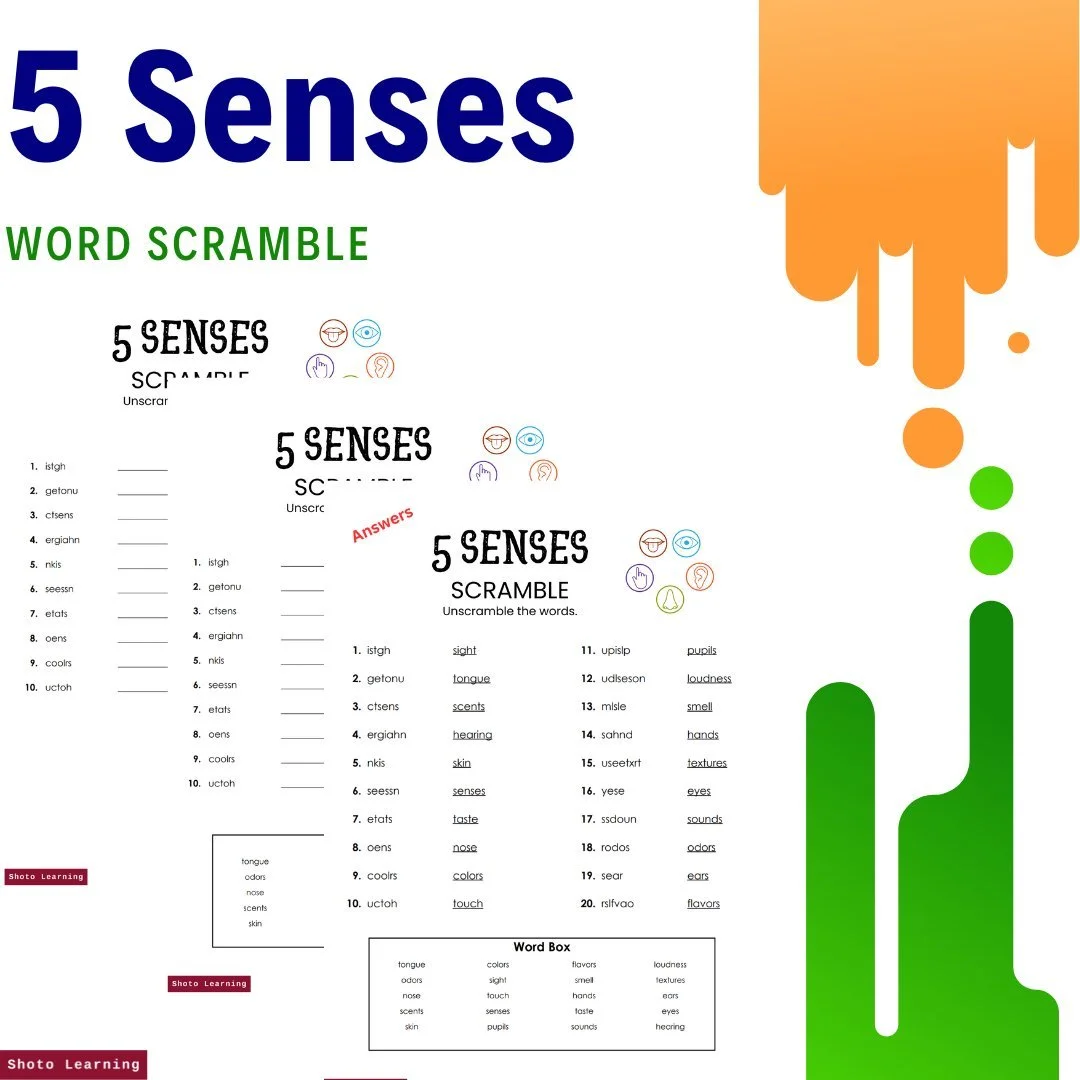
Enhance vocabulary retention and critical thinking skills with our engaging 5 Senses Word Scramble Game! This educational game offers two variations, one with a word box and one without, allowing players to test their knowledge and unscrambling abilities related to the five senses.
Product Features:
Educational and Challenging: The 5 Senses Word Scramble Game is designed to stimulate critical thinking and enhance vocabulary while focusing on the five senses.
Two Variations: Choose between two versions of the game based on the difficulty level. The version with the word box provides a helpful reference, while the version without the word box offers a more challenging experience.
Comprehensive Word Selection: The game includes a diverse range of words associated with sight, hearing, taste, touch, and smell, ensuring a comprehensive learning experience.
Promotes Cognitive Skills: Players will exercise their problem-solving abilities as they unscramble jumbled words and connect them to the correct senses.
Attractive Design: The game features an appealing and visually engaging layout, making it enjoyable to play while reinforcing the concept of the five senses.
Flexible Usage: The 5 Senses Word Scramble Game is suitable for various settings, including classrooms, homeschooling, tutoring sessions, and family game nights.
Teacher and Parent Friendly: The game includes an answer key, making it easy for teachers and parents to check the correctness of the unscrambled words.
Compact and Portable: The game can be easily carried and played anywhere, making it ideal for travel or on-the-go learning.
Playing the 5 Senses Word Scramble Game challenges players to unscramble words associated with each sense, reinforcing their understanding of the topic while having fun. It's an excellent tool for individual practice or interactive group learning sessions.
Order the 5 Senses Word Scramble Game today and witness the excitement and growth as players unscramble their way to a stronger grasp of the five senses. Whether with or without the word box, this game is sure to engage and educate learners of all ages.
Order your copy today!

5 Senses Missing Letter Worksheets (Set of 2)
Enhance students' spelling and vocabulary skills while exploring the fascinating world of the 5 senses with our 5 Senses Missing Letter Worksheets set! This comprehensive set includes two worksheets that challenge students to fill in the missing letters in words related to sight, hearing, taste, touch, and smell.
Product Features:
Engaging and Educational: The Missing Letter Worksheets provide a fun and interactive way for students to practice spelling and reinforce their understanding of the 5 senses.
Two Worksheet Options: The set includes two worksheets with different levels of difficulty. One worksheet features words with a single missing letter, while the other presents words with multiple missing letters.
Hint Word Box: For additional support, an optional hint word box is included on each worksheet, providing students with a reference to guide them in finding the missing letters.
Comprehensive Vocabulary: The worksheets include a variety of words associated with each of the five senses, allowing students to expand their vocabulary while practicing spelling.
Answer Key Included: An answer key is provided for each worksheet, enabling students to self-check their answers and receive immediate feedback.
Clear Instructions: The worksheets are accompanied by clear instructions, making them suitable for independent work, homework assignments, or classroom activities.
Printable and Ready to Use: Simply print out the worksheets, and they are ready for immediate use in the classroom, at home, or as part of distance learning activities.
Suitable for Various Grade Levels: The worksheets are designed to cater to different grade levels, making them adaptable for elementary classrooms, homeschooling, or tutoring sessions.
With our 5 Senses Missing Letter Worksheets, students will sharpen their spelling skills, reinforce their vocabulary, and deepen their understanding of the 5 senses. This set is a valuable resource for teachers, parents, and homeschoolers, providing an effective tool for vocabulary development and language reinforcement.
Order the 5 Senses Missing Letter Worksheets (Set of 2) today and provide students with an engaging and educational activity that combines spelling practice with the exploration of sight, hearing, taste, touch, and smell. Watch as their spelling accuracy and word recognition skills improve, fostering their overall language proficiency.
Order your copy today!

Engage young learners in an interactive and educational exploration of the 5 senses with our captivating Fill in the Blanks Activity Set! This comprehensive set includes 20 fill in the blank statements that will test children's knowledge and understanding of the senses of sight, hearing, taste, touch, and smell.
Product Features:
Educational and Engaging: The fill in the blanks activity set presents 20 statements related to the 5 senses, challenging children to complete the missing words and reinforce their understanding.
Comprehensive Learning: The activity set covers a wide range of concepts and vocabulary associated with each of the five senses, ensuring a thorough learning experience.
Critical Thinking Development: Children will exercise their critical thinking skills as they carefully consider the context of each statement to choose the correct missing word.
Interactive and Interactive: The fill in the blanks format encourages active participation and engagement, making learning enjoyable and memorable.
Clear Instructions: Each activity card provides clear instructions, making it easy for children to follow along and complete the statements accurately.
Colorful and Visually Appealing: The activity cards feature vibrant illustrations and eye-catching designs, capturing children's attention and enhancing the learning experience.
Answer Key Included: An answer key is included in the set, allowing children to self-check their responses and providing immediate feedback.
Suitable for Individual or Group Use: The activity set can be used individually, in pairs, or in small groups, making it suitable for classroom settings, homeschooling, or independent learning.
With our 5 Senses Fill in the Blanks Activity Set, children will deepen their understanding of the senses and expand their vocabulary while honing their critical thinking skills. This set is an excellent addition to classroom activities, homework assignments, or homeschooling curricula, providing a valuable tool for reinforcing knowledge and promoting active learning.
Order the 5 Senses Fill in the Blanks Activity Set today and watch as children's confidence and comprehension of the senses grow. It's a fun and effective way to engage young learners in the exploration of sight, hearing, taste, touch, and smell while fostering their cognitive development.
Order your copy today!

Enhance your understanding of the fascinating world of the five senses with our "Sensory Master" worksheet collection. This set of 20 true or false worksheets provides an engaging and interactive way to test your knowledge and reinforce your comprehension of taste, smell, sight, hearing, and touch.
Key Features:
Comprehensive Coverage: Immerse yourself in a wide range of true or false questions that delve into the intricacies of the five senses. From basic concepts to advanced insights, these worksheets cover various aspects of sensory perception.
Interactive Learning: Challenge yourself with a series of true or false statements that require careful consideration. Engage in critical thinking, recall key facts, and expand your understanding of the senses through this interactive format.
Varied Topics: Explore different facets of the senses, including their functions, anatomical structures, related phenomena, and their significance in our daily lives. Each worksheet is thoughtfully crafted to provide a well-rounded assessment of your knowledge.
Clear and Concise Format: Benefit from a user-friendly layout that presents each true or false statement clearly. With ample space for your answers, you can easily mark whether each statement is true or false.
Answer Key Included: Access the included answer key to review your responses and identify areas for improvement. This valuable resource allows for self-assessment, promoting independent learning and self-correction.
Versatile Usage: Whether you're a student looking to reinforce your understanding, an educator seeking assessment materials, or an avid learner interested in expanding your knowledge, "Sensory Master" accommodates learners of all ages and backgrounds.
Perfect for Individual or Classroom Use: Utilize these worksheets for independent study, homework assignments, group activities, or in-class assessments. "Sensory Master" offers flexibility in incorporating the worksheets into your learning environment.
Immerse yourself in an educational journey that explores the intricacies of taste, smell, sight, hearing, and touch. With "Sensory Master," you can engage with thought-provoking true or false statements and refine your understanding of the remarkable world of the senses.
Don't miss out on this opportunity to expand your knowledge and deepen your appreciation for the ways in which our senses shape our perception of the world. Order "Sensory Master: 20 True or False Worksheet on the 5 Senses" today and embark on an enriching learning experience that will leave you with a profound understanding of our sensory abilities.
Order your copy today!

Introduce young learners to the fascinating world of the 5 senses with our interactive and engaging 5 Senses Word Search puzzle! This word search is specifically designed for primary school students, offering a fun and educational activity that reinforces their understanding of sight, hearing, taste, touch, and smell.
Product Features:
Educational and Entertaining: The word search puzzle provides an enjoyable way for students to reinforce their knowledge of the 5 senses while having fun.
Age-Appropriate: Tailored for primary school students, the puzzle's vocabulary and difficulty level are suitable for their grade, ensuring an optimal learning experience.
20 Engaging Keywords: The puzzle includes 20 carefully selected keywords related to the 5 senses, offering a comprehensive exploration of the topic.
Clear and Concise Layout: The word search puzzle is thoughtfully designed with a clean and easy-to-read grid, ensuring a seamless experience for young learners.
Answer Key Included: An answer key is provided, allowing teachers, parents, or students to check their answers and promote self-assessment.
Whether used as a classroom activity, homework assignment, or brain-teasing game, the 5 Senses Word Search puzzle provides a valuable opportunity for students to reinforce their knowledge and vocabulary related to the 5 senses.
Encourage critical thinking, enhance vocabulary, and deepen understanding as students search for words associated with sight, hearing, taste, touch, and smell. The word search puzzle not only helps students build important skills but also nurtures their curiosity about the amazing abilities of the human body.
Order the 5 Senses Word Search today and watch as your students enjoy the thrill of finding and recognizing words while expanding their understanding of the 5 senses. It's an ideal addition to any primary school curriculum, fostering a love for learning and the exploration of our senses.
Unlock the world of the 5 senses with this captivating word search puzzle and empower your students with knowledge that will stay with them for a lifetime.
Order your copy today!
Embark on an exciting journey of sensory discovery with our "Sensory Exploration Bundle." This comprehensive collection offers a myriad of activities designed to engage learners of all ages and learning styles.
Key Features:
Diverse Activities: Enjoy a variety of engaging activities, including bingo, crossword puzzles, cryptograms, debates, fill-in-the-blank exercises, flashcards, and more.
Comprehensive Lesson Plans: Access meticulously crafted lesson plans to guide educators through each sensory exploration session, ensuring comprehensive coverage and effective learning outcomes.
Interactive Learning Tools: From matching games to missing letter puzzles, our bundle includes interactive tools that enhance retention and critical thinking skills.
Assessment Resources: Evaluate understanding with multiple-choice tests, true-or-false quizzes, and other assessment materials designed to gauge comprehension and progress.
Visual Aids: Enrich presentations and discussions with captivating PowerPoint slides, providing visual reinforcement of sensory concepts and stimulating discussion.
Creative Expression: Foster creativity with word scrambles, word searches, writing prompts, and other activities that encourage imaginative exploration of sensory experiences.
Bonus Materials: Enjoy complimentary ABC order worksheets and additional resources to supplement learning and extend the educational experience.
Whether you're a teacher looking to invigorate your lesson plans or a student eager to delve into the world of sensory perception, our "Sensory Exploration Bundle" offers a comprehensive and engaging resource for unlocking the mysteries of the five senses.
159 pages
Don't miss out, order yours today!