
Understanding Living and Nonliving Things: A Guide for Early Science Education
Introduction
Teaching children about living and nonliving things is a crucial aspect of early science education. Understanding the characteristics of living organisms and how they differ from nonliving objects fosters curiosity and appreciation for the natural world. In this guide, we’ll explore effective methods to teach this foundational concept to young learners.
1. Start with an Engaging Discussion
Kick off your lesson by encouraging children to identify various objects in the classroom or outdoors. Ask them to determine whether these objects are living or nonliving. Prompt them to think critically about the characteristics of living things, such as:
The ability to move
Growth
Reproduction
2. Utilize Visual Aids
Visual aids play a significant role in enhancing comprehension. Incorporate pictures, diagrams, and videos to illustrate the differences between living and nonliving things. Show children images of animals, plants, and everyday objects, encouraging them to classify each as living or nonliving.
3. Conduct Simple Experiments
Hands-on experiments are an excellent way to demonstrate the differences between living and nonliving things. Here are a few ideas:
Plant Seeds: Have children plant seeds and observe their growth over time.
Observe Movements: Compare the movements of living organisms, such as insects and birds, with nonliving objects like rocks and buildings.
4. Go on a Nature Walk
A nature walk is a fantastic opportunity for children to explore their environment. Ask them to identify living and nonliving things they encounter. Encourage them to observe the behaviors of living organisms and how they interact with their surroundings.
5. Sort Objects for Better Understanding
Provide a collection of various objects and challenge children to sort them into living and nonliving categories. This activity can be turned into a fun sorting game or a collaborative charting project.
6. Read Educational Books
Reading books that focus on living and nonliving things can reinforce learning. Choose titles with clear illustrations and simple language, such as "Living and Nonliving" by Rebecca Rissman. Reading aloud not only engages children but also enhances their comprehension.
7. Incorporate Fun Games
Make learning enjoyable by incorporating games that focus on identifying living and nonliving objects. For example, play a game of "I Spy" where children find and categorize items in the room based on their characteristics.
8. Leverage Technology
Utilize online resources such as educational videos and interactive games to teach about living and nonliving things. Websites like BBC Bitesize offer a variety of free educational materials to support your teaching efforts.
Conclusion
By employing a mix of discussions, visual aids, hands-on experiments, nature walks, sorting activities, reading, games, and technology, you can effectively teach children about living and nonliving things. This understanding not only builds a strong foundation for future science education but also nurtures a lifelong appreciation for the natural world.

This “Living and Nonliving Science Activity - Bundle Word Find and Scramble Words Game” is the perfect way to teach kids about the differences between living and nonliving things. It comes with a variety of materials designed to engage kids in a fun and interactive learning experience. The bundle includes word search puzzles, lively science-related clipart images, and vivid word scramble activities. With this bundle, kids can practice recognizing living and nonliving things, learn about their characteristics, and review the definitions of both, making it an invaluable teaching tool. Not only will kids have a great time completing the activities, but they will also be reinforcing their understanding of living and nonliving things. So order the “Living and Nonliving Science Activity - Bundle Word Find and Scramble Words Game” today and watch your kids learn, explore, and have fun with science!
LIVING AND NON-LIVING - WORD FIND & UNSCRAMBLE WORDS
Worksheet for a Science Game featuring living and non-living science words. To find the 32 hidden words and unscramble them.
An excellent resource for early finishers or as a take-home game when teaching a living and nonliving unit.
The vocabulary words covered include:
Air, Alive, Animal, Birds, Cells, Change, Cloud, Energy, Food, Grow, Growth, Human, Light, Living, Mammals, Marine, Movement, Natural, Nonliving, Nutrient, Oxygen, Plant, Reproduce, Reptile, Seed, Shelter, Space, Sun, Tree, Warmth, Waste, Water.
Solution included.
Let’s be friends!
Blog ★ Pinterest ★ Facebook ★ Instagram ★ YouTube
Happy teaching!

Teach your students the difference between living and nonliving things with this interactive word search game. Find words related to living and nonliving things, like plants, animals, rocks, and weather. This activity is perfect for any grade level and will captivate your students' minds. With this game, your students will learn key scientific terms and increase their knowledge of living and nonliving things.
LIVING AND NON-LIVING - WORD FIND GAME PUZZLE WORKSHEET - Word search of various living and non-living vocabulary words. Puzzlers must look in all directions, including backward and diagonally, to find the 30 hidden words.
When teaching a unit on living and nonliving things, this is a good resource for early finishers or as a take-home game.
The vocabulary words that are covered are:
Air, Alive, Animals, Carnivore, Change, Cloud, Cycle, Energy, Food, Grows, Growth, Habitat, Humans, Light, Living, Mammals, Move, Movement, Nature, Nonliving, Plants, Reproduce, Reptiles, Shelter, Space, Sun, Trees, Warmth, Waste, Water
Solution included.
Let’s be friends!
Blog ★ Pinterest ★ Facebook ★ Instagram ★ YouTube
Happy teaching!

Are you looking for an exciting and interactive way to learn and review the basics of living and nonliving science? Look no further than this Living and Nonliving Science Activity Scramble Words Unscramble Vocabulary Word game! Put your knowledge to the test as you unscramble the word clues and unlock the mystery of the living and nonliving world! With fun and exciting puzzles and tasks to solve, this game is sure to sharpen your science skills while keeping you engaged and entertained.
UNSCRAMBLE WORDS: LIVING AND NON-LIVING
Science Game Puzzle Worksheet - with living and non-living science words. To find the 32 hidden and scrambled words.
A good resource for early finishers or as a take-home game when teaching a unit on matter.
The vocabulary words that are covered are:
Air, Alive, Animal, Birds, Cells, Change, Cloud, Energy, Food, Grow, Growth, Human, Light, Living, Mammals, Marine, Movement, Natural, Nonliving, Nutrient, Oxygen, Plant, Reproduce, Reptile, Seed, Shelter, Space, Sun, Tree, Warmth, Waste, Water.
Solution included.
Let’s be friends!
Blog ★ Pinterest ★ Facebook ★ Instagram ★ YouTube
Happy teaching!

This Living and Non-Living Science Activity - Bundle Word Find and Scramble Words Game" is the perfect way to help kids learn the differences between living and non-living things. With this bundle, students will get to use their problem solving and reasoning skills to find the right words as they traverse a word find grid while also unscrambling each word to test their knowledge of the topic. This activity is a great way to engage kids of all ages, as it helps them to gain a better understanding of living and non-living things. In addition, it can help them develop their research and deductive skills, as well as build their confidence in problem solving. With all of these advantages, this Living and Non-Living Science Activity is sure to improve any student’s knowledge and understanding of this topic.
LIVING AND NON-LIVING - WORD FIND & UNSCRAMBLE WORDS
Worksheet for a Science Game featuring living and non-living science words. To find the 32 hidden words and unscramble them.
An excellent resource for early finishers or as a take-home game when teaching a Living and Non-Living unit.
The vocabulary words covered include:
Air, Alive, Animal, Birds, Cells, Change, Cloud, Energy, Food, Grow, Growth, Human, Light, Living, Mammals, Marine, Movement, Natural, Nonliving, Nutrient, Oxygen, Plant, Reproduce, Reptile, Seed, Shelter, Space, Sun, Tree, Warmth, Waste, Water.
Solution included.
Let’s be friends!
Blog ★ Pinterest ★ Facebook ★ Instagram ★ YouTube
Happy teaching!

LIVING AND NON-LIVING - WORD FIND
Game Puzzle Worksheet - featuring word search of different living and nonliving vocabulary words. To find the 32 hidden words, puzzlers must look in all directions, including backward and diagonally.
A good resource for early finishers or as a take-home game when teaching a unit on living and nonliving.
The vocabulary words that are covered are:
Air, Alive, Animal, Birds, Cells, Change, Cloud, Energy, Food, Grow, Growth, Human, Light, Living, Mammals, Marine, Movement, Natural, Nonliving, Nutrient, Oxygen, Plant, Reproduce, Reptile, Seed, Shelter, Space, Sun, Tree, Warmth, Waste, Water
Solution included.
Let’s be friends!
Blog ★ Pinterest ★ Facebook ★ Instagram ★ YouTube
Happy teaching!
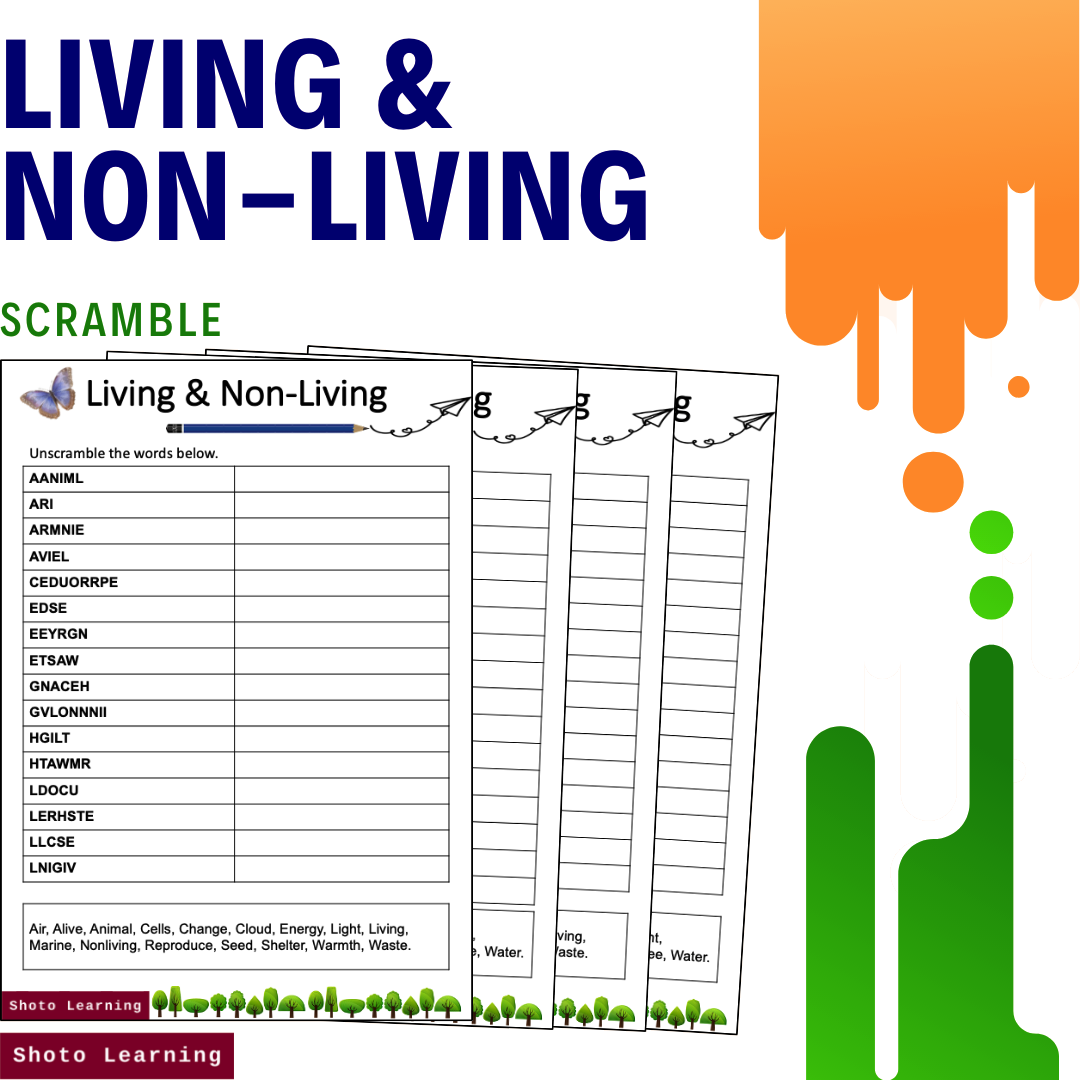
Are you ready to have your science knowledge tested? In this activity, unscramble the words to find the vocabulary needed to describe living and nonliving things. You will have to think critically and use your knowledge to put the words in the correct order. Let the word scramble begin!
UNSCRAMBLE THE WORDS "LIVING AND NON-LIVING"
Unscramble words allows students to re-arrange or unjumble scrambled letters to form a meaningful word. By rearranging letters, this game will assist students in learning to spell.
32 Words included:
Air, Alive, Animal, Birds, Cells, Change, Cloud, Energy, Food, Grow, Growth, Human, Light, Living, Mammals, Marine, Movement, Natural, Nonliving, Nutrient, Oxygen, Plant, Reproduce, Reptile, Seed, Shelter, Space, Sun, Tree, Warmth, Waste, Water.
Solution included.
* Other puzzles are also available in the store.
Let’s be friends!
Blog ★ Pinterest ★ Facebook ★ Instagram ★ YouTube
Happy teaching!