
Understanding States of Matter: A Fun Guide for Young Learners
Teaching the states of matter to young children can be an enjoyable and interactive experience. By incorporating hands-on activities and engaging experiments, educators can help students grasp the essential properties of solids, liquids, and gases. In this blog, we’ll explore effective strategies to teach the concept of states of matter in an age-appropriate manner.
What Are the States of Matter?
Start by introducing the three states of matter: solid, liquid, and gas. Explain that everything in our world can be classified into one of these categories. Use relatable examples such as a pencil (solid), water (liquid), and air (gas) to illustrate these concepts.
Engaging Experiments to Demonstrate States of Matter
Conduct simple experiments to showcase the properties of each state:
Solid to Liquid: Freeze water in a plastic bag to demonstrate how liquids can turn into solids.
Gas in Action: Inflate a balloon to show how gas occupies space.
These hands-on experiments allow students to see the states of matter in action and encourage curiosity.
Visual Aids for Better Understanding
Utilize visual aids to reinforce the learning of states of matter. Create informative posters or charts that highlight the properties of solids, liquids, and gases. Incorporate pictures or videos that illustrate these states in real-world scenarios.
Fun Games to Reinforce Learning
Incorporate games that make learning about states of matter enjoyable:
Jump to the State: Play a game where students jump to the corresponding state of matter when called out (e.g., “solid!”).
Memory Match: Use a memory game to match images of solids, liquids, and gases.
Games not only make learning fun but also enhance retention of the material.
Sensory Activities for Hands-On Learning
Conduct sensory activities that allow students to physically experience different states of matter:
Touch and Describe: Provide students with ice (solid), water (liquid), and steam (gas) and have them describe the textures and temperatures.
These activities engage multiple senses, making the learning process more memorable.
Recommended Reading on States of Matter
Incorporate literature into your lessons by reading books focused on states of matter. Recommended titles include:
“What Is the World Made Of?” by Kathleen Weidner Zoehfeld
“Matter: See It, Touch It, Taste It, Smell It” by Darlene R. Stille
Reading enriches understanding and provides additional context to the concepts being taught.
Real-World Applications of States of Matter
Discuss how the states of matter apply to everyday life. Explain processes like:
Evaporation: How water changes from a liquid to a gas.
Melting: How solid ice transforms into liquid water.
Connecting concepts to real-world examples fosters a deeper understanding.
Encourage Creative Exploration
Invite students to create models or diagrams illustrating the different states of matter. This creative expression allows them to demonstrate their understanding and solidifies their learning.
Conclusion
Teaching the states of matter can be an engaging and interactive experience for young learners. By using hands-on activities, visual aids, games, and real-world applications, educators can help students develop a comprehensive understanding of solids, liquids, and gases. Implement these strategies to make mastering the concept of states of matter both fun and effective!

Uncover the mysteries of the physical world with our all-inclusive States of Matter Worksheet Bundle. Bursting with an array of engaging and effective learning resources, this comprehensive collection is your ultimate guide to mastering the intricacies of gas, solid, liquid, and plasma states of matter.
Key Features:
Dynamic Learning Tools: Immerse yourself in a diverse range of interactive resources, including thought-provoking Debates, insightful Fill in the Blank exercises, captivating Mazes, captivating Posters, stimulating Matching activities, challenging Multiple-Choice questions, enlightening Questions and Answers, comprehensive 45-minute Test, engaging True or False assessments, and inspiring Writing Prompts.
Visual Enrichment: Reinforce your understanding with visually appealing Free Posters and Maze, designed to make complex concepts accessible and memorable.
Assessment and Evaluation: Put your knowledge to the test with Assignments, Multiple-Choice questions, Reading Comprehension, True or False assessments, and a comprehensive 45-minute Test, ensuring you're well-prepared to showcase your expertise.
Critical Thinking: Engage in stimulating Debates and thought-provoking Writing Prompts, encouraging you to delve deeper into the world of states of matter and enhance your critical thinking skills.
Flexibility and Adaptability: Whether you're a student seeking varied study aids or an educator looking to enrich your lessons, this bundle offers versatile resources tailored to different learning styles.
Why Choose Our Worksheet Bundle:
Comprehensive Learning: The inclusion of a wide range of activities ensures a holistic understanding of states of matter, catering to learners of all levels.
Interactive Engagement: Experience active learning through interactive activities, allowing you to absorb knowledge engagingly and enjoyably.
Educator and Student Friendly: Ideal for both classroom instruction and independent study, this bundle equips educators with diverse teaching tools and empowers students with a variety of effective resources.
Enhanced Mastery: The combination of interactive exercises, assessments, and prompts fosters a deep and lasting mastery of the subject matter.
Unleash your curiosity, expand your understanding, and elevate your grasp of states of matter with our all-encompassing Worksheet Bundle. Dive into a world of interactive learning, exploration, and empowerment, and embark on a transformative journey of discovery today!
View on Youtube
80 pages
Order your copy today and start learning!
Grade 4 Science – State of Matter Printable Worksheet Bundle
Make teaching States of Matter fun and stress-free with this engaging Grade 4 science bundle. This comprehensive resource covers solids, liquids, and gases through interactive worksheets, games, assessments, and visuals. Perfect for classroom and homeschool settings!
Key Features:
Covers core science topic: States of Matter (solids, liquids, gases)
Suitable for Grade 4 (can also support Grades 3–5)
Supports curriculum standards and reinforces key concepts
Includes printable and digital-ready formats
What’s Included:
Bingo Game – Reinforce terms and concepts through play
Crossword Puzzle – Fun vocabulary reinforcement
Cryptogram – Challenge students with science riddles
Lesson Plan – Structured teaching guide for easy prep
Matching Activity – Pair terms with definitions
Missing Letters – Boost vocabulary recognition
PowerPoint Presentation – Visual aid for lesson delivery
Reading Comprehension – Practice reading and content recall
Word Scramble – Engage with science terms in a fun way
Test – Assess student understanding
True or False Worksheet – Critical thinking check
Word Search – Familiarize with vocabulary in a fun format
🎁 BONUS Freebies:
ABC Order Worksheet
Maze Activity
Colorful Poster for classroom display or student reference
How to Use:
Use the PowerPoint to introduce or review the topic
Start lessons with the reading comprehension and follow up with matching or vocabulary games
Reinforce learning with bingo, word searches, and scrambles
Finish with the test or true/false worksheet for quick assessment
Display the poster in your science corner for ongoing reference
Assign the freebies as early finisher activities or homework
Why Teachers Love It:
✔ Saves lesson planning time
✔ Engages students with variety and interactivity
✔ Ready to print and use immediately
✔ Perfect for review, practice, or sub plans

Embark on an exhilarating journey through the captivating world of states of matter with our dynamic and diverse Game Bundle Worksheet. This comprehensive collection features an exciting array of engaging games and activities meticulously designed to enhance your understanding of gas, solid, liquid, and plasma states of matter.
Key Features:
Game Variety: Immerse yourself in a plethora of interactive games, including ABC Order, Bingo, Crossword, Cryptogram, Matching, Missing Letters, Scramble, Word Search, and more. Each game is strategically crafted to make learning a playful and enlightening experience.
Visual Enrichment: Elevate your comprehension with Free PowerPoint presentations and Free Posters that bring states of matter to life visually, making complex concepts easily understandable and memorable.
Maze Adventures: Engage in problem-solving and critical thinking as you navigate Free Mazes, offering a fun and challenging way to reinforce your knowledge.
Flexibility and Freedom: Choose from a variety of game formats, whether you're looking to match terms, decode messages, or search for hidden words. Tailor your learning experience to suit your preferences.
Comprehensive Learning: Whether you're a student seeking an engaging study aid or an educator looking to infuse excitement into your lessons, this bundle ensures a well-rounded and immersive exploration of states of matter.
Why Choose Our Game Bundle Worksheet:
Interactive Engagement: Turn learning into a thrilling adventure with a collection of games that keep you actively engaged and excited to uncover the mysteries of states of matter.
Effective Learning: The strategic blend of games and activities ensures a comprehensive understanding of the topic, appealing to diverse learning styles and preferences.
Convenient Resources: Access the bundle's array of games and activities at your convenience, providing an invaluable tool for both classroom instruction and independent study.
Enhanced Retention: The interactive nature of games enhances information retention, allowing you to grasp and recall concepts more effectively.
View on Youtube
Discover the joy of learning while exploring the states of matter through a variety of captivating games and activities. From the thrill of decoding cryptograms to the challenge of completing word searches, our Game Bundle Worksheet offers a stimulating and educational experience. Dive in, unlock knowledge, and embark on a rewarding journey of discovery today!
60 pages
Order your copy today and start learning!

Free States of Matter Poster and Worksheet
This set of free resources is perfect for kids who are learning about the three states of matter: solids, liquids, and gases. The poster features a colorful and informative illustration of the three states of matter, while the worksheet includes questions and activities to help kids test their knowledge.
The Poster
The poster is a great visual aid for kids to learn about the states of matter. It features clear and concise definitions of each state of matter, as well as examples of each state of matter in the real world. The poster also includes a diagram of the phases of matter, which shows how the states of matter can change from one to another.
The worksheet
The worksheet includes a variety of questions and activities to help kids test their knowledge of the states of matter. Kids can match pictures of the states of matter to their names, and answer questions about the phases of matter. The worksheet is also a great way for kids to practice their writing and drawing skills.
This set of free resources is a great way for kids to learn about the states of matter in a fun and interactive way. It is perfect for kids of all ages, and it can be used in the classroom or at home.
Here are some additional details about the resources:
The poster is one page long.
The worksheet is one page long.
The resources are available in PDF format.
The resources are free to download and print.
I hope you enjoy these free resources!

6 Maze Worksheets on the States of Matter
This set of 6 maze worksheets is perfect for kids who are learning about the four states of matter: solids, liquids, gases, and plasma. The worksheets are a great way to test kids' knowledge of the states of matter and their properties.
The Worksheets
Each worksheet features a maze with a picture of an object. The object can be in any of the four states of matter. Kids must match the picture of the object to the correct word for its state of matter by drawing a line from the word to the object.
The Benefits
These worksheets are a great way for kids to learn about the states of matter in a fun and interactive way. They help kids to:
Improve their vocabulary
Challenge their brains
Develop their critical thinking skills
Learn about the scientific method
Have fun!
The Target Audience
These worksheets are perfect for kids. They are a great resource for parents, teachers, and homeschoolers.
I hope your kids enjoy these worksheets!
Order your copy today!

ABC Order States of Matter Worksheet
This engaging worksheet is a great way for students to learn about the three states of matter: solids, liquids, and gases. The worksheet features a list of words related to the states of matter, and students must put the words in alphabetical order.
This worksheet is a great way for students to practice their alphabetical ordering skills and learn about the states of matter. It is also a fun and challenging activity that students are sure to enjoy.
Features:
A list of words related to the states of matter
Blank number space for students to cut and paste the words in alphabetical order
Key answers are on a separate worksheet
Available in PDF format
Benefits:
Helps students learn about the three states of matter
Practices alphabetical ordering skills
Challenges students to think critically
Provides a fun and engaging way to learn about science
This worksheet can be used as a homework assignment, a classroom activity, or a review game. It is a great way for students to learn about states of matter in a fun and engaging way.
Order your copy today and help your students learn about states of matter in a fun and engaging way!

Dive into the captivating world of matter with our comprehensive and engaging PowerPoint presentation on the four fundamental states of matter: gas, liquid, solid, and plasma. This educational resource is designed to provide a clear and visually stimulating overview of the unique characteristics, properties, and behaviors of each state, making it perfect for educators, students, and curious learners alike.
Key Features:
Visual Learning: Immerse yourself in a visually rich learning experience as each state of matter is vividly illustrated, helping you grasp the distinct attributes of gas, liquid, solid, and plasma.
Comprehensive Overview: Uncover the essential properties and behaviors of each state, from the tightly-packed particles of solids to the electrifying dynamics of plasma. Gain a deeper understanding of how matter interacts with its environment.
Clear Explanations: Our presentation offers clear and concise explanations, breaking down complex concepts into easily digestible segments, and ensuring that learners of all levels can grasp the content.
Real-World Relevance: Discover the real-world applications of each state of matter, from the everyday objects we encounter to the awe-inspiring phenomena that shape our universe.
Educator-Friendly: Perfect for educators seeking to enrich their lessons or students looking to enhance their knowledge independently, this PowerPoint presentation provides a valuable resource for classroom instruction or self-guided learning.
Why Choose Our Presentation:
Engaging Visuals: Our visually appealing slides enhance comprehension and retention of key concepts, making learning a captivating experience.
User-Friendly: Navigation through the presentation is intuitive and user-friendly, ensuring a seamless learning journey for all users.
Educational Impact: Our presentation focuses on clarity and accuracy and delivers valuable insights into the states of matter, enhancing your understanding of the physical world around you.
Download and Share: Download the presentation and share it with your fellow learners, colleagues, or students, encouraging a deeper appreciation for the diverse states of matter.
View on Youtube
With our PowerPoint presentation, unlock the secrets of gas, liquid, solid, and plasma states of matter. Embark on a journey of discovery and broaden your understanding of the universe's fundamental building blocks.
Includes: PowerPoint and Speech
Download now and embark on an enlightening exploration of the states of matter!

Delve into the fascinating world of the States of Matter with our "Comprehensive States of Matter Assignment Bundle." This resource features 10 meticulously crafted assignments that explore the essential concepts of solids, liquids, gases, and plasma. Each question is paired with a detailed answer, ensuring a thorough understanding of the topics.
Key Features:
In-Depth Questions: Explore fundamental principles of states of matter, including phase changes, temperature effects, and plasma properties.
Detailed Answers: Gain clarity with comprehensive answers that reinforce key concepts, making complex topics accessible.
Versatile Learning Tool: Ideal for classroom assignments, homework, or self-study, catering to different learning styles and levels.
Critical Thinking Focus: Encourage analytical thinking with assignments designed to challenge students and deepen their comprehension.
Engaging Content: Foster curiosity and a deeper appreciation for the science behind the states of matter, from everyday examples to more advanced concepts.
How to Use It:
Review the Assignments: Begin by reading through each of the 10 assignments to grasp the fundamental concepts related to the states of matter.
Complete the Questions: Answer the questions provided in each assignment to test your knowledge of solids, liquids, gases, and plasma. Challenge yourself to apply theoretical concepts practically.
Check Answers: Use the answer key to verify your responses and understand any mistakes, reinforcing your learning.
Discuss and Reflect: Share your insights with peers or reflect on your learning to deepen your comprehension of the states of matter.
Apply Knowledge: Utilize what you've learned to solve real-world problems or experiments involving the behavior of different states of matter.
This resource is perfect for enhancing understanding of the states of matter in a structured and engaging way, suitable for individual or group study.
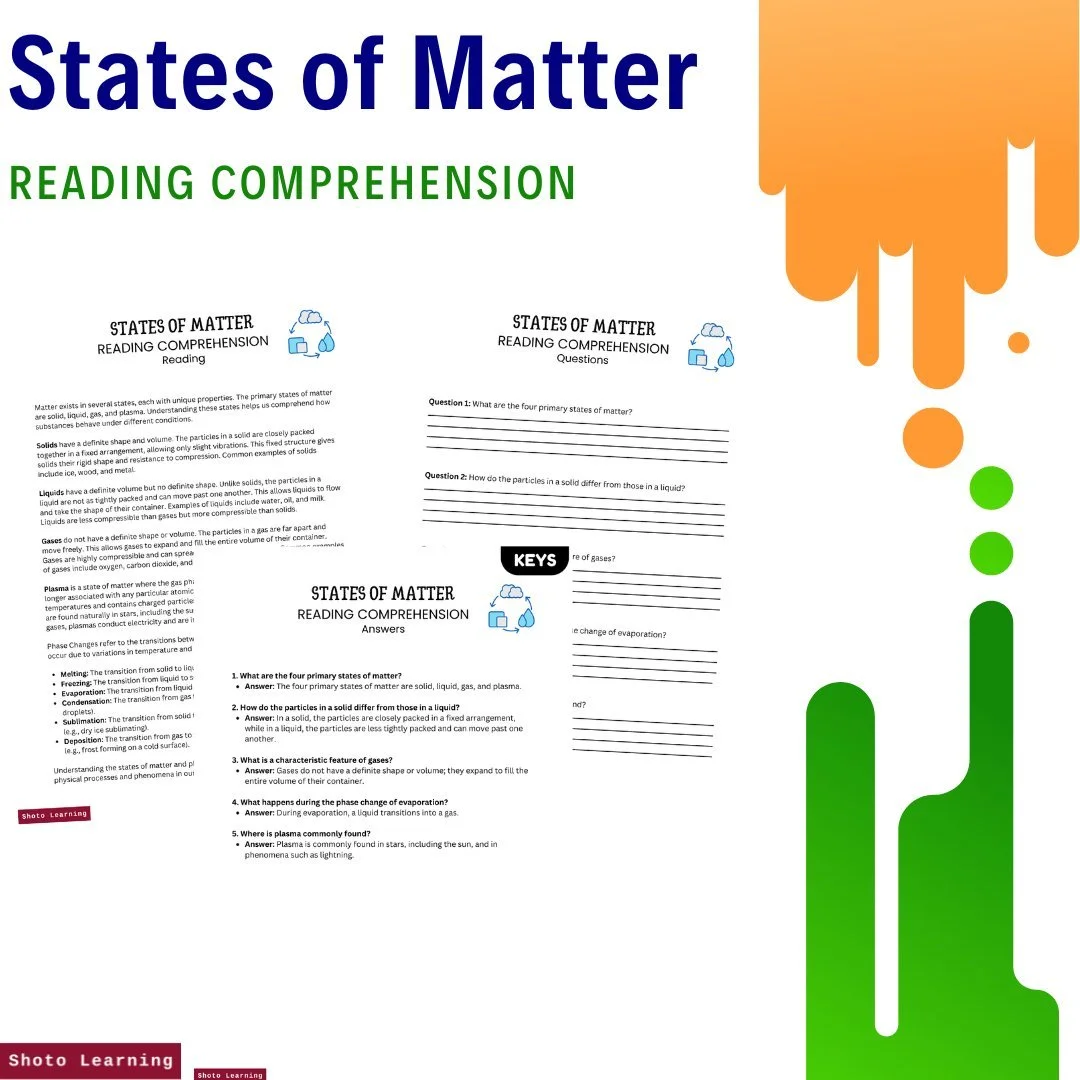
Discover the fundamental concepts of matter with our "States of Matter" Reading Comprehension Worksheet. This resource provides a clear and engaging overview of the different states of matter—solid, liquid, gas, and plasma—and their unique properties.
Key Features:
Educational Content: Explore the characteristics of each state of matter, including their particle arrangements and behaviors, as well as common phase changes like melting and evaporation.
Comprehension Questions: Reinforce learning with 5 targeted questions designed to test understanding and recall of key concepts.
Clear and Accessible: Written in an easy-to-understand format, making complex scientific ideas accessible to students and learners of all ages.
Versatile Use: Perfect for classroom activities, homework assignments, or as a supplementary resource for science lessons on matter and phase changes.
How to Use It:
In-Class Activity: Integrate the worksheet into a lesson on states of matter. Have students read the passage and answer the questions individually or in small groups to deepen their understanding of the different states of matter and their properties.
Homework Assignment: Assign the worksheet as homework to allow students to review and reflect on states of matter concepts at their own pace, reinforcing what they have learned in class.
Study Aid: Provide the worksheet as a study resource for students preparing for exams or quizzes on states of matter. It will help them review key concepts and test their comprehension effectively.
Equip your students with a strong grasp of states of matter with this engaging and educational reading comprehension worksheet!
Order your copy today!
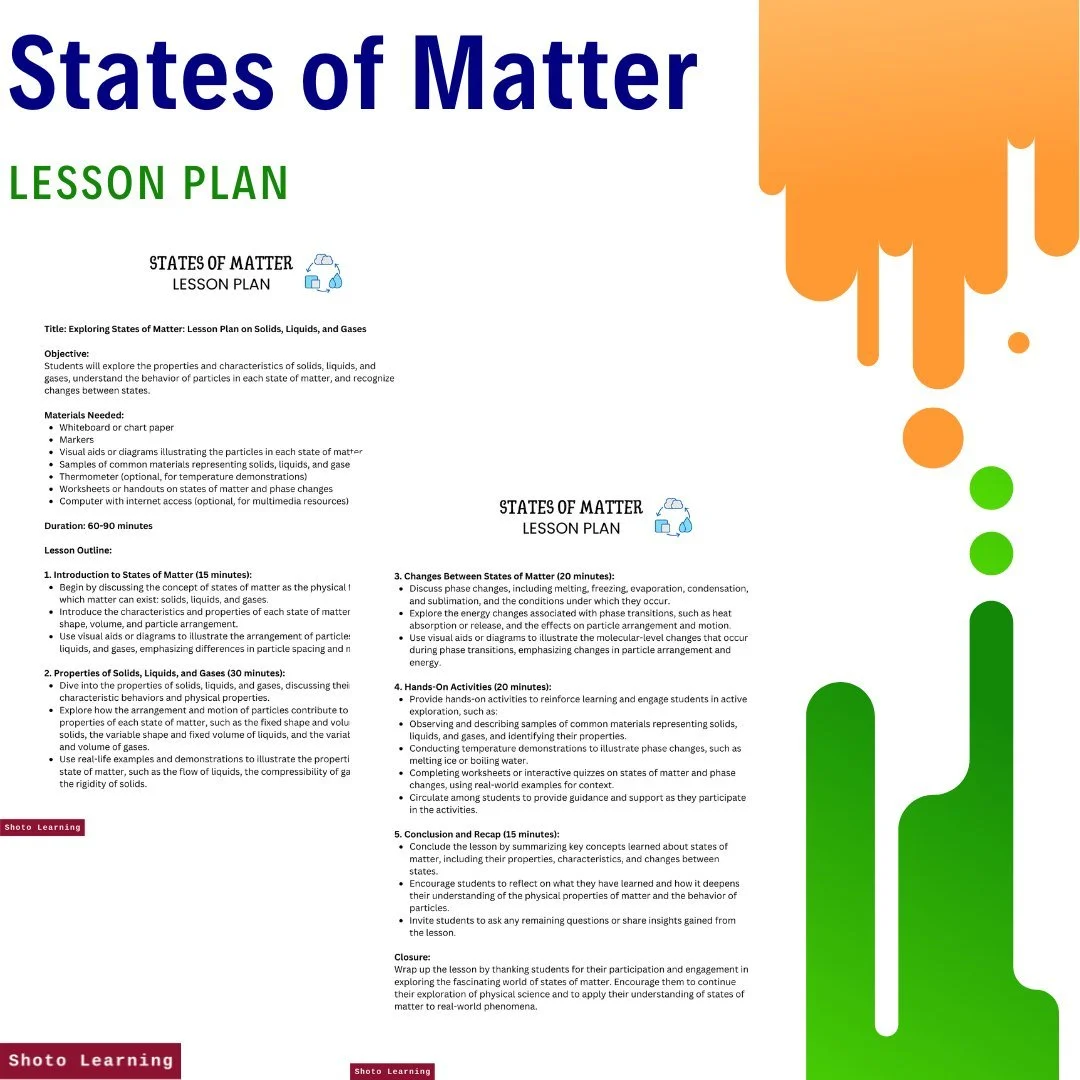
Embark on a captivating exploration of the physical properties of matter with our "Matter Matters" comprehensive lesson plan on states of matter. This all-inclusive resource is designed to engage students in a thorough examination of the characteristics, behaviors, and transitions between solids, liquids, and gases, providing educators with everything they need to deliver an informative and interactive science lesson.
Key Features:
Detailed Lesson Plan: A comprehensive guide to facilitating engaging activities and discussions on states of matter, complete with clear objectives, instructional strategies, and assessment suggestions.
Hands-On Activities: Engaging hands-on activities, such as sample observations, temperature demonstrations, and interactive quizzes, that reinforce learning and foster critical thinking skills.
Real-World Applications: Connections to real-world examples and phenomena related to states of matter, fostering relevance and understanding.
Extension Opportunities: Additional resources and extension activities to deepen understanding and encourage further exploration of states of matter concepts, catering to diverse learning needs and interests.
Multimedia Integration: Optional multimedia resources, such as videos and simulations, to enhance learning and engagement in the classroom, providing opportunities for interactive exploration.
How to Use This Lesson Plan:
Review Objectives: Begin by reviewing the lesson objectives and outcomes to understand the focus and goals.
Prepare Materials: Gather all required materials, including handouts, worksheets, and any multimedia resources.
Introduce Topic: Start with a brief introduction to the topic to engage students and set the context.
Follow the Steps: Teach each section as outlined, incorporating suggested activities, discussions, and questions.
Monitor and Adapt: Observe student engagement and understanding; adapt the lesson pace and methods as needed.
Assess Understanding: Use the provided assessment tools to evaluate student comprehension and provide feedback.
Wrap-Up: Summarize key points and provide closure with a reflective activity or homework assignment.
Whether you're a seasoned science teacher seeking to enrich your curriculum or a new educator looking for comprehensive resources on states of matter, our "Matter Matters" lesson plan is your key to unlocking the mysteries of the physical world. Empower your students to become confident explorers of matter and inspire a lifelong passion for scientific inquiry.
Don't miss out; order yours today!

Explore the fascinating world of matter with our "States of Matter: Hands-On Experiments at Home" worksheet. This two-page resource offers five engaging and easy-to-follow experiments that allow students to investigate the properties and phase changes of solids, liquids, and gases.
Key Features:
Simple and Fun: Each experiment uses common household items to demonstrate key concepts, making science accessible and enjoyable.
Hands-On Learning: Encourage active participation as students observe melting ice, balloon expansion, condensation, non-Newtonian fluids, and dry ice sublimation.
Comprehensive Coverage: Perfect for reinforcing lessons on states of matter, with experiments that cover phase changes, particle behavior, and more.
Versatile Use: Ideal for at-home science activities, classroom demonstrations, or as a supplementary resource for lessons on matter.
How to Use It:
Gather Materials: Collect all items listed for each experiment.
Follow Instructions: Perform the experiments using the provided step-by-step directions.
Observe and Record: Document your observations and results.
Discuss Results: Analyze and discuss the findings based on the guide’s explanations.
Make learning about the states of matter an interactive and memorable experience with these easy, at-home experiments!
Order your copy today!

Unlock your students' understanding of the fascinating world of states of matter with our comprehensive Writing Prompt Worksheet. This engaging resource is designed to spark critical thinking, enhance comprehension, and encourage creative exploration of concepts related to solids, liquids, gases, and more. Whether you're an educator seeking classroom materials or a curious learner eager to delve into the mysteries of matter, this worksheet is your essential guide.
Features:
Diverse Writing Prompts: The worksheet offers a curated selection of 10 thought-provoking writing prompts covering various states of matter. Each prompt is carefully crafted to challenge students' knowledge and encourage deeper exploration.
Comprehensive Coverage: From fundamental particle behavior to advanced concepts like plasma and superconductivity, the prompts encompass various topics to cater to different learning levels.
Clear Guidance: Each writing prompt is accompanied by a concise answer, providing educators and learners with clear explanations that help solidify their understanding.
Critical Thinking: Prompts are designed to stimulate critical thinking skills, encouraging students to analyze, evaluate, and connect concepts within the context of states of matter.
Application and Real-World Context: Explore how states of matter impact daily life, industries, and even the cosmos. Prompts delve into practical applications, making the learning experience relatable and relevant.
Flexibility: Suitable for individual and group settings, our worksheet is adaptable to various educational environments, whether in-class or remote.
Sample Writing Prompts and Answers:
Prompt: Describe the kinetic behavior of particles in a gas. How does it differ from particles in a solid? Answer: In a gas, particles have high kinetic energy, move rapidly, and are widely spaced. In a solid, particles have lower kinetic energy, vibrate in place, and are closely packed.
Prompt: Explain the process of sublimation. Provide an example from everyday life. Answer: Sublimation is when a solid changes directly into a gas without becoming a liquid. An example is dry ice (solid CO2) turning into carbon dioxide gas.
Ignite the curiosity of learners and deepen their comprehension of states of matter with our Writing Prompt Worksheet.
Order yours today and embark on a journey of discovery!

States of Matter Word Search
This fun and educational word search is a great way for kids to learn about the different states of matter. The word search features a variety of words related to solids, liquids, gases, and plasma, and it is challenging enough to keep kids engaged.
With this word search, kids will learn about the different states of matter as well as the properties of each state. They will also have fun challenging themselves to find all the hidden words.
Features:
Learn about the different states of matter
Fun and challenging
Educational
Benefits:
Improves vocabulary skills
Develops problem-solving skills
Promotes critical thinking
Encourages learning about science
Makes learning fun!
Order your copy of States of Matter Word Search today and help your child learn about the different states of matter in a fun and engaging way!

States of Matter: True or False Worksheet
This 20-question true or false worksheet is a fun and educational way for students to learn about the states of matter. The questions cover a variety of topics, including the properties of solids, liquids, and gases, as well as the different ways that matter can change states.
The worksheet is designed for students, but it can also be used with older students as a review or assessment tool. The questions are challenging but not too difficult, and they are all accompanied by answers so that students can check their work.
In addition to learning about the states of matter, students will also develop their critical thinking skills as they work through the worksheet. They will need to think carefully about the questions and use their knowledge of science to determine whether the statements are true or false.
This worksheet is a great resource for teachers and parents who are looking for a way to help their students learn about states of matter. It is also a fun and engaging activity that students will enjoy.
Here are some additional features of the worksheet:
The questions are written clearly and concisely.
The answers are provided at the end of the worksheet.
The worksheet is visually appealing, with colorful illustrations.
The worksheet is easy to use and can be completed independently by students.
Order your copy today and start learning!

45 Minute Test on States of Matter: A Fun and Educational Assessment Tool with Answers Included
This 45 minute test is perfect for kids who are learning about the three states of matter: solids, liquids, and gases. It includes 5 multiple choice questions, 5 fill in the blanks, and 5 short answer questions. The answers are included, so kids can check their work as they go.
The Benefits of This Test
This test is a great way for kids to:
Assess their knowledge of the states of matter
Identify any areas where they need more practice
Get feedback on their understanding of the material
Learn at their own pace
Have fun!
The Target Audience
This test is perfect for kids. It is a challenging but not too difficult test, so kids can learn without getting frustrated.
I hope your kids enjoy this test!
Order your copy today!

State of Matter Scramble Worksheets
These two engaging worksheets are a great way for students to learn about the three states of matter: solids, liquids, and gases. The worksheets feature a variety of scrambled words related to the states of matter, and students must unscramble the words to complete the worksheet.
Worksheet with word box: This worksheet includes a word box with unscrambled words. Students can use the word box to help them unscramble the other words on the worksheet. This worksheet is a great way for students to practice their vocabulary skills and learn about the states of matter.
Worksheet without word box: This worksheet does not include a word box. Students must unscramble the words on the worksheet without any help. This worksheet is a great challenge for students who are familiar with the states of matter and want to test their knowledge.
Both worksheets include answers, so students can check their work. The worksheets are available in PDF format, so they can be printed out.
Features:
Two engaging worksheets on states of matter
A variety of scrambled words to unscramble
A word box on one worksheet to help students with their vocabulary
Key Answers
Available in PDF format
Benefits:
Helps students learn about the three states of matter
Practices vocabulary skills
Challenges students to think critically
Provides a fun and engaging way to learn about science
Order your copy today and help your students learn about the states of matter in a fun and engaging way!

20 Questions and Answers on States of Matter
This set of 20 questions and answers is perfect for kids who are learning about the three states of matter: solids, liquids, and gases. The questions and answers are a great way to test kids' knowledge of the states of matter and their properties.
The Questions and Answers
The questions and answers are all written in a clear and concise way, with easy-to-understand language. The questions are designed to be challenging but not too difficult, so kids can learn without getting frustrated.
The Benefits
These questions and answers are a great way for kids to learn about the states of matter in a fun and interactive way. They help kids to:
Improve their vocabulary
Challenge their brains
Develop their critical thinking skills
Learn about the scientific method
Have fun!
The Target Audience
These questions and answers are perfect for kids. They are a great resource for parents, teachers, and homeschoolers.
I hope your kids enjoy these questions and answers!
Order your copy today!

20 Multiple Choice Questions on States of Matter
This set of 20 multiple-choice questions is perfect for kids who are learning about the three states of matter: solids, liquids, and gases. The questions are a great way to test kids' knowledge of the states of matter and their properties.
The Questions
The questions are all multiple choice, with four answer choices. The questions are designed to be challenging but not too difficult, so kids can learn without getting frustrated. The questions cover a variety of topics related to states of matter, such as:
The definition of solids, liquids, and gases
The properties of solids, liquids, and gases
The changes of state between solids, liquids, and gases
The Benefits
These questions are a great way for kids to learn about the states of matter in a fun and interactive way. They help kids to:
Improve their vocabulary
Challenge their brains
Develop their critical thinking skills
Learn about the scientific method
Have fun!
The Target Audience
These questions are perfect for kids. They are a great resource for parents, teachers, and homeschoolers.
Order your copy today!

States of Matter: Missing Letters Worksheet
This fun and educational worksheet is perfect for kids who are learning about the states of matter. It includes 20 words with missing letters, and one worksheet has a puzzle word list (hint) and one without. Key answers are included.
How to Play:
Look at the word with the missing letters.
Can you guess what the missing letters are?
If you need help, use the puzzle word list (hint).
Once you have guessed all the missing letters, write them in the blanks.
Check your answers with the key at the bottom of the worksheet.
This worksheet is a great way to:
Learn about the states of matter
Improve your vocabulary
Challenge your brain
Have fun!
Number of Worksheets: 2
Features:
20 words with missing letters
Puzzle word list (hint) on one worksheet
Key answers included
Order your copy today and start learning!

States of Matter Matching Worksheet
This fun and educational matching worksheet is perfect for kids who are learning about the three states of matter: solids, liquids, and gases. It includes 10 words and answers, so kids can check their work as they go.
How to Play:
Read words and definitions about the state of matter.
Match it to the word that describes it on the right.
Keep matching until you have matched all 10 states of matter.
This worksheet is a great way to:
Learn about the states of matter
Improve your vocabulary
Challenge your brain
Have fun!
Features:
10 matching questions
Answers included
Benefits:
This worksheet is a great way for kids to learn about the states of matter in a fun and interactive way.
It helps kids improve their vocabulary and challenge their brains.
I hope you enjoy this worksheet!

10 Mix Worksheets on States of Matter
This set of 10 mixed worksheets is perfect for kids who are learning about the three states of matter: solids, liquids, and gases. The worksheets are a great way to test kids' knowledge of the states of matter and their properties.
The Worksheets
The worksheets include a variety of questions and activities, such as:
Matching pictures of the states of matter to their names
Filling in the blanks with the correct state of matter
Answering questions about the phases of matter
The Benefits
These worksheets are a great way for kids to learn about the states of matter in a fun and interactive way. They help kids to:
Improve their vocabulary
Challenge their brains
Develop their critical thinking skills
Have fun!
The Target Audience
These worksheets are perfect for kids and are a great resource for parents, teachers, and homeschoolers.
I hope your kids enjoy these worksheets!

States of Matter Flashcards
This fun and educational set of 20 flashcards is perfect for kids who are learning about the three states of matter: solids, liquids, and gases. Each flashcard features a clear and concise definition of the state of matter.
The flashcards also include an option page where kids can cut and paste additional pictures into the flashcards. This is a great way for kids to personalize their flashcards and make them more memorable.
This flashcard set is a great way to:
Learn about the states of matter
Improve your vocabulary
Challenge your brain
Have fun!
Features:
20 flashcards
Clear and concise definitions
Options page to cut and paste additional pictures
Benefits:
This flashcard set is a great way for kids to learn about the states of matter in a fun and interactive way.
It helps kids improve their vocabulary and challenge their brains.
The colorful illustrations make the flashcards more engaging and fun to complete.
Don't miss out, order yours today!

States of Matter Fill in the Blank Worksheet
This fun and educational worksheet is perfect for kids who are learning about the states of matter. It includes 20 fill in the blank questions that will test kids' knowledge of the three states of matter: solids, liquids, and gases. Answers are included.
How to Play:
Read the fill in the blank question.
Think about the answer and fill in the blank.
Check your answer with the answer key.
This worksheet is a great way to:
Learn about the states of matter
Improve your vocabulary
Challenge your brain
Have fun!
Features:
20 fill-in-the-blank questions
Answers included
Benefits:
This worksheet is a great way for kids to learn about the states of matter in a fun and interactive way.
It helps kids improve their vocabulary and challenge their brains.
The worksheet includes answers, so kids can check their work and learn from their mistakes.
Order your copy today!

10 Debates on States of Matter
This fun and educational worksheet is perfect for kids who are learning about the states of matter. It includes 10 debate prompts that will challenge kids to think critically and use their knowledge of science to defend their position. Answers are included.
How to Play:
Read the debate prompt.
Come up with a position on the topic.
Gather evidence to support your position.
Debate your position with a friend or family member.
Check the answer key to see if you are correct.
This worksheet is a great way to:
Learn about the states of matter
Improve your critical thinking skills
Challenge your brain
Have fun!
Number of Worksheets: 10
Features:
10 debate prompts
Answers included
Colorful illustrations
Benefits:
This worksheet is a great way for kids to learn about the states of matter in a fun and interactive way.
It helps kids improve their critical thinking skills and challenges their brains.
The colorful illustrations make the worksheet more engaging and fun to complete.
The worksheet includes answers, so kids can check their work and learn from their mistakes.
Order your copy today!

States of Matter Cryptogram Worksheet
This fun and educational worksheet is perfect for kids who are learning about the states of matter. It includes a cryptogram puzzle with 3 key codes: symbol to letter, number to letter, and letter to letter. Answers are included.
How to Play:
Look at the cryptogram puzzle.
Can you decipher the code and figure out what the words are?
Use the key codes to help you solve the puzzle.
Once you have solved the puzzle, write the words in the blanks.
Check your answers with the key worksheet.
This worksheet is a great way to:
Learn about the states of matter
Improve your problem-solving skills
Challenge your brain
Have fun!
Number of Worksheets: 3
Features:
Cryptogram puzzle with 3 key codes
Answers included
Benefits:
This worksheet is a great way for kids to learn about the states of matter in a fun and interactive way.
It helps kids improve their problem-solving skills and challenge their brains.
I hope you enjoy this worksheet!
Order your copy today!

States of Matter Crossword Worksheet
This fun and educational worksheet is perfect for kids who are learning about the states of matter. It includes a crossword puzzle with 18 clues that will test kids' knowledge of the three states of matter: solids, liquids, and gases. Two versions are included, one with a word bank and one without.
How to Play:
Choose the version of the worksheet that you want to use.
Read the clues and fill in the crossword puzzle.
If you get stuck, you can use the word bank on the worksheet.
Check your answers with the answer key worksheet.
This worksheet is a great way to:
Learn about the states of matter
Improve your vocabulary
Challenge your brain
Have fun!
Features:
18 crossword clues
Word bank on one version of the worksheet
Answer key
Benefits:
This worksheet is a great way for kids to learn about the states of matter in a fun and interactive way.
It helps kids improve their vocabulary and challenge their brains.
The two versions of the worksheet allow kids to choose the level of challenge that is right for them.
Order your copy today and start learning!
Dive into a comprehensive exploration of states of matter with our all-inclusive worksheet bundle, offering an array of engaging activities to enrich your understanding of gas, solid, liquid, and plasma. This bundle is meticulously curated to cater to various learning styles and preferences, ensuring a captivating and effective learning experience for students, educators, and curious minds of all ages.
Key Features:
Versatile Learning Tools: With an impressive array of worksheets, including ABC Order, Bingo, Crossword, Cryptogram, Debate, Experiments, Fill in the Blank, Flashcards, and much more, this bundle provides a diverse range of resources to reinforce your grasp of state of matter concepts.
Interactive Engagement: Engage in interactive and enjoyable learning experiences with engaging activities like Free Mazes and Free PowerPoint presentations that visually enrich your understanding.
Visual Aids: Reinforce your knowledge with Free Posters that serve as visual aids to reinforce key concepts, making learning visually stimulating and memorable.
Lesson Plan: Dive deep with our detailed lesson plan, complete with engaging activities and discussion topics.
Assessment and Testing: Prepare for assessments with confidence using resources like Tests (45 minutes), Assignments, Reading Comprehension, True or False worksheets, and Multiple-Choice questions that challenge and gauge your understanding.
Creative Exploration: Stimulate your creativity and critical thinking with activities like Writing Prompts, Debates, and Cryptograms that encourage you to delve deeper into the intriguing world of states of matter.
Convenient and Comprehensive: Whether you're a teacher seeking classroom resources or a lifelong learner on a quest for knowledge, our bundle ensures that you have a comprehensive toolkit at your fingertips.
Unlock a wealth of educational opportunities and enhance your mastery of states of matter with this diverse worksheet bundle. From the excitement of Bingo to the thought-provoking challenge of Cryptograms, each activity is designed to make your learning journey engaging, dynamic, and rewarding. Embrace the variety, enhance your understanding, and embark on a captivating exploration of states of matter today!
View on Youtube
Don't wait, order yours today and start enjoying the benefits!