
Measurement Activities for Kindergarten: Engaging Lessons for Sizes, Weights, and Capacities
Learning about sizes, weights, and capacities is an important step for kindergarten students. These skills help children understand the world around them and prepare them for future math lessons. Simple measurement activities can make these big ideas fun and easy to learn for young children.
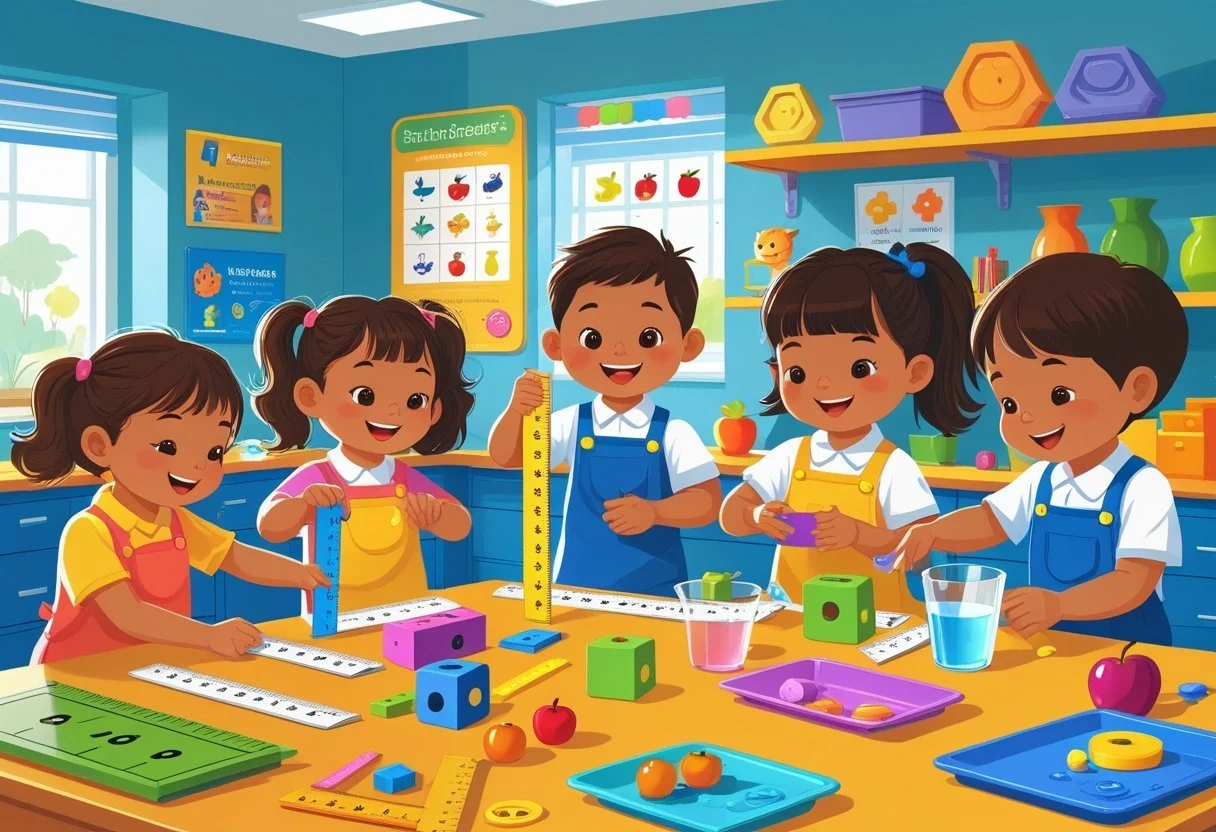
There are many creative games and hands-on activities that let kindergartners practice measuring with everyday objects. They can sort items by size, compare which objects are heavier or lighter, and learn how much different containers can hold. Using real-life examples makes the learning more meaningful.
Key Takeaways
Kindergarten measurement concepts are taught through simple, hands-on activities.
Children explore sizes, weights, and capacities using everyday objects.
Fun games and activities support problem-solving and math skills.
Foundational Measurement Concepts for Kindergarten
Young children need to learn what measurement means before using rulers or scales. They begin by noticing features like how long, heavy, tall, or full things are, and by talking about what they see.
Understanding Measurable Attributes
Measurable attributes are the qualities of objects that can be talked about, compared, and measured. In kindergarten, students focus on length, height, weight, and capacity. For example, a child may notice a pencil is longer than a crayon or a rock is heavier than a leaf.
Teachers can use real objects in the classroom or outside, such as blocks, books, or cups of water. Children learn best when they practice with objects they can touch and move. Sorting items by size or pouring water from one container to another helps them see how things are different or alike.
This stage is about noticing and talking about attributes before using tools. By naming and exploring these qualities, children build a strong base for later math skills.
Using Comparative Language
Comparative language is how children describe differences between objects. They use words like “taller,” “shorter,” “heavier,” “lighter,” “more,” and “less.” These words help children compare two or more things based on measurable attributes.
Kindergarten activities often include sorting items by size or lining them up to see which is the longest. Teachers can ask questions such as, “Which ball is heavier?” or “Which glass is more full?” This encourages discussion and deeper thinking.
Some examples of comparative language words include:
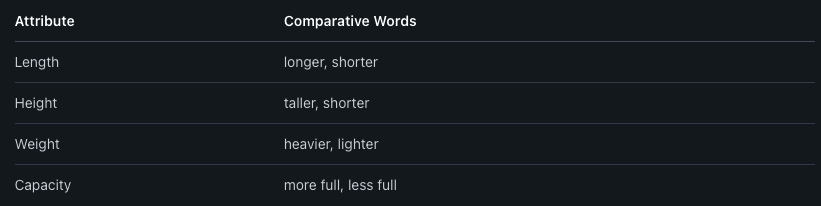
Learning this language helps students express what they notice about objects. It also gets them ready for more complex measurement tasks.
Exploring Standard and Non-Standard Units
Kindergarten students begin measuring using non-standard units. These are everyday objects, such as blocks, paper clips, or hands. For example, a child might use toy cars to measure the length of a desk. This helps them see how measurement works without needing to read numbers or understand inches or centimeters.
Non-standard units make measurement concrete and easy to check. Students quickly see that “five blocks long” makes sense even if they don’t know what a “centimeter” is. Teachers may set up games like, “How many book stacks tall is the chair?”
Later, students are introduced to standard units. This might be a ruler marked with inches or a measuring cup labeled with cups. At this age, the focus is on understanding that standard units give us a consistent way to compare and share measurements. This understanding builds over time as students practice with many objects and tasks.
Engaging Size Measurement Activities
Children can begin to understand size by comparing, sorting, and describing the length and height of things around them. Simple measurement exercises help them build vocabulary like taller, shorter, bigger, and smaller as they work with real-life objects.
Comparing Lengths With Everyday Objects
Kindergarteners enjoy using familiar items to measure and compare lengths. They can use crayons, blocks, or even pencils to see which object is longer or shorter.
For example, a teacher might ask students to line up different shoes and find out which shoe is the longest. Comparing the lengths of classroom tables, books, or ribbons can also keep kids engaged.
A useful way to organize results is with a simple table. For instance:

Group discussions help children explain how they decided which was longer, building confidence in their measurement skills.
Activities for Identifying Taller, Shorter, and Shortest
Recognizing height differences is easy with standing objects or classmates. Children can order themselves by height to see who is taller, shorter, or the shortest in the group.
Teachers can set up stacking games using blocks or cups and ask students to build towers and compare their heights. Using terms like tallest or shortest helps lock in new vocabulary.
A fun idea is to make a height chart on the wall and let children mark their names at their height level. This visual reminder encourages daily use of measurement words.
Hands-On Lesson Plans to Teach Bigger and Smaller
Lesson plans that focus on what is bigger or smaller can include sorting activities, scavenger hunts, or matching games. Children might compare stuffed animals to see which is bigger or which is smaller.
Teachers can provide a tray of objects in different sizes, such as spoons, balls, or shoes. Students can group them from biggest to smallest.
A matching game can involve drawing lines between pictures of items (like apples or trucks) and their shadows or outlines in different sizes. These activities reinforce understanding and use of size words in real situations.
Fun Ways To Teach Weight and Mass Concepts
Young children can learn about weight and mass best through first-hand experiences. Activities that let them touch and move objects help make weight and mass easier to understand. Use basic tools and clear language to support learning.
Hands-On Weight Comparison Activities
Kids need to handle real objects to compare weight and mass. Teachers can gather items like apples, blocks, and plastic cups. Let children hold two objects in their hands, one in each hand, and ask them which feels heavier or lighter. They can also sort objects into "heavier" and "lighter" piles.
Try using a simple chart like this:
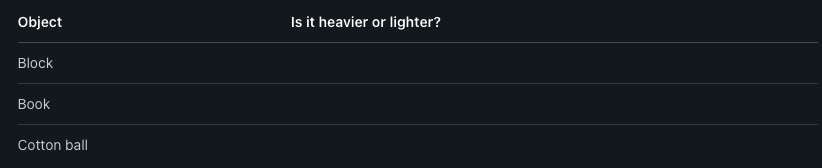
Children can fill in the chart as they compare the different items. This process helps them use the words "heavy," "light," "heavier," and "lighter" correctly.
Understanding Balance and Scales With Non-Standard Measurement
Balances make weight and mass less abstract for young learners. Teachers can use a homemade balance with a coat hanger, string, and small buckets. Children place one object in each bucket and watch to see which side goes down.
Non-standard measurement means using tools other than traditional scales. Children can use things like linking cubes or marbles as "weights." For example, they find out how many cubes it takes to balance a toy car, then compare with a different object.
A quick activity:
Place an apple on one side of the balance.
Add cubes to the other side until both sides are level.
Count the cubes used.
Try with a new object and compare results.
This makes measuring weight and mass visual and easy to understand.
Exploring Heavier and Lighter
Teaching the words "heavier" and "lighter" comes through comparing objects. Children can collect classroom items and predict which will be heavier. They record their guesses, then check using their hands or a balance.
Teachers might give groups of objects like a pencil, a block, and a crayon. Kids first predict, then test each one. They talk about "which is the heaviest" and "which is the lightest." These comparisons build vocabulary and reasoning skills.
Using a set list can help:
Heaviest
Lighter
Lightest
Heavier
Repeating these words in activities makes the language of weight and mass familiar for young children.
Creative Capacity Measurement Activities
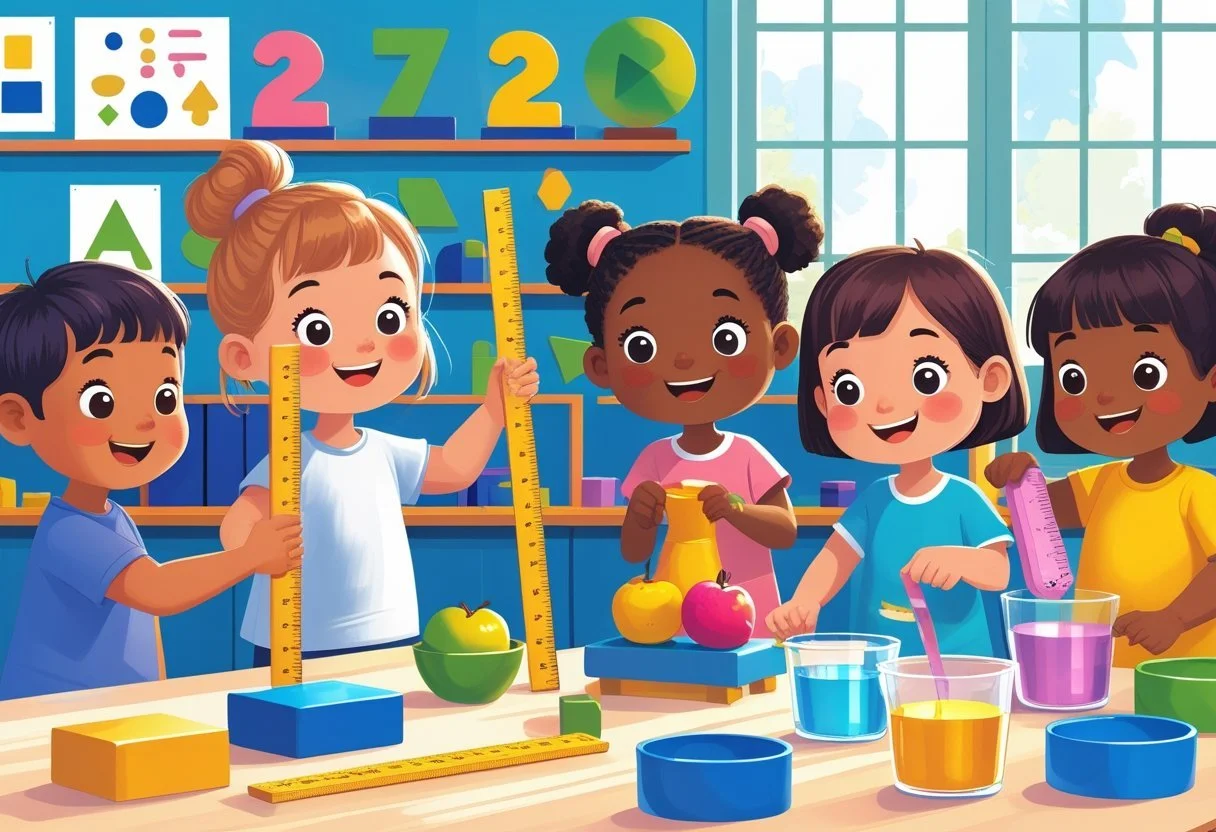
Children can learn about capacity by filling and comparing containers in fun, hands-on ways. These activities use familiar items to teach important measurement skills that form the basis for later math learning.
Measuring Capacity With Everyday Materials
Teachers and parents can gather various containers, such as cups, jars, and bottles, for measuring activities. Children fill each container with different materials, such as water, sand, or rice. Then they pour the contents from one container to another to see which holds more or less.
A simple chart can help organize results:

Kids learn that different shapes and sizes can hold different amounts, even if they look similar. Using a common "unit" like a small cup to fill larger containers helps children compare capacities with more confidence.
Using Cubes to Explore Volume
Unifix cubes or standard cubes are excellent for teaching young children about volume. Children can use these cubes to fill different containers. For example, they fill a small box and a larger tub, then count how many cubes fit in each.
List of steps:
Choose a container.
Fill it with cubes.
Count the cubes.
Record the number.
This shows them that bigger containers can fit more cubes. They also learn that "volume" means how much space something takes up. Using units of measurement like cubes makes it easy for children to compare the space inside different containers.
Comparing Full, Half Full, and Empty
It is important for children to understand the basic terms "full," "half full," and "empty." Teachers can set up a station with several clear containers and water or colored beans. Children fill one container to the top (full), fill another halfway (half full), and leave one with nothing (empty).
Visual examples help children see the differences:
Full: No space left at the top
Half full: Container is only filled to the middle
Empty: No material inside
Children can point, discuss, and use their own words to describe each level. This lays the foundation for future measurement and comparison activities.
Teaching Standard and Non-Standard Units
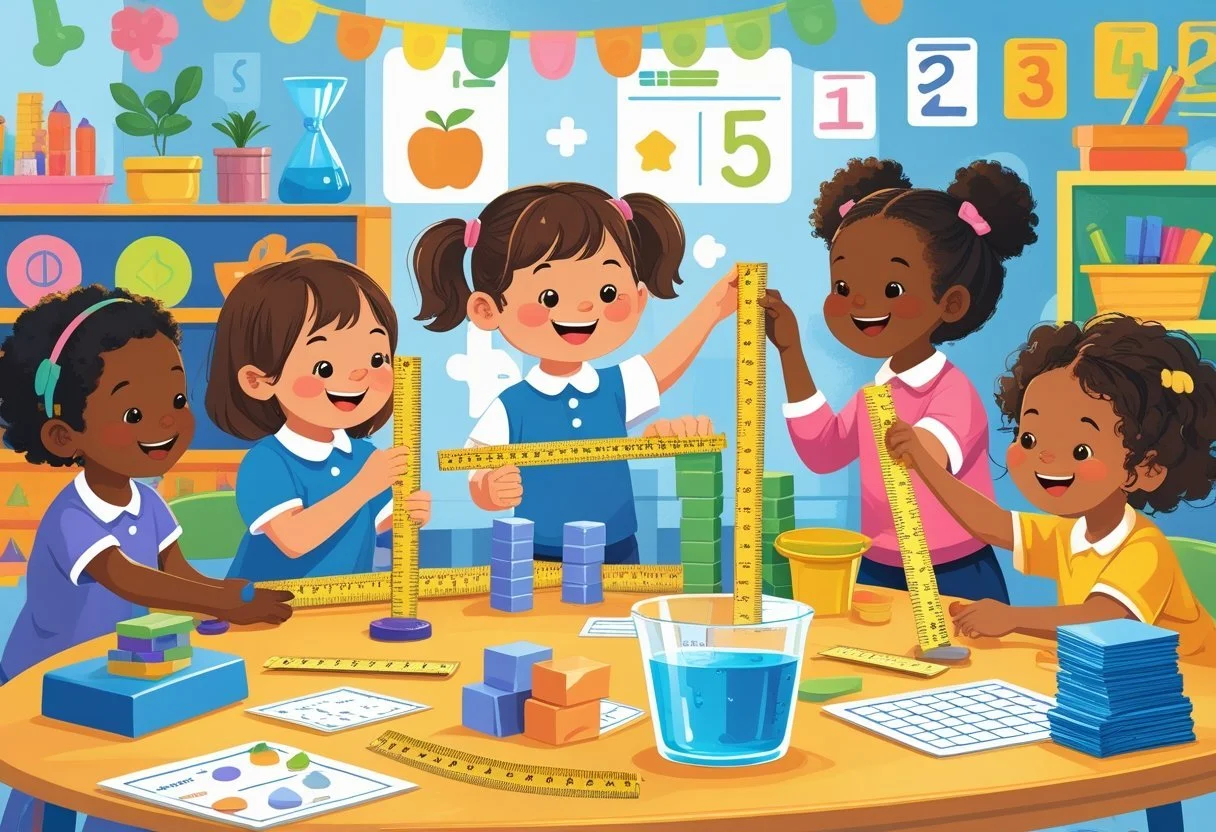
Kindergarten students can learn about measurement with both standard tools and everyday objects. Introducing different units and methods helps children compare, sort, and understand the world around them.
Using Rulers, Centimeters, and Inches
Standard units like centimeters and inches help children understand fixed measurements. Teachers can show how a ruler works by letting kids measure classroom items such as pencils, books, or blocks.
Rulers with both centimeters and inches help children see that some objects can be measured in more than one way. This also guides them to notice that numbers on the ruler have meaning and connections to real-world lengths.
Simple Steps for Using Standard Units:
Choose a common classroom object.
Ask students to measure it using both centimeters and inches.
Record the results in a table like the one below.

This helps students see the differences and similarities between units. Teachers can also talk about other standard units, like temperature, to expand understanding, though length is the main focus in early years.
Non-Standard Measurement With Creative Tools
Non-standard measurement uses items like blocks, paperclips, or even hand spans. These units let children focus on making comparisons before learning numbers or exact units.
Kids can measure a table with toy cars or line up crayons next to a shoe. This activity is more about counting how many blocks long something is, rather than using a ruler. It’s hands-on and easy for young children to understand.
Popular Non-Standard Units:
Counting blocks
Linking cubes
Straws
Books
Hands or feet
Using creative tools allows students to see that measurement can be flexible. It builds the skill of comparing, which helps when moving on to standard units later. Children also notice that the results can change depending on the size of the item used to measure. This leads to helpful classroom discussions about why standard units are important.
Incorporating Measurement Into Critical Thinking and Problem-Solving
Young children learn best by solving real problems and responding to thoughtful questions. Using measurement this way helps develop skills in both critical thinking and problem-solving.
Real-Life Problem Scenarios
Teachers can use daily situations to introduce measurement challenges. For example, students might decide which container holds more water during snack time or compare the length of classroom objects before lining up.
Using tasks like “Who has the heavier backpack?” or “Which box will fit all these blocks?” lets children apply measurement concepts to everyday issues. This makes learning more meaningful.
A simple chart can help organize results:

These activities help children connect measurement with decision-making and reasoning, strengthening their ability to solve problems.
Questioning Strategies for Measurement
Asking the right questions leads children to think more deeply about measurement. For instance, a teacher might ask, “How do you know which is heavier?” or “What happens if we use a bigger cup to fill the jar?”
Open-ended questions encourage kids to explain their thinking and compare ideas. Some helpful prompts include:
Which item is the longest? How can you tell?
Can you find something that weighs more than this rock?
If we use this scoop, how many scoops will fill the bowl?
What tools could we use to check our guess?
Using these questions in daily lessons helps build strong thinking and measuring skills at the same time.
Assessment and Practice With Worksheets and Activities
Worksheets let teachers check what students understand about comparing sizes, measuring objects, and sorting by weight or capacity. Group games help children apply what they have learned by using measurement words in real activities.
Printable Measurement Worksheets
Teachers use printable worksheets to practice comparing lengths, heights, and weights. Worksheets might show two pictures and ask children to circle the taller or heavier object. Some have students draw lines to match items of similar sizes or measure classroom items with paper clips or blocks.
A simple worksheet could include a table:

These tasks help students notice differences and build math vocabulary. Teachers can use worksheets for quick checks or as part of a math center. Worksheets are easy to send home for extra practice and can be used to meet lesson plan goals for measurement skills.
Interactive Group Games
Group games like "Measure Hunt" encourage students to find something longer, shorter, or heavier than a classroom object. In "Capacity Relay," teams race to fill containers using scoops, talking about what is full, empty, more, or less. These activities get kids moving and using measurement words.
Teachers create lesson plans with group games to help every child participate. Games can use everyday items, such as blocks, cups, or crayons. They also help students think about size, weight, and capacity in situations beyond their worksheets. Group activities support social skills while reinforcing key measurement ideas in a fun, hands-on way.
Frequently Asked Questions
Teachers can use a variety of hands-on activities and real-life objects to help kindergarteners learn about measurement. Games, projects, and classroom tools make lessons more concrete and enjoyable for young students.
What are some engaging hands-on measurement activities for kindergarteners?
Students can sort classroom items by size, compare the lengths of strings, or stack building blocks to measure height. Water play with different-sized containers is also a fun way to explore measurement. Another idea is using play dough to form lines and shapes, then comparing their lengths.
How can teachers incorporate real-life objects into measurement lessons for kindergarten students?
Teachers can bring in common items like spoons, cups, shoes, or books for measurement activities. Students might compare two shoes to see which is longer, or use dried beans to fill different containers and count how many fit. Using lunch boxes or classroom tables to compare weights also connects lessons to the real world.
What are some effective strategies to teach kindergartners about comparing sizes?
Visual aids such as number lines, picture cards, and simple charts help students see and compare sizes. Giving students objects to line up side-by-side or stack makes comparisons easier. Teachers can encourage group discussions where students describe which objects are bigger, smaller, longer, or shorter.
Can you suggest some interactive games that introduce weights and measurements to young children?
Balance scales let students guess which item is heavier or lighter. “Measure Hunt” games have children find classroom objects that match a specific size or weight. “Fill the Container” challenges ask children to guess how many small objects will fit in a larger space or container.
How do educators integrate the concept of capacity in kindergarten-level math activities?
Teachers can use water, sand, or rice in clear containers to let children pour, scoop, and compare. Students watch which container holds more or less. Comparing how much liquid different cups or pitchers can hold helps children visualize capacity.
What are age-appropriate measurement projects that help kindergarteners understand spatial concepts?
Building block towers to a certain height and drawing or cutting strips of paper to match measured lengths can help children learn about space. Arranging classroom furniture or mats based on size gives practical experience with spatial measurement. Simple map-making with shapes introduces position and direction.

Introduce young learners to the world of measurement with our Free Kindergarten Pre-School Measurement Worksheets—a playful and educational resource designed to build foundational math skills.
Key Features:
Engaging visuals and age-appropriate activities
Covers key concepts: tall vs. short, long vs. short
Easy-to-follow worksheets for independent or guided learning
Perfect for classroom, homeschool, or extra practice at home
Printable and completely free!
How to Use:
Print the worksheets and guide your child through each fun-filled activity. Children will learn to compare height and length using familiar objects and colorful illustrations. These activities encourage hands-on interaction, helping kids visually grasp size differences and apply critical thinking skills in everyday situations.
Perfect for parents, teachers, and homeschoolers, this free resource is ideal for introducing measurement concepts in a fun and memorable way. Build early math confidence and get your little one excited about learning!
Download now and turn measurement into a fun adventure for your preschooler or kindergartener!

Make learning measurement exciting and meaningful for young learners with our Kindergarten Measurement Worksheets! Designed for preschool and kindergarten students, this hands-on math resource includes a variety of fun, engaging activities that build essential early math skills.
Key Features:
Covers length, height, width, weight, and capacity
Hands-on measuring with cubes and real-world objects
Encourages visual comparison and critical thinking
Includes activities for long/short, tall/short, wide/narrow, light/heavy, and more
Printable and easy to use in classrooms or at home
How to Use: Start by introducing one concept at a time—like comparing tall vs. short items in the classroom or around the house. Use included cube templates or real cubes to measure the height and length of different objects. Students can build cube trains to "measure" items and compare sizes. Worksheets guide them to think critically about volume and weight by asking which containers hold more or which items feel heavier. All activities are scaffolded to support independent learning and problem-solving through play.
Perfect for early finishers, math centers, or homeschooling, this resource supports foundational skills your learners will use throughout their education.

Help your preschoolers explore the world of size, length, and weight with this engaging Pre-K Size Comparison Worksheet Pack! Perfect for early learners, this resource includes 10 printable activities designed to introduce foundational math concepts through fun, hands-on exercises.
Children will practice identifying long vs. short, tall vs. short, wide vs. narrow, heavy vs. light, and more vs. less. These worksheets are ideal for practicing visual discrimination, sorting, coloring, and cutting & pasting, while improving comparison and observation skills.
✨ What’s Included:
Long or Short – Circle the correct one
Long or Short – Cut and Paste activity
Tall or Short – Color the correct picture
Tall or Short – Cut and Paste activity
Wide or Narrow – Circle the correct size
Wide or Narrow – Coloring activity
Light or Heavy – Circle the right object (2 pages)
More or Less – Circle the correct amount
Holds More or Less – Coloring page
🧠 Key Features:
Simple instructions for independent learning
Promotes size awareness and comparison skills
Mix of coloring, circling, and cut-and-paste activities
Supports early math standards
Ideal for home, classroom, or homeschooling use
Whether you're a teacher, homeschooler, or parent, these worksheets are a must-have for building your little learner’s confidence in math and measurement. Use them during morning work, centers, or math rotations. Print, prep, and teach—it’s that easy!
Related products:
Complete Pre-K Bundle – 212 Pages