
Understanding Word Families: Unlocking the Power of Vocabulary for Enhanced Language Development
Words are the building blocks of language. They connect in special groups called word families that share parts and meanings. When we learn about word families, we can unlock new words and make sense of ones we don't know yet.

Understanding word families helps us become better readers and writers by showing us patterns in language instead of memorizing each word by itself. For example, knowing that "happy," "happily," and "happiness" all belong to the same family lets us quickly grasp their meanings and relationships.
Word families give us clues about how words work together. This knowledge makes reading easier and helps us express our thoughts more clearly when we speak or write.
Key Takeaways
Word families share common roots or base words that help us recognize patterns in vocabulary.
Learning word families improves reading skills by making it easier to decode unfamiliar words.
Understanding word relationships strengthens communication abilities and expands vocabulary naturally.
The Basics of Word Families
Word families are groups of words that share common elements and patterns. These connections help us understand how language works and grows through predictable structures.
Defining Word Families
A word family consists of words that share the same root or base word. These words are connected through patterns of letters and sounds. For example, the words "help," "helping," "helper," and "helpful" all belong to one word family.
Word families show how morphology (the study of word structure) works in language. When we add prefixes and suffixes to a base word, we create new words that relate to the original meaning.
Common patterns in word families include:
Adding suffixes (-ing, -ed, -er)
Adding prefixes (un-, re-, dis-)
Changing vowel patterns
One word family can expand to include many related words. The root word "read" grows into "reader," "reading," "reread," and "unreadable."
Importance in Language Development
Word families serve as building blocks for vocabulary growth. When children learn one word in a family, they can more easily understand related words they encounter later.
Research shows that knowledge of word families improves reading fluency. Readers who recognize patterns spend less time decoding each word.
Word families enhance spelling skills through pattern recognition. Once a child understands the "-ake" pattern in "cake," they can more easily spell "rake," "lake," and "bake."
These patterns help language learners predict word meanings. Understanding the root "spect" (meaning "to look") helps with words like "inspect," "spectator," and "perspective."
Word families also support comprehension by revealing relationships between words. Recognizing connections between "migrate," "immigration," and "migratory" deepens understanding of each term.
Exploring the Structure of Word Families
Word families consist of related words that share a common root or base. Understanding their structure helps us recognize patterns and expand our vocabulary efficiently.
Roots, Prefixes, and Suffixes
The root forms the foundation of a word family. It carries the core meaning that connects all related words. For example, the root "struct" means "to build" and appears in words like construct, structure, and instruction.
Prefixes attach to the beginning of roots. They modify meaning in specific ways. The prefix "re-" means "again" or "back," changing "construct" to "reconstruct" (to build again).
Suffixes attach to the end of roots. They often change a word's part of speech. Adding "-ion" to "construct" creates "construction," transforming a verb into a noun.
Many roots come from Latin or Greek. The root "bio" (life) appears in biology, biography, and biodiversity. Learning these common roots helps unlock the meaning of unfamiliar words.
Patterns and Spelling
Word families follow predictable spelling patterns. These patterns help readers recognize related words quickly. For instance, words with the root "sign" maintain this spelling in "signature," "design," and "assign."
Some spelling changes occur when adding affixes. Examples include:
Dropping final 'e': hope → hoping
Doubling consonants: run → running
Changing 'y' to 'i': happy → happiness
These spelling patterns help maintain pronunciation across word families. Understanding them improves both reading and spelling skills.
Word families with irregular patterns exist too. The words "receive," "deceive," and "perceive" follow the "i before e except after c" rule. Recognizing these exceptions is just as important as learning the regular patterns.
The Role of Word Families in Reading
Word families are groups of words that share common patterns and roots. They play a crucial role in helping readers decode unfamiliar words and understand text more efficiently through pattern recognition.
Decoding and Reading Comprehension
When readers encounter unfamiliar words, they can use their knowledge of word families to break them down into manageable parts. For example, knowing the "-at" family (cat, bat, rat) helps readers decode new words like "flat" or "splat."
Word families support both phonological awareness and orthographic processing. Readers who recognize these patterns can:
Decode words more quickly
Focus more on meaning rather than individual letter sounds
Build reading fluency through pattern recognition
Research shows that students who understand word families typically demonstrate stronger reading comprehension skills. They spend less mental energy figuring out individual words and more on understanding the text's overall meaning.
Prior Knowledge and Reading Skills
Familiarity with word families builds essential prior knowledge that readers can apply to new reading situations. This knowledge creates a foundation for more advanced reading skills.
Students with strong word family awareness can:
Connect new vocabulary to words they already know
Predict pronunciations based on familiar patterns
Infer meanings of unfamiliar words using root knowledge
Teachers often focus on word families in early reading instruction. This approach helps students develop pattern recognition skills that transfer to increasingly complex texts.
Building word family knowledge is particularly helpful for struggling readers. It provides them with concrete strategies to approach unfamiliar words rather than guessing or becoming discouraged.
Enhancing Vocabulary with Word Families
Word families provide a powerful framework for building vocabulary skills. By recognizing patterns in related words, students can quickly expand their word knowledge and improve reading comprehension.
Learning Strategies
Using word families helps students recognize patterns across multiple words. When students learn that "run," "running," and "runner" share a common base, they develop decoding skills more efficiently.
Teachers can introduce word sorts where students group words by their roots or affixes. This hands-on approach reinforces pattern recognition.
Effective Word Family Activities:
Word walls organized by root words
Word family charts that show connections
Games like "Word Family Bingo" or "Root Word Hunt"
Daily practice identifying affixes and base words
Regular exposure to word families helps students internalize spelling patterns. This supports both reading fluency and writing skills.
Scaffolding and Formative Assessment
Educators can scaffold word family instruction by starting with simple patterns before moving to more complex relationships. Beginning with short vowel patterns (hat, cat, bat) provides a foundation for tackling more advanced word families.
Scaffolding Progression:
Simple rhyming patterns (-at, -an)
Long vowel patterns with silent e
Common prefixes and suffixes
Greek and Latin roots
Formative assessment helps track student progress with word families. Teachers might use exit tickets where students identify members of a word family or create new derivatives.
Mini-quizzes that ask students to match words to their families provide valuable feedback. This allows educators to adjust instruction based on student needs.
Practical Applications of Word Families
Word families offer powerful tools for expanding vocabulary and improving reading comprehension. These applications extend from classroom instruction to self-study techniques using visual aids and organizational methods.
Instructional Approaches
Teachers use word families to build strong reading foundations through systematic instruction. They often start with simple patterns like "-at" words (cat, hat, rat) before introducing more complex families.
Daily word sorts help students categorize words by their patterns. This activity strengthens pattern recognition skills and reinforces spelling rules naturally.
The "word ladder" technique connects related words through single-letter changes. Students might transform "cat" to "coat" through sequential steps (cat → cot → coat), seeing how patterns evolve.
"Word building" activities use letter tiles or magnetic letters to physically construct words within families. This hands-on approach reinforces the connection between sounds and spelling patterns.
Teachers also incorporate word family instruction into writing exercises. Students apply their knowledge by creating sentences or stories using words from specific families.
Graphic Organizers and Tools
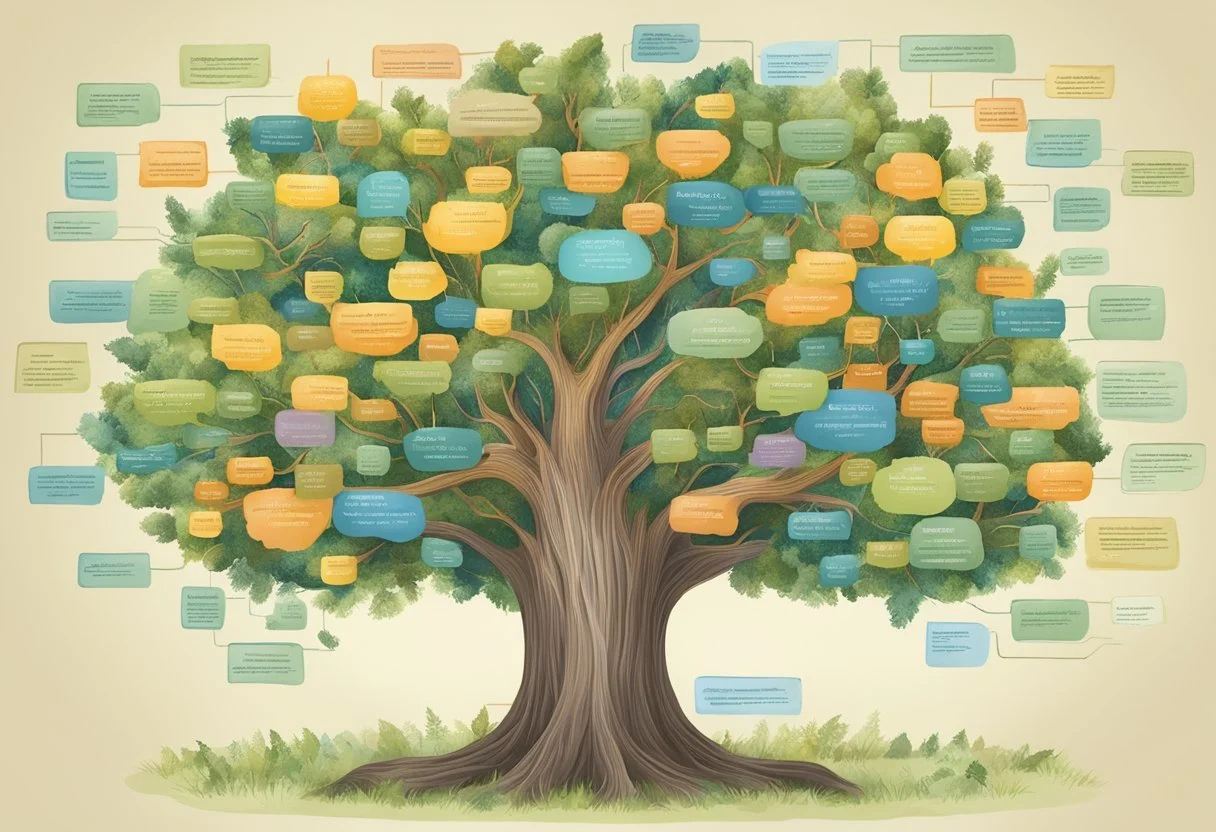
Word family trees visually display related words branching from a common root or pattern. These trees help students visualize relationships between words with similar structures.
Word wheels serve as interactive tools where students rotate disks to create different words. The inner disk shows the word family ending while the outer disk contains various beginning consonants.
Wall charts displaying word families provide constant visual reinforcement in classrooms. Students refer to these charts during reading and writing activities.
Digital applications now offer interactive word family exercises. These programs adapt to student progress and provide immediate feedback on pattern recognition.
Concept maps help students connect word families to meanings and contexts. This approach bridges the gap between recognizing patterns and applying vocabulary in real communication.
Encouraging Curiosity in Word Origins

Understanding where words come from creates a deeper connection with language. When we explore word origins, we discover patterns and relationships that make vocabulary learning more meaningful and memorable.
Discovering Morphology
Morphology is the study of how words are formed and how they relate to other words. Looking at word parts like roots, prefixes, and suffixes helps us understand new vocabulary more easily. For example, the word "unhappiness" contains three morphemes: "un-" (not), "happy" (feeling good), and "-ness" (state of being).
Students can develop morphological awareness through simple activities. Word sorting games help identify patterns in spelling and meaning. Creating word webs shows how related words connect to a common root.
Teachers can introduce common prefixes like "re-" (again) and "un-" (not) to show how they change word meanings. This knowledge helps readers decode unfamiliar words they encounter in texts.
The Joy of Etymology
Etymology explores the history and origins of words. Many English words come from Latin, Greek, German, and French sources. Knowing a word's etymology often explains its spelling and meaning.
For instance, the word "photograph" comes from Greek roots: "photo" (light) and "graph" (writing)—literally "writing with light." This connection makes the word more memorable.
Students can become word detectives by researching word origins in dictionaries. They might discover that "astronaut" means "star sailor" or that "breakfast" refers to breaking the overnight fast.
Etymology shows how language evolves over time. Words like "emoji" (from Japanese) and "pajamas" (from Hindi) remind us that English continuously borrows from other languages.
Strengthening Language Arts through Phonic Elements
Phonic elements serve as building blocks for strong language arts skills. They help students recognize patterns in words, which improves reading fluency and comprehension.
Rhyming and Rhythm in Word Families
Rhyming words belong to the same word family and share similar ending sounds. For example, "cat," "hat," and "mat" all belong to the "-at" family.
Students who practice with rhyming words develop phonological awareness, a key skill for early readers. This awareness helps them decode new words more easily.
Rhythm in language arts connects to word patterns. When children learn to hear syllables and beats in words, they gain better reading fluency.
Teachers often use songs, poems, and chants to reinforce these concepts. These activities make learning fun while strengthening important skills.
Simple games like rhyming bingo or creating rhyming chains help students internalize these patterns naturally.
Recognizing Synonyms and Antonyms
Synonyms are words with similar meanings, while antonyms have opposite meanings. Understanding these relationships expands vocabulary knowledge.
When students know that "happy" and "joyful" are synonyms, they gain tools for more precise communication. Similarly, recognizing that "hot" and "cold" are antonyms helps with comprehension.
Word family knowledge supports this learning. Words with similar roots often have related meanings, creating natural synonym groups.
Activities that strengthen synonym and antonym recognition include:
Word sorting exercises
Matching games
Creating word webs
Reading stories with rich vocabulary
These practices help students build connections between words and develop a more nuanced understanding of language.
Advancing Vocabulary with Creative Exercises
Engaging with vocabulary through interactive methods significantly improves word retention and usage in everyday communication. Creative exercises activate multiple learning pathways in the brain, making new words stick more effectively than passive memorization.
Word Family Games and Activities
Word family scavenger hunts encourage learners to find related words in their environment. Players can search for "-at" family words like cat, hat, and bat, recording their discoveries in a personal dictionary.
Popular Word Family Activities:
Word sort challenges (grouping words by patterns)
Word family dominoes (matching endings)
Create-a-story using specific word families
Word family bingo
These games work well in classrooms and home settings. They transform vocabulary learning from tedious to enjoyable. When learners encounter words through play, they form stronger memory connections.
Digital applications now offer interactive word family games that adapt to individual learning paces. These apps provide immediate feedback and track progress over time.
Innovation in Learning and Recall
Mind mapping represents a powerful technique for visualizing word relationships. Learners place a root word at the center and branch out with related family members, creating a visual web of connections.
Effective Recall Techniques:
Spaced repetition systems (reviewing words at strategic intervals)
Vocabulary journals with personal examples
Word association chains
Multi-sensory approaches (saying, writing, and acting out words)
Research shows that learners retain vocabulary longer when they create personal connections to new words. A student might remember "precipitation" by connecting it to getting wet during a rainy soccer game.
Technology now enables personalized vocabulary learning experiences through adaptive algorithms. These systems identify pattern recognition strengths and adjust exercises accordingly.
Conclusion

Word families are powerful tools for building a strong vocabulary. They help us connect words with similar meanings and origins. Understanding these connections makes learning new words easier.
By studying word families, students can grow their vocabulary faster. They can carry this knowledge into reading and writing tasks. Word families act as bridges between known and unknown words.
Words are symbols that represent ideas and objects. When we group them into families, we find patterns that help us decode unfamiliar words. This skill brings pleasure and delight to learning language.
Teachers and parents can record progress as children master word families. This tracking shows growth over time. It also highlights areas that need more practice.
Remember that word families work best when used regularly. Daily practice strengthens these connections. Even a few minutes each day makes a difference.
The journey of vocabulary development never truly ends. Word families provide a map for this ongoing adventure. They transform intimidating words into friendly faces.
Frequently Asked Questions
Word families represent groups of words sharing common roots or patterns. They serve as powerful tools for building vocabulary and deepening language skills across various dimensions of learning.
How can mastering word families enhance language comprehension and production?
Word families create mental networks of related words in the brain. These connections help learners recognize unfamiliar words by identifying familiar parts.
When readers encounter new words containing known word patterns, they process them more quickly. This faster processing leads to improved reading fluency and comprehension.
Word families also enhance speaking and writing by providing ready access to related words. Learners can retrieve appropriate vocabulary more efficiently when they understand word relationships.
What strategies are effective for teaching word families to language learners?
Word sorts allow learners to categorize words by patterns, reinforcing recognition of common elements. This hands-on approach works especially well for visual learners.
Games focusing on word building from base words make learning engaging and interactive. Card games, board games, and digital applications can all incorporate word family practice.
Regular reading with attention to word patterns helps learners naturally absorb word families. Teachers can point out patterns in texts and encourage students to find related words.
In what ways do word families contribute to reading and spelling proficiency?
Word families create predictable spelling patterns that readers can apply to new words. Once a learner knows "-ake" in "cake," they can more easily read "bake" and "lake."
Spelling becomes more systematic when learners recognize consistent patterns across word families. This pattern recognition reduces the need to memorize each word individually.
Word families also support decoding skills by providing consistent pronunciation patterns. This consistency helps readers develop automaticity with common word chunks.
Can understanding word families accelerate vocabulary acquisition and if so, how?
Word families multiply vocabulary growth by connecting new words to known patterns. Learning one pattern can unlock understanding of dozens of related words.
Knowledge of prefixes and suffixes allows learners to modify base words to create new meanings. Understanding how "happy" connects to "unhappy," "happiness," and "happily" expands vocabulary efficiently.
This structured approach to vocabulary building creates deeper word knowledge than memorizing isolated words. Learners understand not just individual words but entire systems of related terms.
What is the role of phonics in the identification and use of word families?
Phonics instruction develops awareness of sound-spelling relationships that form the foundation of word families. Students learn to connect letter patterns with consistent sounds.
Beginning readers use phonics to decode words by recognizing familiar chunks or rimes. The "-at" family in "cat," "hat," and "mat" demonstrates how phonics and word families intersect.
This phonological foundation helps readers identify and produce rhyming words. Rhyming reinforces word family patterns and makes them more memorable for learners.
How do word families support the development of morphological awareness?
Morphological awareness involves understanding how words are formed from meaningful parts. Word families highlight these building blocks of language.
Students with strong morphological awareness recognize how affixes modify base words. They see how "teach" connects to "teacher," "teaching," and "teachable" through consistent patterns.
This awareness helps learners analyze unfamiliar words by breaking them into familiar components. When encountering "biodegradable," they can identify the prefix "bio-," the root "grade," and the suffix "-able."

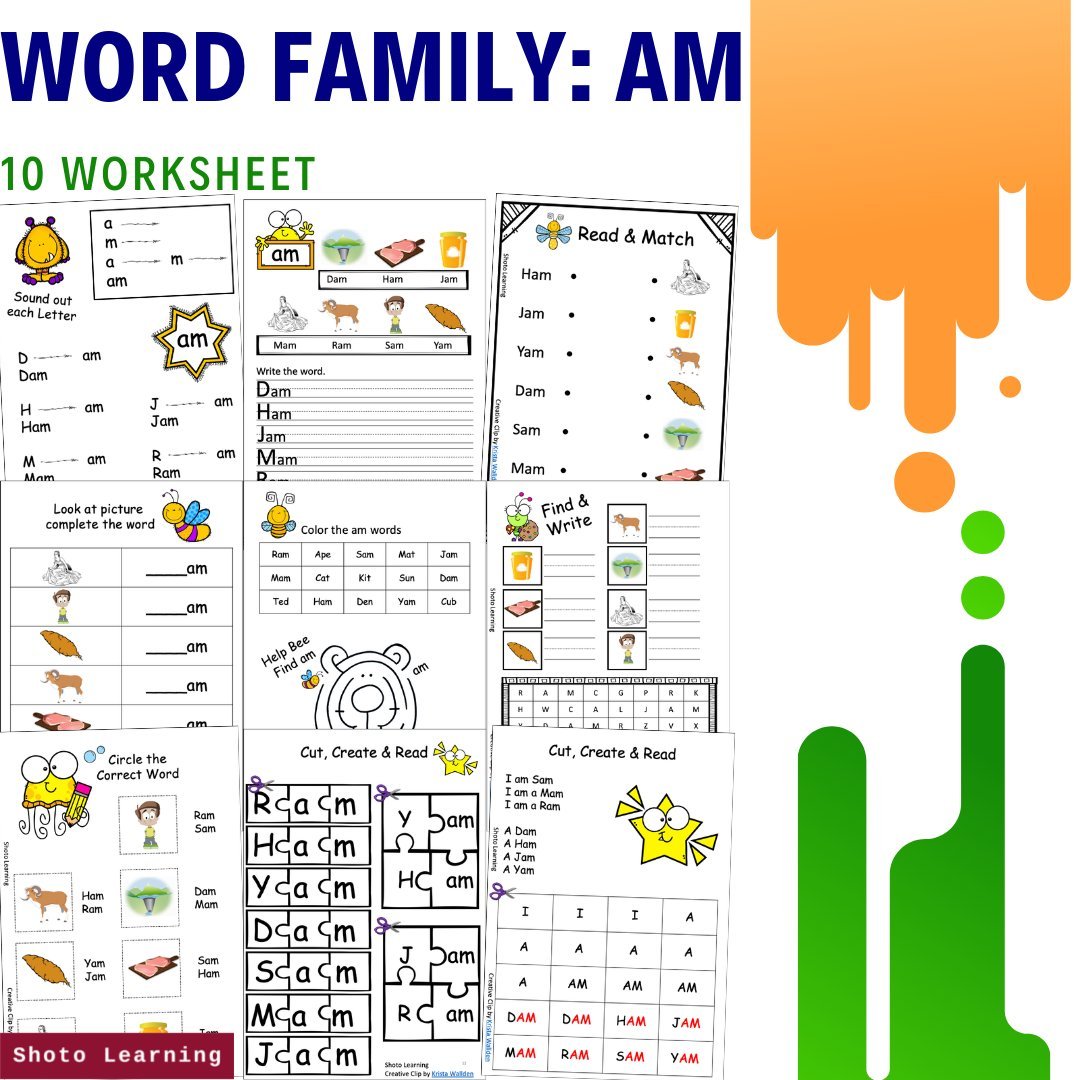


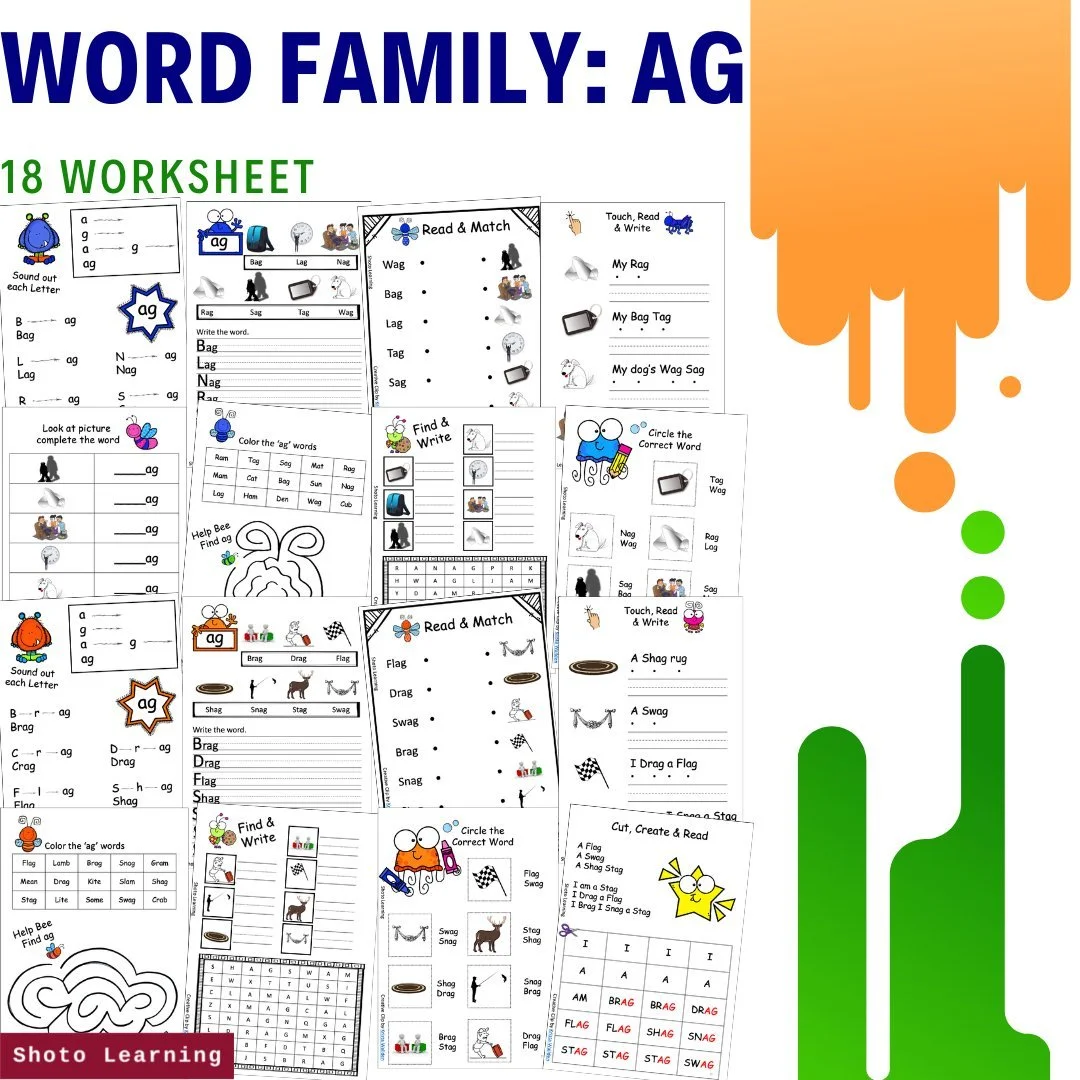


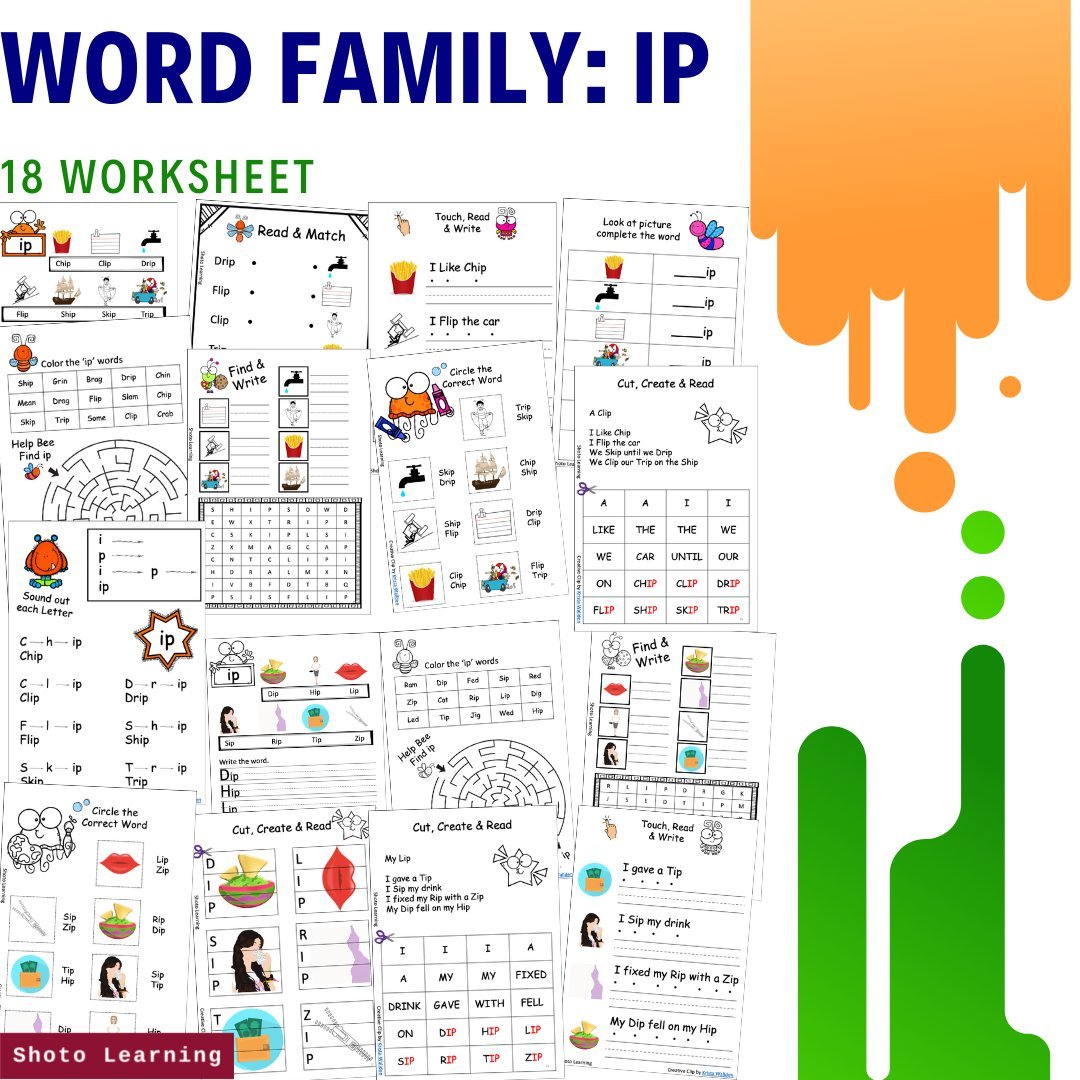


Unlock the power of the AM Word Family with our interactive CVC blend worksheet!
Key Features:
Hands-On Learning: Combines speaking, reading, and writing for comprehensive skill development.
Engaging Activities: Includes games and exercises to make learning fun.
Versatile Practice: Focuses on 3 & 4-letter words, perfect for various skill levels.
Easy to Use: Ideal for classroom or home use; simply print and start learning!
This 21-page eBook enhances English language skills, making word family learning an essential and enjoyable experience.
Order your copy today!