
Using Word Problems to Build Critical Thinking in Math Education
Word problems are much more than just math exercises—they challenge students to think deeply and solve problems step by step. Using word problems helps learners develop critical thinking by requiring them to analyze information, make connections, and choose the best strategies. These kinds of questions encourage students to read carefully, understand what is being asked, and use logical reasoning to find a solution.

When word problems are used often in the classroom, students also practice important skills like communication and teamwork. They learn how to explain their thinking, share ideas, and listen to others’ methods. Word problems can also be changed to fit different learning needs, making them a valuable tool for every classroom.
Key Takeaways
Word problems grow critical thinking by requiring analysis and strategy.
Talking about approaches helps students build math communication skills.
Adapting word problems supports different learning styles and abilities.
The Role of Word Problems in Developing Critical Thinking
Word problems present students with more than just numbers and operations. They create situations that require students to interpret information, connect ideas, and draw rational conclusions using mathematical concepts.
Connecting Real-World Contexts to Mathematical Concepts
Word problems give meaning to abstract math by placing it in everyday life. When a student faces a mathematical question about shopping, travel, or sharing, it becomes easier to see how math works outside the classroom.
This real-world connection motivates learners to apply mathematical concepts in practical ways. It helps them recognize patterns and relationships that go beyond what is printed in textbooks.
By bridging classroom learning with daily scenarios, word problems let students see mathematics as a tool with real value. This also encourages careful reading and analysis, both important parts of critical thinking.
Enhancing Logical Reasoning and Problem-Solving Skills
Mathematics word problems often require more than one step to solve, pushing students to plan, organize thoughts, and use multiple operations. This process teaches them to break a complex problem into smaller, manageable parts.
Teachers may use a table or list to help students organize their work. For example:

Working through these steps requires strong logical reasoning. Students must decide which facts are important and how to connect different pieces of information together.
By regularly practicing word problems, learners become more confident in using logic to solve tough questions, both in math and elsewhere.
Building a Growth Mindset Through Word Problems
Word problems do not always have quick or obvious answers. When students struggle with a question and keep trying until they find a solution, they build resilience and persistence.
Mistakes are common in multi-step problems. Instead of feeling discouraged, students learn that each mistake is a part of the learning process. Teachers can help by encouraging students to reflect and try new strategies instead of giving up.
This approach develops a growth mindset, which is the belief that abilities in math and thinking can improve with effort and practice. Word problems challenge learners, helping them accept difficulty as a normal step in building their mathematical understanding and critical thinking skills.
Core Strategies for Approaching Word Problems
Learning to solve word problems helps students connect mathematical ideas to real situations. By following a process, students can avoid confusion, focus on what is important, and strengthen critical thinking skills.
Careful Reading and Interpretation
Understanding a word problem begins with slow, careful reading. Students should look for key details and underline or highlight important numbers, units, and phrases. Sometimes, it helps to reread the problem to make sure nothing is missed.
Encouraging students to restate the problem in their own words can clear up confusion. This step helps them understand the context and what is actually being asked. For example, is the problem asking how many items are left after some are taken away, or is it asking how many items are in total?
It can also be helpful to identify keywords:
Addition: total, sum, in all, together
Subtraction: left, fewer, how many more, remain
By paying attention to these clues, students get a clear picture before trying to solve anything.
Breaking Down Problems Into Manageable Steps
Word problems can feel overwhelming because they often have a lot of information. Breaking them down into smaller steps makes them easier to solve.
A useful strategy is to list out given information and what is being asked. Organizing information in a table can help:

Next, students can make a plan. This could mean drawing a picture or diagram to visualize what is happening. Another helpful technique is numbering each question or sub-task in multi-step problems.
Students should remember to solve each small part before moving on. This keeps work organized and lowers mistakes.
Identifying Necessary Mathematical Operations
Once the problem is understood and organized, the next step is to decide which math operations to use. Words in the problem often give clear hints. Verbs like add, gave, or joined usually mean addition. Words like took away, lost, or difference usually signal subtraction.
Sometimes, a problem needs more than one operation. In those cases, students should solve each part step by step, checking their work as they go. Writing down symbols for each math step (like + or -) can help keep track.
If a question asks "how many in all," students should likely add. If it asks "how many are left," subtraction might be needed. By matching the question's language to a specific operation, students can avoid common errors and clearly show their thinking.
Bridging Word Problems With Math Talk and Communication

Using word problems with intentional math talk helps students think more deeply about math concepts. Encouraging open discussions and clear explanations strengthens both understanding and communication.
Encouraging Classroom Discussions
Teachers can build a supportive math talk community by making time for students to discuss their ideas about word problems. When students talk through math problems, they share different viewpoints and reasoning. This allows everyone to learn new strategies and see how others approach the same problem.
Effective math talk involves asking open-ended questions, such as:
"How did you figure that out?"
"Can you explain your thinking?"
"Why do you think that answer makes sense?"
Teachers may also use group activities, like partner work or small group discussions, to make it easier for students to share. When students feel comfortable talking about math, they are more willing to share mistakes and learn from each other.
These discussions not only build math skills, but also boost confidence in solving real-life problems.
Articulating the Problem-Solving Process
Clear communication matters in math class, especially when solving word problems. Students should practice explaining the steps they took to reach an answer.
A good way to do this is with sentence stems:
"First, I..."
"Next, I..."
"Finally, I..."
Teachers can ask students to write or say their process using these simple starters. This helps students organize their thinking and spot errors.
Using math vocabulary correctly—like sum, difference, quotient, product—strengthens explanations. With practice, students get better at describing their problem-solving strategies and understanding other students’ logic.
Writing about their process or sharing in small groups teaches students to reflect, clarify, and revise their thinking, making problem solving in math more accessible.
Designing and Adapting Rich Math Tasks
Rich math tasks help students use mathematics word problems to build critical thinking skills. Creating these tasks involves changing simple questions and using tools like visuals and real-world examples.
Transforming Routine Problems Into Open-Ended Tasks
Routine math problems often ask for just one answer. Teachers can adapt these by making them open-ended. For example, instead of “What is the sum of 15 and 8?” ask, “List two pairs of numbers that add to 23. Which pair would you rather have and why?”
Key steps to transform problems:
Remove specific numbers or operations.
Ask for multiple solutions or different methods.
Encourage students to explain their reasoning.
This shift lets students explore more than one approach. Instead of memorizing a process, they use logic, comparisons, and personal choices. This builds critical thinking because students must decide on strategies and justify their answers. Open-ended tasks also allow group work, where students discuss different solutions.
Incorporating Visuals and Realistic Scenarios
Using visuals like charts, graphs, and diagrams makes problems easier to understand. Visual aids help students organize information and see patterns, especially when learning new ideas.
Realistic scenarios connect math to everyday life. For example, a problem about shopping or planning an event uses real numbers and choices. Students might solve how much food to buy for a party or compare prices.
Ways to use visuals and real scenarios:

With these strategies, students see math as useful. They learn to analyze information, make decisions, and apply math beyond the classroom.
Common Challenges and Mistakes in Solving Word Problems
Many students face obstacles when solving word problems, such as missing important details or using the wrong strategies. Careful reading, correct operation selection, and checking answers can reduce common errors.
Overlooking Key Information
A main challenge in solving word problems is missing key facts or data. Students may rush through the text, skipping words or numbers that are essential for the solution.
Important clues are often found in the wording. For example, words like “more than,” “fewer,” or “altogether” give hints about the relationship between numbers. Missing these leads to confusion or incomplete answers.
Making a habit of underlining or listing important facts can help. Teachers may encourage students to read the problem twice—once to get the general idea, and a second time to pick out details. This helps ensure all information is used.
Tip: Before solving, students can make a table like below to organize information:

This table helps avoid overlooking necessary data and brings structure to the problem-solving process.
Misapplying Mathematical Operations
Misunderstanding which operation to use—addition, subtraction, multiplication, or division—is a common mistake in word problems. Sometimes, students may pick an operation too quickly, without fully understanding what is being asked.
Certain keywords can point to the right operation. For instance, “sum” signals addition, while “difference” means subtraction. But relying only on keywords can also cause errors if the context is not understood.
It is helpful for learners to restate the question in their own words. This can clarify what is needed and which operation should be used. Mistakes often happen when students use numbers without thinking about their meaning.
Using step-by-step checklists can help, such as:
What is the problem asking?
What information is given?
Which operation fits the question?
These habits reduce the chances of applying the wrong operation and increase accuracy.
Neglecting to Verify Solutions
After solving word problems, skipping the step of checking answers is a frequent error. Students may move on quickly once they find a number, even if it doesn’t make sense in the context.
Verification is important to catch simple calculation errors or misunderstandings. Learners should read the last sentence of the problem again to make sure their answer matches what is being asked. They should ask themselves: “Does this answer make sense?”
For example, if a problem is about finding the number of apples left, the answer should not be negative or much larger than the original amount. Estimating or plugging the answer back into the problem can also help spot mistakes.
Encouraging a habit of checking work not only prevents errors but also builds stronger math and reasoning skills over time.
Supporting Diverse Learners With Word Problems
Different students often connect best with problems that match their lives and backgrounds. Making word problems more accessible means personalizing contexts and making sure the language is clear and manageable for all learners.
Personalizing Contexts for Student Relevance
Word problems become more meaningful when connected to a student's everyday life. Teachers can choose scenarios based on students’ interests, experiences, cultural backgrounds, or community events. For example, shopping at a local store, sharing food at a family dinner, or managing time for after-school activities.
Personalization lets students see the value in mathematical concepts such as addition, subtraction, measuring, or time management. When contexts are familiar, students are more engaged and more likely to use critical thinking to solve the problem.
Teachers can gather information about students through surveys, class discussions, or observing daily conversations. Using this insight, they can design word problems that reflect different cultures, languages, and traditions. A table like the one below helps plan these connections:

Personalized problems support understanding by letting students picture themselves in each mathematical situation.
Adjusting Reading Levels for Accessibility
Students may have different reading abilities, which can make solving word problems difficult. To support all learners, teachers should use simple sentences, clear vocabulary, and avoid extra details that may confuse the main question.
Breaking word problems into steps helps students focus on the required information. For example, teachers can bold important facts or use bullet points to separate each piece of the problem. This avoids overwhelming readers and keeps attention on the mathematical concepts, like multiplication or fractions.
Offering a glossary for mathematical terms ensures everyone understands the key words before they solve the problem. Teachers can also read problems aloud, give translations, or pair students so they can discuss together.
Scaffolds such as sentence starters or guiding questions can help students organize their thoughts. By matching the language and structure to students’ levels, teachers help every learner practice reasoning and problem-solving with confidence.
Using Word Problems to Succeed on Standardized Tests
Standardized tests often use word problems not only to check math skills, but also to test reasoning and understanding. Students who know how to break down word problems and apply test-taking strategies usually have a better chance of success.
Integrating Test-Taking Strategies
Many standardized tests present word problems with tricky language and extra information. Students can use simple steps to stay focused.
Key strategies include:
Read each word problem carefully
Underline or highlight the numbers and key words.Identify what is being asked
Restate the question in their own words to avoid confusion.Eliminate distractors
Ignore details that are not important to the problem.Check answer choices
Look out for options that seem correct but do not answer the real question.
Using a table can help students organize their work:
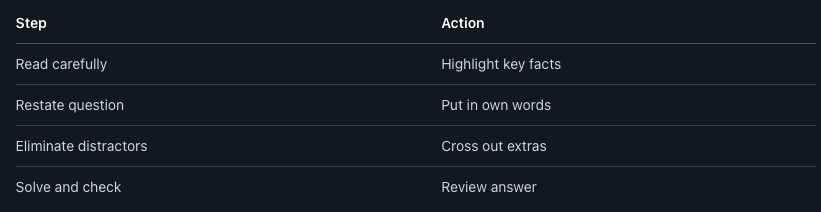
These steps make it easier to manage time and avoid common mistakes during the test.
Practicing With Exam-Style Word Problems
Regular practice with exam-style word problems helps students get used to formats and phrasing used on standardized tests. Students learn to spot what each problem is really asking, often involving more than one step or operation.
Tips for practice:
Use practice tests from previous years or ones provided by the school.
Find problems that require more than one calculation, like those with several steps or extra facts.
Practice writing out all steps, including reasoning, not just final answers.
Exam-style word problems cover different topics like fractions, percentages, or measurements. By seeing many types, students also build problem-solving confidence and reduce test anxiety. Practicing these problems supports better math understanding and raises scores on standardized tests.
Frequently Asked Questions
Solving word problems can help students apply math skills to real-life situations. Using strategies, helpful visuals, and question prompts makes it easier for students to break down complex problems and think critically about their solutions.
What are effective strategies for teaching word problems in mathematics?
Teachers can use step-by-step approaches such as “Read, Understand, Plan, Solve, and Check.” Visual aids like diagrams, math drawings, and number lines often clarify the steps.
Asking students to explain their thinking or solve problems in groups can increase understanding. Daily practice with varied problem types also helps improve skills.
How can math word problems enhance critical thinking skills in students?
Math word problems often require students to identify what information is important, make sense of the data, and choose which operations to use.
They also encourage looking for multiple ways to solve a problem, considering other perspectives, and justifying answers with clear reasoning.
What are some examples of word problems that are particularly effective for building critical thinking?
Problems with extra or missing information make students decide what is relevant. Multi-step problems require more than one operation and force students to plan their approach.
Open-ended problems without only one possible answer also help students use creativity and logical reasoning.
What approaches can be used to teach word problems to special education students?
Breaking problems into smaller, manageable parts can help. Using visual organizers like graphic charts or color-coding important details makes the process clearer.
Guided practice, providing sentence starters, and modeling with think-alouds can support understanding. Offering multiple ways to show thinking, like drawings or objects, adds more support.
Can you recommend any acronyms or mnemonic devices that aid in solving math word problems?
A popular strategy is the C.U.B.E.S. method: Circle the numbers, Underline the question, Box key words, Eliminate extra information, and Solve.
Another is R.U.N.S.: Read the problem, Underline the question, Name the important information, and Solve.
What are the components of a good word problem anchor chart for classroom use?
An effective anchor chart should show clear steps for problem solving, like reading for understanding, choosing an operation, and checking work.
It should include sample keywords, visual strategies (like drawing pictures), and space for sample problems. Using simple language and visuals helps all students refer back to these charts when solving problems.