
Helping Students Understand Algebra Early for Stronger Math Foundations
Understanding algebra early sets the stage for success in school and beyond. Students who begin to grasp algebraic ideas at a young age develop strong problem-solving and logical thinking skills. Helping students understand algebra early means introducing patterns, relationships, and simple equations in ways that are easy to explore and connect to their everyday experiences.

This early start makes algebra less intimidating later. When students see math as a language they can decode, they build confidence and enjoy learning more complex concepts as they grow. Teachers and parents can guide this process by using fun activities and clear explanations that show how algebra relates to real life.
Introducing algebra concepts early also encourages critical thinking and helps students prepare for future math challenges. By focusing on simple ideas and building gradually, young learners become ready to solve problems and think abstractly with greater ease.
Key Takeaways
Early math experiences build a strong foundation for algebra success.
Simple, relatable activities help students grasp algebraic thinking.
Developing algebra skills early supports confident problem-solving later.
The Importance of Early Algebra Education
Early algebra education builds key skills that support success in math and other subjects. It helps students understand arithmetic deeply, closes learning gaps, and opens doors to careers in science, technology, engineering, and math (STEM). Emphasizing algebra from a young age strengthens math fluency and critical thinking.
Academic and Long-Term Benefits
Introducing algebra concepts early helps students grasp math as a connected system rather than isolated topics. It develops algebraic thinking, which includes recognizing patterns, understanding variables, and solving problems with unknowns. These skills make learning Algebra I and other advanced math easier later.
Research shows that students who receive sustained early algebra education perform better in middle and high school math. They can work with complex concepts sooner and with less difficulty. This foundation improves overall problem-solving ability, which is valuable in everyday situations and academic tasks.
Addressing Gaps in Mathematics Learning
Early algebra teaching targets gaps that often appear in math education. It helps students move beyond memorizing facts to understanding why math works. Students learn to use their prior knowledge of arithmetic to reason algebraically.
This approach reduces frustration and math anxiety by making math more logical and less about guesswork. Early interventions also help teachers identify areas where students struggle the most, allowing tailored support to improve understanding.
Influence on Future STEM Opportunities
The skills developed through early algebra education strongly influence the likelihood of pursuing STEM fields. Algebra is a key barrier that many students face; mastering it early increases confidence and readiness for science and technology courses.
Early algebra prepares students for critical thinking and abstract reasoning needed in STEM careers. It encourages a mindset that is comfortable with complex problems and new ideas, which supports success in college and technical training programs.
Understanding Fundamental Algebraic Concepts
Algebra builds on basic math skills and introduces new ideas that help students think logically and solve problems. It involves using symbols to represent numbers and writing rules to describe relationships between these symbols.
What Is Algebra?
Algebra is a branch of math that uses letters and symbols to stand for unknown numbers. This helps make general rules and solve problems without knowing all the details.
It focuses on finding patterns, making predictions, and thinking logically. Students learn to work with expressions, equations, and inequalities. Algebra creates a foundation for higher math and real-world problem-solving.
Understanding algebra means recognizing that math can use symbols to represent numbers and operations. This allows students to work with ideas instead of just specific numbers.
Introducing Variables and Expressions
Variables are symbols, usually letters like x or y, that stand for unknown or changing numbers. Introducing variables helps students think of math in a flexible way.
An algebraic expression combines numbers, variables, and operations (such as +, −, ×). For example, 3x + 5 is an expression where 3 is multiplied by a variable x, and then 5 is added.
Learning to write and interpret expressions allows students to describe problems using symbols. This skill is essential for solving equations later on.
Role of Elementary Arithmetic in Algebra
Elementary arithmetic provides the tools needed to understand algebraic concepts. Skills with addition, subtraction, multiplication, and division help students grasp how algebraic expressions work.
For example, understanding multiplication’s properties helps in simplifying expressions like 2(x + 3). Knowing how division and multiplication relate supports solving equations.
Basic arithmetic also lays the groundwork for recognizing patterns, a core part of algebraic thinking. Without strong arithmetic skills, students will struggle with algebra’s symbolic language.
Developing Early Algebraic Thinking
Early algebraic thinking starts with recognizing patterns, making generalizations, and connecting arithmetic to algebra. Students build skills that help them solve problems and understand relationships between numbers in new ways.
Building Algebraic Reasoning Skills
Students develop algebraic reasoning by exploring patterns and relationships. Teachers use simple activities like identifying number patterns or describing how a sequence changes. For example, students may find that adding 2 each time creates a growing pattern.
Using properties of operations, such as the commutative or distributive property, helps students explain why patterns work. This reasoning supports their understanding of unknowns and variable quantities. Engaging students in explaining their thinking encourages deeper comprehension.
Visual tools and manipulatives can also strengthen algebraic reasoning. These tools make abstract ideas more concrete and help young learners connect symbols to real-world situations.
Cultivating Generalization Abilities
Generalization involves recognizing a rule that applies to many cases, not just one example. Early algebra focuses on helping students see how a pattern or relationship holds true across different numbers.
Teachers guide students to describe patterns using words, pictures, or symbols. For instance, students might express the pattern “add 3” as a rule for any starting number. This bridges concrete experiences with abstract thinking.
By encouraging students to form and test general statements, they develop confidence in using algebra concepts like variables. This skill is key for solving equations and understanding functions later on.
Transitioning from Arithmetic to Algebra
Transitioning from arithmetic to algebra means moving from basic calculations to expressing and solving problems with symbols. Students begin by representing addition or subtraction problems in multiple ways, such as with pictures, numbers, or equations.
Recognizing equivalence, or that two expressions can have the same value, is a bridge concept. For example, knowing 3 + 4 equals 7 helps students understand that x + 4 = 7 means x must be 3.
This shift encourages students to think about why math works, not just how to do it. Teachers often use story problems and hands-on activities to make this change meaningful and accessible.
Strategies for Teaching Algebra to Young Learners
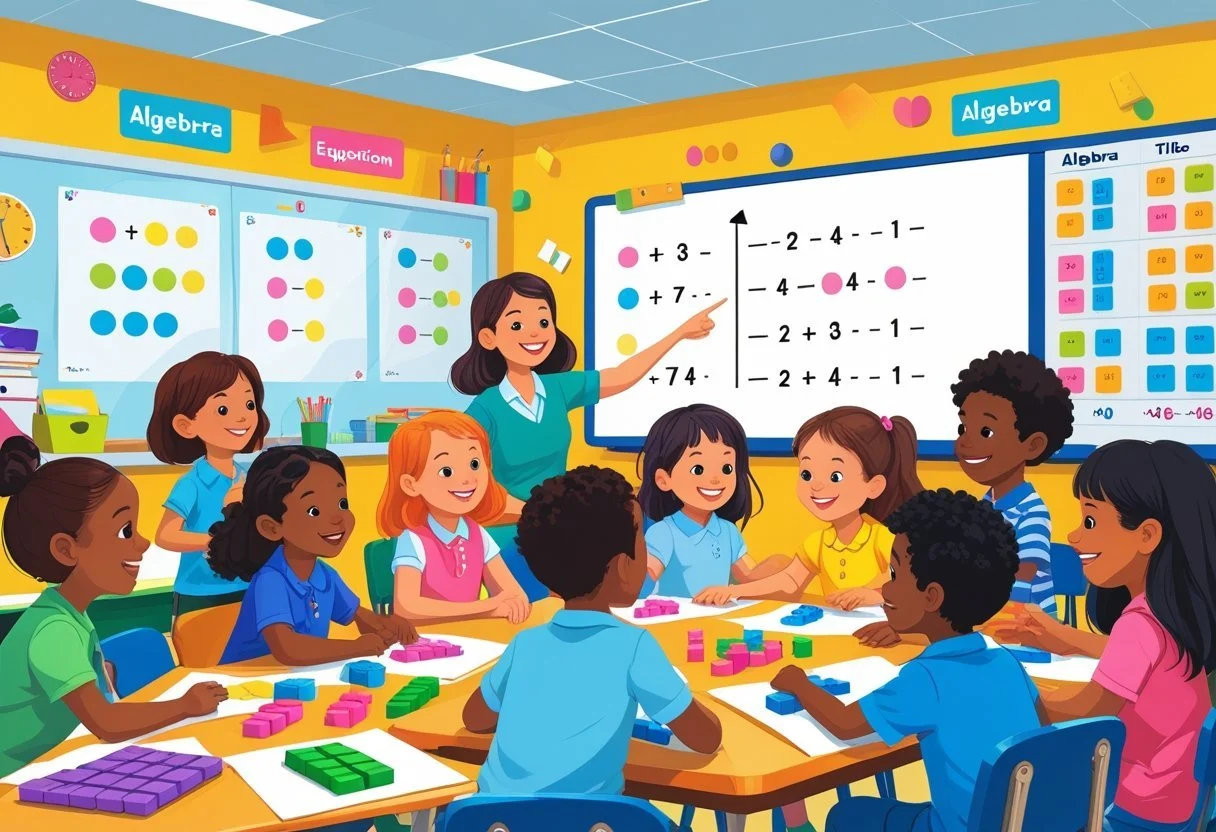
Teaching algebra early requires clear methods that make abstract ideas easy to grasp. Using practical tools, relatable examples, and interactive tasks helps students explore algebraic concepts step by step. These approaches support understanding of expressions and patterns in meaningful ways.
Incorporating Hands-On Activities
Hands-on activities allow students to directly work with math ideas instead of just hearing about them. Using objects like blocks, tiles, or cards, learners can build patterns or represent simple algebraic expressions visually. This makes it easier to see how numbers and variables relate.
For example, students can group tiles to model expressions, such as 3x + 2, by showing three groups of a certain object plus two extra objects. Activities like these connect abstract symbols to concrete items, which supports their grasp of algebraic thinking.
Manipulating items also enhances problem-solving skills by letting students test different solutions. It gives them a chance to explore, make mistakes, and understand concepts deeply rather than memorize rules.
Harnessing Visual and Real-World Examples
Visual aids and real-life contexts help make algebra more understandable. Diagrams, charts, and pictures can turn algebraic expressions into images, showing relationships clearly. For instance, using a balance scale as a visual metaphor can explain how equations work.
Teachers can relate algebra to everyday situations like shopping, cooking, or measuring. Showing how an algebraic expression models a real problem motivates students and aids retention. For example, writing an expression to calculate total cost based on price and quantity connects math to daily life.
Using real-world data increases students’ interest in algebra. It also helps them see that algebra is not just numbers and letters but a useful tool to solve practical problems.
Fostering Engagement Through Games and Quizzes
Games and quizzes provide fun ways to practice algebra skills without feeling like work. Puzzles and challenges that involve recognizing patterns or solving for unknowns keep learners motivated. These activities support memorization and understanding through repetition in an enjoyable format.
Games like matching equivalent expressions or completing number sequences encourage students to identify patterns, a key part of algebraic thinking. Quizzes give quick feedback, helping students spot what they understand and what needs more practice.
Including friendly competition or team challenges can boost participation. These formats allow students to reinforce algebraic concepts while building confidence in their abilities.
Encouraging Collaborative Learning
Collaboration helps students learn by sharing ideas and strategies. Working in pairs or small groups allows them to talk through algebraic problems, explain reasoning, and correct mistakes together. This social interaction deepens their understanding.
Group work supports development of critical thinking by encouraging students to analyze different approaches for expressions or equations. Explaining their thought process helps them internalize algebraic concepts and build communication skills.
Teachers can guide collaboration by assigning tasks that need joint problem-solving, like creating a pattern or simplifying an expression together. This creates a supportive environment where students learn from both peers and instructors.
Progression in Early Algebra Learning
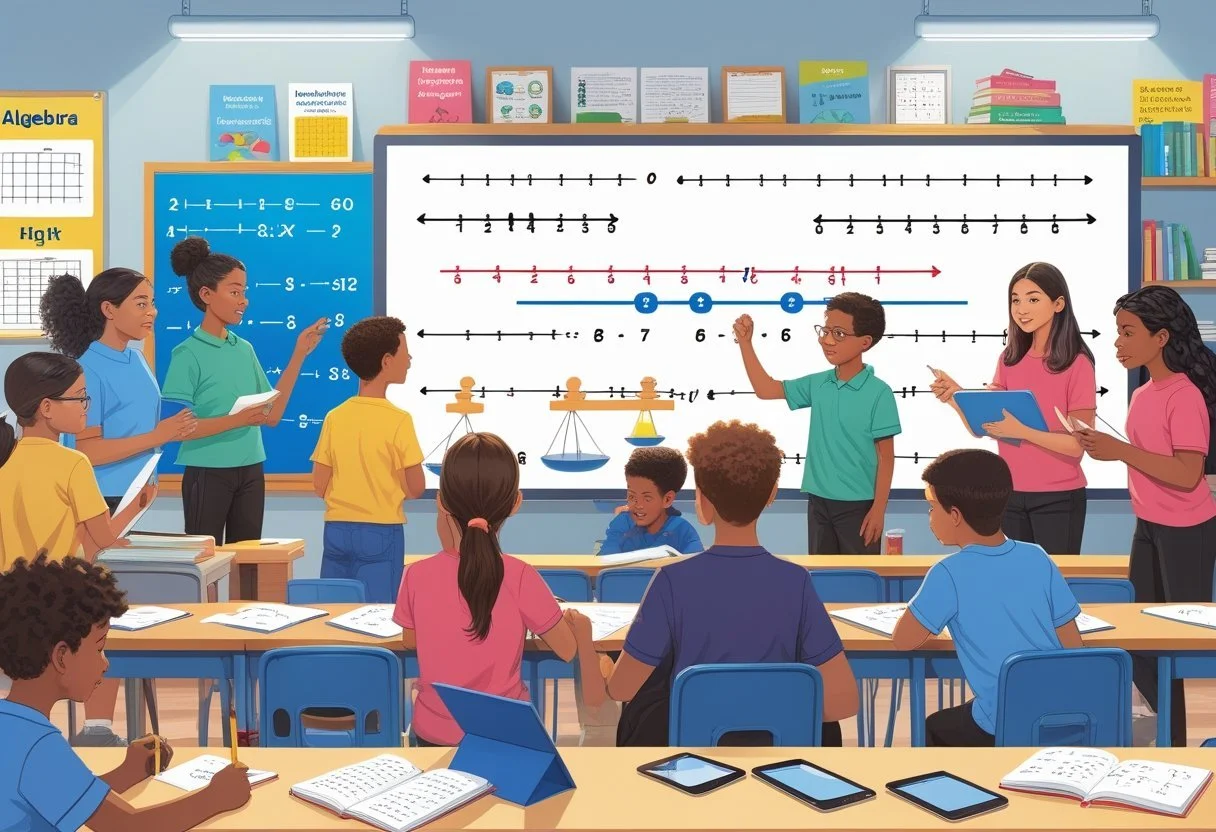
Early algebra learning builds over time as students move from simple patterns to more complex ideas like expressions and equations. It requires clear steps to develop algebraic reasoning, assess readiness, and support different learning needs.
Levels of Algebraic Thinking
Algebraic thinking starts with recognizing patterns and relationships in numbers and shapes. Young students first learn to describe and extend patterns using simple rules.
As they progress, they begin to use symbols to represent unknowns and express generalizations. This stage often includes work with equations and simple functions, helping students connect arithmetic to algebra.
By upper elementary grades, students develop reasoning skills to solve problems involving variables. Gradual exposure to these ideas helps build strong foundations for formal algebra courses later.
Assessing Development and Readiness
Teachers assess early algebra skills by observing how students explain patterns, use symbols, and solve problems. Common tools include tasks that ask students to create rules for number sequences or represent situations with equations.
Formative assessments track progress regularly, guiding instruction to match individual needs. Readiness is measured not just by correct answers but by how students think about problems and use algebraic concepts.
Ongoing assessment ensures students are prepared to handle new algebra ideas without frustration, reducing struggles in middle and high school math.
Supporting Diverse Learners
Supporting diverse learners means providing multiple ways to understand and practice algebra. Visual models, hands-on activities, and math discussions help students with different learning styles grasp abstract ideas.
Teachers can tailor instruction by breaking down concepts into smaller steps and using familiar examples. Tools like manipulatives or interactive technology make algebraic reasoning more accessible.
Recognizing that students progress at different paces, educators must be flexible and patient. Early support helps all students build confidence and skills in algebra, benefiting their future learning.
Key Algebraic Skills: Equations and Problem Solving
Algebra requires understanding how to create and work with equations. Mastery of writing equations, solving them step-by-step, and applying these skills in real situations builds a strong foundation. These skills help students move from simple arithmetic to more complex problem-solving.
Understanding and Writing Equations
Writing equations starts with knowing what variables represent. Variables are symbols, often letters, that stand for unknown numbers. Students learn to translate words into algebraic expressions, like turning "five more than a number" into x + 5.
Equations show relationships between expressions using an equal sign. For example, 2x + 3 = 7 is an equation. It says two times a number plus three equals seven. Understanding this structure helps students organize information clearly.
Using algebraic expressions correctly is important. This includes combining like terms and recognizing how numbers and variables work together. Teachers often use real examples to make this step easier, helping students see why equations matter.
Techniques for Solving Equations
Solving equations means finding the value of the variable that makes the equation true. The first step is isolating the variable. This often involves reversing operations, like subtracting a number to cancel addition.
Students learn key techniques:
Simplify both sides by combining like terms
Use inverse operations to move numbers around
Apply the distributive property when needed (e.g., a(b + c) = ab + ac)
One-step and two-step equations are common starting points. With practice, students can tackle more complex equations involving variables on both sides. Step-by-step work, sometimes using tools or visuals, improves their confidence and reasoning.
Applying Algebra to Real-Life Problems
Algebra connects math to everyday situations. Students use it to solve problems like calculating costs, distances, or time. Translating word problems into equations is a key skill.
For example, if they know the total cost and price per item, they can write an equation to find the number of items. This method encourages critical thinking and helps students see algebra as practical.
By solving real problems, students improve abstract thinking and logical reasoning. This experience supports success not only in math class but also in future careers that rely on problem-solving with variables and equations.
Building a Supportive Environment for Algebra Success
Creating a strong support system helps students feel confident and engaged with algebra. Family involvement and using algebra ideas in different subjects both play key roles. These approaches deepen understanding and show how algebra connects to everyday life and other learning areas.
Engaging Families in Mathematics Learning
Families can boost a student's success in algebra by staying informed and involved. Parents who understand basic algebra concepts can support homework and encourage problem-solving habits.
Schools can offer workshops or simple guides to help families learn key ideas. Clear communication about what students are learning builds trust and shows families how to help without needing to be math experts.
Encouraging families to discuss math positively at home creates a supportive mindset. When students see math as useful and approachable, they are more likely to try and persist with harder topics.
Integrating Algebra Across the Curriculum
Algebra is not just a standalone subject. Linking it to science, technology, and even art classes shows students its real-world uses.
For example, science experiments can use algebra to predict results. Technology classes may apply algebra concepts to coding and data analysis. This integration makes abstract ideas more concrete and meaningful.
Teachers can work together to align lessons, reinforcing the same math concepts in different subjects. This creates consistent learning and helps students see math as a useful tool across their education.
A clear focus on algebra’s role in many fields motivates students and builds a deeper understanding of mathematics education.
Future Directions in Early Algebra Education
Future work in early algebra focuses on improving how students learn key concepts and how teachers are prepared to support this learning. The goal is to make algebra accessible and understandable from a young age, using targeted strategies in both curriculum design and teacher training.
Innovative Curriculum Design
Curriculum development is moving toward creating learning experiences that blend arithmetic and algebra seamlessly. This means students explore patterns, relationships, and unknown values in ways that match their natural thinking.
Programs aim to build on students’ informal understanding of math, turning it into formal algebraic ideas. Materials often include visual tools, puzzles, and real-world problems to engage students while teaching core algebra principles.
Key features include:
Focus on patterns and functions early on
Incorporation of problem-solving tasks that promote reasoning
Use of progressive learning goals to guide sequencing from grades 3 to 5
This approach helps students develop a strong foundation that eases the transition to formal algebra in later grades.
Professional Development for Educators
Effective early algebra education depends on well-trained teachers who understand how to teach algebraic thinking to young learners. Professional development programs are focusing on deepening teachers’ content knowledge and instructional skills.
Training often includes:
Strategies for connecting arithmetic to algebra
Techniques to encourage student reasoning and exploration
Use of formative assessments to track algebra understanding
Ongoing support helps teachers feel confident using new curriculum materials and adapting lessons to student needs. Schools are encouraged to provide time for collaboration where teachers share best practices and review student progress.
This investment in teacher learning ensures that early algebra instruction is consistent and effective across classrooms.
Frequently Asked Questions
Many key ideas in algebra build on each other, starting with simple concepts like patterns and basic operations. Understanding common student mistakes, using different teaching methods, and technology can all help clarify these ideas. Also, age-appropriate problems and support from parents play important roles.
What are the foundational concepts in algebra that should be taught first to students?
Students should first learn about variables as symbols for numbers. They need to understand simple operations like addition, subtraction, multiplication, and division using these symbols. Patterns, equality, and simple equations set a strong base for later topics.
How can educators identify and address common misconceptions in early algebra learning?
Teachers can watch for errors like confusing the equal sign or mixing rules of operations. Asking students to explain their thinking helps reveal misunderstandings. Clear examples and step-by-step instruction can correct these mistakes early.
What are effective strategies to engage students in algebra who have different learning styles?
Using visual aids like graphs or blocks helps learners who think better with images. Hands-on activities and real-world problems work for kinesthetic learners. Discussions and written explanations benefit verbal learners. Mixing these approaches keeps students involved.
In what ways can technology be utilized to enhance algebraic understanding for students?
Interactive apps and online tools can provide immediate feedback and allow students to practice at their own pace. Visual models and simulations make abstract ideas more concrete. Video lessons offer an alternative way to explain difficult concepts.
What are some age-appropriate algebra problems that can help solidify basic algebraic concepts?
Simple puzzles involving unknown numbers, like "Find a number that, when added to 5, equals 12," are effective. Pattern recognition tasks and basic equation solving also build confidence. Problems should be relatable and gradually increase in difficulty.
How can parents support their children's algebra education at home?
Parents can encourage practice by asking simple math questions in daily life. Showing interest in homework and discussing math concepts can motivate children. Providing a quiet, distraction-free place to study helps children focus on learning.