
Introducing Newton’s Laws of Motion with Games for Engaging Physics Learning
Learning Newton’s Laws of Motion can be challenging, but games offer a simple way to make these ideas clear and fun. By using interactive activities, students can see how forces work in real life instead of just reading about them. Games help students understand motion, force, and the way objects react to pushes and pulls by letting them experience these concepts firsthand.
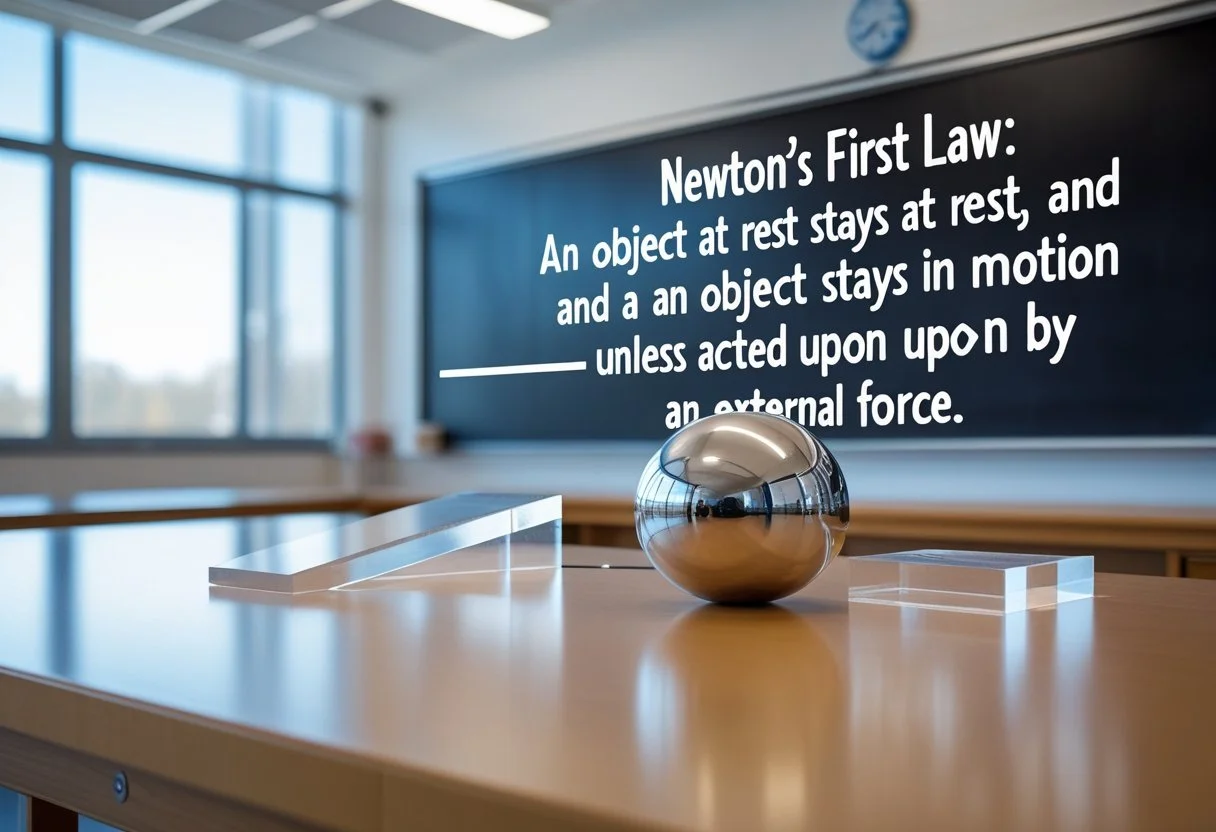
These activities show how Newton's three laws work in action. For example, games can demonstrate why objects keep moving unless a force stops them or how heavier objects need more force to move. They also help explain the relationship between action and reaction in a way that sticks better than just memorizing formulas.
Using games gives students hands-on learning opportunities that connect science to their everyday world. This approach encourages curiosity and helps students think critically about physics through play and exploration.
Key Takeaways
Games make learning about motion and force more accessible and engaging.
Interactive activities clarify how Newton’s three laws work in everyday situations.
Hands-on play fosters better understanding and critical thinking about physics concepts.
The Importance of Using Games to Teach Newton’s Laws
Games help students understand Newton’s laws by making abstract ideas more concrete. They offer clear steps and challenges that help break down complex physics concepts. Using games also boosts focus and memory by actively involving students in learning.
Benefits of Game-Based Learning
Game-based learning lets students explore Newton’s laws through doing, not just listening. It reduces the cognitive load by breaking down each law into simple parts. Students can see real examples of forces, motion, and inertia as they play.
Games encourage problem-solving and critical thinking. For example, a tug-of-war game can show forces in action, while a digital simulation can demonstrate motion laws clearly. These methods help students link theory with real-world examples.
Enhancing Engagement and Retention
Games capture students’ attention better than lectures. They add excitement and variety to lessons on Newton’s laws, making physics less intimidating.
Interactive play creates stronger memories. When students physically test out a law, like pushing a toy car to experience friction or inertia, they remember it longer. It also helps them understand cause and effect, rather than just memorizing terms.
Incorporating Games in the Physics Classroom
Teachers can use games to fit many lesson plans on Newton’s laws. Simple activities like races, building model rockets, or using apps with force simulations work well.
To be effective, games should focus on key physics principles. Clear goals help students connect actions in the game to the laws of motion. Debriefing after gameplay is important to discuss what happened and why.
Using games alongside hands-on experiments creates a balanced, practical approach that supports different learning styles.
Understanding the Basics: Force and Motion
Force and motion are closely linked concepts that explain how objects move or stay still. Both involve direction and magnitude, which affect how and where an object changes its state of motion. Examining forces helps to see why objects start moving, change speed, or stop.
Defining Force and Motion
Force is any push or pull on an object. It has two key parts: direction (where it points) and magnitude (how strong it is). When a force acts on an object, it can change that object’s motion by causing it to speed up, slow down, or change direction.
Motion is the change of an object’s position over time. Without force, an object will keep moving at the same speed and direction or stay at rest. This idea is part of Newton's First Law. Forces cause changes in motion, meaning motion depends on forces acting on an object.
Types of Forces in Everyday Life
Several types of forces work around us all the time. The most common include:
Friction: A force that opposes motion when two surfaces touch.
Gravity: A force pulling objects toward the Earth.
Applied Force: When a person or thing pushes or pulls an object.
Normal Force: The support force from a surface holding an object up.
Each force has both magnitude and direction, and forces can combine or balance each other. When forces balance, no motion changes. When forces don’t balance, objects accelerate or decelerate in the direction of the stronger force.
Newton’s First Law: Teaching Inertia Through Play
Newton’s First Law explains that an object will stay still or keep moving in a straight line unless a force changes its motion. This idea, called inertia, depends on the object’s mass and is affected by friction. Using games can make learning these ideas easier by showing how objects behave in different situations.
Exploring the Law of Inertia
The Law of Inertia means objects resist changes to their motion. A heavy object has more inertia, so it is harder to start or stop moving. An object at rest stays at rest until a force moves it, while a moving object keeps moving until something, like friction or a push, stops it.
Inertia depends on mass. Larger masses need stronger forces to change their motion. Friction also plays a role by opposing the motion and eventually stopping moving objects. Teaching these points helps students understand everyday motion and forces clearly.
Game Ideas for Demonstrating Inertia
Simple games work well to show inertia. One idea is the “Coin and Card” game, where a coin rests on a card placed over a glass. When the card is flicked away quickly, the coin drops into the glass because it resists motion change.
Another game uses toy cars on different surfaces. Students push cars on smooth vs. rough surfaces to see how friction affects motion. This helps show that moving objects will not stop immediately unless friction or another force acts on them.
Connecting Inertia to Real-World Examples
Inertia explains many everyday experiences. For example, passengers in a car lurch forward when it stops suddenly because their bodies want to keep moving. Seatbelts apply a force to stop this motion safely.
In sports, a soccer ball remains still until kicked. Its mass influences how hard players must kick. Friction from the grass also slows the ball down. These examples help students see how inertia and forces work outside the classroom.
Newton’s Second Law: Investigating f=ma in Interactive Activities
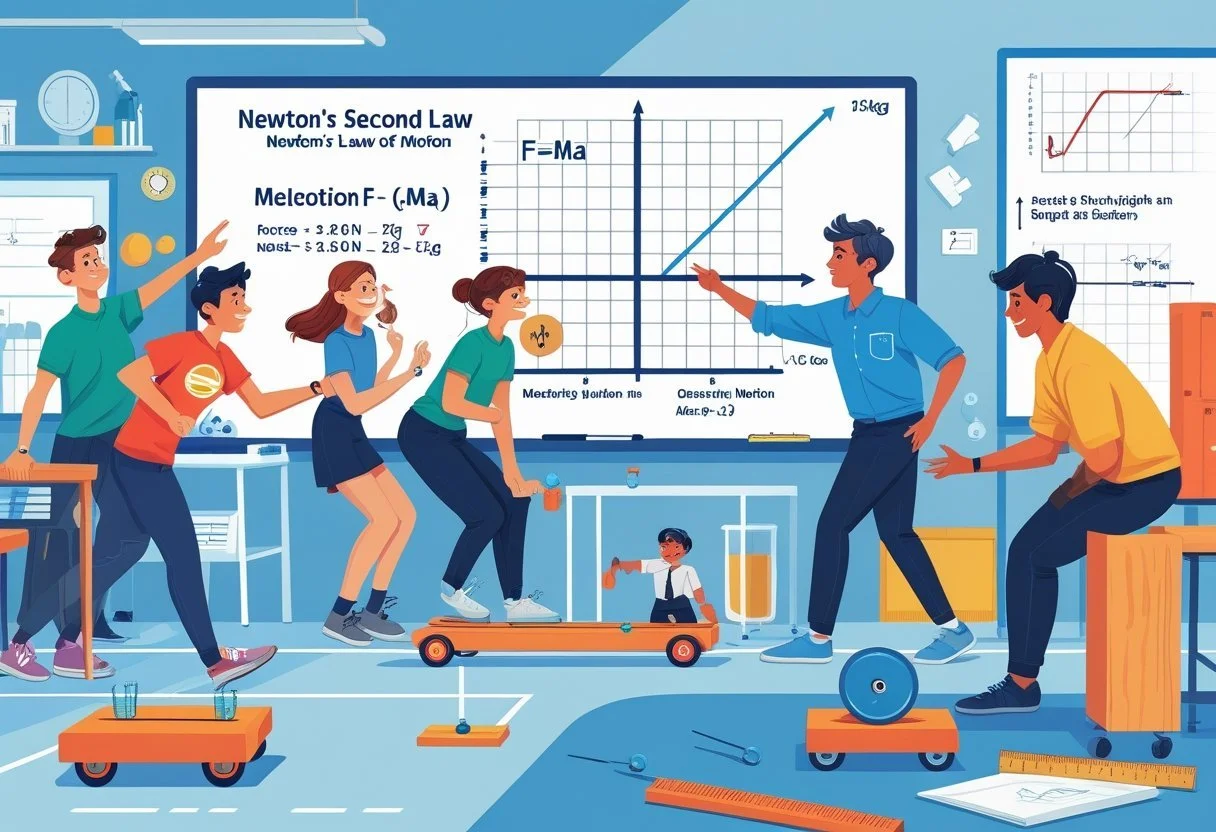
Newton’s Second Law explains how force, mass, and acceleration work together in moving objects. Exploring this law through activities helps learners see how changing one factor affects the others. Understanding the connections between these parts builds clear knowledge of how motion happens.
Relationship of Force, Mass, and Acceleration
Newton’s Second Law states that the net force acting on an object equals the mass of the object multiplied by its acceleration. Expressed as F = ma, this means:
If the force increases, the acceleration increases, assuming mass stays the same.
If the mass increases, the acceleration decreases, assuming force stays the same.
This law helps explain everyday movements. For example, heavier objects need more force to speed up or slow down compared to lighter ones. The acceleration directly depends on the force applied and inversely on the object’s mass. Seeing this relationship clearly guides learners to understand how forces control motion.
Hands-On Games to Model f=ma
Interactive games and experiments are useful tools for exploring Newton’s Second Law. Activities like virtual rocket sleds or force sliders let learners change force and mass values and watch acceleration adjust in real time. These games often include:
Sliders to adjust mass or force
Graphs showing the acceleration result
Tasks to predict how objects will move based on inputs
These hands-on experiences allow students to experiment with Newton’s Second Law without extra materials. They see the cause-and-effect relationship between force, mass, and acceleration directly. This approach strengthens understanding by applying theory in a visual and practical way.
Newton’s Third Law: Action and Reaction Games
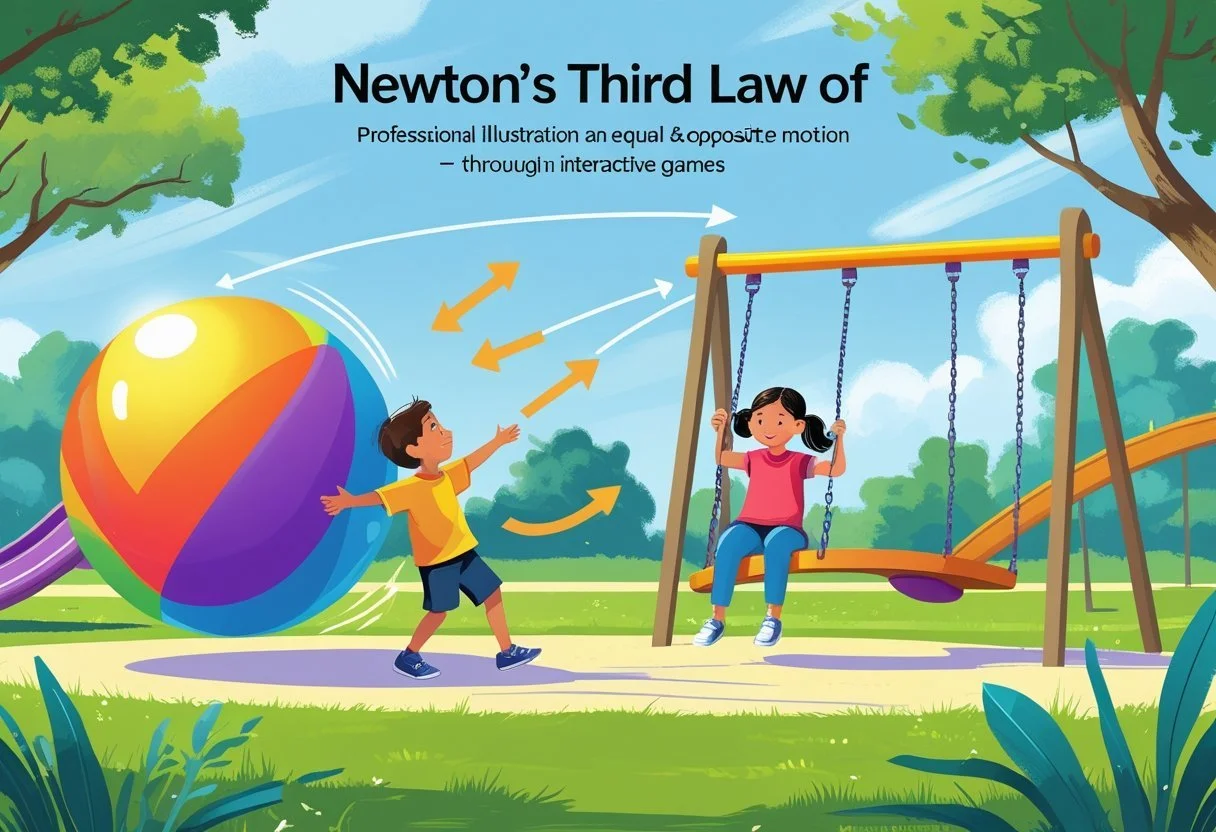
Newton’s third law states that for every action, there is an equal and opposite reaction. This law explains how forces always come in pairs, pushing or pulling in opposite directions. Games that focus on this principle help learners see how balance and force direction work in real situations.
Explaining Equal and Opposite Reactions
The key idea behind Newton’s third law is that forces come in pairs. When one object pushes or pulls on another, the second object pushes or pulls back with the same strength but in the opposite direction.
Games that demonstrate this can include simple activities like pushing off walls or using balloons. For example, when a player pushes against a wall, the wall pushes back, keeping both balanced and showing forces work in pairs. This helps learners understand balance and how forces affect motion.
Using hands-on games lets students feel the forces acting and reacting. It makes the concept of equal and opposite reactions easier to grasp because they experience the force in action.
Cooperative Games to Showcase Third Law
Cooperative games use teamwork to highlight action-reaction forces. One example is a paired tug-of-war, where two players pull on a rope. They feel equal force in opposite directions, balancing the forces between them.
Another game is a water balloon toss. When one person throws the balloon, their hand pushes forward, and the balloon pushes back as it leaves. This shows how forces act in pairs during motion.
These games make students aware that forces always have direction. Players must adjust their balance and positioning to handle the opposing forces, reinforcing how Newton’s third law works in everyday examples.
Key Physics Concepts Reinforced by Games
Games that focus on physics help players see how forces act on objects in clear and hands-on ways. They show how friction slows movement, how speed and velocity describe how fast and where an object moves, and how gravity pulls objects down. These ideas are important for understanding motion and forces.
Understanding Friction and Frictional Forces
Friction is a force that opposes motion when two surfaces rub against each other. Games let players change the amount of friction and watch how it affects movement. For example, sliding a cart over rough or smooth surfaces shows how more friction slows the cart faster.
Frictional force depends on the texture of surfaces and the weight pressing them together. By experimenting, players learn that higher friction means more resistance to motion.
This helps players grasp why it’s harder to move objects on rough surfaces compared to smooth ones. Learning about friction through games is useful because it connects theory with real experiences.
Exploring Speed and Velocity
Speed measures how fast something moves without direction, while velocity includes both speed and direction. Physics games often challenge players to control speed and choose paths to reach goals quickly.
Players can see the difference between moving fast straight ahead (high speed and velocity) and changing direction even at the same speed (velocity changes). This clarifies why velocity is a vector while speed is a scalar.
Games also show how acceleration changes speed and velocity. Players might watch objects speed up or slow down as forces act, reinforcing how acceleration influences motion over time.
Investigating Effects of Gravity
Gravity is a force pulling objects toward the Earth or other large bodies. Many interactive games simulate gravity by letting players drop or launch objects and observe their paths.
Games show that gravity causes objects to fall with increasing speed, but it shapes motion too. For example, a rocket sled or skydiver’s falling speed changes with gravity and air resistance.
This hands-on approach helps players understand concepts like free fall, acceleration due to gravity, and how gravity affects trajectory and motion. It makes learning about gravity direct and easy to visualize.
Designing Effective Games for Learning Newton’s Laws
Games for teaching Newton’s laws should combine clear science concepts with interactive, hands-on tasks. The activities must engage students actively and encourage them to explore forces, motion, and reactions. Practical steps include ensuring safety, planning how the game fits the lesson, and finding ways to check students’ understanding.
Creating Safe and Educational Activities
Safety is the first priority when designing games that involve motion. Activities like paper airplane races or egg drop challenges work well because they use simple materials and low risk setups.
Materials should be non-toxic and easy to handle. A clear explanation of rules minimizes accidents and keeps students focused on learning physics.
Each game should highlight one or more of Newton’s laws. For example, a tug-of-war demonstrates Newton’s third law clearly. Games that include motion, force, and balance encourage students to see physics in real time.
Tips for Classroom Implementation
Teachers need to prepare the space and materials before starting. Group students to allow teamwork and discussion about the science behind the game.
Instructions must be clear, with step-by-step guidance linking the activity to concepts like inertia or acceleration. Time limits help keep students focused and the lesson on track.
Using simple tools like stopwatches or rulers adds measurement and data collection, reinforcing physics concepts. Teachers should circulate to answer questions and guide observations about Newton’s laws.
Assessment and Reflection Techniques
Assessments can be informal and interactive. Observing how students explain the cause and effect during activities reveals their understanding.
Reflection questions after games might include: "How did force affect movement?" or "What did the results show about Newton’s first law?" These encourage deeper thinking.
Written or oral quizzes can cover key terms and laws. Using diagrams or doodle notes helps visual learners connect theory with what they experienced in the game. Regular review ensures the concepts stick.
Frequently Asked Questions
Games help students see Newton’s laws in action by using motion and forces in a visual way. They can link theory to real movement and provide interactive examples that make physics easier to grasp.
How can video games help in understanding Newton’s Laws of Motion?
Video games often simulate forces like gravity, friction, and acceleration, showing how objects move under different conditions. This lets players observe the impact of Newton’s laws firsthand.
Games also encourage experimentation, where players can test how changing variables like force or mass affects motion.
What are some educational games that incorporate Newton’s laws effectively?
Several games use Newton’s laws as core concepts, such as physics puzzle games and rocket sled simulators. These games challenge players to apply force and motion principles to succeed.
Interactive apps like digital lab simulations also offer scenarios to practice and learn the laws in a controlled environment.
In what ways do physics-based games simulate real-world motion?
These games use physics engines that model forces and interactions between objects accurately. They calculate how objects accelerate, collide, and respond to forces like friction or gravity.
This approach keeps game physics consistent with real laws, producing believable object behavior.
What educational outcomes can be expected from using games to teach physics?
Players develop deeper conceptual understanding and gain practical experience with motion and forces. It improves problem-solving skills and supports retention by making abstract ideas concrete.
Games also increase engagement and motivation to learn science.
How do game developers ensure accurate representation of physics in their games?
Developers use physics calculations based on real formulas to mimic motion. They often test and refine the game's physics engine to match expected results from Newton’s laws.
Some games consult educators or scientists to keep simulations true to real-world behavior.
Can you recommend any interactive activities that demonstrate the principles of Newton’s Laws?
Using rockets or toy cars to show acceleration and force is effective. Building simple machines or experimenting with objects on inclined planes also helps.
Digital tools like free-body diagram interactives and motion simulators provide hands-on practice with the laws.


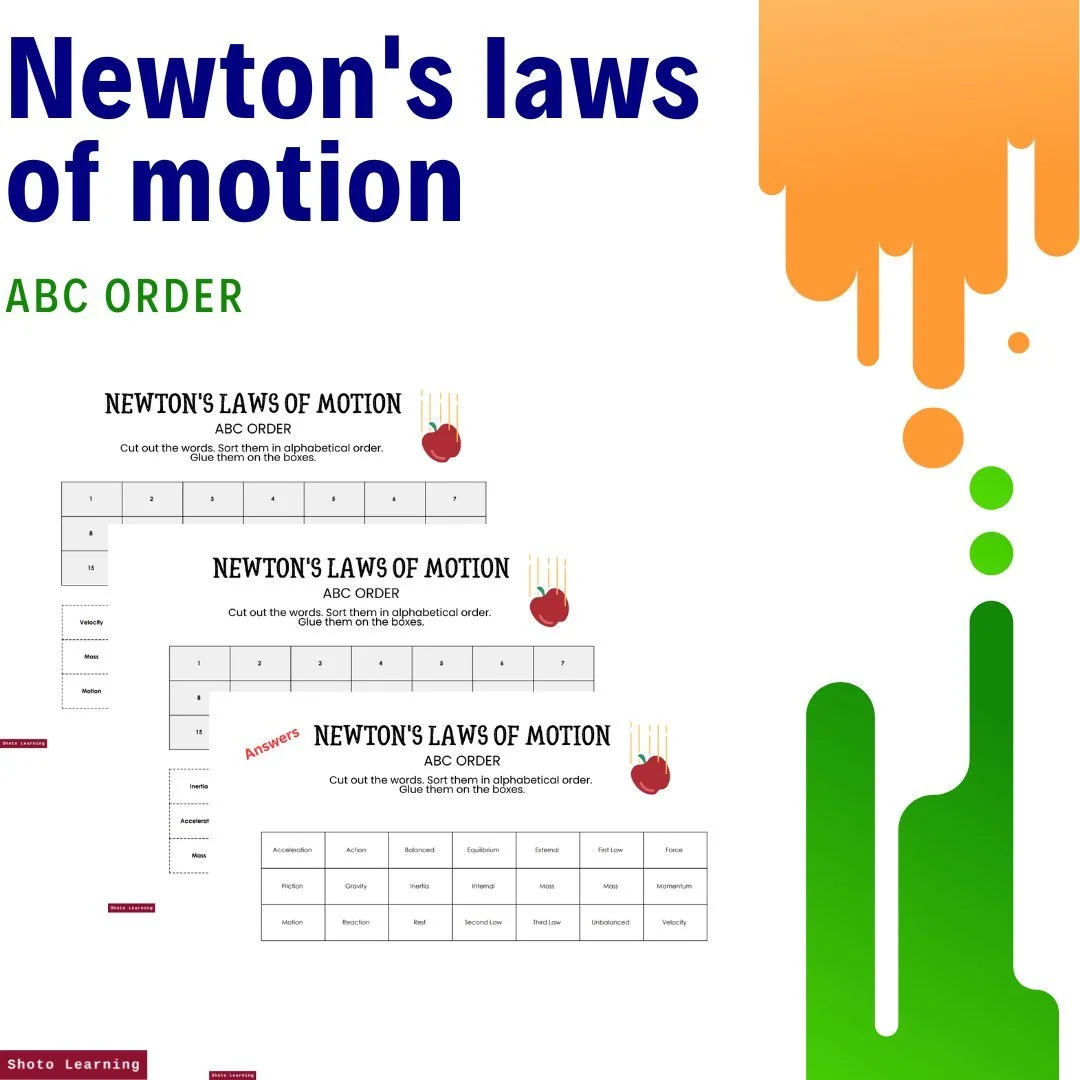

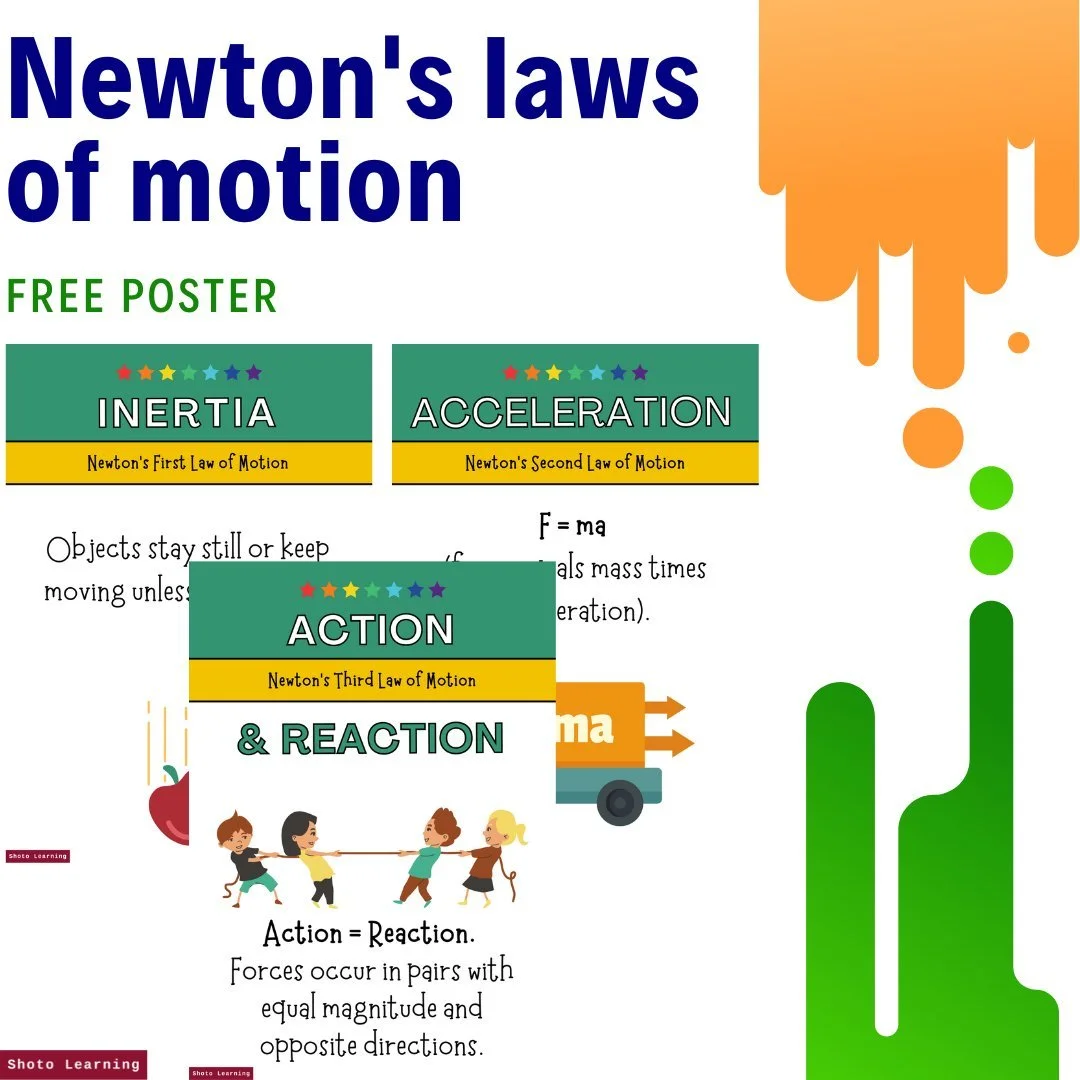


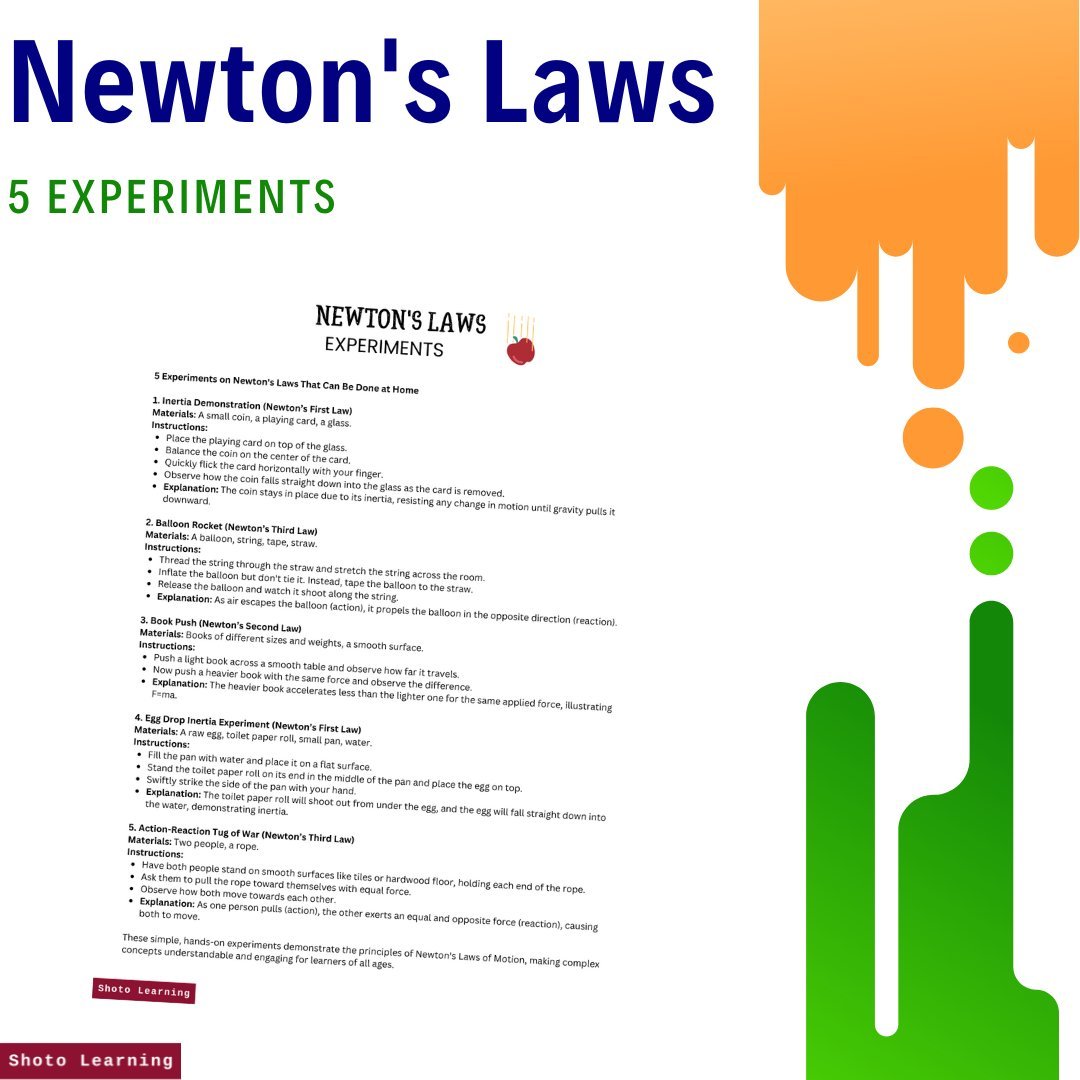


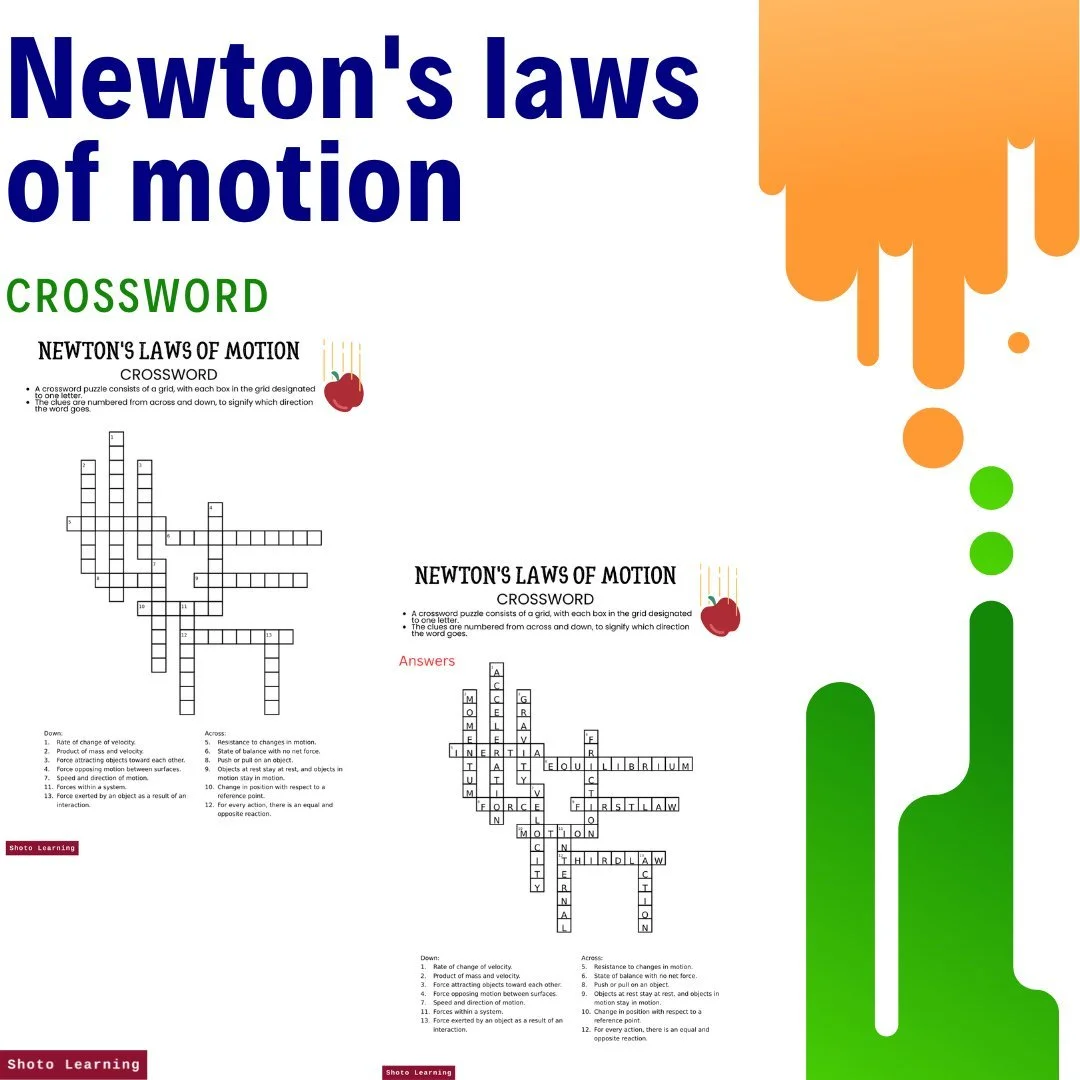


This bundle includes a variety of activities and resources to help students learn about Newton's laws of motion. The activities are designed to be engaging and interactive, and they cover all three laws of motion.
The activities include:
Assignments: Embark on 10 stimulating assignments covering diverse topics, encouraging critical thinking and practical application of knowledge.
Bingo: Students will play a bingo game to review the concepts of Newton's laws of motion.
Crossword: Students will complete a crossword puzzle to learn about the terms associated with Newton's laws of motion.
Cryptogram: Students will solve a cryptogram to reveal a hidden message about Newton's laws of motion.
Debate: Students will debate the merits of two different perspectives on Newton's laws of motion.
Experiments: Explore hands-on experiments illustrating fundamental principles across various disciplines, fostering deeper understanding and engagement.
Fill in the Blank: Students will fill in the blanks in a passage about Newton's laws of motion.
Flash Cards: Students will use flashcards to review the concepts of Newton's laws of motion.
Free ABC Order: Students will order the letters of Newton's three laws of motion in alphabetical order.
Free Maze: Students will solve a maze to learn about the forces that act on objects in motion.
Free Poster: Students can print out a free poster to display in their classroom.
Lesson Plan: Dive deep with our detailed lesson plan, complete with engaging activities and discussion topics.
Matching: Students will match the terms associated with Newton's laws of motion with their definitions.
Missing Letters: Students will fill in the missing letters in a word puzzle about Newton's laws of motion.
Multiple Choice: Students will answer multiple-choice questions about Newton's laws of motion.
PowerPoint: Students can use this PowerPoint presentation to learn about Newton's laws of motion.
Questions and Answers: Students will answer questions about Newton's laws of motion.
Reading Comprehension: Sharpen reading skills with engaging passages, perfect for students and educators alike.
Scramble: Students will unscramble words related to Newton's laws of motion.
Spin Wheel: Students will spin a wheel to answer questions about Newton's laws of motion.
Test 45 Minutes: Students will take a 45-minute test to assess their understanding of Newton's laws of motion.
True or False: Students will answer true or false questions about Newton's laws of motion.
Word Search: Students will find words related to Newton's laws of motion in a word search puzzle.
Writing Prompts: Students will write about their understanding of Newton's laws of motion.
This bundle is a great way for students to learn about Newton's laws of motion in a fun and engaging way.
133 pages
Order your copy today!