
Real-Life Math Projects for Students: Engaging Activities to Enhance Learning
Math is all around us, from the way we plan a grocery trip to how we measure space for new furniture or save money for something special. Real-life math projects help students connect abstract concepts to daily situations, making math more useful and easier to understand. By working on hands-on projects, students often see the purpose of what they're learning and can build critical thinking and problem-solving skills.
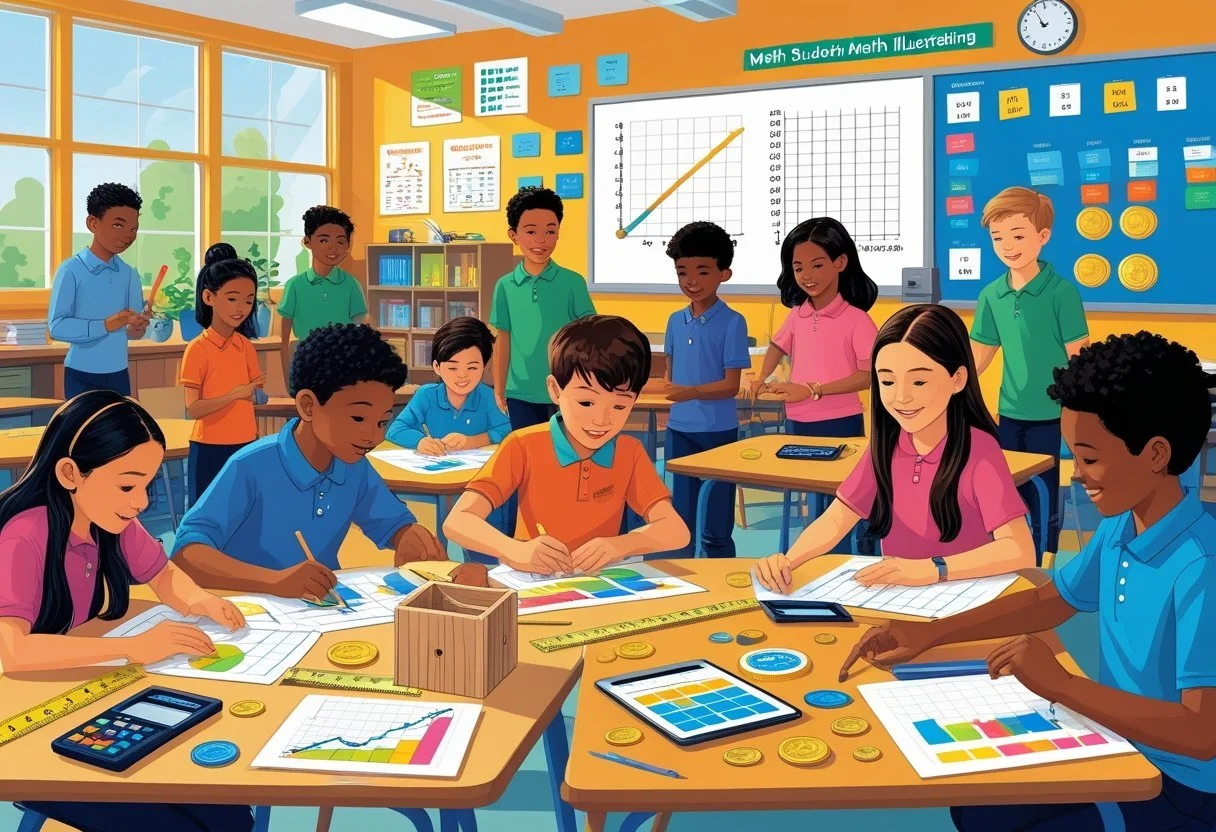
With real-life math projects, learners use math to tackle tasks that matter in the real world, like budgeting, measuring for a project, or analyzing data. These projects encourage creativity, teamwork, and a deeper understanding of numbers and patterns.
Key Takeaways
Real-life math projects link math lessons to everyday experiences.
Students gain practical problem-solving and collaboration skills.
Hands-on projects make math more engaging and meaningful.
What Are Real-Life Math Projects?
Real-life math projects help students understand how mathematics is used outside the classroom. They often use hands-on activities and real-world situations to make learning practical and engaging.
Definition and Purpose
Real-life math projects are activities where students apply math skills to situations they might face in everyday life. These projects often take the form of open-ended tasks, puzzles, or real-world problems.
The main purpose is to bridge the gap between mathematical theory and daily experiences. Students learn how concepts like fractions, percentages, or geometry matter beyond worksheets and exams.
These projects are designed to boost student engagement by showing the value of math in decision making, planning, and problem solving. They encourage students to use critical thinking, analyze results, and develop a deeper understanding of mathematical ideas.
Types of Math Projects
There are many types of real-life math projects, each with a specific focus. Some common examples include:
Budget Planning: Students create a weekly or monthly budget, tracking expenses and income.
Survey Analysis: Students collect and analyze data from surveys about their school or community.
Measuring Projects: Projects like building a birdhouse or planning a garden use measurement, area, and volume.
Statistics Projects: Students graph and interpret data from sports scores, weather reports, or class votes.
Shopping Simulations: Calculating discounts, tax, and totals during a simulated shopping trip.
These activities can be individual or group tasks and often connect to other subjects like science or social studies.
Benefits for Students
Real-life math projects offer several benefits to students. They make abstract math ideas more concrete, helping students see the purpose behind what they are learning.
By using hands-on tasks and real data, students develop stronger problem-solving skills. They learn how to analyze information and make informed decisions.
Projects improve student engagement because the work feels meaningful. Collaborative projects also help students practice communication, teamwork, and critical thinking. These experiences can make math less intimidating and more enjoyable for a wide range of learners.
Getting Started With Real-Life Math Projects
Real-life math projects connect concepts to actual situations and encourage students to solve problems they might find outside the classroom. These projects can improve engagement, help build key problem-solving skills, and make math feel useful in daily life.
Identifying Everyday Math Applications
Teachers and students should start by noticing where math shows up in normal routines. This could be in buying groceries, cooking, planning a trip, or measuring materials for building.
Examples include tracking spending, following recipes, or comparing cell phone plans. When math is tied to real tasks, students see its value and purpose.
Many teachers create simple lists of daily activities and ask students which ones involve math. Asking students to share times they used math outside school also helps everyone find more examples. This step shows that math isn’t just for tests but for making practical choices and solving real problems.
Choosing Suitable Project Topics
Selecting the right project ideas helps keep students interested and motivated. Good topics match students’ age, skill level, and real-world concerns.
For middle school students, popular ideas include:
Budgeting for a family meal
Planning a class event with a set amount of money
Measuring distances for a sports field
Comparing prices for new shoes from different stores
Teachers can let students pick from a list or brainstorm their own ideas. The best topics are ones where math is needed to make a decision, plan, or complete a task. Clear instructions, materials, and real data should be used whenever possible to keep projects focused and practical.
Collaboration and Communication
Working in groups builds teamwork and helps students communicate their ideas. When students work together, they can compare different ways to solve a problem and explain their thinking to each other.
Teachers may assign roles like recorder, group leader, or presenter to keep groups organized. Students should be encouraged to ask questions and listen to everyone in the group.
Class discussions after a project give students a chance to share their process and results. Presenting findings also helps develop speaking, listening, and reasoning skills, making the learning experience more complete and interactive.
Creative Math Projects in Geometry and Measurement
Students can better understand geometry and measurement through hands-on projects that connect math to daily life. Using creative activities like design, art, and real-world tasks, students develop practical skills and see math in action.
Geometric Design in Architecture
Architecture relies on geometric design to create sturdy, beautiful buildings. Students can explore this by studying how shapes like triangles, rectangles, and arches make structures both strong and visually appealing.
A hands-on project might be building a small model of a bridge or a house. Students measure and cut materials, ensuring the structure balances support and symmetry. This shows how mathematical art and precision are critical for real construction.
Learners often compare real landmarks for inspiration. Famous examples include the use of domes, pyramids, and columns. By sketching floor plans or creating blueprints, students learn about scale, angles, and area, linking math with creative thinking.
Exploring Measurement in Real Settings
Measurement is part of everyday life. Students can practice by measuring rooms, furniture, or outdoor spaces, then using these numbers to solve problems or make improvements.
A common project includes designing a school garden, where students calculate perimeter and area to plan the layout. They use standard and metric units, applying math to real choices, such as how much soil or fencing is needed.
Field trips or home surveys also work well. Students might track walking distances with measuring tapes or create a table of their data:
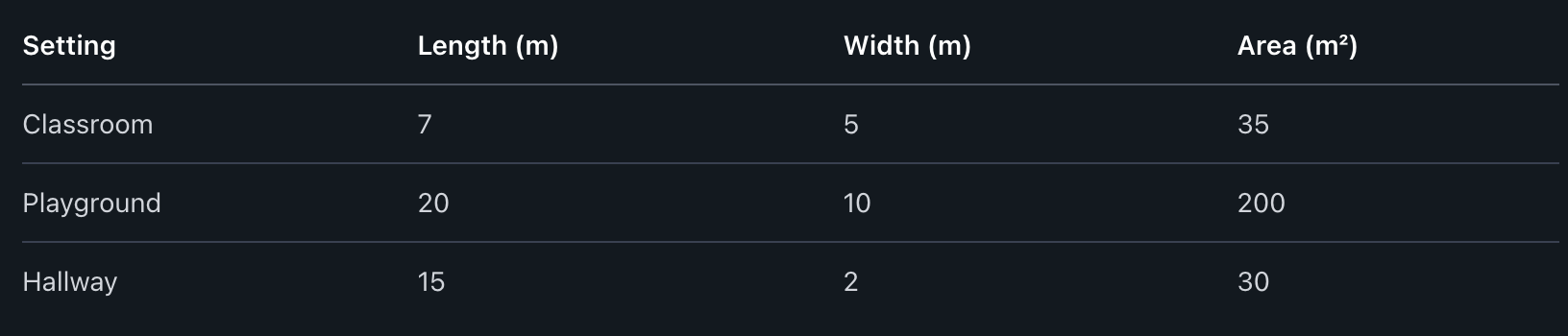
These projects help develop estimation, unit conversion, and spatial sense.
Fractals and Tessellations
Fractals are repeating patterns that look the same at any scale. Tessellations use repeated shapes to fill a space with no gaps. Both ideas blend math and art, making them popular choices for creative projects.
Students can create fractals by drawing shapes like triangles inside triangles (the Sierpinski triangle) or making branching patterns. This helps them see repetition, self-similarity, and geometric rules in action.
Tessellation projects involve making designs using only polygons like squares, hexagons, or triangles. Students experiment with how these shapes fit together and design colorful patterns.
These activities encourage creativity and attention to detail, while reinforcing properties like symmetry, rotation, and translation in geometry.
Applied Data Analysis and Statistical Projects
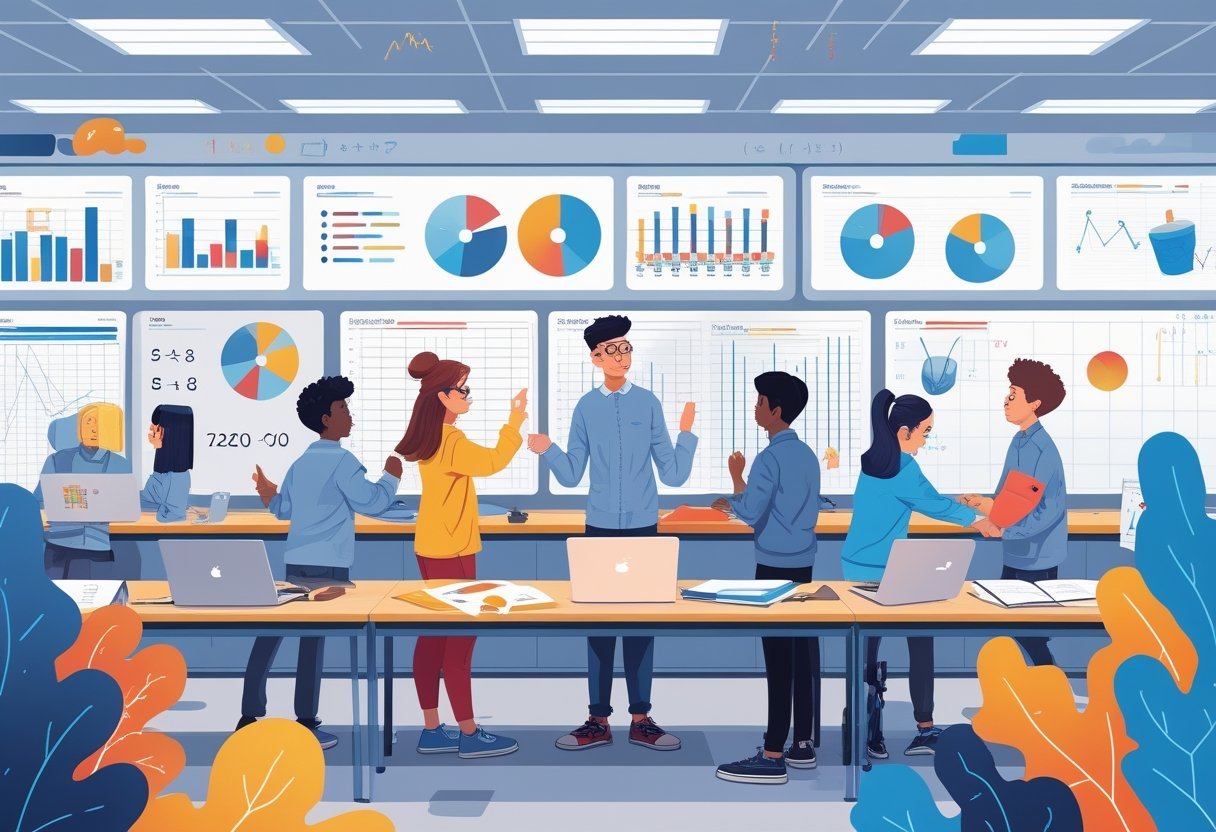
Students often use real-life data to ask questions, test ideas, and understand patterns. These projects help them make sense of everyday situations by gathering information, analyzing it, and building simple mathematical models.
Real-World Data Collection
Collecting data from the real world teaches students how to design a survey, conduct observations, or gather facts from reliable sources. For example, they might record students’ favorite school subjects or count cars passing their street at certain hours.
A well-organized data collection process involves choosing a sample group, creating clear questions, and noting answers carefully. Students learn to avoid bias and to check for errors in their results.
Popular data collection activities include:
Surveying classmates about screen time or daily habits
Tracking weather changes over a month
Monitoring attendance or on-time arrivals to school
These activities let students see how numbers reflect what happens around them.
Statistical Analysis for Decision Making
Once data is gathered, students use statistical analysis to draw conclusions. They calculate measures of central tendency such as mean, median, and mode to describe what is typical in their group.
Statistical analysis helps students spot trends and answer questions like, “Do students who study more hours get higher grades?” Hypothesis testing and simple probability models can be used to make predictions or test theories.
Decision-making projects might include:
Comparing test scores before and after a review session
Analyzing spending habits in different grade levels
Studying results from a school’s recycling program
These steps help students understand how data supports or challenges what they expect, building mathematical modeling skills.
Visualizing Mathematical Patterns
Visualizing data makes complex information easier to understand. Students use charts, graphs, and tables to show the results of their analysis.
Common visualizations include:
Bar graphs comparing survey answers
Line graphs showing trends over time
Pie charts to illustrate parts of a whole
Creating these visuals helps students see mathematical patterns they might miss in raw numbers. It also teaches them how to communicate results clearly and accurately.
Well-designed graphs and charts turn data into useful information, guiding decisions and deeper analysis.
Financial Mathematics and Planning Projects

Financial mathematics helps students learn about managing money in ways that matter to their everyday lives. These projects encourage skills like budgeting, making choices with money, and understanding how investing works.
Budgeting Exercises
Budgeting exercises let students practice planning and making decisions about money. For example, students can work with a monthly budget where they get a set amount to spend on rent, food, clothes, and school supplies.
They might use simple addition and subtraction to keep track of their spending and save for future needs. Teachers often include tasks like paying pretend bills or comparing the costs of different products.
Students can build a budget table that lists sources of income and all possible expenses. This promotes thinking about needs versus wants and learning how small choices add up over time. Budgeting projects make financial planning real and relatable for students.
Exploring Financial Literacy
Learning about financial literacy includes understanding key ideas such as saving, spending, borrowing, and the basics of credit. Teachers may use stories or real-world scenarios so students can practice making smart money decisions.
Hands-on projects could include preparing a simple personal spending report or a savings plan for a special goal. Students can discuss terms like interest and loans in class and calculate how much borrowing money truly costs over time.
Using interactive activities, students build the skills needed to make informed financial choices. Lessons tie in math skills, especially with percentages and fractions, to explain taxes or discounts. This makes the connection between math and real life much clearer.
Stock Market Simulations
Stock market simulations give students a chance to explore investing without any real risk. In this type of project, they are given virtual money to "buy" and "sell" stocks.
They track how their investments grow or shrink over time, learning how the stock market works and what can affect stock prices. Students often record their trades and calculate their returns using addition and subtraction.
This experience helps them understand financial planning for the long-term. Concepts like diversification, risk, and profit are introduced, helping students see both the potential benefits and the challenges of investing. Stock market simulations make financial literacy active and engaging.
Interdisciplinary and Advanced Math Applications
Math reaches far beyond textbooks—appearing in art, nature, technology, and social problems. By exploring these real-world connections, students see the value of mathematical ideas across different parts of life.
Mathematics in Art and Nature
Patterns found in nature, like the spiral shapes in sunflowers and shells, often follow the Fibonacci sequence. Artists use these patterns to create pleasing artwork, a process called mathematical art.
Many famous artists, such as M.C. Escher, used geometric shapes and symmetry to craft unique pieces. The golden ratio, linked to the Fibonacci sequence, pops up in painting, architecture, and photography.
Students might explore nature walks to identify shapes and sequences in leaves, pinecones, or flower petals. Projects could include designing geometric tessellations or analyzing famous works of art for symmetry and proportion.
Game Theory and Cryptography
Game theory studies how people make decisions in competitive situations. It can explain simple games like rock-paper-scissors or complex strategies in economics and business. Concepts like “payoff matrices” and “prisoner's dilemma” help students think logically about choice and risk.
Cryptography is the science of coding and securing messages. Algebra and number theory play a role in secret codes, from Caesar’s old ciphers to today’s internet encryption. Projects can involve sending messages in code, cracking puzzles, or discussing how encryption keeps data safe online.
These advanced topics give students hands-on experiences with logical strategy, problem-solving, and digital safety.
Social Networks and Modeling
Math helps explain how people and things connect, using ideas from network science. Social networks show how groups of friends, classmates, and even global communities interact. Real-life models use graphs and nodes to show these links.
Modeling can reveal how ideas or trends spread through a group, like viral videos on social media. Students can create friendship graphs or simulate message passing in a network.
This kind of project teaches about connections, influence, and how math can predict real patterns in society. Simple models can be built with paper, string, or software to visualize these real-world relationships.
Tips for Successful Math Projects
Supporting student creativity and offering useful feedback helps make math projects more meaningful. When teachers focus on both creative freedom and careful assessment, students gain a stronger understanding of how math relates to their lives.
Encouraging Creativity
Creative math projects let students try new approaches and solve problems in their own way. Teachers can boost creativity by allowing students to pick from a list of project ideas, such as designing budgets for events, measuring parts of a room, or creating surveys. This helps students see that math can solve real questions.
Flexible rules help students experiment without fear of mistakes. They can show work using charts, drawings, or even short videos. Group work and open-ended questions make projects more engaging and allow for teamwork. Teachers should set clear goals but give space for original thinking.
Ideas to Encourage Creativity:
Let students choose project topics
Allow use of art, graphs, or presentations
Encourage real-world investigations
Support group brainstorm sessions
Assessment and Reflection
Assessment makes it clear how students can improve. Teachers should use rubrics to lay out what is expected. A good rubric includes points for teamwork, planning, math skills, and how well the project connects math to real life. Sharing the rubric before starting helps students focus their efforts.
Reflection is just as important as grading. After finishing, students should discuss what they learned, where they struggled, and what they would do differently. Written journals, short presentations, or checklists make reflection easy. Teachers can ask guiding questions, such as:
What math idea did you use?
How did the project help you understand it?
What would you change if you did it again?
This process makes sure that students not only finish the project but also understand what they accomplished and how to grow for the next time.
Frequently Asked Questions
Real-life math projects help learners make meaningful connections between classroom lessons and practical uses. Students of all ages can benefit from activities that use math in everyday scenarios like budgeting, cooking, engineering, and problem-solving.
What are some engaging math project ideas for high school students?
High school students can analyze shopping data to compare prices, calculate discounts, or design a home budget. They can build scale models using geometry, track sports statistics, or explore how interest rates affect savings and loans.
Projects like planning a road trip involving distance, gas costs, and time management combine several math concepts. Creating surveys and analyzing the results teaches statistics and data interpretation.
How can middle school math projects be connected to real-world applications?
Middle school students can apply math by measuring ingredients for recipes or planning a school event budget. Mapping out classroom seating or organizing a class fundraiser teaches about area, percentages, and predictions.
They might also keep a weather log, graph temperature changes, or estimate distances to local landmarks. Using math for art projects like tessellations connects creativity with mathematical patterns.
Can you suggest some real-world math activities suitable for elementary students?
Elementary students can estimate the number of candies in a jar, measure classroom objects, or keep track of reading minutes with graphs. They can use addition and subtraction to shop within a set budget, or practice fractions by slicing pizzas or fruit.
Counting steps during a walk and tracking daily weather are other options that use numbers in daily life.
What types of mathematics projects can college students undertake that have practical relevance?
College students can conduct statistical surveys, analyze economic indicators, or create financial models for small businesses. Data science projects using real datasets are popular.
They might use calculus to optimize resources or build and test physics models. Simulating traffic flow, predicting population growth, or studying the spread of diseases with mathematical models are practical college-level projects.
How can mathematics be made interesting through real-life application projects?
Using topics like personal finance, architecture, cooking, or sports statistics can show the importance of math in everyday choices. Hands-on tasks, such as building structures or analyzing current events, make math more relatable and less abstract.
Working in groups or comparing findings encourages discussion and deeper understanding.
Where can I find downloadable PDF resources for real-life math projects?
Educational websites, school district pages, and teacher resource sites often provide free PDFs on math projects. Platforms like Edutopia, Teachers Pay Teachers, and Math-Drills offer ideas and worksheets.
Libraries and official education department sites also share downloadable resources. Always check that the materials fit the right grade level and project goal.