
Skip Counting Mastery: Engaging 1-100 Missing Number Charts & Worksheets for Learning - Essential Tools for Elementary Math Skills Development
Skip counting is a fun and effective way to build strong number sense in young learners. When children master skip counting with 1-100 missing number charts, they develop important math foundations that help them throughout their education. These engaging activities help students recognize number patterns, which improves their counting skills and prepares them for multiplication concepts later on.
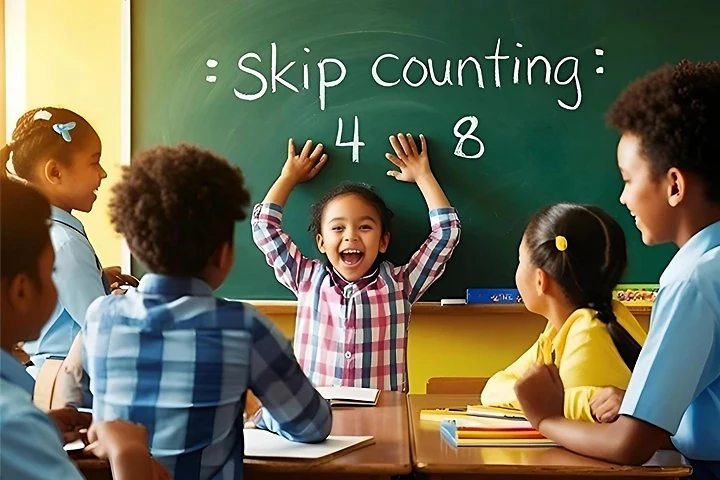
Learning to skip count isn't just about memorizing sequences. It's about understanding the relationships between numbers and developing confidence with math. Missing number charts provide the perfect challenge for students to practice their skills while having fun solving number puzzles.
Key Takeaways
Skip counting activities using missing number charts build essential pattern recognition and number sense for young mathematicians.
Regular practice with skip counting worksheets helps children develop counting fluency and prepares them for more advanced math concepts.
Using engaging number charts creates a positive math learning experience that strengthens children's confidence in their numerical skills.
The Fundamentals of Skip Counting
Skip counting builds a strong foundation for mathematics by creating patterns and sequences that help children understand number relationships. This essential skill connects to many mathematical concepts and makes learning numbers more efficient.
Defining Skip Counting
Skip counting means counting forward by numbers other than one. Instead of saying "1, 2, 3, 4," a child might count by twos: "2, 4, 6, 8." This method creates predictable patterns that help children see how numbers relate to each other.
Common skip counting patterns include counting by 2s, 5s, 10s, and 3s. Each pattern has unique applications in mathematics.
Counting by 2s helps children recognize even and odd numbers. Counting by 5s makes telling time easier. Counting by 10s builds place value understanding.
Skip counting also helps children visualize number patterns on a number line or chart. These visual representations strengthen their number sense.
Importance in Mathematical Foundation
Skip counting prepares children for more advanced math concepts. It creates a bridge between basic counting and multiplication.
When a child counts "5, 10, 15, 20," they're building the foundation for understanding that 5 × 4 = 20. This connection makes multiplication more intuitive and less abstract.
Place value concepts become clearer through skip counting by 10s. Children see how numbers increase by tens and understand the value of each digit in a number.
Skip counting also improves mental math abilities. Children who can skip count can add and subtract more efficiently without counting by ones.
Problem-solving skills develop as children recognize number patterns. They begin to predict what comes next in a sequence.
Skip Counting vs. Traditional Counting
Traditional counting by ones helps children learn number names and sequence. Skip counting builds upon this foundation in more efficient ways.
Counting by ones is time-consuming for larger numbers. Skip counting allows children to reach higher numbers more quickly and with better understanding.
Comparison of Methods:
Counting by ones: "1, 2, 3, 4, 5, 6, 7, 8, 9, 10"
Counting by twos: "2, 4, 6, 8, 10"
Counting by fives: "5, 10"
Skip counting reveals mathematical patterns that counting by ones might not make obvious. These patterns help children understand number relationships.
Traditional counting serves as an important first step, but skip counting provides tools for mathematical thinking that extend far beyond basic number recognition.
Essential Skip Counting Techniques
Skip counting builds strong number sense and creates a foundation for multiplication, division, and pattern recognition. These techniques help students navigate number charts with confidence and develop mental math fluency.
Counting by Twos, Fives, and Tens
Skip counting by twos helps students recognize even and odd number patterns. Start at 0 and count: 0, 2, 4, 6, 8, 10. Students can practice by highlighting these numbers on a 100-chart or by jumping on numbered floor tiles.
Counting by fives creates a rhythm that connects to telling time and money concepts. The pattern ends in either 0 or 5: 0, 5, 10, 15, 20, 25. This sequence appears on analog clocks and in nickel values.
Tens counting builds decimal system understanding. The pattern 0, 10, 20, 30, 40 shows place value relationships. Students can visualize tens counting using base-ten blocks or bundled craft sticks.
Each pattern has visual cues on the hundreds chart - twos create vertical zigzags, fives form two straight columns, and tens appear in a single column.
Progressive Counting: Beyond Basic Intervals
After mastering standard intervals, students can tackle counting by threes (3, 6, 9, 12...) and fours (4, 8, 12, 16...). These patterns prepare students for multiplication facts and division concepts.
Mental math tricks emerge through progressive counting. Students learn to count from any starting point, not just zero. For example, counting by fives from 3: 3, 8, 13, 18, 23.
Skip counting backward builds reverse operations skills. Starting at 100 and counting backward by tens (100, 90, 80...) introduces subtraction concepts and prepares for regrouping.
Mixed interval counting challenges advanced students. They might count by twos for three numbers, then switch to counting by threes (2, 4, 6, 9, 12, 15...), creating complex patterns that develop flexible thinking.
Educational Worksheets and Tools for Skip Counting
Skip counting practice requires effective learning materials that present number patterns in engaging ways. Teachers and parents can choose from various resources that make learning this essential math skill both educational and fun.
Skip Counting Worksheets
Skip counting worksheets come in many formats to help students practice counting by 2s, 5s, 10s, and other numbers. These worksheets often include fill-in-the-blank activities where students complete number sequences.
Many worksheets feature themed designs with animals, sports, or seasonal elements to increase student interest. For example, a worksheet might show frogs hopping by 5s or rockets blasting off by 10s.
Differentiated worksheets allow teachers to match activities to student ability levels. Beginners might work with smaller numbers (counting to 20), while advanced students can practice with larger numbers up to 100 or beyond.
Popular worksheet types include:
Number sequence completion
Connect-the-dots following skip counting patterns
Circle or color the numbers in a specific pattern
Word problems requiring skip counting solutions
Hundreds Charts and Number Lines
Hundreds charts display numbers 1-100 in a 10×10 grid format, making them perfect visual aids for recognizing number patterns. Students can highlight numbers when skip counting to see the visual patterns emerge.
Ways to use hundreds charts:
Highlighting numbers in different colors for various skip counting sequences
Covering certain numbers to create "missing number" challenges
Folding the chart to demonstrate relationships between different numbers
Number lines provide a linear representation of skip counting patterns. They help students visualize the equal jumps between numbers when skip counting.
Teachers often use magnetic number lines on whiteboards or floor number lines that students can physically jump along. This kinesthetic approach helps students physically experience the skip counting patterns.
Task Cards and Color by Number Activities
Task cards offer bite-sized skip counting challenges that students can work on independently or in centers. Each card typically presents a single problem or pattern to identify.
Self-checking task cards with QR codes allow students to scan and verify their answers, promoting independent learning. Cards can be arranged in increasing difficulty levels to support student growth.
Color by number activities combine skip counting with art. Students identify numbers in a specific skip counting pattern and color corresponding sections of a picture.
These activities provide engaging practice while creating a concrete connection between the abstract number pattern and a visual outcome. For instance, students might color all multiples of 5 blue and all multiples of 3 red.
Many teachers use these as reward activities after students master basic skip counting patterns. The colorful results provide visual proof of student understanding and success.
Integrating Skip Counting into Other Mathematical Concepts
Skip counting builds a foundation for several key mathematical concepts. Students who master skip counting find themselves better prepared to understand multiplication, division, place value, and mathematical patterns.
Multiplication and Division
Skip counting and multiplication are naturally connected. When students count by 5s (5, 10, 15, 20...), they're actually reciting the 5 times table. This connection helps children visualize multiplication as repeated addition.
For example:
Counting by 2s from 2 to 10: 2, 4, 6, 8, 10
This represents: 1×2, 2×2, 3×2, 4×2, 5×2
Creating a simple skip counting chart can help students see these relationships. When they count by 7s seven times, they've calculated 7×7=49.
Division concepts also benefit from skip counting practice. When solving 42÷7, students can skip count by 7s (7, 14, 21, 28, 35, 42) and count how many jumps they made (6), revealing the answer.
Understanding Place Value
Skip counting reinforces place value concepts, especially when counting by 10s, 100s, and 1000s. This practice highlights how our number system is organized.
When students count by 10s (10, 20, 30...), they notice that only the tens digit changes. This pattern demonstrates how each position in a number has a specific value.
Try this activity: Have students use a 100-chart to color all numbers when counting by 10s. They'll notice a vertical pattern forming in the ones column.
Similarly, counting by 100s shows how the hundreds place operates. Students begin to understand how numbers are built from smaller units, strengthening their grasp of our base-10 system.
Patterns and Sequences
Skip counting develops pattern recognition skills that are crucial for algebraic thinking. As students skip count, they learn to predict what comes next in a sequence.
When counting by 3s, students discover patterns like:
All numbers end in a cycle of 3, 6, 9, 2, 5, 8, 1, 4, 7, 0
These patterns help them check their work and develop number sense
Growing patterns become more evident through skip counting. Students can analyze how much a sequence increases each time and describe the rule for the pattern.
This skill transfers directly to understanding functions and algebraic relationships later. Activities with pattern blocks or number lines help students visualize these mathematical relationships and build reasoning skills.
Practical Applications of Skip Counting
Skip counting offers numerous real-world benefits beyond the classroom. This fundamental math skill helps children and adults complete everyday tasks more efficiently and accurately.
Time Management and Telling Time
Skip counting by 5s and 15s is essential for telling time on analog clocks. When learning to read a clock, children use skip counting by 5s around the numbers (5, 10, 15, 20...) to understand minute hand positions.
Digital time calculations also benefit from skip counting. Working out time intervals becomes simpler when students can skip count by 15s for quarter hours or 30s for half hours.
For scheduling purposes, skip counting helps estimate durations. A student can quickly determine that four 15-minute activities will take 60 minutes total by skip counting: 15, 30, 45, 60.
Counting Money and Making Change
Skip counting is crucial when handling money. Counting coins becomes faster and more accurate with skip counting skills:

Making change relies heavily on skip counting. A cashier might count up from $3.45 to $20.00 using skip counting: $3.45, $3.50 (nickel), $4.00 (two quarters), $5.00 (dollar), $10.00 (five dollars), $20.00 (ten dollars).
This basic life skill helps children develop financial literacy and confidence when dealing with money.
Estimation and Rounding Numbers
Skip counting facilitates quick estimations and mental math. When shopping, skip counting helps estimate the total cost of multiple identical items.
For items priced at $4 each, finding the cost of 6 items becomes simple by skip counting: 4, 8, 12, 16, 20, 24.
Rounding numbers connects directly to skip counting. When rounding to the nearest 10, students identify where a number falls within the skip counting sequence by 10s.
Skip counting by 10s and 100s builds number sense that makes estimation more intuitive. This skill helps with practical tasks like estimating grocery bills, time needed for activities, or quantities of materials.
Creating a Supportive Learning Environment
The right environment makes all the difference in helping children master skip counting and number sequences. Both physical setup and emotional support play crucial roles in developing strong number sense foundations.
At-Home Strategies for Parents
Create a dedicated learning space where children can practice skip counting without distractions. This doesn't need to be elaborate—a small table in a quiet corner works well. Keep counting materials visible and accessible, such as number charts, counters, and manipulatives.
Turn everyday activities into counting opportunities. While setting the table, ask your child to count plates by 2s. During grocery shopping, count items as you place them in the cart. This reinforces that numbers are part of daily life.
Use positive reinforcement when children attempt skip counting. Simple praise like "I notice how carefully you're counting by 5s" helps build confidence. Avoid expressing frustration when mistakes happen. Instead, model persistence by saying, "Let's try that again together."
Classroom Techniques for Teachers
Arrange the classroom with clear math centers that include skip counting materials. A well-organized counting center should offer various manipulatives like blocks, beans, or buttons for hands-on practice with counting large quantities.
Create visual supports throughout the room. Post number lines, hundreds charts with missing numbers, and skip counting patterns at eye level. These serve as helpful references during independent work.
Implement structured routines that incorporate skip counting practice:
Morning meeting counting rituals
Transition times using skip counting
Math warm-ups with partner counting activities
Differentiate instruction by providing tiered activities. Some students might work on skip counting by 2s while others tackle 5s or 10s. This meets learners where they are while maintaining engagement.
Using Technology and Games for Reinforcement
Digital tools can provide engaging practice opportunities. Interactive apps like "Skip Count Fun" or "Number Patterns" offer immediate feedback and colorful visuals. Limit screen time to 15-20 minutes per session to maintain focus.
Balance technology with physical games. Try "Skip Counting Hopscotch" where children hop and count by specified numbers. "Count and Capture" board games reinforce patterns while developing strategic thinking.
Create a reading center with books that incorporate counting themes. Titles like "Count by 10s" or "Skip Counting on the Farm" blend literacy with numeracy. After reading, have children identify the counting patterns they discovered.
Consider game-based assessments where students demonstrate mastery through play rather than traditional worksheets. This reduces test anxiety while still measuring understanding.
Aligning Skip Counting with Educational Standards

Skip counting activities align with specific educational benchmarks across early elementary grades. These standards provide teachers with clear goals for student achievement in mathematics and help create consistent expectations.
Common Core Standards and Curriculum Planning
The Common Core State Standards emphasize skip counting as a foundational math skill. In first grade, students should count to 120, starting at any number less than 100, and understand place value through skip counting by 10s.
Key First Grade Standards:
Count to 120, starting at any number
Skip count by 10s within 120
Use skip counting to build foundations for multiplication
By second grade math, standards expand to include:
Skip counting by 5s, 10s, and 100s within 1000
Using skip counting to solve addition and subtraction problems
Teachers can integrate these standards through number charts with missing numbers, which directly support visual pattern recognition. Curriculum planning should include daily practice opportunities through games and worksheets targeting specific counting patterns.
Assessment and Progress Tracking
Effective assessment of skip counting skills requires both formal and informal evaluation methods. Teachers can use pre-assessments to identify students' starting points and track progress over time.
Assessment tools include:
Timed skip counting exercises
Missing number worksheets
Verbal counting checks
Pattern recognition activities
Progress tracking helps identify which students need additional support or enrichment. Data collection might show that some students master counting by 2s and 5s but struggle with 3s or 4s.
Teachers should document student achievement using simple rubrics:
Beginning - counts with significant assistance
Developing - counts with occasional prompting
Proficient - counts independently and accurately
Regular assessment ensures students build the necessary foundation before advancing to multiplication concepts in later grades.
Advancing to More Complex Mathematical Topics
Skip counting builds essential mathematical skills that extend far beyond the basic number sequence. These patterns form the basis for understanding multiplication, division, and even more advanced concepts in algebra and geometry.
The Role of Skip Counting in Higher Math
Skip counting serves as a mathematical foundation for multiplication tables. When students count by 2s, 5s, or 10s, they're actually working with multiplication patterns. For example, counting by 5s (5, 10, 15, 20...) corresponds directly to the 5-times table.
This skill helps students recognize number relationships and patterns. The ability to quickly identify these patterns makes solving complex equations easier later on.
Skip counting also connects to division concepts. A student who can count by 7s can more easily determine if a number is divisible by 7.
Teachers can use skip counting activities to introduce the idea of functions. The "rule" for skip counting (add 2, add 5, etc.) parallels the concept of functions in algebra.
From Skip Counting to Algebra and Geometry
In algebra, skip counting evolves into understanding sequences and series. The pattern recognition developed through skip counting helps students identify arithmetic sequences where each term differs by a constant value.
Skip counting by specific numbers also connects to angles in geometry. Counting by 30s or 45s helps students recognize common angle measurements.
When solving equations, the ability to skip count quickly allows students to check their work. If x = 7, then 3x means skip counting by 7 three times (7, 14, 21).
Proportional relationships in algebra build on skip counting skills. Understanding that counting by 4s means each number is 4 more than the previous number lays groundwork for slope concepts.
Students who master skip counting develop mental math fluency that benefits them in all higher math topics.
Frequently Asked Questions
Skip counting and missing number charts spark many questions from teachers and parents. These tools offer versatile approaches to building number sense and mathematical fluency in young learners.
How can a hundreds chart with missing numbers improve number recognition for children?
Missing number charts force children to think critically about number patterns and relationships. When faced with blank spaces, kids must determine what numbers belong there based on surrounding values.
This process strengthens their understanding of numerical sequences and place value concepts. Children develop mental math strategies as they identify patterns like "the number below is always 10 more" or "the next number is always 1 greater."
Regular practice with missing number charts helps children visualize number relationships and recognize patterns that exist within our base-10 number system.
Where can I find free resources for a missing numbers 100 chart to use in my classroom?
Many educational websites offer free printable missing number charts. Teachers Pay Teachers features numerous free downloadable charts with varying difficulty levels.
Education.com and Math-Drills.com provide customizable charts that allow teachers to select which numbers to remove. Many school district websites also share free math resources including hundreds charts.
The National Council of Teachers of Mathematics (NCTM) offers member resources that include quality hundreds chart activities and printables.
What are some interactive methods to teach children skip counting using a hundreds chart?
Color-coding is an effective technique where students highlight numbers in different patterns. For example, coloring all multiples of 2 blue and all multiples of 5 red helps visualize these sequences.
Physical movement enhances learning when children hop or step along a floor-sized hundreds chart. Digital interactive charts on tablets or computers allow students to drag numbers into empty spaces or tap to reveal hidden numbers.
Games like "Chart Race" where students race to fill in missing numbers or "Pattern Detective" where they identify skip counting rules make learning engaging and memorable.
What skip counting exercises are appropriate for first graders?
First graders typically begin with skip counting by 2s, 5s, and 10s. Simple exercises like counting objects in groups or choral counting as a class build confidence.
Hundreds chart activities where students color or circle every 2nd, 5th, or 10th number help visualize these patterns. Movement-based activities such as clapping or jumping while skip counting make learning multisensory and fun.
First graders benefit from connecting skip counting to real-world examples, like counting pairs of shoes, fingers on hands, or dimes in a dollar.
Can you provide examples of skip counting by 3 worksheets to advance math skills?
"Connect the Dots" worksheets where students draw lines between multiples of 3 reveal interesting patterns. "Fill in the Blanks" activities present sequences like 3, 6, 9, ___, ___, ___ for students to complete.
Worksheets combining visual models with numbers help children see that skip counting by 3 means adding 3 each time. Puzzle-style worksheets where students color all multiples of 3 on a hundreds chart reveal diagonal patterns.
Word problems using skip counting by 3 help students apply this skill to practical situations, such as "If each triangle has 3 sides, how many sides do 7 triangles have?"
Are there any resources for learning skip counting by large numbers like 1000?
Place value charts help students understand the pattern when skip counting by 1000 (1000, 2000, 3000...). Digital tools like number lines that zoom out to show larger numbers visualize these big jumps.
Videos and interactive games specifically designed for large number skip counting are available through Khan Academy and other educational platforms. Pattern recognition activities help students see that skip counting by 1000 follows the same principles as counting by 1s, just in thousands place.
Real-world applications involving money or measurement provide context for large number skip counting.


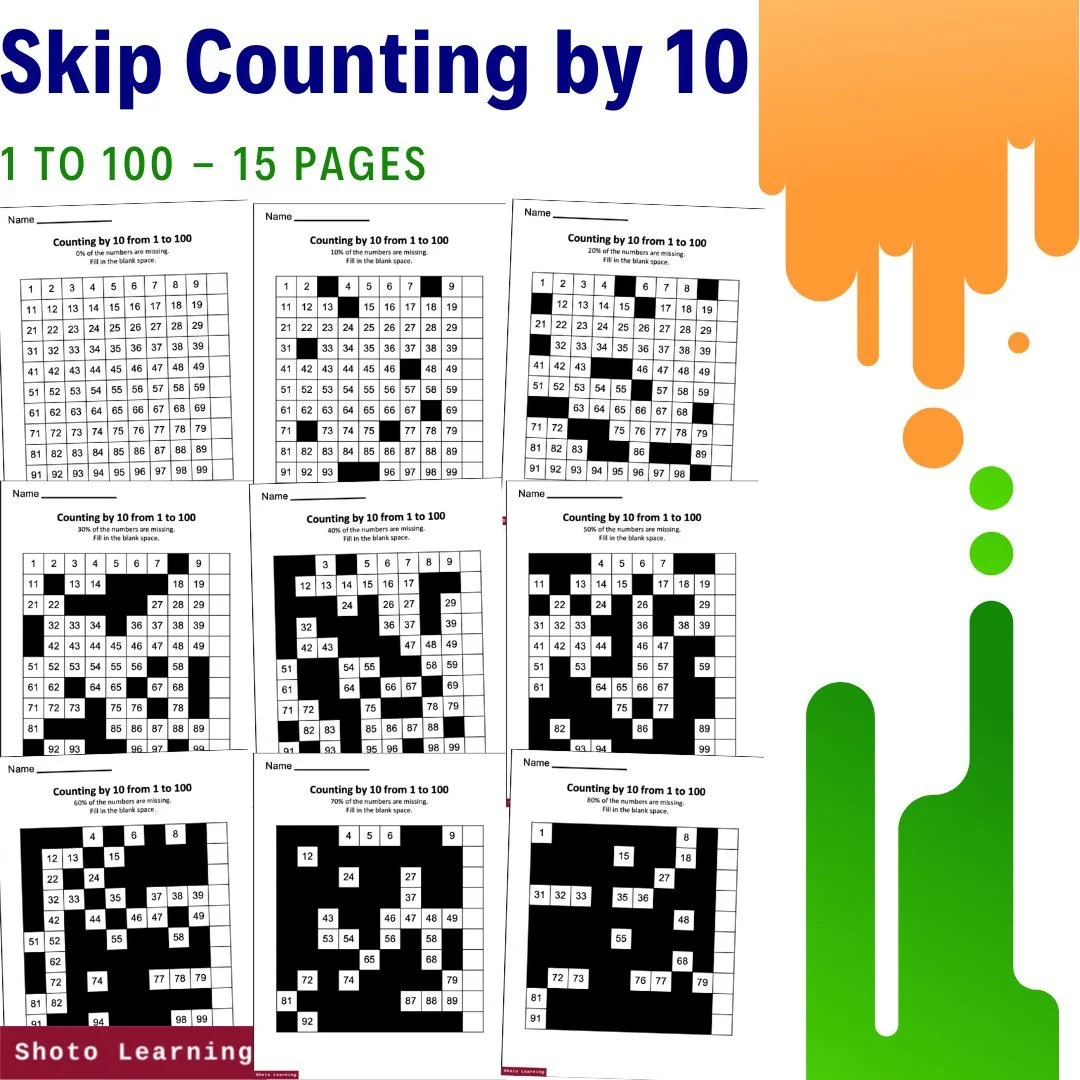


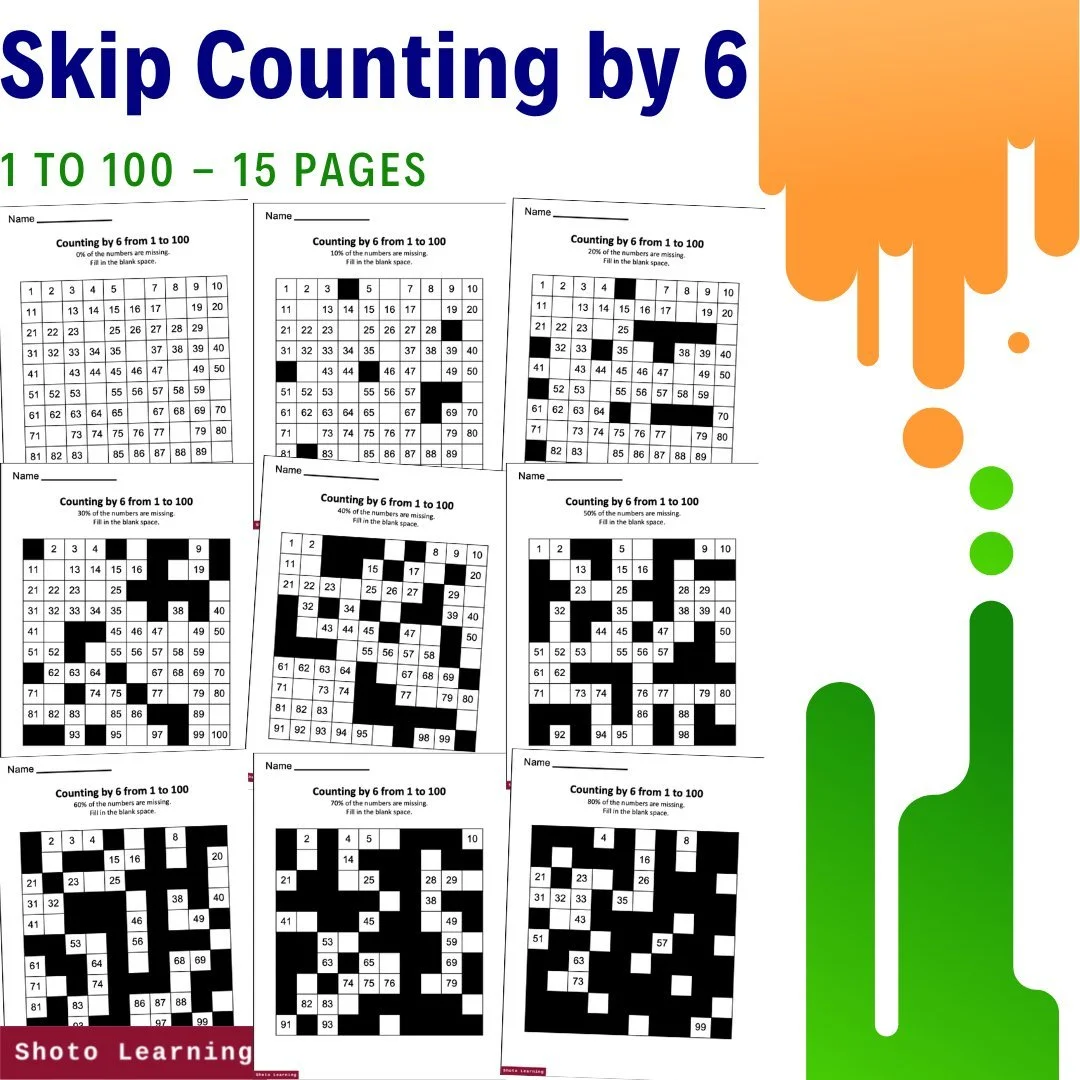


Introduce students to skip counting by 12 with these beginner-friendly worksheets, covering numbers 1 to 100. It is ideal for number identification and practicing skip counting.
Key Features:
Focus on skip counting by 12 from 1 to 100
2-page package:
Page 1: Number Identification Sheet
Page 2: 0% Numbers Missing
Simple design for beginners
How to Use:
Number Identification: Use Page 1 to help students recognize numbers and understand the concept of skip counting by 12.
Practice: Utilize Page 2 for exercises where students fill in missing numbers in the sequence, reinforcing their skip counting skills.
Reinforcement: Repeat exercises to build confidence and proficiency in skip counting by 12.
Download your copy today!