
Master Skip Counting with 1-120 Number Charts and Worksheets: A Comprehensive Guide for Mathematical Fluency
Skip counting is a foundational math skill that helps children understand number patterns and build early multiplication concepts. Using 1-120 number charts provides visual support for students as they learn to count by 2s, 5s, 10s, and other intervals. These charts and worksheets make abstract number relationships concrete, helping students develop number sense and mental math abilities.

Children who master skip counting often find later math concepts easier to grasp. Number charts serve as powerful tools that allow students to see patterns emerge as they highlight or color numbers in sequences. Worksheets that incorporate these patterns give kids the practice they need to internalize these important counting skills.
Key Takeaways
Skip counting builds essential number pattern recognition and serves as a foundation for multiplication concepts.
Number charts from 1-120 provide visual support that helps students discover and understand mathematical relationships.
Regular practice with varied worksheets reinforces skip counting skills and improves students' overall confidence with numbers.
Understanding Skip Counting
Skip counting is a fundamental math skill where students count by numbers other than one. This pattern-based counting method builds strong number sense and prepares children for multiplication and division concepts later.
The Basics of Skip Counting
Skip counting means counting forward by a specific number each time. Instead of saying "one, two, three," students might count "two, four, six" or "five, ten, fifteen." This creates predictable number patterns that help children recognize numerical relationships.
Common skip counting sequences include:
Counting by 2s: 2, 4, 6, 8, 10...
Counting by 5s: 5, 10, 15, 20, 25...
Counting by 10s: 10, 20, 30, 40, 50...
Students typically begin with these sequences before moving to more challenging ones like counting by 3s, 4s, or 7s. Number charts provide visual support, helping children see the patterns and practice independently.
Skip counting connects directly to repeated addition and multiplication concepts. For example, counting by 5s (5, 10, 15) parallels adding 5 repeatedly (5+5+5) or multiplying (3×5).
Significance in Math Curriculum
Skip counting serves as a critical building block in early mathematics education. First grade math standards often emphasize this skill as it develops number fluency and pattern recognition.
Teachers use various teaching tools to reinforce skip counting. Number lines, hundred charts, and counting manipulatives make abstract number patterns concrete and visible for young learners.
The benefits of mastering skip counting extend throughout the math curriculum:
Foundation for multiplication facts
Development of pattern recognition
Improvement in mental math abilities
Preparation for telling time and counting money
Regular practice with skip counting helps students see the structured nature of our number system. This understanding supports mathematical confidence and builds the mental framework needed for more complex operations in later grades.
Exploring Number Charts
Number charts are powerful visual tools that help students see number patterns and relationships. They lay out numbers in sequence, making it easier to understand counting, skip counting, and number order.
Types of Number Charts
Number charts come in several formats to meet different learning needs. The most common include:
Traditional 100 charts: Display numbers 1-100 in a 10×10 grid
Extended 120 charts: Show numbers 1-120, adding important teen numbers
Partially filled charts: Include some blank spaces for students to complete
Skip counting charts: Highlight patterns when counting by 2s, 5s, 10s, etc.
Some charts use color-coding to emphasize patterns or number families. Others incorporate pictures or symbols to engage younger learners.
Blank printable 120 charts allow teachers to customize activities for their classroom. These versatile tools adapt to various grade levels and teaching objectives.
Benefits of Using a 120 Chart
A 120 chart strengthens number sense in multiple ways. Students develop a mental image of number relationships when using these visual tools regularly.
The grid format makes patterns instantly visible. Children notice how numbers in columns end with the same digit and how rows increase by tens. This spatial arrangement helps students see connections they might miss otherwise.
These charts support multiple math skills:
Addition and subtraction: Finding numbers 10 more/less by moving rows
Skip counting: Highlighting patterns when counting by 2s, 5s, etc.
Place value: Seeing tens and ones positions clearly
Many teachers report that hundreds charts reduce counting errors and build confidence. Students gain independence as they refer to charts during problem-solving.
Differences: 100 Chart vs. 120 Chart
While 100 charts were the standard for decades, 120 charts offer distinct advantages. The traditional hundred charts stop at 100, but 120 charts continue to 120, including crucial teen decades.
The main differences include:
Coverage: 120 charts show numbers 1-120, while 100 charts stop at 100
Size: 120 charts typically use a 10×12 grid compared to the 10×10 grid of 100 charts
Pattern completion: 120 charts complete the tens and ones patterns through 120
These extended charts align better with current math standards that emphasize understanding place value beyond 100. Students see complete patterns when counting by 10s from any number.
Printable 120 charts provide a smooth transition when students begin working with three-digit numbers. They help children visualize the continuation of our base-ten number system beyond 100.
Effective Use of Worksheets
Worksheets serve as valuable tools for reinforcing number concepts and providing structured practice opportunities. They help students develop fluency with numbers while offering teachers insight into student progress.
Worksheets for Number Recognition
Number recognition worksheets build foundational skills needed for skip counting and pattern identification. These materials typically feature numbers from 1-120 displayed in various formats to help students become familiar with numerical sequences.
Students can practice circling specific numbers or coloring numbers that follow certain patterns. Fill-in-the-blank activities with missing numbers are particularly effective. For example:
Fill in the missing numbers: 45, 46, ___, 48, ___, 50
These worksheets align with Common Core standards requiring students to count to 120 and understand place value. Teachers can increase difficulty by:
Adding more missing numbers
Spacing numbers further apart
Incorporating larger numbers as students progress
Skip Counting Practice Sheets
Skip counting worksheets help students recognize patterns and build multiplication foundations. These materials typically feature activities where students count by 2s, 5s, 10s, and other intervals.
Types of skip counting worksheets:
Number line completion
Hundred chart highlighting
Connect-the-dots puzzles
Pattern recognition activities
One effective worksheet design presents partially completed sequences:
Count by 5s: 5, 10, 15, ___, ___, 30, ___, 40
These worksheets develop students' ability to recognize numerical patterns. Teachers can introduce real-world applications like counting coins or measuring objects to make practice meaningful.
Assessing Learning with Worksheets
Assessment worksheets help teachers evaluate students' understanding of number patterns and skip counting. These tools provide concrete evidence of progress and identify areas needing additional support.
Effective assessment worksheets include:
Timed activities to measure fluency
Error analysis sections where students explain their thinking
Mixed review formats covering multiple skip counting patterns
Teachers can track progress by keeping dated samples of student work. Many counting worksheets now include self-checking components that promote student independence.
Digital worksheets offer additional assessment opportunities through immediate feedback. The data collected helps teachers form small groups for targeted instruction based on specific needs related to counting to 120.
Fill in the Blanks Strategy
Fill in the blanks activities offer a powerful way to reinforce number sequences and skip counting patterns. This approach challenges students to identify missing numbers, strengthening their understanding of numerical relationships and counting fluency.
Creating a Number Chart with Blanks
Number charts with strategic blanks help students practice skip counting skills effectively. Start with a basic 1-120 chart and remove numbers that follow specific patterns. For example, erase every fifth number to practice counting by 5s.
Tips for creating effective blank charts:
Remove numbers in patterns (every 2nd, 5th, or 10th number)
Increase difficulty gradually by removing more numbers
Use different colors to highlight pattern groups
Include blank spaces at the end of rows to reinforce decade transitions
Provide clear instructions on which pattern students should follow. For younger learners, include example numbers to demonstrate the pattern. A counting to 120 worksheet with blanks works well for both classroom and homework activities.
Reverse Skip Counting Exercises
Reverse skip counting adds challenge by requiring students to count backward from a given number. This builds flexibility in mathematical thinking and strengthens number sense.
Effective reverse counting activities:
Start with a completed chart and have students trace backward paths
Create partially filled charts where students count down by 2s, 5s, or 10s
Use blank spaces strategically at transition points (like 100 to 99)
For example, provide numbers 120, ___, 110, ___, 100 and ask students to fill in missing values. This reinforces both skip counting and place value concepts.
Consider creating worksheets that combine forward and reverse counting on the same page. This contrast helps students understand the relationship between addition and subtraction patterns.
Advanced Skip Counting Techniques
Skip counting builds essential number sense that extends beyond basic counting by 2s, 5s, and 10s. These advanced techniques help students develop deeper mathematical understanding while making calculations faster and more efficient.
Understanding Place Value
Place value knowledge significantly enhances skip counting abilities. When students understand that numbers have different values based on their position, they can skip count more strategically.
For example, when counting by 10s from 47, students should recognize they're simply increasing the tens place (47, 57, 67, 77). This concept becomes especially powerful when crossing into hundreds (97, 107, 117).
Try this activity: Have students use base-10 blocks while skip counting. When counting by 10s, they add one tens rod each time. This visual representation helps solidify the connection between skip counting and place value.
A color-coded hundreds chart can also highlight place value patterns. Numbers in the same column share the same digit in the ones place, while numbers in the same row share the tens digit.
Identifying Prime Numbers
Skip counting helps identify prime numbers - those special numbers divisible only by 1 and themselves. Students can use the sieve of Eratosthenes method with a hundreds chart to find primes.
Steps to find prime numbers:
Cross out 1 (not prime)
Circle 2, then cross out all multiples of 2
Circle 3, then cross out all multiples of 3
Continue this pattern
After completing this process, all circled numbers are prime. This visual method shows why skip counting helps identify non-prime numbers - they're always multiples of smaller numbers.
Prime number hunt: Challenge students to find patterns among prime numbers. For instance, except for 2, all prime numbers are odd. Many primes appear to be 1 more or 1 less than multiples of 6.
Using Hundreds Chart Puzzles
Hundreds chart puzzles transform skip counting into engaging challenges. These puzzles develop number sense while reinforcing skip counting patterns.
Popular hundreds chart puzzles include:
Mystery Number: Provide clues like "I'm in the 5s column, and when you skip count by 10s from me three times, you land on 75."
Pattern Blocks: Color all numbers reached when skip counting by different amounts to reveal geometric patterns.
Skip Counting Pathways: Connect numbers in a specific skip counting sequence to form shapes or letters.
Digital hundreds charts allow students to highlight skip counting patterns with different colors. For example, counting by 3s might be red, while counting by 4s might be blue. Where colors overlap reveals common multiples.
Try creating "partially filled" hundreds charts where students must use skip counting to complete missing sections.
Math Games and Activities
Learning to skip count becomes more fun when using games and hands-on activities. Number charts provide the perfect foundation for engaging math experiences that reinforce counting skills while keeping children motivated.
Interactive Games with Number Charts
Number Chart Races encourage children to quickly identify patterns. Players take turns rolling dice to determine how many spaces to move on a 1-120 chart. The first player to reach 120 wins. This reinforces skip counting by the number rolled.
Pattern Detectives helps children recognize number sequences. Cover certain numbers on the chart and ask students to identify what's missing. For example, cover all multiples of 5 and ask them to name the pattern.
Counting Hopscotch transfers number charts to the playground. Draw a large grid outdoors with numbers 1-120 and have children hop in specific patterns (by 2s, 5s, or 10s).
Digital Alternatives include online games where students drag numbers into correct positions or complete timed challenges to count by specific intervals.
Hands-On Activities for Counting
Chart Coloring helps visualize number patterns. Give students a blank 1-120 chart and have them color multiples of 2, 5, or 10 in different colors. This activity helps them differentiate between counting sequences.
Number Card Sort strengthens understanding of numerical order. Create cards with numbers 1-120 and have students arrange them in order or in skip-counting patterns.
Tactile Number Lines support kinesthetic learners. Students create physical number lines using beads, buttons, or stickers to represent skip counting intervals.
Read and Write activities reinforce language skills. Students practice reading numbers aloud while tracing or writing them. This connects the spoken number words to their written numerals.
Count and Move activities get children physically engaged. Students count while performing actions—jumping 10 times while counting by 10s to 100.
Utilizing Technology in Learning

Technology provides powerful tools that enhance skip counting practice and make learning numbers more engaging. Digital resources offer interactive ways to help students master number patterns and sequences.
Digital Tools and Apps
Many math apps feature colorful, interactive number grids that make skip counting practice fun. Apps like "Number Chart Games" and "Skip Counting Master" allow students to highlight patterns when counting by 2s, 5s, 10s, and other intervals. These tools often include audio features that pronounce numbers as students touch them.
Some classroom tablets offer math games where students drag numbers into sequence or color patterns on digital number charts. These activities provide immediate feedback, helping students quickly correct mistakes.
Interactive whiteboard activities let teachers demonstrate skip counting patterns visually. Students can see numbers highlighted in different colors as they count by various intervals on a 1-120 chart.
Online Worksheets and Resources
Educational websites offer printable and interactive number charts in various formats. Sites like Education.com and Math-Drills.com provide customizable 1-120 charts that teachers can modify to focus on specific skip counting patterns.
Many online platforms include self-checking activities where students fill in missing numbers when skip counting. These digital worksheets often track progress and adjust difficulty based on student performance.
Virtual manipulatives allow students to interact with number lines and charts by dragging numbers or highlighting patterns. These tools help reinforce the visual patterns that emerge when skip counting.
Video tutorials demonstrate skip counting techniques using animated number grids, making abstract concepts more concrete for visual learners.
Frequently Asked Questions
These questions and answers provide practical guidance on using number charts effectively and finding resources to support skip counting practice. They include step-by-step approaches and creative activities for building strong counting skills.
What are the steps to effectively use number charts for skip counting?
Begin by introducing the standard counting sequence from 1-120. Point to numbers while counting aloud to connect visual and verbal patterns.
Next, highlight specific patterns using colored markers or counters. For example, use red for counting by 2s, blue for 5s, and green for 10s.
Practice tracing the pattern with a finger while counting aloud. This multi-sensory approach helps children internalize number patterns and relationships.
Finally, gradually remove visual supports and encourage mental skip counting. Start with smaller ranges before expanding to the full 1-120 sequence.
How can 1-120 number charts help improve counting skills?
Number charts make abstract number concepts more concrete and visual. They help children see patterns and relationships between numbers at a glance.
Regular practice with charts improves fluency and speed in counting. Students develop automatic recognition of number sequences and intervals.
These charts build number sense by showing how numbers relate to each other. Children can see that adding 10 means moving down one row, while adding 1 means moving one space right.
Charts also support early algebra concepts by revealing patterns in our number system. This foundation helps with later math skills like multiplication and division.
Where can I find free printable worksheets for counting to 120?
Education.com offers numerous free printable counting worksheets with options for different skill levels. Their resources include both filled and partially filled charts.
The Florida Center for Reading Research (FCRR) provides research-based number chart activities and printables at no cost. Their materials are organized by grade level and skill.
TeachersPayTeachers has many free downloads created by classroom teachers. Search for "120 chart" or "skip counting" to find hundreds of options.
Many school district websites also share free math resources. Check local elementary school websites for downloadable math practice materials.
What techniques are best for teaching kids to fill in missing numbers on a 120 chart?
Start with partially completed charts where only a few strategic numbers are missing. This builds confidence before tackling more challenging patterns.
Teach children to look for patterns in rows and columns. Explain that each row starts 10 more than the previous row, while numbers in columns increase by 10.
Use questioning to guide thinking: "What comes before this number?" or "What pattern do you notice in this row?" This encourages analytical thinking.
Create games where children race to fill in missing numbers. Timed activities add excitement while building fluency with number sequences.
Are there any downloadable PDFs available for skip counting exercises?
Math-Drills.com offers comprehensive skip counting PDFs organized by intervals (2s, 5s, 10s). Their resources include both charts and written exercises.
K5Learning provides downloadable PDFs focusing specifically on skip counting patterns. Their materials include visual supports and practice exercises.
The Mathematics Shed has skip counting tracks and games available as free PDFs. These resources incorporate movement and fun into practice sessions.
Many PDFs include both blank and filled charts to allow for different types of practice. Some also offer assessment tools to track progress.
Can you suggest activities for reinforcing skip counting with children?
Number hopscotch encourages physical movement while practicing skip counting. Draw a hopscotch grid with numbers in skip counting sequence and have children call out numbers as they hop.
Creating skip counting songs or chants makes practice memorable. Many children learn counting by 5s through the familiar tune "Five Little Monkeys."
Board games using dice marked with skip counting intervals (instead of 1-6) provide fun practice. Children count forward by the designated amount with each roll.
Hundred pocket charts with removable number cards allow for hands-on manipulation. Children can physically handle numbers while arranging them in skip counting patterns.


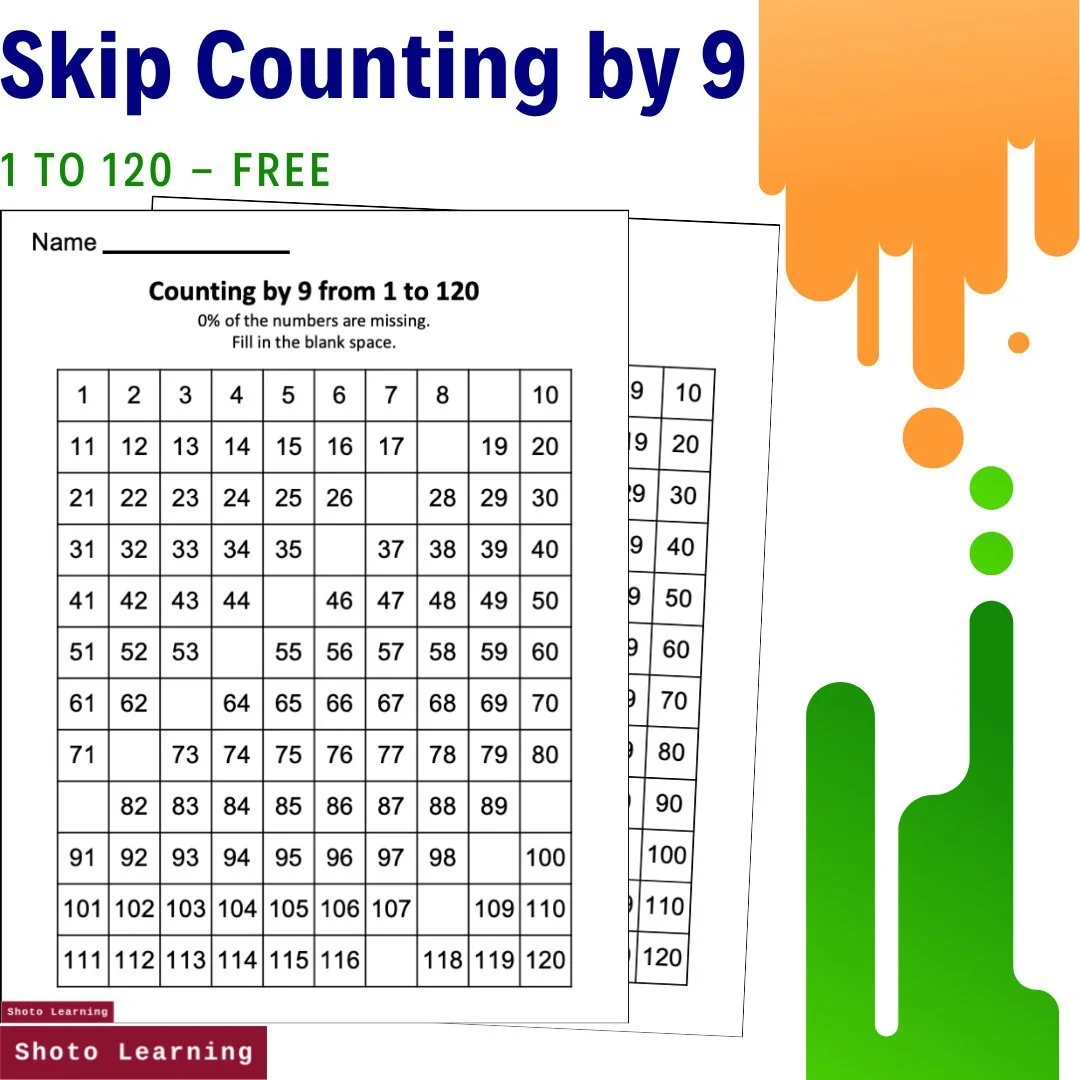


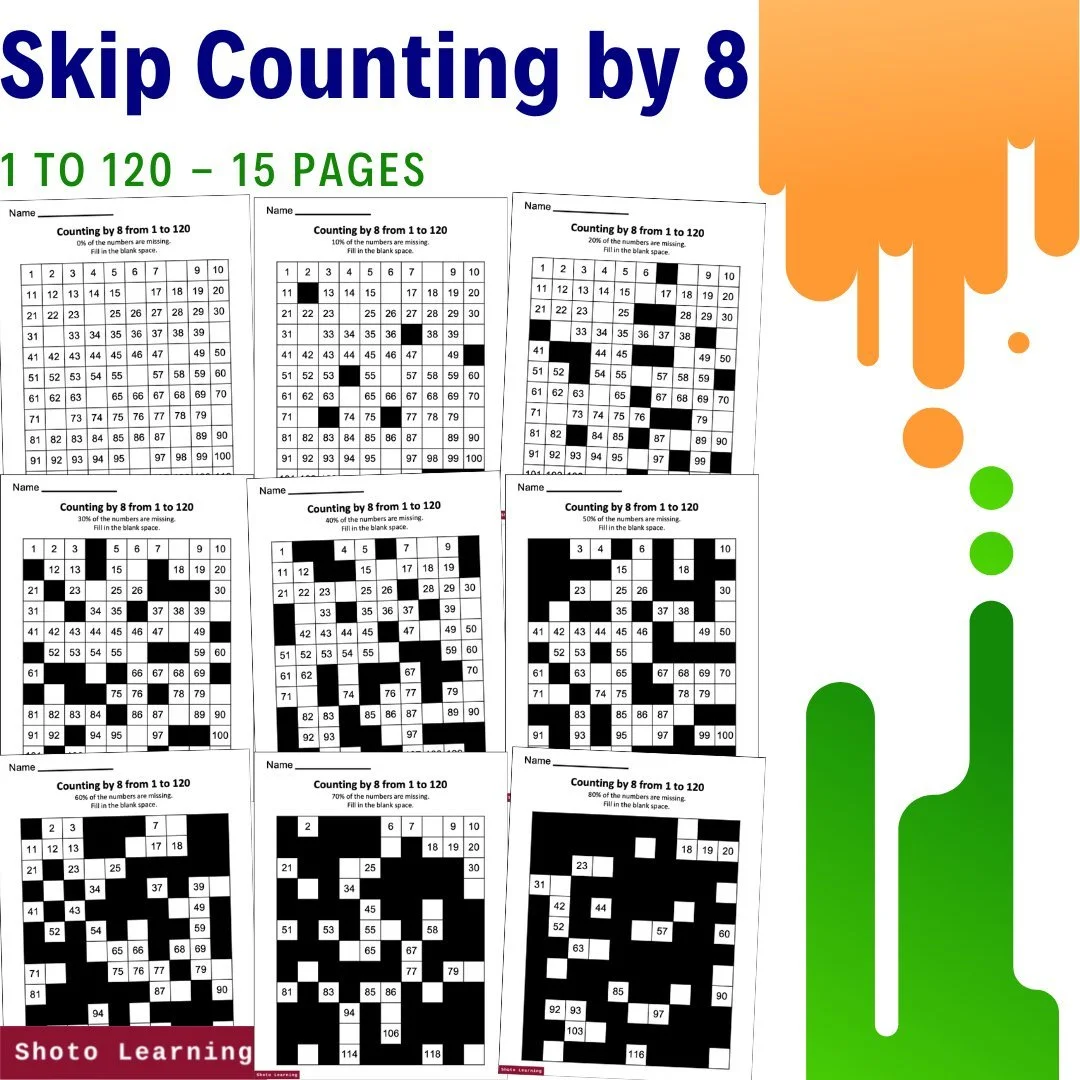


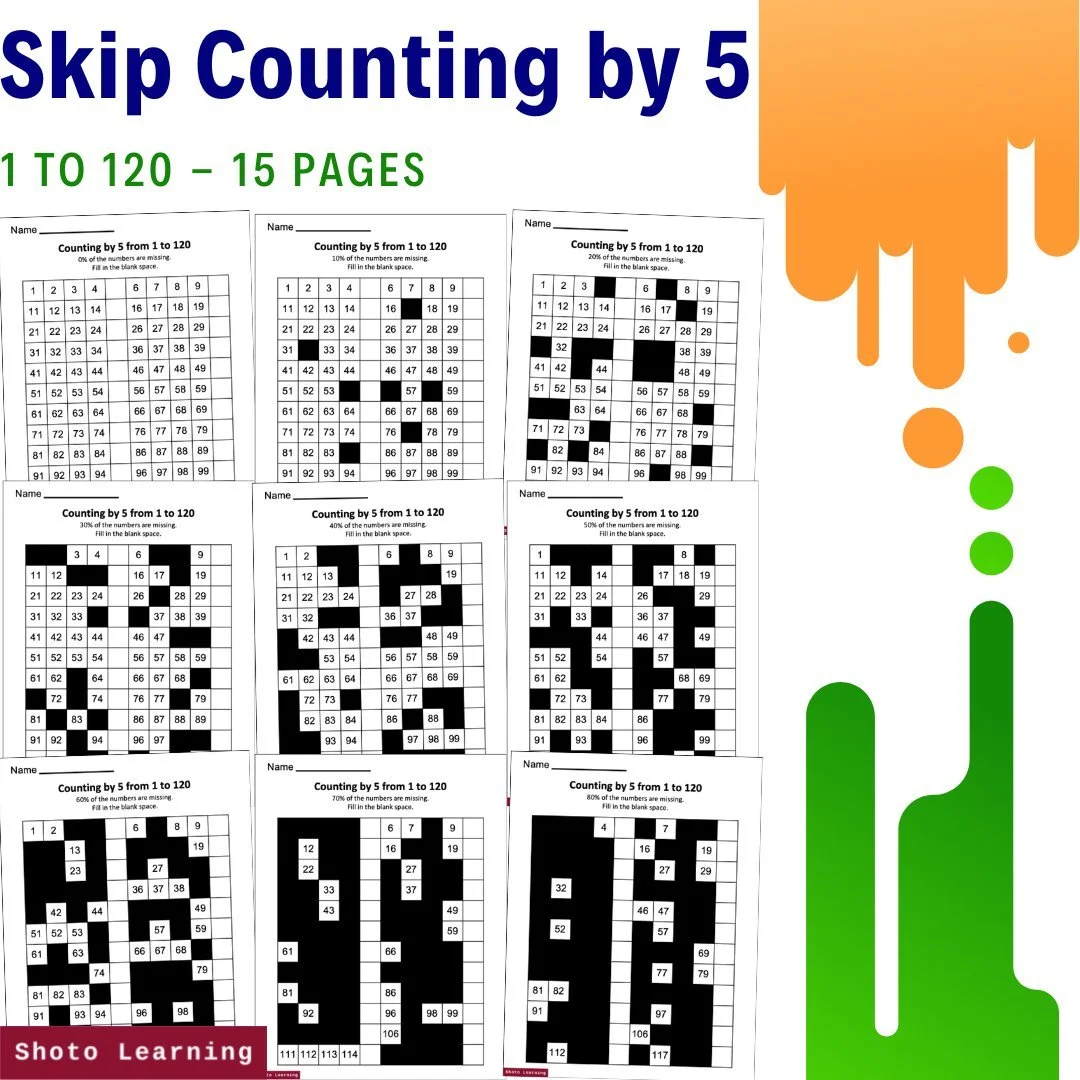
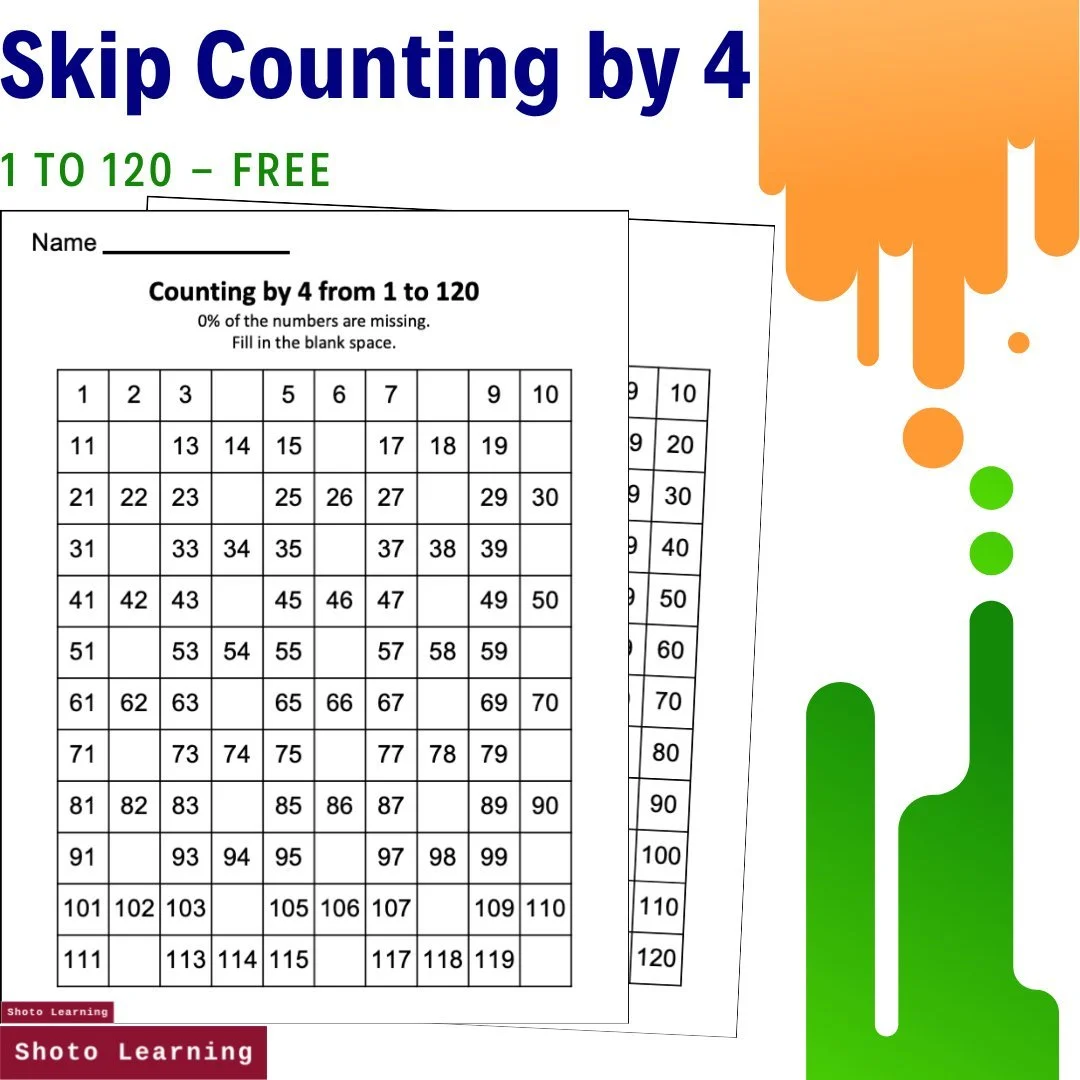


Introduce beginners to skip counting by 12 with our free, easy-to-use worksheets covering numbers 1 to 120. Ideal for number identification and building foundational math skills.
Key Features:
Comprehensive Coverage: Focuses on skip counting by 12 from 1 to 120.
Structured Worksheets: Two-page package for effective learning.
Page 1: Identification sheet for recognizing numbers in the sequence.
Page 2: Practice sheet with missing numbers to enhance problem-solving skills.
Beginner-Friendly: Designed with simplicity to facilitate easy learning.
How to Use:
Start with Identification: Use Page 1 to familiarize with numbers in the skip-counting sequence.
Practice Missing Numbers: Move to Page 2 to identify and fill in missing numbers, reinforcing understanding.
Regular Practice: Consistent use of these worksheets will build confidence and proficiency in skip counting by 12.
Download your copy today!