
Creative Ways to Teach Symmetry and Patterns for Engaging and Effective Learning
Teaching symmetry and patterns can be made engaging through creative, hands-on activities that help students see these concepts in everyday life. Using art projects, nature exploration, and manipulatives like pattern blocks, students build spatial reasoning and connect math to the world around them. This approach makes learning both meaningful and accessible, encouraging students to notice symmetry in real objects like leaves, animals, and buildings.
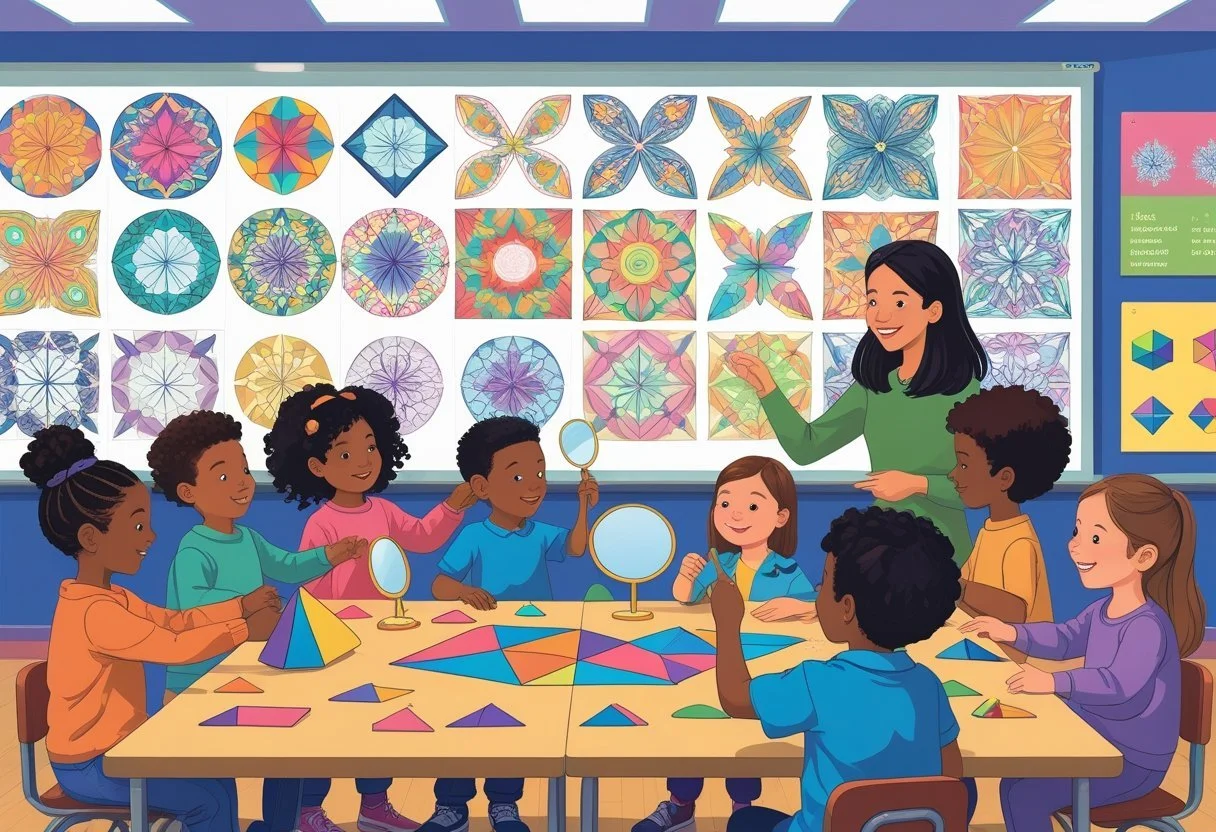
Hands-on experiences allow learners to move beyond memorizing definitions and formulas. They get to create symmetrical designs, explore lines of symmetry, and appreciate patterns through play and discovery. This method supports a deeper understanding of math concepts while developing critical thinking and creativity, making lessons more memorable and fun.
Key Takeways
Hands-on activities help students understand and apply symmetry and patterns.
Connecting math to real-world examples improves engagement and learning.
Creative approaches support both spatial skills and mathematical thinking.
Core Concepts of Symmetry and Patterns
Symmetry and patterns are foundational ideas in math that help organize shapes and designs. Understanding how objects balance and repeat gives insight into geometry and nature. Key ideas include what makes something symmetrical or not, the different kinds of patterns seen in math, and how lines of symmetry show balance within shapes.
Defining Symmetry and Asymmetry
Symmetry means that one part of an object is a mirror image of another part. When an object can be divided so both sides match exactly, it is symmetrical. This balance creates a sense of order and harmony.
Asymmetrical objects lack this exact mirror image. Their parts do not match on either side, which can create visual interest or complexity. Asymmetry is common in nature and art, offering a contrast to perfectly symmetrical shapes.
Teaching these differences helps learners see how balance works in math and design. Recognizing symmetry and asymmetry can improve observation skills and understanding of shapes.
Types of Patterns in Mathematics
Patterns are repeated arrangements of shapes, numbers, or colors. They show how things follow a rule or sequence. Patterns can be simple or complex.
Common types include:
Repeating patterns: The same unit repeats regularly (e.g., red-blue-red-blue).
Growing patterns: Items increase or change step by step (e.g., 2, 4, 6, 8).
Symmetrical patterns: Designs that reflect across a line of symmetry.
Patterns help develop problem-solving by showing predictable changes. They also connect with real life, like in art, nature, and music.
Understanding Lines of Symmetry
A line of symmetry divides a shape into two mirrored halves. If a line can be drawn so that one side matches exactly with the other, that line is a line of symmetry.
Shapes can have:
One line of symmetry: Like a rectangle.
Multiple lines of symmetry: Like a square or circle.
No lines of symmetry: Like a scalene triangle.
Knowing how to find and count lines of symmetry strengthens spatial awareness. It also connects to concepts like reflection and congruence in geometry.
Engaging Activities for Teaching Symmetry
Teaching symmetry can be made more effective and interesting by using specific activities that involve hands-on learning, artistic creativity, and natural observation. These methods help students see and understand symmetrical and asymmetrical patterns in different ways. Each approach supports learning by building skills in math and art while encouraging active exploration.
Hands-On Symmetry Activities
Hands-on symmetry activities let students physically explore lines of symmetry and symmetrical designs. Folding paper to find the fold line or cutting shapes can show how one side mirrors the other.
Using mirrors to reflect half of a drawing helps students visualize symmetry clearly. Activities can include drawing symmetrical shapes or building symmetrical patterns with blocks.
These tasks strengthen understanding of geometric properties like congruence and transformations. Students learn to identify symmetrical and asymmetrical objects through active practice, not just by listening.
Incorporating Art and Creativity
Symmetrical art projects are a powerful way to teach symmetry concepts. Drawing, painting, or creating symmetrical patterns allows students to apply math skills visually.
Students can create symmetrical designs by painting one half of a paper and folding it to imprint a mirror image. This simple technique combines creativity with the concept of symmetrical balance.
Exploring asymmetrical designs alongside symmetrical ones teaches students the contrast between balance and imbalance in art. This strengthens their ability to recognize different patterns in everyday objects and artwork.
Symmetry Through Movement and Nature
Observing symmetry in nature helps students relate math to the real world. Activities might include nature walks to find leaves, insects, or flowers with symmetrical patterns.
Movement-based exercises, like mirroring a partner's actions, can teach symmetry dynamically. This helps develop spatial awareness and a deeper understanding of symmetrical balance in motion.
Using natural examples shows how symmetry applies beyond the classroom, making abstract concepts easier to grasp. It also encourages careful observation and appreciation of the world’s repetitive patterns.
Using Manipulatives to Explore Patterns
Manipulatives help students learn patterns and symmetry by letting them see and touch shapes. They make abstract ideas easier to understand. Pattern blocks and geoboards are two common tools used to explore symmetrical designs and patterns in math.
Pattern Blocks for Symmetrical Designs
Pattern blocks come in different shapes like triangles, squares, and hexagons. Students use these blocks to build shapes and create symmetrical designs by arranging blocks evenly on either side of a line.
This hands-on activity helps students spot patterns and understand symmetry visually. They can try flipping or rotating designs to see how shapes fit together.
Teachers often use pattern blocks in small groups. This allows students to share ideas and test their designs together. Pattern blocks support learning about more than just symmetry; they also connect to fractions and geometry through visual models.
Geoboards and Visual Learning
Geoboards use rubber bands stretched around pegs on a board to form shapes and patterns. Students create triangles, squares, and other polygons, then explore symmetry by making mirror images or repeating shapes.
This tool aids in understanding geometric concepts and symmetry by giving students a clear visual and tactile way to experiment. They can easily change their designs for reflections or rotations.
Using geoboards helps students develop spatial reasoning. It also connects theoretical math with physical activities, which can improve comprehension and retention of patterns and symmetrical designs.
Creative Classroom Ideas for Symmetry and Patterns
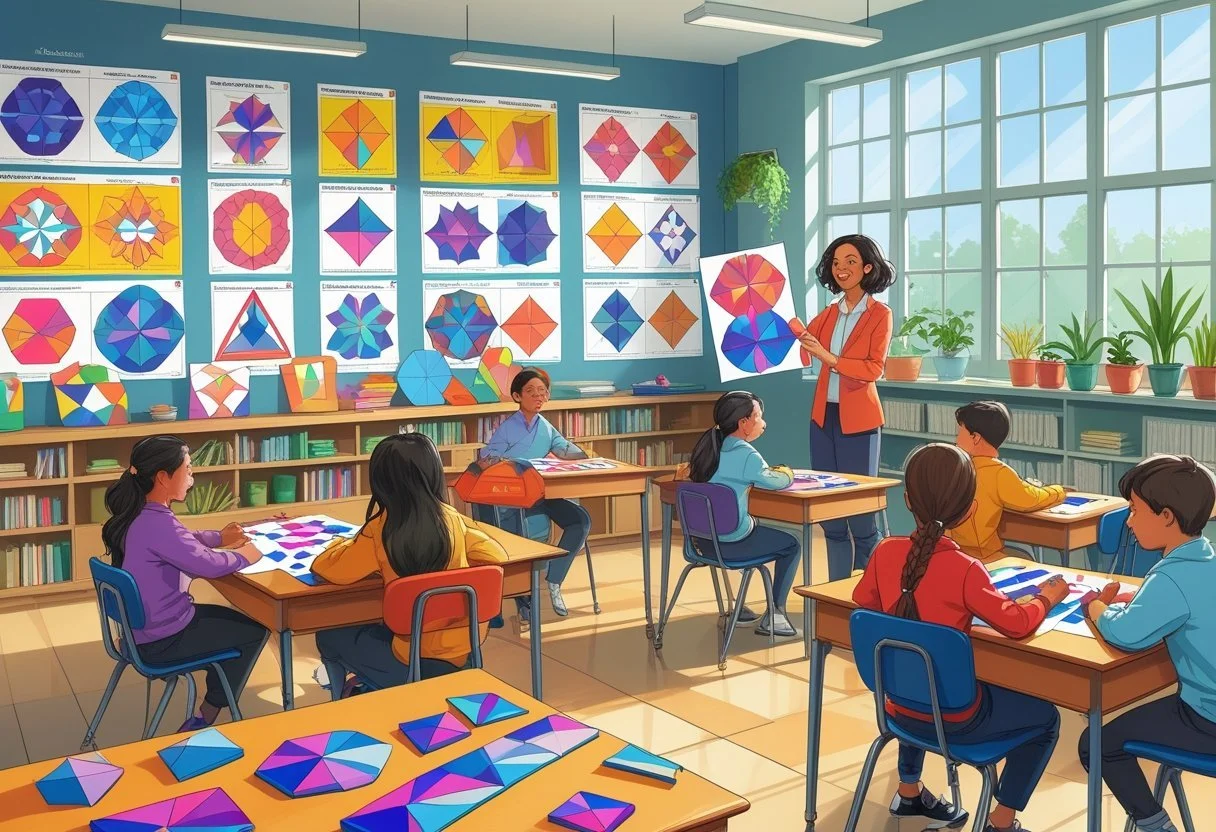
Teaching symmetry and patterns can involve a variety of hands-on and visual methods. Students benefit from activities that combine technology, stories, and real-world examples to deepen understanding. These approaches help make abstract ideas clear and relatable.
Integrating Technology and Literature
Using technology, teachers can introduce symmetry through interactive apps and digital pattern blocks. These tools let students explore symmetrical designs by creating and manipulating shapes on screens. Virtual drawing programs also allow for easy experimentation with mirror images and repeated patterns.
Incorporating literature can engage students by connecting math with stories and art. Picture books featuring animals or objects with natural symmetry spark curiosity and discussion. Teachers might include stories that highlight patterns in nature, linking reading with math concepts.
Combining technology with literature offers a multi-sensory experience. Students not only see symmetry but also hear and read about it. This mix deepens their grasp of patterns and reinforces learning through different modes.
Cultural and Real-World Connections
Symmetry appears in many cultural artifacts and natural objects, making it a useful way to tie lessons to the world outside the classroom. Teachers can use examples like traditional patterned fabrics, mosaics, or architectural designs to show how cultures use symmetrical patterns.
Real-world objects like leaves, insects, and flowers are excellent for hands-on symmetry activities. They allow students to observe and measure symmetry directly. Using natural items also encourages careful observation and connects math to everyday life.
Showing students how symmetry shapes art, nature, and design helps them see its importance. It builds spatial reasoning and appreciation for mathematical concepts beyond classroom exercises. Students learn that symmetry is not just a rule but a tool for organizing and creating.
Assessing Understanding and Differentiation
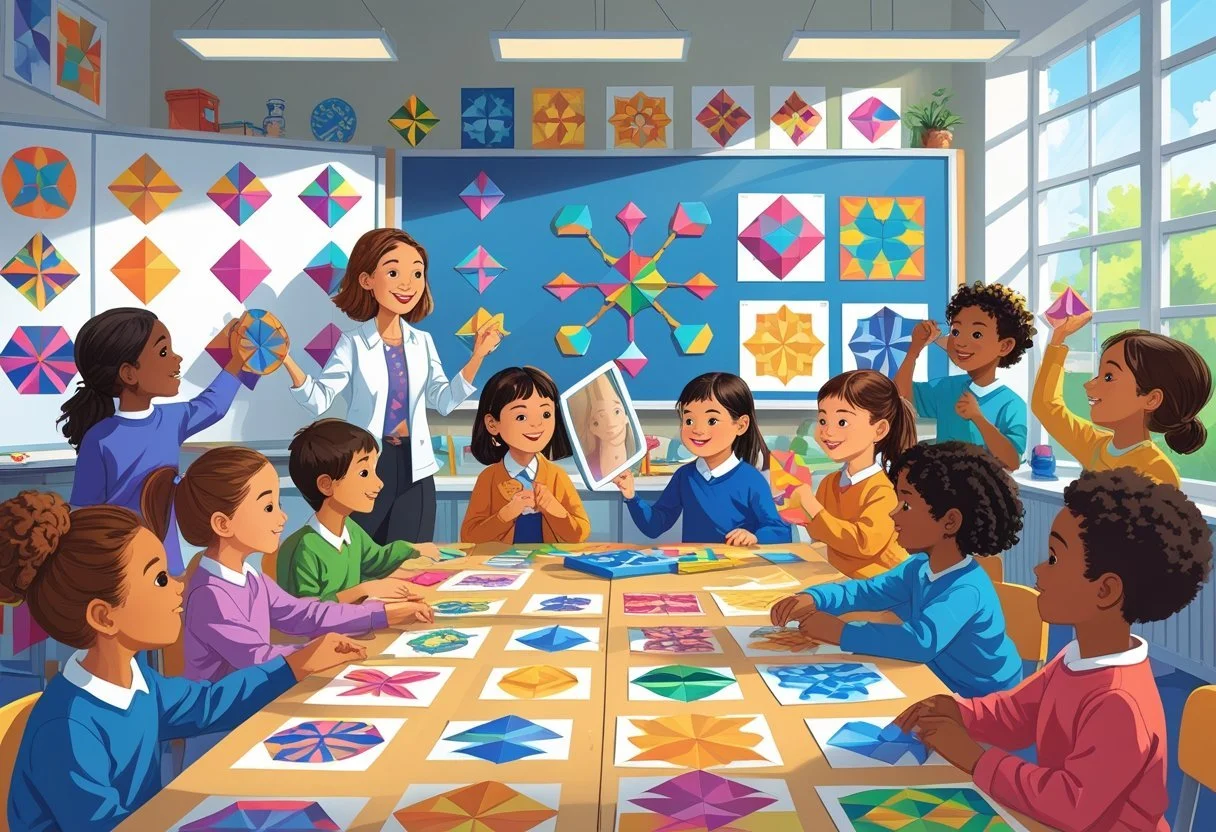
Effective teaching of symmetry involves checking student progress regularly and adapting lessons to meet different learning needs. Teachers use practical methods to evaluate understanding and provide support that fits each student’s skill level.
Formative Assessment Ideas
Formative assessments help teachers see how well students grasp symmetry concepts during lessons. Activities like quick quizzes, drawing symmetrical shapes, or matching patterns allow teachers to observe skills in real time.
Using exit tickets with simple symmetry questions at the end of class offers quick insight into who needs more help. Teachers can also ask students to explain symmetry in their own words or create mirror images using paper folding or digital tools.
These hands-on tasks encourage student participation and give teachers immediate feedback. This approach moves beyond paper tests by connecting assessment with creative practice.
Scaffolded Approaches for Diverse Learners
Supporting diverse learners means breaking down symmetry tasks into smaller, manageable steps. Teachers might start with identifying symmetry in familiar objects like leaves or butterfly wings before moving to abstract shapes.
Providing visual aids, step-by-step guides, or peer support helps students build confidence. For example, a student who struggles might first practice folding paper to see symmetry physically, then move to drawing lines of symmetry on shapes.
Using differentiated materials, such as simpler patterns or more complex tasks, meets different readiness levels. This targeted support ensures every student can engage with symmetry concepts successfully and build spatial reasoning skills at their own pace.
Extending Learning Beyond the Classroom
Symmetry and patterns appear everywhere outside school. Using daily life and the natural world as learning spaces helps students see these concepts clearly. Activities at home and in the community create practical chances to practice and explore.
Home-Based Symmetry Challenges
At home, simple tasks can encourage students to identify and create symmetry. Folding paper to find lines of symmetry or drawing patterns with repeated shapes are effective exercises. Parents can use mirrors to show how one side reflects the other, making symmetry tangible.
Everyday objects also work well. For example:
Arranging utensils evenly on a table
Sorting socks by matching patterns
Creating symmetrical designs with building blocks
These hands-on activities develop spatial thinking and pattern recognition without needing special materials. They build skills that support math fluency and can be adapted to suit different ages.
Community and Outdoor Learning
The outdoors offers natural examples of symmetry and patterns. Walking in parks or gardens, students can observe leaf shapes, butterfly wings, and flower arrangements. These observations help connect math ideas to the real world.
Communities have patterns too. Local architecture, tiled walkways, and murals often show repeating patterns or symmetry. Field trips to museums or nature centers provide guided learning opportunities about these concepts.
Engaging with the environment this way encourages careful observation and critical thinking. It also shows how math is part of everyday life, not just something on paper.
Frequently Asked Questions
Teaching symmetry and patterns can be done with a mix of hands-on activities, technology, art projects, and games. Different learning styles and natural examples also play a key role in helping students grasp these concepts effectively.
What are some effective hands-on activities for teaching symmetry to students?
Using pattern blocks to build symmetrical shapes helps students see lines of symmetry clearly. Mirror painting and cutting paper shapes in half to fold and reveal symmetry are also practical activities. These methods engage students physically and visually.
How can educators use technology to enhance learning about patterns in the classroom?
Digital drawing tools allow students to create symmetrical designs easily. Interactive apps provide instant feedback on pattern recognition. Online simulations can show transformations like reflections and rotations in real time, making abstract ideas clearer.
Which art and craft projects can help children understand the concept of symmetry?
Creating mandalas, folding and cutting paper to make symmetrical shapes, and using paint or stamps to mirror designs are effective projects. These encourage creativity while reinforcing the idea of balanced and matching parts on both sides.
What strategies can be used to teach symmetry and patterns to children with different learning styles?
Visual learners benefit from diagrams and color-coded symmetry lines. Kinesthetic learners engage more with hands-on activities like building blocks or drawing. Teachers can include auditory descriptions and stories for verbal learners to help explain patterns.
How can games and puzzles be incorporated into lessons about symmetry and patterns?
Puzzles that require matching halves or completing shapes promote recognition of symmetry. Board games or digital games with pattern challenges help develop problem-solving skills while reinforcing key math concepts.
What role does nature play in teaching students about natural patterns and symmetry?
Nature provides clear examples, such as butterfly wings, leaves, and flowers with symmetrical shapes. Outdoor activities like observing shells or snowflakes give students real-world experience with patterns, linking math to their environment.