
Teaching Fractions: Hands-On Ideas for Every Classroom That Build Lasting Understanding
Many students find fractions tricky, but learning fractions does not have to be confusing or boring. Hands-on activities can help students see, touch, and understand fractions in a real and simple way. Using visual models and practical games, teachers can make fractions easier for everyone in the classroom.
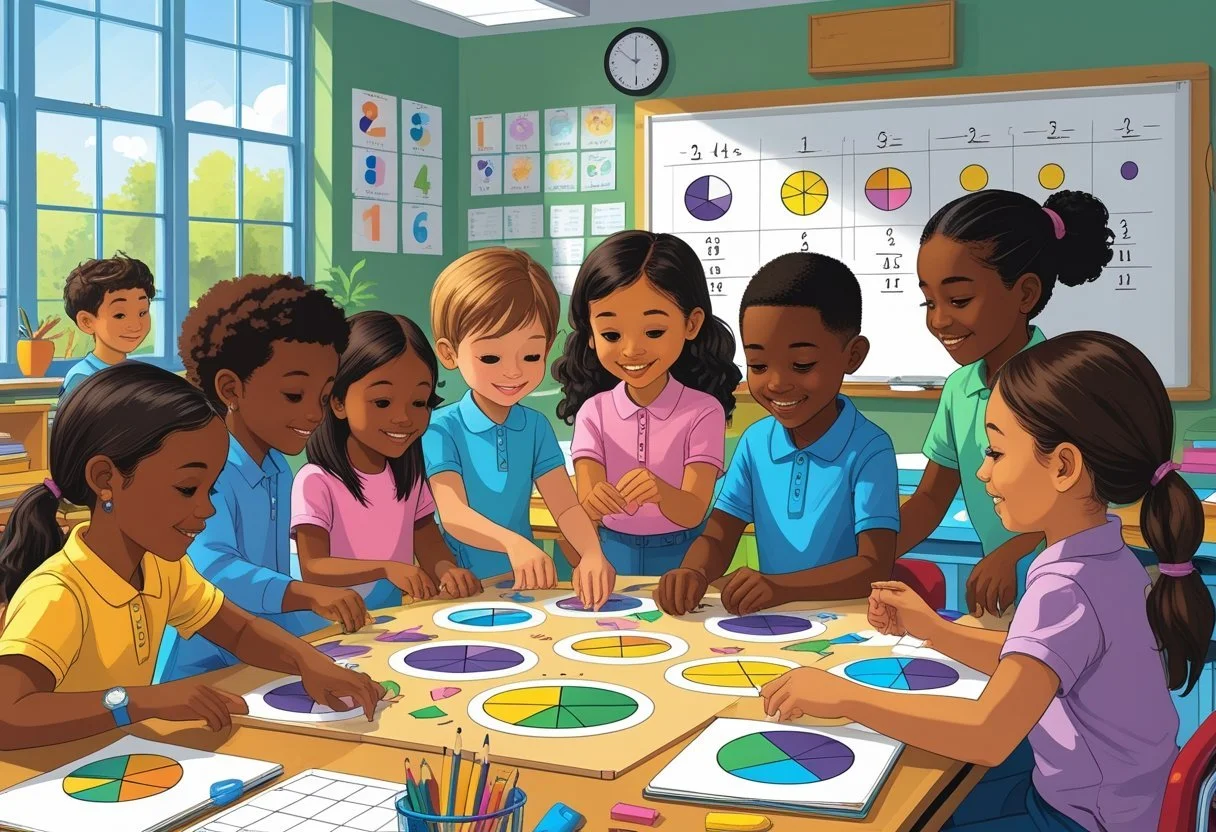
Exploring fractions with concrete objects lets students build skills step by step. These hands-on ideas can help learners of all ages gain confidence and make real progress with fractions. Whether in groups or alone, students can develop a true understanding and enjoy math more.
Key Takeaways
Practical tools make learning fractions clearer.
Interactive games and centers boost fraction skills.
Helpful strategies build lasting understanding.
Understanding the Basics of Fractions
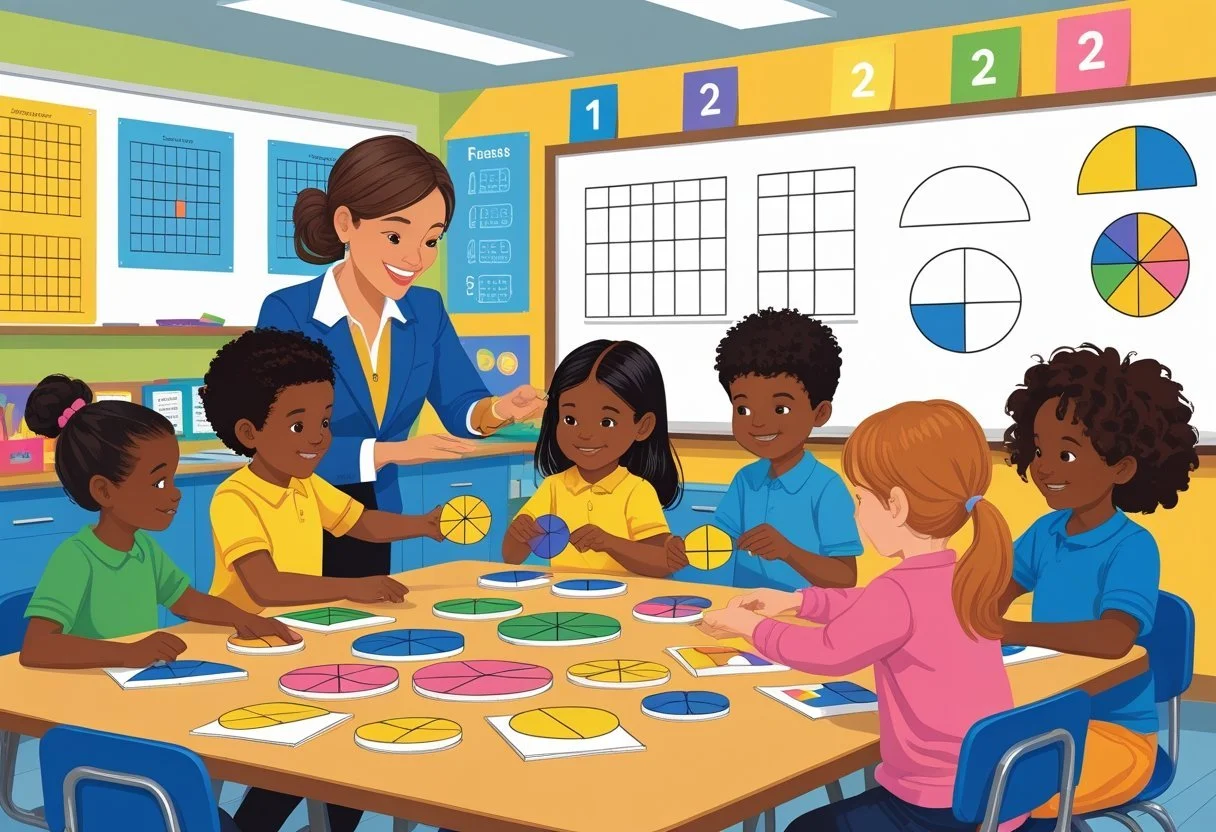
Fractions are a key part of math, showing parts of a whole or a group. Knowing how they work helps students with division, comparison, and measurement.
What Are Fractions?
Fractions show equal parts of a whole or a collection. A fraction uses two numbers, split by a line, like 1/2 or 3/4. The top number tells how many parts are being considered. The bottom number shows the total parts the whole is divided into.
Examples of fractions:
1/2 (one-half)
3/4 (three-fourths)
2/3 (two-thirds)
Fractions can be used with objects, shapes, or groups. For example, if a pizza is cut into four equal slices and someone eats one, they have eaten 1/4 of the pizza. Fractions help describe and compare parts of anything shared or divided.
Numerator and Denominator
The numerator is the top number. It tells how many parts are being counted.
The denominator is the bottom number. It shows how many equal parts the whole has.
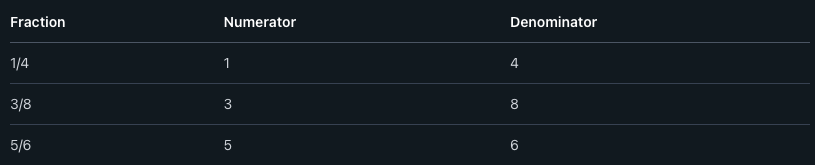
If you see the fraction 3/5, the 3 (numerator) means three parts are chosen. The 5 (denominator) means everything is split into five equal parts. Understanding these terms makes it easier to read, write, and explain fractions.
Proper and Improper Fractions
Fractions can be proper or improper.
Proper fractions have a numerator smaller than the denominator, like 2/5 or 3/7. These always show less than one whole.
Improper fractions have a numerator equal to or bigger than the denominator, such as 5/4 or 7/7. These can be more than one whole. For example, 7/7 is the same as 1 whole. Improper fractions can be changed to mixed numbers, like 5/4 becoming 1 1/4.
Knowing about proper and improper fractions is important for fraction lessons. It helps explain how fractions can show parts of a whole or more than a whole.
Representing Fractions Visually
Fractions are easier to understand with pictures. Visuals help show the size and meaning of each fraction.
Common ways to show fractions include:
Fraction circles (disks divided into equal sections)
Fraction bars or strips
Grids or rectangles split into parts
For example, if a rectangle is split into eight parts and three are colored, it represents the fraction 3/8. Drawing or using fraction tiles makes abstract ideas clear and concrete.
Visual models support exploring fractions with hands-on activities. These visuals are important in any fraction lesson for building strong understanding, especially when comparing or adding fractions.
Hands-On Fraction Activities for the Classroom
Hands-on fraction activities give students a concrete way to learn about parts of a whole and how fractions work. By using real objects—like pizza, flowers, dominoes, and Legos—teachers can make fractions easier to see, touch, and understand.
Using Pizza to Teach Fractions
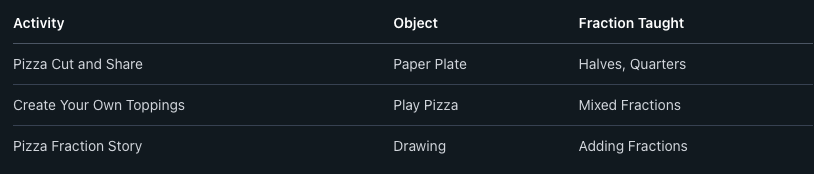
Fraction pizza activities use large paper pizza cutouts or real pizza to show students how fractions represent parts of a whole. Teachers can cut a paper plate into several equal slices, like eighths or quarters, and use markers to label each piece.
Students can move, swap, or combine slices to make new fractions. For example, putting together two 1/8 slices makes 1/4. In small groups, each student builds their own pizza, shares slices, or solves problems like "How many slices are left if two are eaten?"
This method makes it simple for students to connect fraction equations with something familiar. A table below shows sample activities:
Fraction Flowers and Manipulatives
Fraction flowers are a colorful way to show fractions using paper petals and circles. Teachers cut out circles for the flower centers and use strips for petals, each petal colored to show different fractions (such as 1/6 or 1/8).
Students glue the petals around the center to represent fractions of the whole flower. This hands-on activity helps students see that the number of petals relates directly to the denominator. Manipulatives like fraction bars and tiles can show the same ideas.
A simple list of manipulatives includes:
Fraction tiles
Colored bars
Fraction circles
Counting cubes
These help students make clear fraction models without just using numbers.
Dominoes, Paper Plates, and Dough
Standard dominoes work well for showing fractions. Each side of a domino can represent the numerator and denominator; for example, a domino with four dots on one side and eight on the other shows 4/8. Students can match, compare, and add fractions by lining up different dominoes.
Paper plates are easy to cut and label into equal parts, helping students divide, combine, and count fractions hands-on. Dough or modeling clay lets students roll, flatten, and cut shapes into halves, thirds, or quarters, making abstract ideas real.
These items turn abstract fraction ideas into something students can handle and change. It helps students remember what each part and whole means because they can manipulate them directly.
Incorporating Legos into Fraction Lessons
Legos provide a simple and effective way to visualize fractions. For example, students can use bricks of the same width but different lengths (like one brick with 8 bumps and another with 4). Putting together two 4-bump bricks shows that 4/8 + 4/8 equals a whole.
Students can build models to compare fractions like 1/2, 1/4, and 3/4. Teachers ask them to stack, line up, or trade bricks to answer questions such as, "How many 2-stud bricks equal one 8-stud brick?"
Legos allow for easy rearrangement and quick checking of answers, giving an interactive, hands-on feel to fraction lessons. This method is helpful for visual and tactile learners who benefit from moving and building as they learn fraction concepts.
Engaging Fraction Games and Centers
Hands-on games turn fractions from a confusing concept into an interactive experience. Using tools like bingo cards, game boards, sorting mats, and movement-based play helps students connect math symbols to real-world ideas.
Fractions Bingo and Board Games
Fractions Bingo is a popular choice in classrooms. Each student gets a bingo card with different fractions like 1/2, 1/3, or 3/4. The teacher calls out fraction prompts, either by name, picture, or word problem. Students cover the matching squares. The first to complete a row or column wins.
The Fraction Frenzy board game takes this type of play further. Players move along a board by answering fraction questions or drawing fraction cards. Tasks might include matching visual models to their written fractions or solving simple addition problems with like denominators.
These games allow students to practice identifying and representing fractions. They also help teachers check understanding quickly. To increase difficulty, teachers can include mixed numbers, improper fractions, or fraction comparisons.
Sorting and Fraction Frenzy Activities
Sorting activities let students handle fraction cards or tiles and put them into groups. For example, students might sort shapes by the fraction of the area shaded. They could also sort number lines labeled with different fractions.
In math centers, teachers set up "fraction trays" where students sort pizza slices, pie models, or strips labeled with fractions. This helps them see which fractions are equivalent and which are different.
Another useful activity is the Fraction Frenzy challenge, where students race to match sets of equivalent fractions before time runs out. Using color-coded cards or small whiteboards helps keep these activities organized and easy to manage.
Fraction Hopscotch and Movement Games
Fraction Hopscotch gets students moving as they review math. Teachers mark a hopscotch grid with different fractions instead of numbers. Students toss a marker, say the fraction it lands on, and answer a related question or show the fraction using their fingers or objects.
Movement games might also include "Fraction Freeze," where students move around the classroom to music, and when the music stops, they must get into groups showing a certain fraction (like groups of 1/4 of the class). These activities reinforce fraction recognition and division in a natural way.
Using movement games and hopscotch helps students learn fractions while being active. These resources work well in both small groups and whole-class settings.
Developing Fraction Skills and Concepts
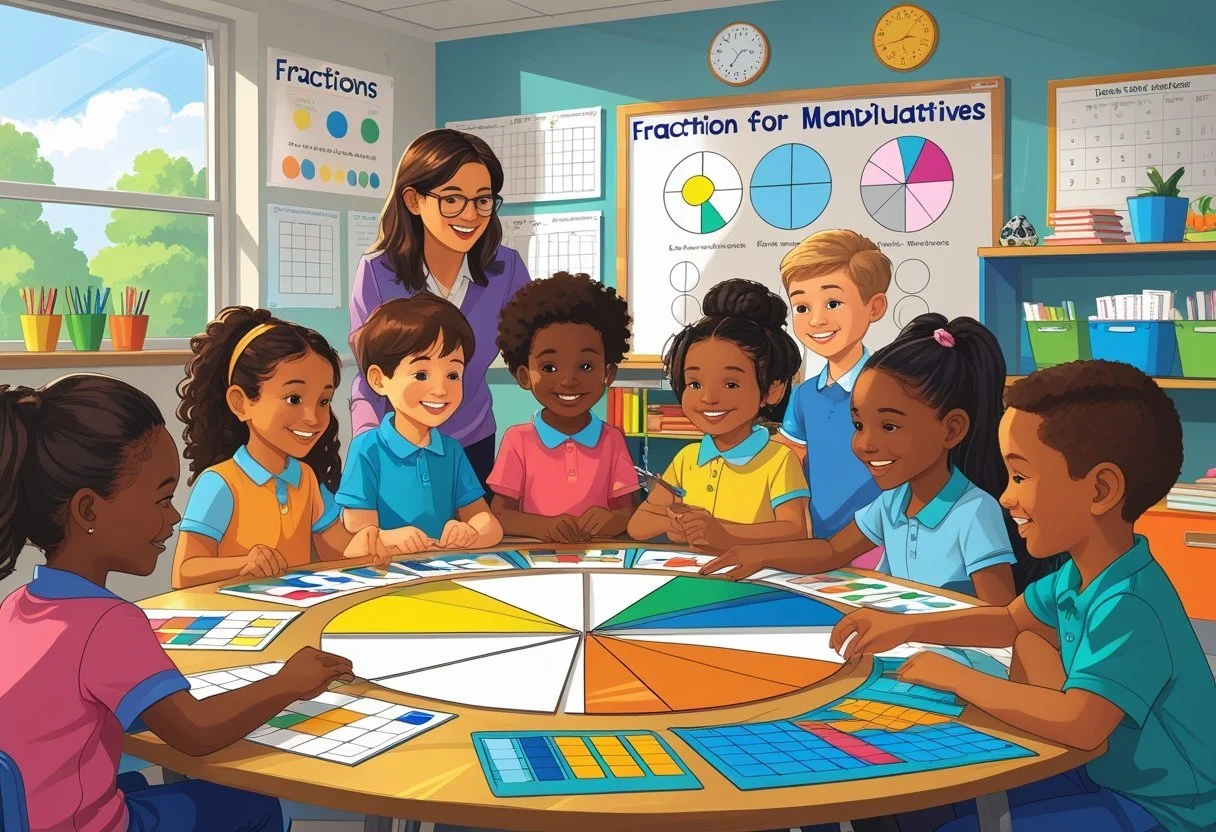
Students benefit when teachers use a mix of visual models, hands-on activities, and focused practice. These tools help students understand fractions and build their skills step by step.
Building a Strong Fractions Unit
A successful fractions unit starts with clear goals and a well-structured sequence. Teachers should begin by introducing basic concepts like numerator and denominator. Using fraction circles, bars, or tiles gives students a physical way to see how fractions work.
Frequent use of real-world examples, such as food or measurements, keeps lessons practical. Teachers can create a unit outline like:
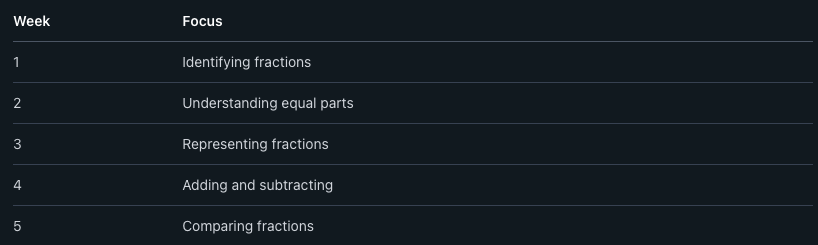
This step-by-step approach helps students master one skill before moving to the next.
Practicing Fractions with Flip Books
A fraction flip book is a simple tool that helps students practice and remember important fraction facts. Each page shows a different fraction, its visual model, and an example problem.
Students use their flip books for quick reference and as practice during quiet work. Teachers can assign students to fill in missing parts or draw models. This activity helps reinforce vocabulary, visual understanding, and problem-solving.
Flip books are easy to update as students learn more, allowing for review throughout the year. Practice with flip books also supports homework and group activities.
Comparing and Ordering Fractions
Comparing fractions is easier when students use visual aids and clear steps. Teachers should introduce strategies like drawing fraction bars, using number lines, or finding common denominators.
Key steps for comparing fractions include:
Check if denominators are the same.
If not, use models or convert to common denominators.
Place fractions on number lines.
Order from least to greatest.
These hands-on methods help students see relationships between fractions. Practicing with real-world examples, such as comparing pieces of pizza, makes lessons relevant and memorable. Students benefit from repeated practice with sets of fractions to build confidence.
Exploring Equivalent Fractions
Students often find equivalent fractions confusing without the right practice. Using pictures and activities can help show why different fractions can mean the same amount.
Visual Models for Equivalent Fractions
Visual models like fraction bars, number lines, and circles help students see how fractions work. When students use fraction bars of different colors, they can line up pieces to compare sizes. For example, lining up two 1/4 bars next to one 1/2 bar shows that 2/4 and 1/2 cover the same space.
Number lines are useful for placing fractions at the same spot. Marking 3/6 and 1/2 at the same point helps students see they are equal.
A table can also help:
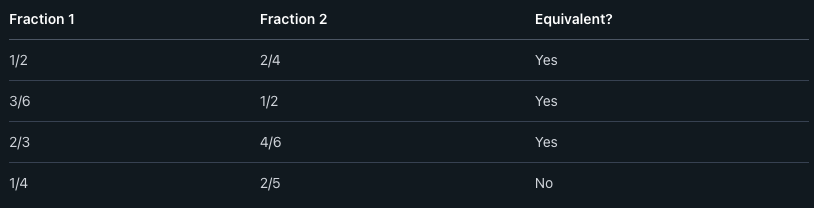
Using these models helps learners understand equivalence more clearly.
Hands-On Activities for Equivalence
Hands-on activities give students ways to learn by doing, not just seeing. One simple activity is folding paper strips. Students fold one strip into halves and another into fourths, then compare the sizes. This shows, for example, that two fourths are equal to one half.
Fraction tiles let students build fractions piece by piece. Students can fill a whole with six 1/6 pieces or three 1/2 pieces and notice the connections.
Games like "Fraction Match" have students pair fraction cards with matching values, encouraging quick thinking about equivalence. Teachers can also have students draw pictures of pizzas or shapes and shade different, but equal, sections to reinforce the idea.
By using objects, drawings, and games, students practice seeing and making equivalent fractions in ways that feel real and easy to remember.
Incorporating Digital Fraction Resources
Teachers use digital fraction activities to help students visualize and practice mathematics in new ways. There are also several online resources and apps designed to support students through interactive exercises and real-time feedback.
Interactive Digital Activities
Interactive digital activities let students move objects, match fractions, and solve problems with immediate results. For example, some platforms offer virtual manipulatives like fraction bars or circles. These allow students to drag and drop pieces on their screens, making abstract ideas more concrete.
Many websites include games that cover basic concepts such as equivalency, ordering, and addition or subtraction of fractions. One popular activity is a fraction matching game, where students pair visual models with correct values.
Digital quizzes and puzzles also help check understanding. Some tools provide hints or explanations when an answer is wrong. This helps students learn from mistakes and try again without waiting for teacher feedback.
Online Fraction Tools and Apps
Online tools and apps give both students and teachers many ways to work with fractions. Virtual whiteboards allow teachers to demonstrate problems step by step. Some apps, like Fractions by The Math Learning Center, include interactive features for both whole-class and independent practice.
Students can use apps to draw, shade, and compare fractions on their tablets or computers. Many apps track progress and adjust difficulty based on performance.
A few helpful online fraction resources include:
GeoGebra Fractions: For interactive modeling
SplashLearn: For leveled practice and games
Khan Academy Fraction Lessons: For video instruction and practice questions
Most of these tools are free or offer basic versions at no cost, making them easy to add to any classroom routine.
Strategies and Tips for Effective Fraction Instruction
Hands-on tools and clear visuals can make teaching fractions easier for students to understand. Adjusting resources and teaching methods helps meet the needs of all learners.
Using Anchor Charts
Anchor charts are large posters or displays that show key fraction concepts. Teachers create these charts with students to help them remember ideas like parts of a whole, equivalent fractions, and comparing fractions.
A simple anchor chart might include fraction circles or bars and real-life examples, such as slices of pizza. Students can use these visuals for quick help during lessons or group activities.
Regularly updating and referring to anchor charts keeps fraction vocabulary visible. Teachers might include a table on the chart to show examples:
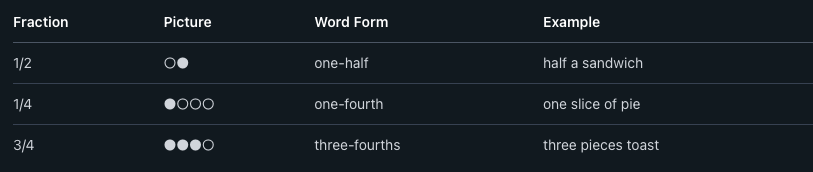
Making anchor charts interactive by letting students add examples or questions helps encourage participation.
Adapting Instruction for Diverse Learners
Fraction lessons can be challenging for students with different needs. Teachers should use a variety of fraction resources, such as fraction tiles, number lines, and digital games, to help students make sense of new concepts.
Visual aids and hands-on materials often make abstract ideas more concrete for learners who need extra support. For students who need more challenge, teachers can give fraction puzzles or real-world word problems that involve comparing or adding fractions.
Pair and group activities, along with frequent check-ins, help teachers spot who needs more help. Providing instructions in smaller steps and using simple language make the lessons more accessible. This approach supports all learners in building confidence with fractions.
Frequently Asked Questions
Teachers use card games, food items, and fraction circles to make fractions easier to understand. Lesson plans with step-by-step group work give students practice using real-life materials and games.
What are effective hands-on activities for teaching fractions to 3rd graders?
Fraction circles and bars help 3rd graders see how fractions fit together. Teachers often cut fruits or paper into parts to show halves, thirds, and fourths.
Sorting objects like buttons or blocks into groups is also helpful. Playing matching games with fraction cards can reinforce learning.
How can I create a lesson plan that includes interactive fraction activities for 4th grade students?
Teachers can start by setting a clear lesson goal, like recognizing equivalent fractions. Next, they use items such as measuring cups, paper strips, or classroom tools.
Group activities, such as building pizzas from paper shapes, help students work together. Teachers should include time for students to share answers and talk about how they solved problems.
What are some engaging fractions activities suitable for 5th grade classrooms?
In 5th grade, students can use recipe adjustments to practice multiplying and dividing fractions. Fraction bingo and board games are also engaging.
Teachers may use math manipulatives, like fraction tiles, to show how fractions are added or subtracted. Students can measure and compare water or sand levels in containers.
Which hands-on activities can help 7th graders better understand fractions?
Seventh graders often work with more complex topics like fraction operations. They can solve real problems by measuring ingredients for a science experiment or doubling a recipe.
Teachers may use fraction number lines and algebra tiles to show adding and subtracting fractions with unlike denominators. Group projects can work well to apply these skills.
Can you suggest practical fraction exercises for students in class 5?
Class 5 students benefit from drawing fraction models and solving word problems with visual aids. Folding paper to create equal parts is an easy exercise.
Another option is to divide up a set amount of objects—like sharing a bag of marbles among classmates. Students could also create fraction art by coloring sections of a grid.
What methods work best to teach fractions through hands-on activities in class 3?
Simple activities, like dividing a chocolate bar or pizza image into parts, help class 3 students grasp basic fractions. Teachers often use matching cards that pair numbers with pictures of divided objects.
Building fractions from shaded and unshaded LEGO bricks is another hands-on method. Using familiar classroom items makes fractions less abstract and more meaningful.