
Teaching the Digestive System: Visual Tools and Activities for Effective Learning
Teaching the digestive system can be challenging, but using visual tools and engaging activities makes the process clearer and more memorable for students. Visual aids like diagrams and models help students see how each part of the system works together to break down food and absorb nutrients. This approach allows learners to understand complex processes in a simple way.
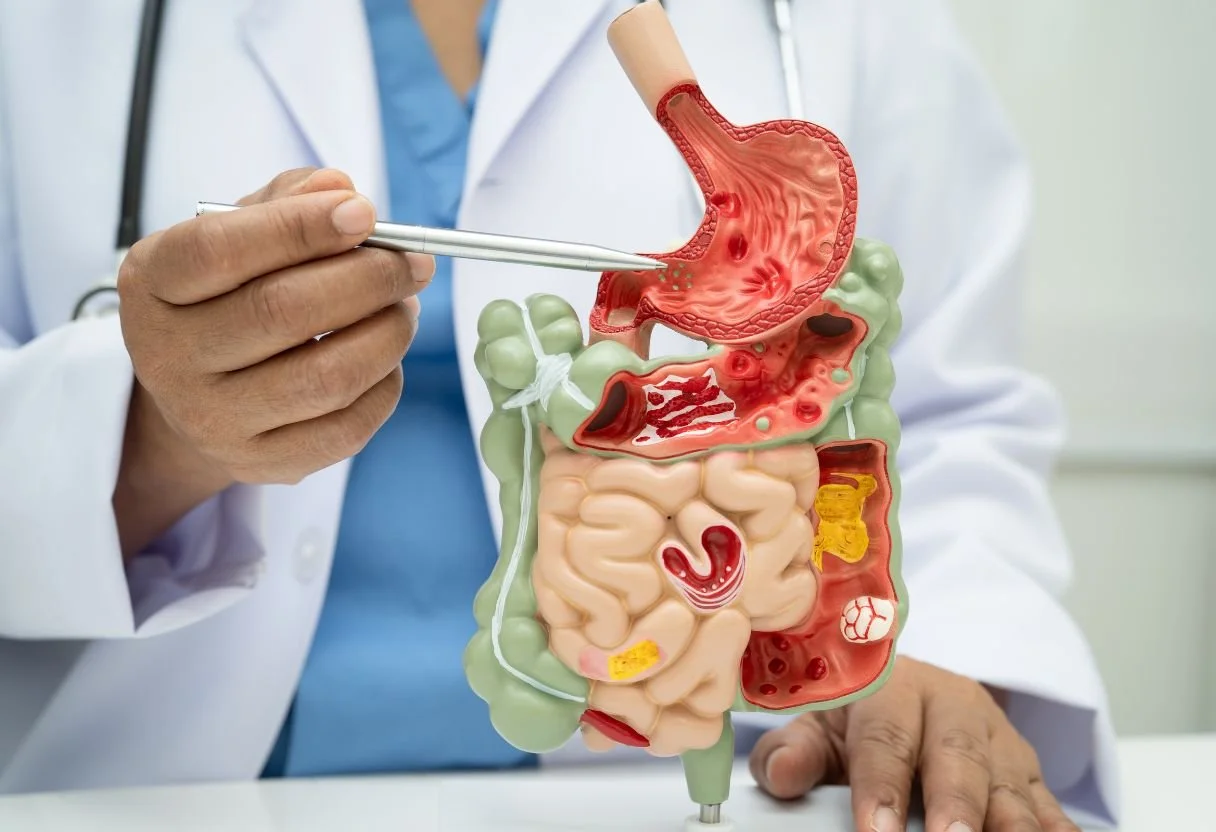
Hands-on activities also play a key role in teaching digestion. By creating models or doing interactive experiments, students can connect what they see with how their bodies actually function. These methods make learning more active and improve retention.
Combining visual tools with hands-on experiences creates a complete learning environment. This mix helps students grasp not just the parts of the digestive system, but also how digestion happens step by step.
Key Takeaways
Visuals simplify the structure and role of digestive organs.
Activities help students experience digestion concepts firsthand.
Using both methods together boosts understanding and engagement.
Understanding the Digestive System
The digestive system is made up of organs that work together to break down food so the body can absorb nutrients. It involves a series of steps where food is moved, digested, and processed into energy and waste.
Major Organs and Their Roles
The digestive system includes several major organs, each with a specific role. The mouth starts digestion by chewing food and mixing it with saliva. The esophagus moves food from the mouth to the stomach.
The stomach stores food and uses acids and enzymes to break it down further. The small intestine is where most nutrient absorption happens. The large intestine absorbs water and forms waste.
Other important parts include the liver, which produces bile to break down fats, the pancreas that releases digestive enzymes, and the gallbladder, which stores bile until it’s needed.
The Human Digestive Process
Digestion begins in the mouth, where mechanical chewing breaks food into smaller pieces. Saliva adds enzymes to start breaking down carbohydrates. The food then travels down the esophagus through muscle movements called peristalsis.
In the stomach, food mixes with acid and enzymes to break down proteins and liquids. The mixture moves to the small intestine, where digestive juices from the pancreas and bile from the liver aid in breaking fats, proteins, and carbohydrates.
The walls of the small intestine absorb nutrients into the bloodstream. Leftover waste passes into the large intestine, where water is removed before waste leaves the body.
Importance of Digestion in the Human Body
Digestion allows the human body to convert food into energy and nutrients necessary for growth and repair. Without it, the body cannot get the vitamins, minerals, and other nutrients needed to function correctly.
Effective digestion supports the immune system and overall health. Proper breakdown and absorption of food help maintain energy levels and keep organs working well. Waste removal through digestion also prevents buildup of harmful substances in the body.
Key Stages of Digestion
Digestion begins in the mouth and continues through the esophagus to the stomach. Each part plays a specific role in breaking down food mechanically and chemically to prepare nutrients for absorption.
Mouth and Mechanical Breakdown
The mouth is where digestion starts. Teeth chew food into smaller pieces, which makes swallowing easier and increases the surface area for enzymes to work. Saliva, produced by glands, moistens food and contains enzymes like amylase. Amylase begins breaking down starches into simpler sugars.
The tongue helps move food around and forms it into a soft, rounded shape called a bolus. This bolus is then ready to be swallowed safely. Mechanical breakdown in the mouth is crucial because it prepares food for chemical digestion and smooth passage through the next stages.
Role of the Esophagus and Peristalsis
After swallowing, the bolus enters the esophagus, a muscular tube connecting the mouth to the stomach. The esophagus does not digest food but moves it down using peristalsis—a series of wave-like muscle contractions.
Peristalsis pushes food in one direction, preventing backflow. The lower esophageal sphincter, a muscular valve, opens to let food into the stomach and closes to keep stomach acids from rising back up, protecting the esophagus from damage.
Chemical Digestion in the Stomach
The stomach continues digestion by mixing food with gastric juices. These juices contain hydrochloric acid and enzymes like pepsin. Acid lowers the pH, which helps pepsin break down proteins into smaller chains called peptides.
The stomach’s muscular walls churn food, turning it into a thick liquid called chyme. This process increases contact between enzymes and food for more effective digestion. Chemical digestion in the stomach prepares food for absorption in the intestines by breaking down proteins and killing harmful microbes.
Small Intestine and Nutrient Absorption
The small intestine plays a critical role in breaking down food and absorbing nutrients. Its structure helps maximize the surface area for absorption, allowing nutrients and water to move efficiently into the body.
Function of the Small Intestine
The small intestine is responsible for continuing digestion after food leaves the stomach. It uses enzymes to break down carbohydrates, proteins, and fats into smaller molecules that the body can absorb.
It is divided into three parts: the duodenum, jejunum, and ileum. Each part has a specific role, but all work together to digest food and prepare nutrients for absorption.
The inner walls have tiny finger-like projections called villi. These increase the surface area, making absorption faster and more effective.
Nutrient and Water Absorption
Nutrients like sugars, amino acids, fatty acids, vitamins, and minerals pass from the small intestine into the blood or lymph through the villi.
Water is also absorbed here, helping the body stay hydrated and keep digestive waste moving smoothly.
Any undigested food that cannot pass through moves into the large intestine, where water continues to be absorbed and waste forms.
This absorption process ensures that the body gets the energy and building blocks it needs to function properly.
Large Intestine and Waste Elimination
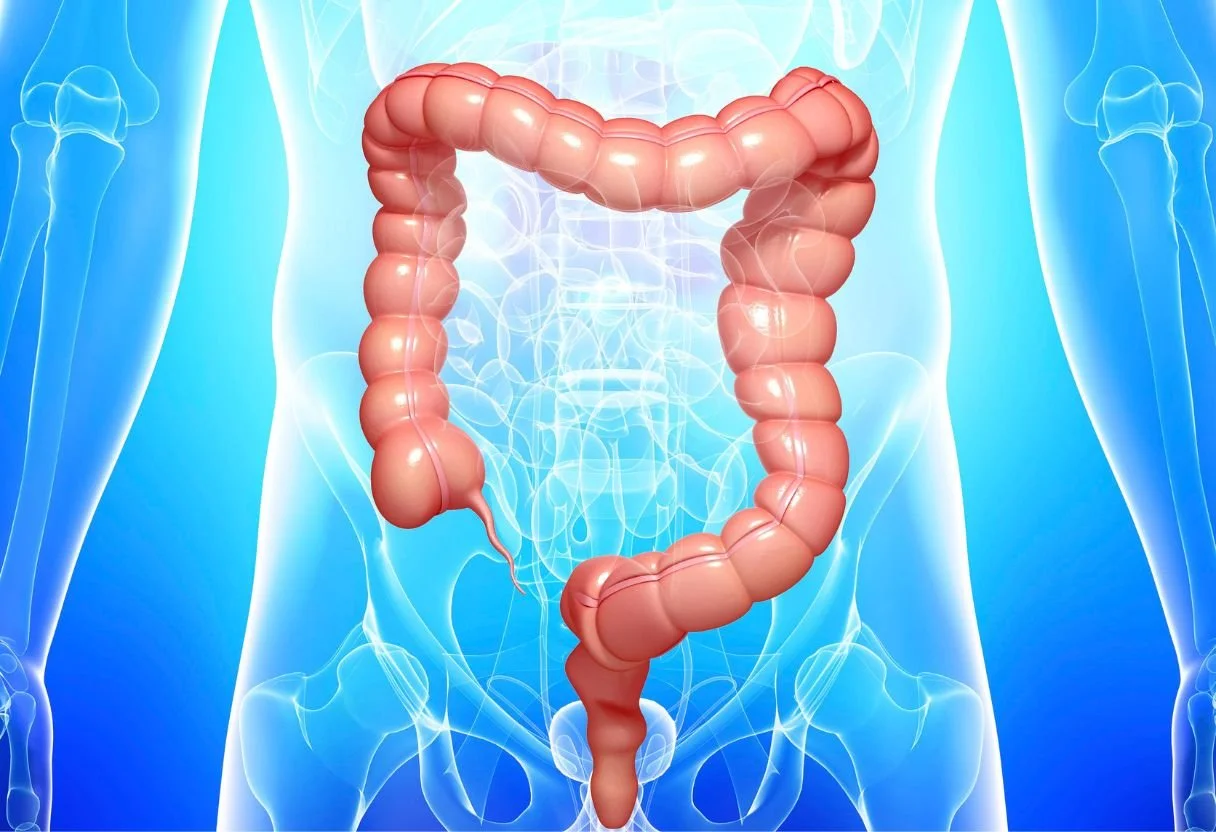
The large intestine plays a key role in absorbing water from digested food and forming solid waste. It helps prepare the waste for removal from the body. These processes are crucial for maintaining the body's fluid balance and overall health.
Water Reabsorption and Feces Formation
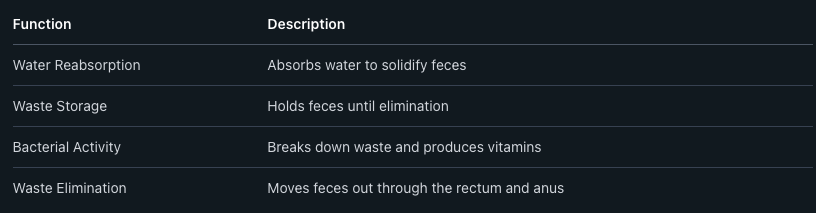
The large intestine absorbs most of the water left from digestion. As the liquid moves through, water is pulled back into the body’s tissues. This process turns the liquid into solid waste called feces.
The walls of the large intestine contain many blood vessels that help absorb water efficiently. Nutrients are mostly absorbed before this stage, so the large intestine mainly focuses on water recovery.
If the large intestine absorbs too little water, diarrhea can occur. Too much absorption can lead to constipation. Proper water reabsorption keeps waste the right consistency for easy elimination.
Role of the Large Intestine in the Digestive System
The large intestine also stores feces until the body is ready to eliminate it. It compacts waste and moves it through the colon by muscle contractions called peristalsis.
It houses helpful bacteria that break down some materials remaining in the waste. These bacteria also produce vitamins like vitamin K, which the body can absorb.
The final step in this system is elimination, where feces leave the body through the rectum and anus. This process removes waste and helps maintain internal cleanliness and balance.
Visual Tools for Teaching the Digestive System
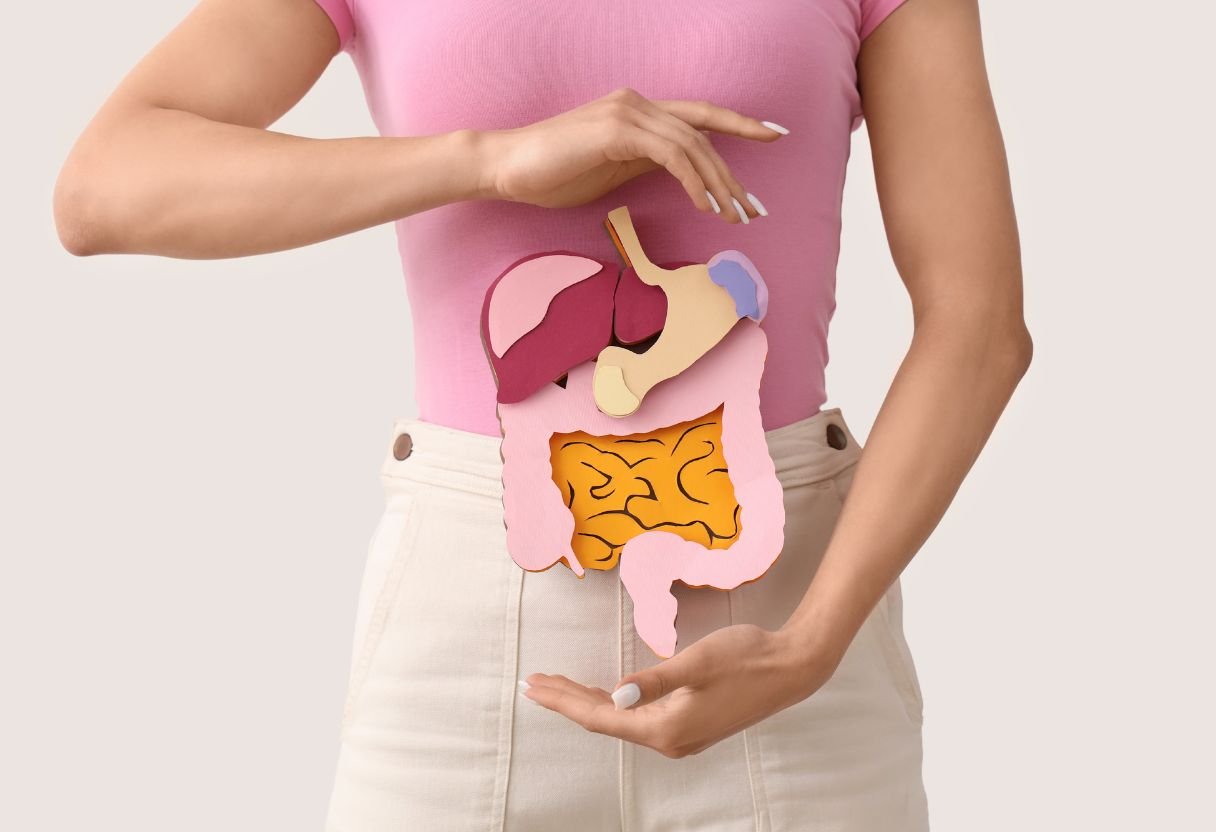
Visual tools help students understand the parts and functions of the digestive system clearly. Using physical models, digital simulations, and animations makes learning more engaging and easier to follow. These tools highlight the organs, processes, and connections involved in digestion.
Anatomical Models and Diagrams
Anatomical models provide a hands-on experience with the digestive system. These models show the size, shape, and position of organs such as the stomach, intestines, and liver. Teachers often use labeled diagrams alongside models to reinforce organ names and functions.
Physical models can be taken apart and reassembled, helping students see how the parts connect. This approach supports memorization and deeper comprehension by making abstract ideas concrete. Diagrams on posters or anchor charts serve as constant visual references during lessons.
Interactive Digital Simulations
Interactive digital simulations offer a virtual way to explore digestion. Students can use simulations to move food through each stage of the digestive process. This type of tool often breaks down complex steps into smaller, manageable activities.
Simulations show how enzymes work or how nutrients are absorbed, making invisible processes visible. Visual aids like 3D animations allow zooming in on organs to see details that physical models cannot show. These tools often include quizzes and tasks to test student understanding.
Comics and Animation Activities
Comics and animations use storytelling and images to explain the digestive process. They capture students' attention with characters and simple narratives about how food travels through the body. This format helps students remember facts by linking them with fun visuals.
Animation activities can show time-lapse digestion or organ interactions. Comics often use humor or relatable situations to make learning feel less like a chore. These visual tools are useful for younger learners or those who benefit from creative content to grasp scientific ideas.
Hands-On Digestive System Activities
Using physical models, experiments, and crafts helps students understand the digestive system clearly. These activities connect concepts like organ functions and digestion stages with real-life examples. They also make learning more interactive and memorable.
Building a Digestive System Model
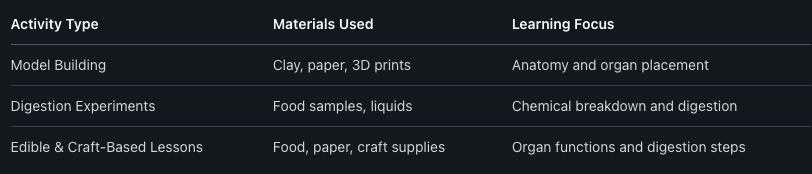
Creating a model of the digestive system helps students see how organs are positioned and linked. They can use clay, paper, or even a 3D printer to build parts like the esophagus, stomach, intestines, and liver.
This activity encourages students to label each part and explain its role. For example, they might show how food passes through the esophagus or where nutrients are absorbed in the intestines.
Models can be simple or detailed. Adding movable parts to mimic muscle movement or digestion processes increases engagement. This hands-on task supports visual and tactile learners by turning abstract ideas into something physical.
Experiments Simulating Digestion
Experiments can demonstrate how the digestive system breaks down food. A common one uses crackers or bread soaked in different liquids to simulate saliva and stomach acid. Students observe how food softens and disintegrates over time.
Another experiment measures digestion speed by testing how long various foods take to break down. This can teach about fiber’s role and nutrient absorption.
These experiments focus on the chemical and physical changes in digestion. They give students a chance to use the scientific method by making predictions, recording observations, and discussing results in detail.
Edible and Craft-Based Activities
Using food and crafts in lessons makes digestion relatable and fun. Students can create edible models of organs, like stomachs made from balloons filled with crackers and juice to show acid breakdown.
Cut-and-paste activities let students assemble the digestive tract in order. Worksheets may include matching functions to organs or sequencing digestion steps.
These hands-on tasks reinforce learning by combining creativity with factual knowledge. They help students remember key details about how the digestive system works and the role of different foods during digestion.
Summary Table:
Teaching Enzymes and Chemical Digestion
Understanding enzymes is essential for grasping how chemical digestion works in the body. Teaching methods should help students identify key enzymes and see how these proteins break down food into nutrients.
Exploring the Role of Enzymes
Enzymes are proteins that speed up the breakdown of food during chemical digestion. Each enzyme targets specific nutrients: amylase breaks down carbohydrates, protease digests proteins, and lipase handles fats.
Students should learn how enzymes work best in certain conditions, such as specific pH levels and temperatures. For example, pepsin acts in the acidic environment of the stomach, while trypsin works in the small intestine’s more neutral setting.
Highlighting how enzymes are produced in different organs, like the pancreas and salivary glands, helps students connect chemical digestion with organ function. Visual aids, like charts listing enzymes and their substrates, can clarify these relationships.
Classroom Simulations and Experiments
Hands-on activities help students observe enzymes in action. Simple experiments might include using pineapple juice or saliva to break down food samples, demonstrating enzymatic activity.
Simulations or virtual labs can model how enzymes work and allow students to test how variables like temperature or pH affect digestion rates. This helps explain why enzymes have optimal ranges for function.
Teachers can use colored liquids to represent nutrients moving through the digestive tract, visually showing absorption after chemical digestion. This approach reinforces the cause-and-effect process behind enzymes breaking down food molecules into usable nutrients.
Integrating Visual Tools and Activities in Lesson Plans
Visual tools and hands-on activities help students understand the digestive system and its processes better. Using clear models and interactive tasks allows students to follow the path food takes through the body. Successful lessons include materials that fit different student needs and ways to check understanding.
Adapting for Different Learning Styles
Teachers can use various visual aids to reach students with different learning preferences. For example, diagrams, videos, and 3D models help visual learners see the digestive process clearly. Kinesthetic learners benefit from building models or acting out how food travels through the mouth, stomach, and intestines.
Incorporating interactive activities such as labeling parts of the digestive system or sorting foods by how they are digested makes the lesson more engaging. Using simple crafts to create a large digestive tract model supports hands-on understanding.
A variety of resources ensures all students grasp how the digestive system breaks down food into nutrients the body can use.
Assessment and Reflection Strategies
Formative assessments like quizzes or matching games test knowledge of digestive system parts and their functions. Teachers can also use exit tickets where students write one thing they learned about digestion.
Discussion prompts like “Explain the path food takes through your digestive system” encourage students to reflect on the digestive process in their own words. It reveals who understands the material and who may need extra help.
Finally, visual projects or presentations allow students to demonstrate learning by showing how food moves and changes inside the body. These strategies help confirm students' grasp of key concepts without relying on memorization alone.
Frequently Asked Questions
Teaching the digestive system works best when activities, visual aids, and projects are chosen to fit the students’ age and learning style. Using interactive tools and clear resources can help make complex ideas easier to grasp.
What are effective classroom activities for teaching the digestive system to high school students?
High school students benefit from lab stations where they explore digestion in parts, such as enzyme activity. Hands-on experiments involving food breakdown and nutrient absorption work well. Discussions that correct misconceptions and encourage critical thinking also help deepen understanding.
Can you suggest interactive activities that help illustrate the digestive process for grade 8 students?
Interactive games and labeling activities where students identify organs and their functions are useful. Digital simulations can show how food moves through the system. Simple experiments, like tracking the breakdown of bread in saliva, engage students physically and visually.
Where can I find downloadable digestive system activity worksheets suitable for elementary students?
Printable worksheets are available on many educational sites, including ones that focus on labeling organs and matching functions. These often include coloring pages and simple quizzes tailored to younger learners.
How can visual aids be used to enhance understanding of the digestive system in an educational setting?
Visual tools such as storyboards, diagrams, and 3D models help students see how each part connects. Videos and animated slides can break down complex steps into clear segments, making it easier for students to follow.
What are some project ideas that can help students demonstrate their knowledge of the digestive system?
Students can create models of the digestive tract using common materials or digital presentations. Group projects might include researching nutrition and digestion or building interactive posters to show the system’s processes.
What are the best practices for using interactive digital tools to teach students about digestion?
Digital tools work best when they include quizzes, labeling games, and virtual labs. These tools should break content into small parts and allow students to explore at their own pace. Combining these with hands-on activities is more effective than using digital resources alone.

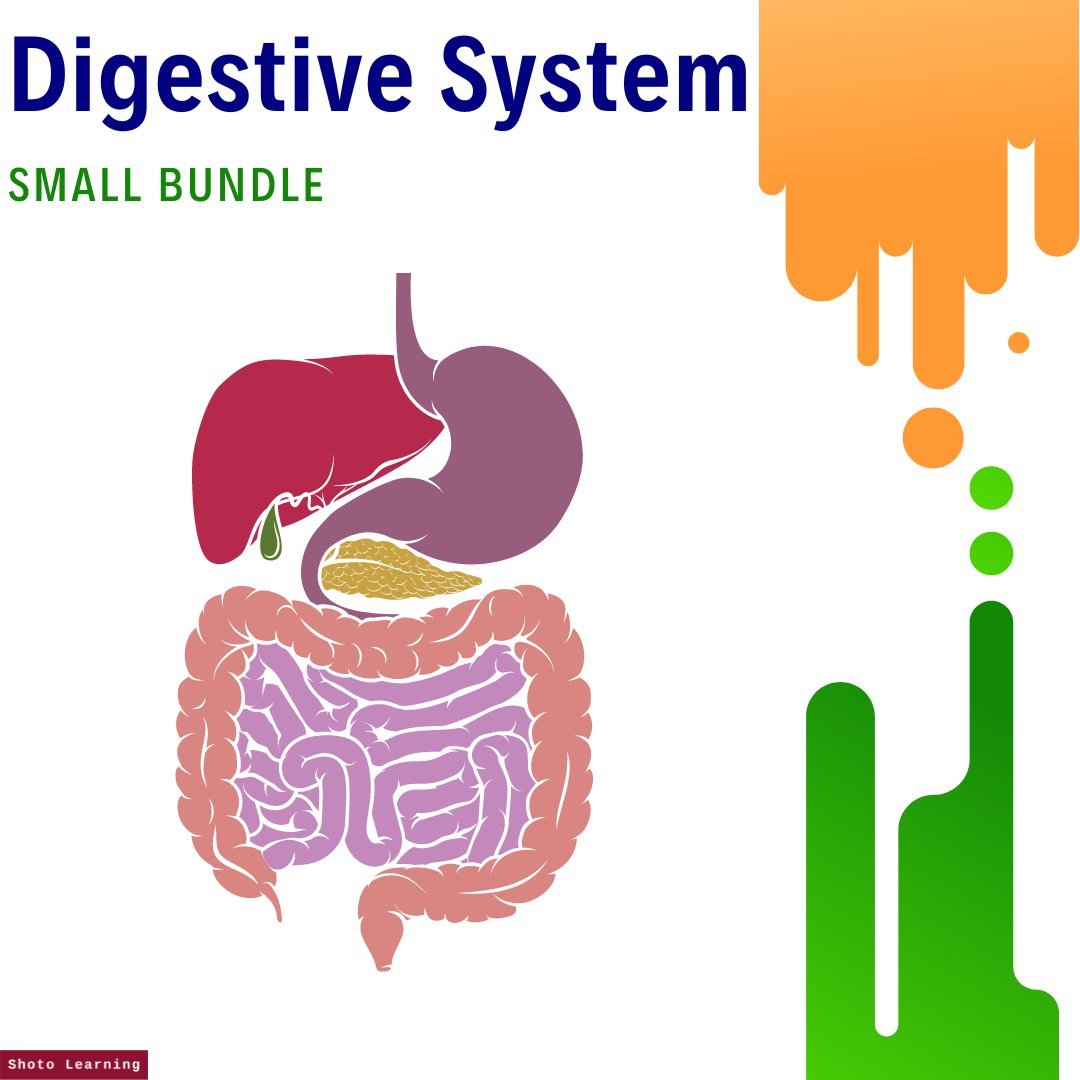


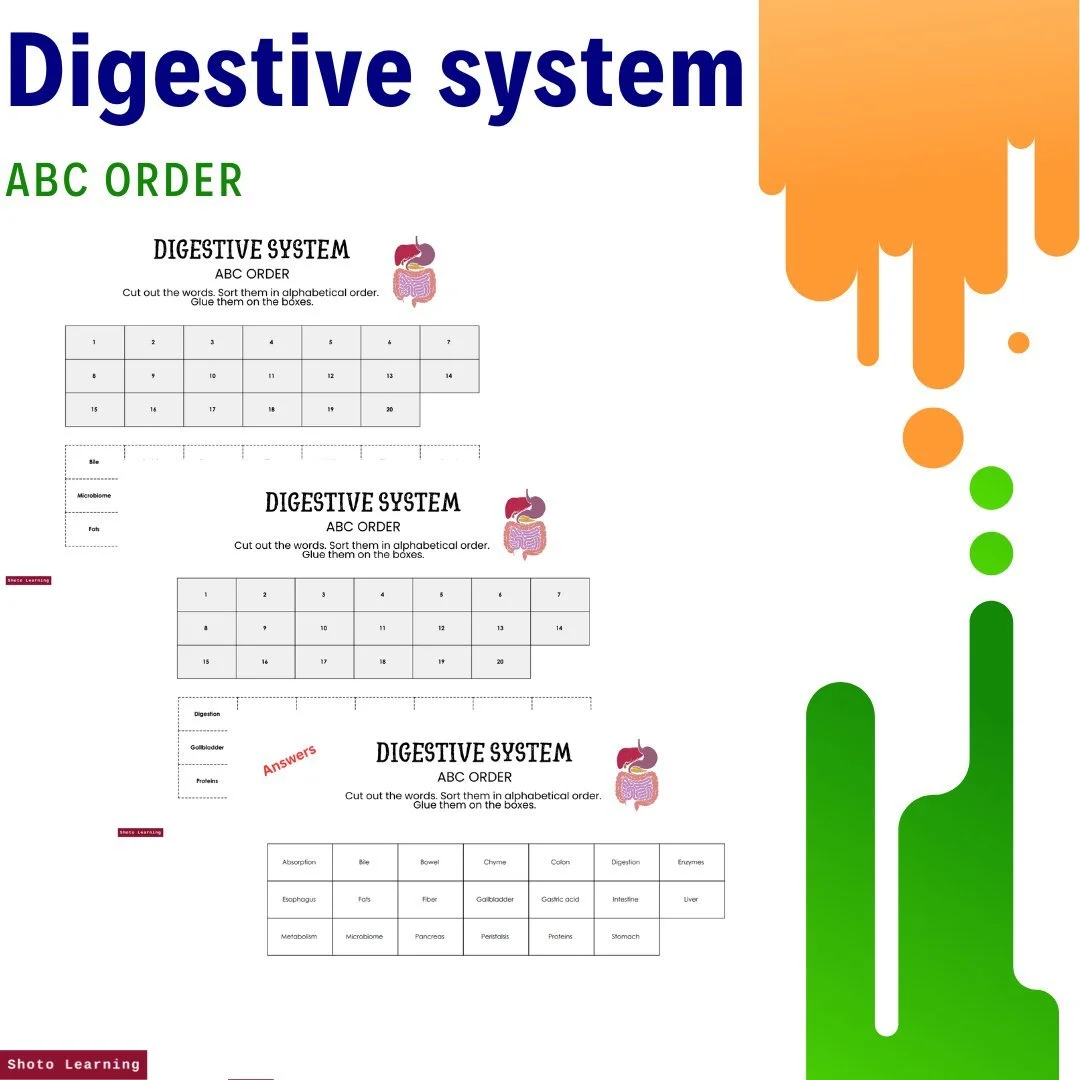


This bundle is a great way to learn about the digestive system and reinforce language skills at the same time. The activities are all arranged in alphabetical order, which helps students systematically learn the vocabulary terms.
The activities included in the bundle are:
Assignments
Bingo
Crossword
Cryptogram
Debate
Experiments
Fill in the blank
Flashcards
Free ABC Order
Free Cut and Paste
Free poster
Lesson Plan
Matching
Missing letters
Multiple choice
PowerPoint
Questions and answers
Reading Comprehension
Scramble
Spin wheel
Test (45 minutes)
True or false
Word search
Writing prompts
The bundle also includes a teacher answer key, so you can easily assess student progress.
Whether you're a teacher, homeschooler, or parent, this bundle is a great resource for learning about the digestive system. Order your copy today!
Here are some of the benefits of using this bundle:
Students will learn about the digestive system in a fun and interactive way.
The activities are arranged in alphabetical order, which helps students systematically learn the vocabulary terms.
The activities reinforce language skills, such as spelling, vocabulary, and comprehension.
The bundle includes a teacher answer key, so you can easily assess student progress.
This bundle is perfect for:
Teachers
Homeschoolers
Parents
Anyone who wants to learn about the digestive system in a fun and interactive way.
138 pages
Order your copy today!