
Teaching children about the frog life cycle can be both fun and educational when using the right tools. Worksheets, hands-on activities, and simple experiments help students understand how frogs grow from eggs into tadpoles and then adult frogs. Providing a mix of visual aids and interactive lessons makes learning about frogs engaging and easy to follow.
Using worksheets alongside activities like coloring pages, crafting, and observation experiments brings science to life. These methods encourage children to explore each stage of the frog’s development while reinforcing important concepts. Interactive lessons also support different learning styles and help keep kids interested in the topic.
Incorporating these resources into lesson plans allows educators and parents to teach the frog life cycle effectively, making a complex process clear and memorable for young learners.
Key Takeways
Visual and interactive resources enhance understanding of frog development.
Hands-on activities make learning about frogs more engaging.
Combining worksheets and experiments supports effective teaching.
Understanding the Frog Life Cycle
The frog life cycle shows how frogs grow and change from eggs to adult frogs. It includes different stages where the frog looks and acts very differently. This process highlights important features of amphibians and the natural changes they go through.
Overview of Amphibians
Amphibians are animals that live both in water and on land at different times in their lives. Frogs are a common type of amphibian. They usually start life in water as eggs.
Amphibians have moist skin that helps them breathe through it. They rely on water or damp environments to survive, especially when they are young. This dual life—part in water, part on land—is a key trait of amphibians.
Frogs depend on clean water to lay their eggs and for their young to develop. Environmental changes can affect their life cycle and survival since they rely on both land and water habitats.
Stages of the Frog Life Cycle
The frog life cycle has four main stages: egg, tadpole, froglet, and adult frog.
Egg: Frogs lay eggs in water. The eggs are jelly-like and protect the developing embryos.
Tadpole: After hatching, the frog is a tadpole. It lives in water, has gills, and swims with a tail.
Froglet: Tadpoles slowly develop legs and lungs. The tail shrinks, preparing the froglet for land.
Adult Frog: The mature frog can live on land and breathes air. It can also return to water to mate and start the cycle again.
Each stage serves a different purpose in the frog’s growth and survival.
Metamorphosis Explained
Metamorphosis is the process that changes tadpoles into adult frogs. It involves big physical changes.
At the start, tadpoles breathe with gills and swim with tails. During metamorphosis, lungs develop so the frog can breathe air.
Legs grow first, followed by the shrinking of the tail. The digestive system changes from one suited for plants to one for eating insects.
This transformation allows frogs to move from living in water to living on land. Metamorphosis is crucial to completing the frog life cycle successfully.
Stages of Frog Development
Frogs go through distinct changes as they grow. Each stage has unique features and helps the frog adapt to new environments. Understanding these stages is key to teaching how frogs live and grow.
Eggs and Frogspawn
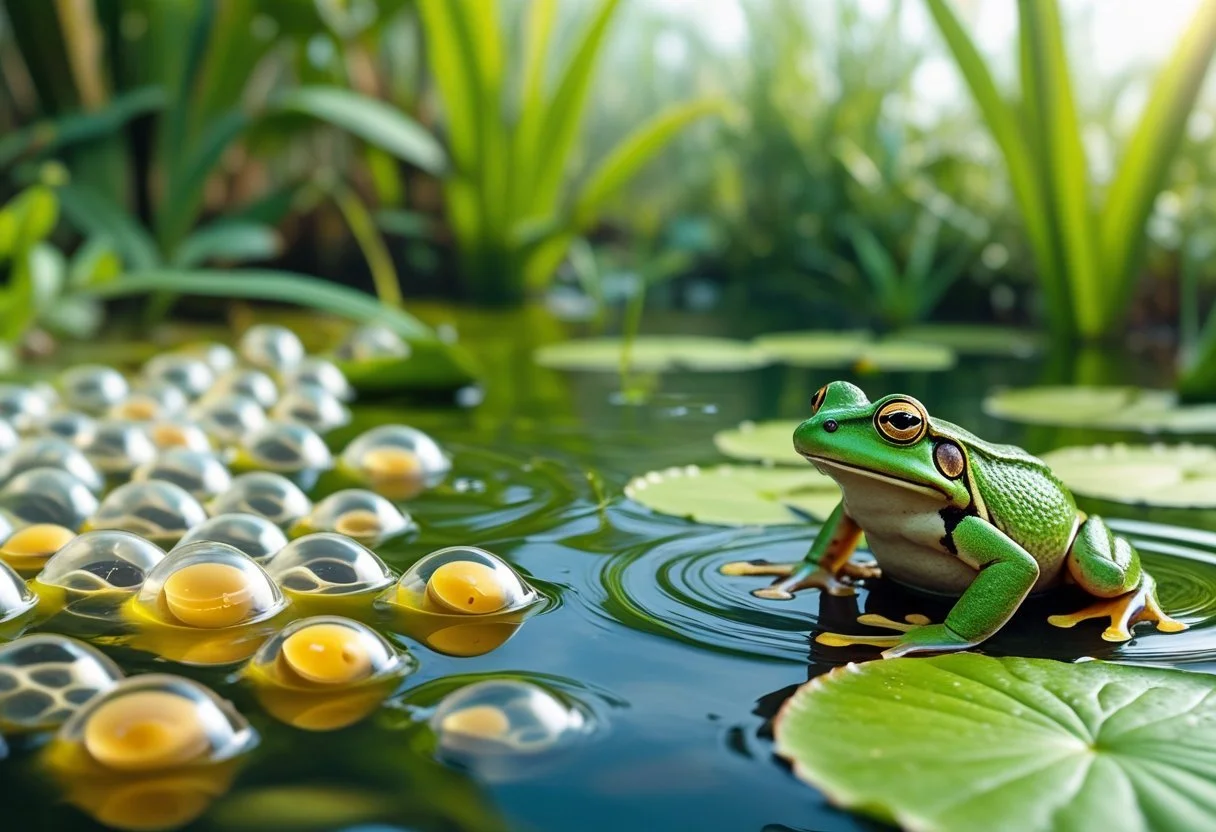
Frogs start life as eggs laid in water. These eggs are usually grouped together in clusters called frogspawn. The eggs are surrounded by a jelly-like substance that protects them from predators and keeps them moist.
Inside each egg, an embryo begins to develop. This stage can last from several days to a few weeks, depending on water temperature and species. The eggs hatch into tadpoles once the embryos mature enough to swim in water.
Tadpoles and Early Growth
Tadpoles hatch from the eggs with tails and gills for swimming and breathing underwater. At this point, they look more like fish than frogs. Tadpoles eat algae and other small plants in the water to grow.
During this stage, their bodies start changing gradually. They develop lungs for breathing air, and tiny limb buds appear where legs will grow. This growth can take several weeks as tadpoles prepare for their next stage.
Transition to Froglet
The tadpole slowly transforms into a froglet. Legs grow longer, and their tails shrink as they absorb nutrients. Their gills disappear, and they begin to breathe air with their lungs.
Froglets can live both in water and on land. They start eating small insects instead of plants. This stage is a key adjustment period as they get ready for life outside the water.
Adult Frogs
Adult frogs have fully developed legs and no tail. They live on land but usually stay near water for breeding. Adult frogs breathe through their lungs and skin.
Their diet mainly consists of insects and small invertebrates. Adult frogs are able to reproduce, starting the cycle anew by laying eggs in water. They play important roles in ecosystems as both predators and prey.
Frog Life Cycle Worksheets
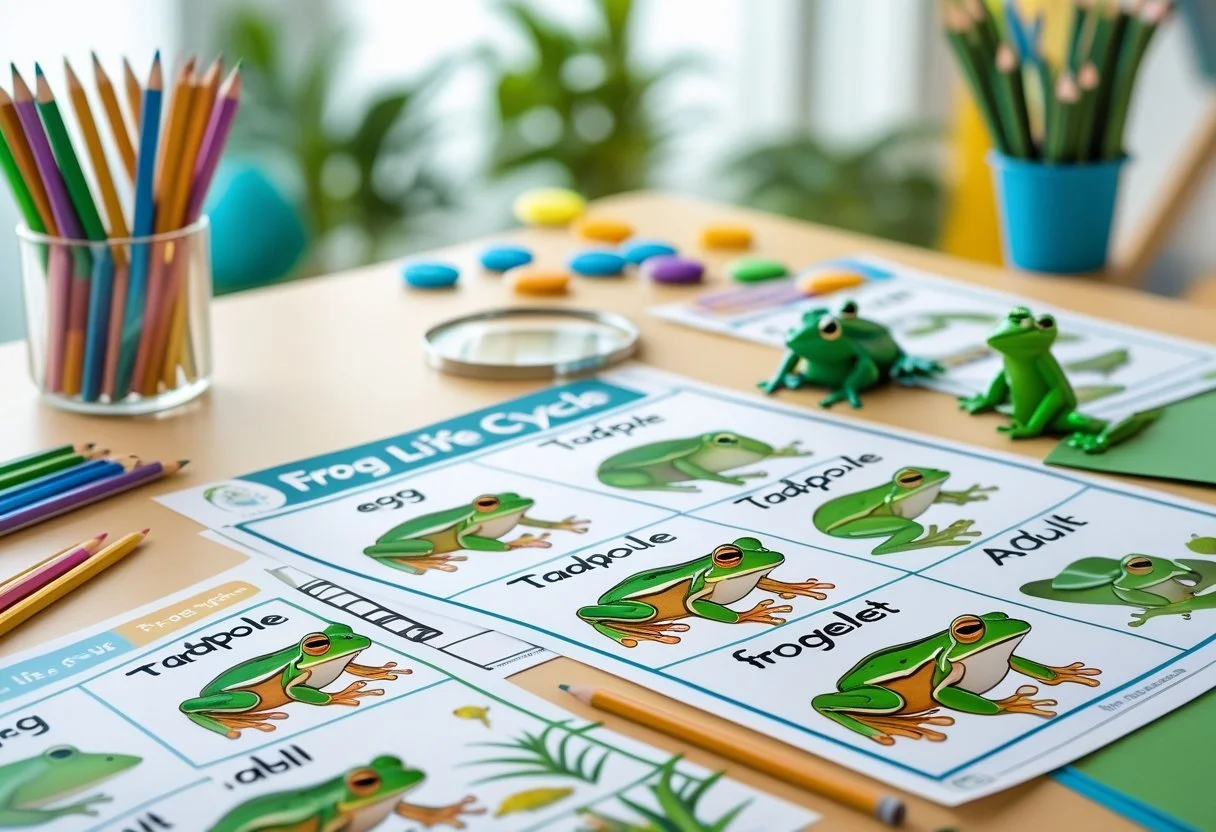
Frog life cycle worksheets help students learn each stage of a frog’s development. They can include matching pictures, filling in blanks, or cutting out and ordering life cycle stages. Such worksheets improve both science knowledge and vocabulary through clear, hands-on activities.
Types of Frog Life Cycle Worksheets
There are several types of frog life cycle worksheets designed for different learning goals. Some focus on identifying and naming stages like egg, tadpole, froglet, and adult frog. Others involve coloring or labeling parts to reinforce vocabulary.
Cut-and-paste worksheets let students arrange the stages in the correct order. This helps with sequencing skills and understanding the process. Some worksheets include simple questions or prompts to encourage writing about each stage.
Worksheets may vary by grade level, offering more detailed content for older students and simpler formats for younger children. Interactive Google Slides versions also exist, combining digital learning with printable options.
Printable and Free Worksheet Resources
Many free printable worksheets are available online for teaching the frog life cycle. These resources often include colorful illustrations and easy-to-follow instructions to engage students.
Websites like Teach Junkie, Super Teacher Worksheets, and Nature Inspired Learning offer high-quality free printables. These can be downloaded and printed multiple times for classroom or home use.
Free worksheets frequently come with accompanying activities such as cutouts, matching games, or simple quizzes. Printable life cycle worksheets help teachers avoid preparation time while delivering clear, organized content.
Labeling and Sequencing Activities
Labeling worksheets require students to match words with pictures of frog life cycle stages. This builds both science vocabulary and observation skills by focusing on names like “tadpole” and “froglet.”
Sequencing activities ask learners to arrange images or descriptions in the correct order. These tasks clarify how frogs change over time and strengthen understanding of gradual development.
Combining labeling and sequencing encourages critical thinking. For example, students might first label an unmarked diagram, then cut out images to place them sequentially. Such activities support multiple learning styles through hands-on involvement.
Hands-On Activities for Learning About Frogs
Hands-on activities help children understand the frog life cycle by allowing them to actively participate. These include crafts that show the stages of growth, games that build recognition skills, and exercises that develop fine motor skills and knowledge about frogs. Each activity uses visual and tactile elements to make learning clear and engaging.
Frog Life Cycle Crafts
Crafts are a great way for kids to visualize each stage of a frog’s life, from egg to adult. Using paper, cotton balls, and other simple materials, children can build models of frog eggs, tadpoles, and frogs with legs. These models help students see physical changes clearly.
Crafts can also be designed to show the order of development. For example, children can create a mobile with each stage hanging in sequence. This hands-on approach helps reinforce the life cycle steps and makes the concept easier to remember.
Matching Games and Cut-and-Paste
Matching games use cards or pictures to connect different frog life stages or parts of a frog. These games build memory and help children learn to identify each phase by sight. Matching pairs, such as "egg" with "tadpole," teaches recognition as well as sequencing.
Cut-and-paste worksheets allow learners to organize life cycle stages in the right order. Kids cut out pictures and glue them onto a sheet, reinforcing their understanding through both touch and sight. This hands-on method is effective for developing sorting skills and sequencing knowledge while learning about frogs.
Coloring and Tracing Exercises
Coloring pictures of frogs and their life stages helps children focus on details like features and body parts. Tracing outlines of eggs, tadpoles, and frogs improves hand-eye coordination and fine motor skills. These exercises can include labels to build vocabulary related to the frog’s life cycle.
Using coloring sheets with clear, simple images encourages observation. When kids color and trace, they learn to notice differences between stages and identify frog parts. This quiet activity supports learning by reinforcing concepts through repetition and creativity.
Experimental Learning: Frog Life Cycle Experiments

Hands-on experiments help students see the stages of the frog life cycle clearly. Watching real tadpoles grow and change gives a firm understanding of each step from egg to adult frog. Setting up a controlled environment for study and carefully recording changes supports active learning and scientific thinking.
Observing Tadpoles and Their Transformation
Students can watch tadpoles hatch from eggs and grow through visible stages. Tadpoles start with tails and gills, then gradually develop legs and lungs. This transformation from water to land animal is a key part of the frog life cycle lesson.
Teachers should provide clear explanations of each stage and encourage students to note physical changes. Observations can be daily or weekly. It is important to avoid disturbing the tadpoles or handling them too much to keep them healthy.
Setting Up a Safe Classroom Habitat
A safe habitat for tadpoles includes clean water, proper temperature, and plants or hiding places. A clear container with fresh water should be used and changed regularly to prevent harmful bacteria.
Adding aquatic plants helps oxygenate the water and offers shelter. It is important to avoid chemicals and maintain a stable environment. Sunlight or a light source should be indirect to mimic natural conditions.
Teachers should remind students to treat the habitat gently and responsibly. This setup allows tadpoles to grow naturally while keeping them safe in the classroom.
Tracking and Recording Growth
Students should record tadpole growth with notes, drawings, or pictures. Tracking changes like leg development, tail shrinkage, and body size helps understand the timeline of the frog life cycle.
A simple chart or checklist can organize observations. Key points to track:
Egg hatching date
Appearance of legs
Changes in tail size
Transition to froglet stage
Recording data regularly teaches students how to gather and analyze scientific information. This process also builds attention to detail and patience.
Lesson Planning and Teaching Strategies
Effective lesson planning for the frog life cycle includes clear objectives, hands-on activities, and tools that reinforce learning. Teachers should choose methods that connect visual, verbal, and kinesthetic learning to support all students. Planning also involves pacing lessons to fit different attention spans and abilities.
Integrating Worksheets into Lessons
Worksheets should support key concepts of the frog life cycle, such as the stages: egg, tadpole, froglet, and adult frog. They work best when paired with videos, diagrams, or real-life observations to deepen understanding.
Use worksheets for labeling diagrams, sequencing the life stages, or matching vocabulary terms. This allows students to practice and assess their knowledge. Worksheets can also include simple experiments, like observing tadpoles developing, to link theory to hands-on learning.
Tips for using worksheets:
Introduce worksheets after teaching each stage, not all at once.
Encourage discussion about answers to build comprehension.
Use coloring or drawing tasks for younger learners to increase engagement.
Differentiation for Diverse Learners
Different students learn in different ways and at different speeds. Teachers can use multiple methods to teach the frog life cycle to meet these needs.
Strategies include:
Visual aids like videos and picture flashcards for visual learners.
Group discussions and storytelling for auditory learners.
Hands-on activities and crafts for kinesthetic learners.
Teachers should prepare simpler worksheets for students who need extra support. More advanced students can work on research projects or lead presentations. Adjusting group work size and providing varied materials helps all students stay involved and succeed.
Assessment and Reinforcement
To help students understand the frog life cycle, teachers need tools that check learning and strengthen key ideas. Worksheets provide structure for review, while observing frogs and leading discussions deepen understanding through real experiences.
Using Worksheets for Review
Frog life cycle worksheets are effective for assessing student knowledge. They often include labeling diagrams, sequencing life stages, and short-answer questions. These tasks help teachers quickly see if students can identify and explain each stage — egg, tadpole, froglet, and adult frog.
Worksheets can be repeated or varied to reinforce learning. For example, teachers might use cut-and-paste activities to arrange stages or vocabulary exercises to build key terms. This variety keeps students engaged and supports different learning styles.
Using worksheets regularly allows teachers to track progress over time. They also serve as a reference for students to review what they’ve learned, making it easier to recall facts during class discussion or tests.
Observation and Discussion Techniques
Direct observation of frogs or videos is a strong way to deepen understanding of the life cycle. Watching real or recorded changes from eggs to adult frogs helps students connect facts with real-life examples.
Teachers can guide students to make detailed notes or drawings during observation. Asking open-ended questions like “What changes do you see?” or “Why do you think this stage happens?” encourages critical thinking.
Group discussions following observations let students share ideas and correct misunderstandings. This active talk and reflection support learning beyond memorization.
Using these techniques alongside worksheets creates a balanced mix of review and hands-on experience for better retention of the frog life cycle.
Frequently Asked Questions
The frog life cycle includes several clear stages and can be taught using different hands-on methods and visual aids. Worksheets help reinforce learning by guiding students through labeling and sequencing tasks. Experiments and activities bring science to life, while connecting this topic to broader subjects supports deeper understanding.
What are the key stages of a frog's life cycle?
The main stages are egg, tadpole, tadpole with legs, froglet, and adult frog. Eggs hatch into tadpoles, which live in water and have gills. As they grow, tadpoles develop legs and lungs before becoming adult frogs that live mostly on land.
Which activities best engage students in learning about frog metamorphosis?
Hands-on activities like foldable life cycle models and crafts work well. Watching videos or observing real tadpoles can capture interest. Cut-and-paste worksheets help students arrange the stages in order, making the process clear and fun.
How can worksheets be used to effectively teach the frog life cycle?
Worksheets can include diagrams for labeling body parts and stages. They support vocabulary building and writing practice. Interactive worksheets, like matching or sequencing, reinforce the order and details of frog development.
What are some simple experiments to demonstrate the frog life cycle to children?
Keeping tadpoles in a clear container allows students to observe growth and change over time. Measuring growth or noting behaviors adds a scientific approach. Experiments like comparing tadpole movement or testing water conditions help explain habitat needs.
How can the concept of the frog life cycle be integrated into a broader science curriculum?
It can connect to topics like animal classification, ecosystems, and adaptation. Teachers can link it to lessons on amphibians and environmental science. It also supports lessons on growth, change, and life processes common to many organisms.
Can you suggest any interactive online resources for teaching the frog life cycle?
Websites offering videos, printable worksheets, and digital games are helpful. Some sites include quizzes and coloring pages to mix fun with learning. Tools that combine real-life frog sounds or citizen science projects add engaging, real-world connections.


Enhance your student’s understanding of the Life Cycle of a Frog with this Complete Bundle, packed with over 21 interactive and engaging activities for 2nd and 3rd-grade science students. This comprehensive bundle covers everything from worksheets and games to assessments and creative projects, making it an all-in-one solution for teaching the frog’s life cycle. Plus, enjoy 4 free bonus activities to enrich your lessons even further!
Key Features:
Assignments: 10 detailed questions with answers to test students' understanding of the frog life cycle stages.
Bingo Game: A fun, interactive game to reinforce key vocabulary.
Crossword Puzzle: A word puzzle that helps students recall important life cycle terms.
Cryptogram: Decode a secret message related to the frog’s life cycle for a critical thinking challenge.
Debate Questions: 10 debate-style questions to spark student discussions on frogs and their life cycle.
Science Experiment: A hands-on experiment for students to observe frog development and draw scientific conclusions.
Fill-in-the-Blank Worksheet: A simple, engaging worksheet for reinforcing key facts and vocabulary.
Flashcards: One-sided flashcards with key terms and descriptions for quick review and memorization.
Lesson Plan: A 45-minute, easy-to-follow lesson plan with clear objectives, activities, and assessment guidance.
Matching Worksheets: Two sets of matching activities to pair frog life cycle terms with their definitions.
Missing Letters: An activity for reinforcing spelling and terminology by filling in the blanks of important words.
Multiple-Choice Quiz: Test students' knowledge with a set of 20 multiple-choice questions.
PowerPoint Presentation: A comprehensive slideshow, with an included speech script and free YouTube access, to guide your teaching.
Questions & Answers: 20 questions and answers on the life cycle for classroom discussions or assessments.
Reading Comprehension Worksheet: A passage about frogs with related questions to improve reading skills and understanding.
Scramble Game: An activity where students unscramble life cycle terms.
Test: A 45-minute test that covers all stages of the frog’s life cycle.
True or False Quiz: A quick review quiz to assess comprehension of true or false statements about frogs.
Word Search: A fun puzzle to help students familiarize themselves with key life cycle vocabulary.
Writing Prompts: 10 creative writing prompts that encourage students to express what they’ve learned about frogs in their own words.
Free Activities:
ABC Order Worksheet: Practice arranging frog life cycle terms in alphabetical order.
Craft Activity: A creative frog life cycle craft that lets students visually represent each stage.
Cut and Paste Activity: A sequencing activity where students arrange the life cycle stages in the correct order.
Poster: A free, printable poster of the frog life cycle that can be used as a visual aid in the classroom.
How to Use:
Introduce the Lesson: Begin by presenting the PowerPoint and following the included speech to guide your students through the frog life cycle.
Classroom Activities: Reinforce learning with interactive games like Bingo, Crossword, and Word Search to keep students engaged.
Critical Thinking & Assessment: Use assignments, quizzes, and the final test to assess students’ understanding of the material.
Creative Projects: Encourage students to express their learning through writing prompts, debate questions, or the hands-on craft activity.
Remote Learning: Use the included PDF copies of worksheets and PowerPoint to facilitate remote or hybrid learning.
This Complete Life Cycle of a Frog Bundle offers a wide variety of activities, ensuring your students stay engaged while mastering the content through different learning methods. Perfect for science lessons in the classroom, homeschooling, or independent study!
133 pages
Order your copy today!