
Teaching Types of Cells: Prokaryotic vs. Eukaryotic - Key Differences Explained for Biology Students
Cells are the building blocks of all living organisms on Earth. From the tiniest bacteria to the largest mammals, cells form the basic unit of life. Understanding the differences between cell types helps us grasp how life has evolved and functions across species.
Prokaryotic and eukaryotic cells represent the two fundamental categories into which all cells are classified, with distinct structures that determine how they operate. Prokaryotes, like bacteria, have simpler structures without membrane-bound organelles. Eukaryotes, which make up plants, animals, fungi, and protists, contain specialized compartments that perform specific functions.
When teaching about cells, it's helpful to compare these two types side by side. Their differences in size, organization, and genetic material highlight evolution's incredible journey. These contrasts also explain why certain organisms can survive in extreme environments while others require specific conditions.
Key Takeaways
All living organisms are composed of either prokaryotic or eukaryotic cells, which differ in their internal organization and complexity.
Prokaryotic cells lack a nucleus and membrane-bound organelles, while eukaryotic cells contain these specialized structures.
Understanding cell types provides insight into evolutionary relationships and helps explain how different organisms function.
Foundational Concepts of Cell Biology
Cells form the basic building blocks of all living organisms. They contain essential structures that perform specific functions to maintain life through complex biochemical processes.
Overview of Cell Theory
Cell theory represents one of biology's most fundamental frameworks. It consists of three main principles:
All living organisms are composed of cells
Cells are the basic unit of structure and function in living things
All cells come from pre-existing cells
This theory emerged from the work of scientists like Robert Hooke, who first observed cell walls in cork tissue in 1665, and Anton van Leeuwenhoek, who documented single-celled organisms. Matthias Schleiden and Theodor Schwann formally proposed cell theory in the 1830s.
Cells vary greatly in size and complexity. Some organisms consist of just one cell, while humans contain trillions. Despite these differences, all cells share certain characteristics such as being enclosed by a cell membrane and containing genetic material.
Differences Between Cell Types
Scientists classify cells into two major categories: prokaryotic and eukaryotic.
Prokaryotic Cells:
Lack a true nucleus
No membrane-bound organelles
Smaller (typically 0.1-5.0 μm)
Found in bacteria and archaea
Simpler internal structure
Single circular DNA molecule
Eukaryotic Cells:
Contain a membrane-bound nucleus
Have specialized organelles (mitochondria, Golgi, etc.)
Larger (typically 10-100 μm)
Found in plants, animals, fungi, and protists
More complex internal organization
Multiple linear DNA molecules (chromosomes)
These fundamental differences reflect the evolutionary divergence that occurred billions of years ago. Prokaryotes emerged first, with eukaryotes evolving later, likely through endosymbiotic relationships between different prokaryotic cells.
Characteristics of Prokaryotic Cells
Prokaryotic cells are the simplest and most ancient form of cellular life on Earth. They lack a nucleus and other membrane-bound organelles that are found in more complex cells.
Cell Structure and Organelles
Prokaryotic cells have a simpler structure compared to eukaryotic cells. They are typically smaller, ranging from 0.1 to 5.0 micrometers in diameter. The plasma membrane (also called cell membrane) encloses the cell and regulates what enters and exits.
Most bacteria have a rigid cell wall containing peptidoglycan, which provides protection and structural support. In many prokaryotes, a capsule surrounds the cell wall, helping the cell attach to surfaces and resist drying out.
Unlike eukaryotes, prokaryotes lack membrane-bound organelles. They do contain ribosomes for protein synthesis, but these are smaller than eukaryotic ribosomes.
Many prokaryotic cells have external structures like flagella for movement and pili for attachment to surfaces or other cells.
Genetic Material and Reproduction
Prokaryotes contain a single circular chromosome located in an area called the nucleoid. This DNA is not enclosed within a nuclear membrane but floats freely in the cytoplasm.
Some prokaryotes also contain small circular DNA molecules called plasmids. These carry additional genes that may provide advantages like antibiotic resistance.
Bacteria and archaea reproduce primarily through binary fission, a simple form of asexual reproduction. During this process, the cell grows, duplicates its DNA, and divides into two identical daughter cells.
The simplicity of prokaryotic reproduction allows them to multiply rapidly under favorable conditions. Some bacteria can double their population in just 20 minutes.
Characteristics of Eukaryotic Cells
Eukaryotic cells represent one of the most complex achievements of cellular evolution. These cells contain specialized structures and compartments that perform specific functions to support cell survival and reproduction.
Complex Organelles and Structures
Eukaryotic cells contain numerous membrane-bound organelles that perform specialized tasks. The mitochondria serve as the cell's power plants, converting nutrients into energy through cellular respiration. These organelles have their own DNA and can replicate independently.
The endoplasmic reticulum (ER) forms an extensive network throughout the cytoplasm. The rough ER, studded with ribosomes, manufactures proteins, while the smooth ER synthesizes lipids and detoxifies harmful substances.
Ribosomes exist both free in the cytoplasm and attached to the rough ER. They assemble proteins according to instructions from the nucleus.
Plant cells contain chloroplasts, which capture sunlight to produce food through photosynthesis. Like mitochondria, chloroplasts possess their own DNA.
The cytoplasm in eukaryotic cells is highly organized, with a cytoskeleton of protein fibers that provide structure and facilitate movement.
Nucleus and Genetic Information
The defining feature of eukaryotic cells is the nucleus, a membrane-enclosed structure that houses genetic material. This double-membrane barrier separates DNA from the cytoplasm and controls what enters and exits.
Inside the nucleus, DNA is organized into linear chromosomes rather than the circular form found in prokaryotes. Human cells typically contain 46 chromosomes, while other species have different numbers.
Eukaryotic cells undergo complex forms of cell division. Mitosis produces two identical daughter cells for growth and repair, while meiosis creates gametes with half the chromosome number for sexual reproduction.
The nucleus contains a nucleolus, where ribosomal RNA is produced. This structure plays a key role in assembling ribosomes, which are essential for protein synthesis.
Cell Size and Complexity
Cell size and structural complexity vary significantly between prokaryotic and eukaryotic cells, with important implications for their functions in living organisms.
Analyzing Structural Differences
Prokaryotic cells are typically much smaller than eukaryotic cells, measuring about 0.1-5.0 micrometers in diameter. Eukaryotic cells range from 10-100 micrometers—up to 10 times larger.
This size difference reflects their internal complexity. Prokaryotes lack membrane-bound organelles and have a simple structure. Their DNA floats freely in the cytoplasm as a nucleoid.
Eukaryotic cells contain numerous specialized organelles enclosed by membranes. These include the nucleus, mitochondria, Golgi apparatus, and endoplasmic reticulum. This compartmentalization allows for specialized functions within the cell.
The cytoskeleton, composed of microtubules and other protein filaments, provides structural support in eukaryotes. This feature is largely absent in prokaryotes.
Implications of Size on Function
Cell size directly affects a cell's surface area-to-volume ratio, a critical factor in cellular function. Smaller prokaryotic cells have higher surface-to-volume ratios, allowing more efficient nutrient absorption and waste removal.
Larger eukaryotic cells face challenges in material transport across their volume. To overcome this, they developed complex internal transport systems and specialized organelles.
The complexity of eukaryotes enables multicellularity, where different cells perform specialized functions. Prokaryotes remain primarily unicellular, though some form simple colonies.
Cell theory recognizes these differences while maintaining that all cells share fundamental properties. Both types require membranes to separate from their environment and contain genetic material to direct cellular activities.
Energy, Metabolism, and Cellular Processes
Cells require energy to function, and they use specific mechanisms to produce and manage this energy. These processes differ between prokaryotic and eukaryotic cells due to their structural differences.
Prokaryotic vs. Eukaryotic Metabolism
Prokaryotic cells have simpler metabolic pathways because they lack membrane-bound organelles. Their metabolism occurs directly in the cytoplasm, making it more streamlined and often faster.
The cell membrane in prokaryotes plays a crucial role in energy production through processes like electron transport chains. These cells are metabolically diverse, with some capable of photosynthesis, chemosynthesis, or various fermentation pathways.
Eukaryotic cells have compartmentalized metabolism in specialized organelles. Mitochondria serve as the powerhouse of the cell, while chloroplasts in plant cells capture solar energy through photosynthesis.
This compartmentalization allows eukaryotes to run multiple metabolic processes simultaneously without interference. However, this complexity requires additional energy for maintenance and coordination between organelles.
Cellular Respiration and ATP Production
Both cell types produce ATP (adenosine triphosphate), the cellular energy currency, but through different mechanisms. Prokaryotes typically generate ATP through substrate-level phosphorylation and membrane-based electron transport.
Eukaryotes produce most of their ATP in mitochondria through a complex series of reactions in cellular respiration. This process involves glycolysis, the citric acid cycle, and oxidative phosphorylation.
The inner membrane of mitochondria contains the machinery for the electron transport chain, which generates a proton gradient used to synthesize ATP efficiently.
Protein synthesis and DNA replication consume significant energy in both cell types. These processes require ATP for various stages including transcription and translation of genetic material.
Genetics and Cell Reproduction
Cells carry genetic information that guides their functions and allows them to reproduce. Both prokaryotic and eukaryotic cells have distinct methods for organizing and copying their genetic material.
DNA Structure and Function
DNA (deoxyribonucleic acid) serves as the genetic material in all cells. It consists of two strands twisted into a double helix, with each strand made of nucleotides containing the bases adenine, thymine, guanine, and cytosine.
In prokaryotic cells, DNA exists as a single circular chromosome floating in the cytoplasm. These cells lack a protective nuclear membrane around their genetic material.
Eukaryotic cells organize their DNA differently. Their genetic material resides within the nucleus, wrapped around histone proteins to form chromosomes. The nucleolus, a structure within the nucleus, produces ribosomes necessary for protein synthesis.
Gene expression—the process of using genetic information to make proteins—follows similar basic steps in both cell types but involves more complex regulation in eukaryotes.
Patterns of Inheritance
Cell division ensures genetic material passes from parent cells to daughter cells. Prokaryotes typically reproduce through binary fission, a simple division process that creates identical copies.
Eukaryotic cells use more complex division methods. Mitosis produces two genetically identical daughter cells and is used for growth and tissue repair. The process carefully distributes chromosomes equally between the new cells.
Meiosis, occurring only in sex cells, reduces chromosome numbers by half. This special division creates genetic diversity through processes like crossing over, where chromosomes exchange genetic material.
These inheritance patterns explain why offspring resemble their parents while still maintaining unique traits. The precise replication and distribution of chromosomes ensures genetic continuity between generations.
Observation and Analysis of Cells
Scientists use various tools and techniques to study cells. These methods help distinguish between different cell types and understand their structures and functions.
Microscopy Techniques
Light microscopes are essential tools for basic cell observation. They magnify cells up to 1000 times, allowing students to see larger cell structures like the cell wall and nucleus.
For more detailed views, electron microscopes are necessary. These powerful tools can magnify cells up to 10,000 times or more. They reveal tiny structures like ribosomes that light microscopes cannot show.
Staining techniques enhance cell visibility. Methylene blue works well for prokaryotic bacterial cells, while iodine helps identify starch in plant cells.
Phase-contrast microscopy lets scientists observe living cells without staining them. This is particularly useful for watching cell processes in real time.
Fluorescence microscopy uses special dyes that highlight specific parts of cells. This helps researchers track certain proteins or genetic information within the cell.
Cell Identification and Classification
Scientists identify cells based on key structural features. Prokaryotes (like bacterial cells) lack a true nucleus. Their genetic information floats in the cytoplasm in a nucleoid region.
Eukaryotes have membrane-bound nuclei that house their DNA. This is the most obvious difference between eukaryotic and prokaryotic cells.
Cell size also helps with identification. Prokaryotes are typically smaller (1-5 micrometers) than eukaryotes (10-100 micrometers).
The presence of certain organelles indicates cell type:
Chloroplasts: Found only in plant cells and algae
Cell walls: Present in plant cells, fungi, and bacteria
Cytoplasmic membrane: Present in all cells but with different compositions
Animal cells can be identified by their lack of cell walls and their irregular shapes. Plant cells appear more rectangular with rigid cell walls.
Frequently Asked Questions
Cell biology can be complex, but understanding the differences between prokaryotic and eukaryotic cells helps clarify how organisms function. These common questions address the key distinctions in structure, examples, and functions of both cell types.
What are the distinguishing characteristics of prokaryotic and eukaryotic cells?
Prokaryotic cells lack a true nucleus and membrane-bound organelles. Their DNA floats freely in the cytoplasm as a circular chromosome.
Eukaryotic cells contain a membrane-bound nucleus that houses their DNA. They also possess numerous membrane-bound organelles such as mitochondria, endoplasmic reticulum, and Golgi apparatus.
Prokaryotes are typically smaller (0.1-5 μm) than eukaryotes (10-100 μm). They also have simpler internal structures and organization.
Can you provide examples of both prokaryotic and eukaryotic cells?
Prokaryotic cells include bacteria and archaea. Examples of bacteria are E. coli, Streptococcus, and Staphylococcus. Archaea include methanogens and halophiles.
Eukaryotic cells make up plants, animals, fungi, and protists. Human cells, oak tree cells, mushroom cells, and amoeba cells are all eukaryotic.
Single-celled eukaryotes include yeasts, paramecium, and amoebas. Multicellular eukaryotes include all plants and animals.
In what ways are prokaryotic and eukaryotic cells structurally different?
Prokaryotic cells have cell walls made of peptidoglycan (bacteria) or pseudopeptidoglycan (archaea). They may have flagella for movement and pili for attachment.
Eukaryotic cells have varied cell boundaries. Animal cells have only a cell membrane, while plant cells have a cell membrane and cell wall made of cellulose.
Eukaryotes contain a cytoskeleton of microtubules and microfilaments that maintain cell shape. Their DNA is organized into multiple linear chromosomes within the nucleus.
How do the reproductive processes differ between prokaryotic and eukaryotic cells?
Prokaryotic cells reproduce asexually through binary fission. The cell duplicates its DNA, grows, and splits into two identical daughter cells.
Eukaryotic cells can divide through mitosis (asexual) or participate in sexual reproduction through meiosis. Mitosis creates two genetically identical cells.
Meiosis produces four haploid cells with half the chromosomes of the parent cell. This process allows for genetic variation in offspring.
What are the key similarities that prokaryotic and eukaryotic cells share?
Both cell types contain DNA as their genetic material, though organized differently. They both use this genetic information to produce RNA and proteins.
All cells have a cell membrane that separates the interior from the external environment. This phospholipid bilayer controls what enters and exits the cell.
Both types carry out metabolism, including cellular respiration. They use ribosomes to synthesize proteins and contain cytoplasm where many cellular reactions occur.
How can one visually distinguish between a prokaryotic and a eukaryotic cell using a diagram?
In diagrams, prokaryotic cells appear simpler and smaller with few internal structures. Look for the absence of a nucleus and the presence of a nucleoid region with DNA.
Eukaryotic cell diagrams show a prominent nucleus with a nuclear membrane. They also display various organelles such as mitochondria, endoplasmic reticulum, and Golgi apparatus.
Plant cell diagrams specifically show cell walls, chloroplasts, and a large central vacuole. Animal cell diagrams lack these features but may show centrioles and lysosomes.


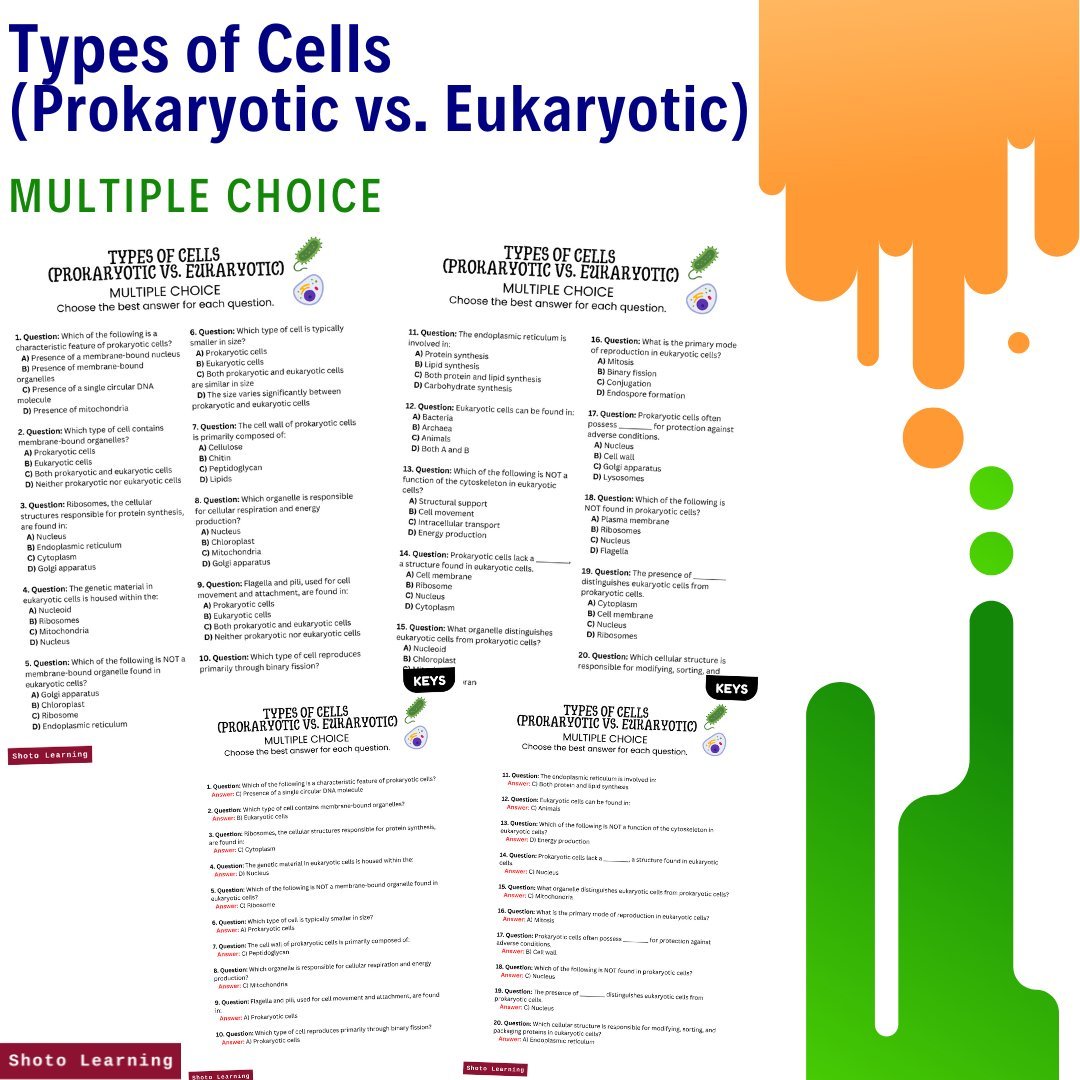


Embark on an exciting journey into the realm of cellular biology with our comprehensive "Cell Biology Activity Bundle," focusing on the comparison between prokaryotic and eukaryotic cells. This bundle features a diverse selection of engaging activities and resources designed to deepen understanding, promote critical thinking, and reinforce key concepts. Whether you're a teacher looking to enhance classroom lessons or a student seeking additional practice, this bundle provides a wealth of educational opportunities. From bingo and crossword puzzles to flashcards and writing prompts, there's something for everyone in this comprehensive bundle.
Bundle Includes:
Assignments: Embark on 10 stimulating assignments covering diverse topics, encouraging critical thinking and practical application of knowledge.
Bingo - 30 Bingo Cards: Enjoy a fun and interactive game of bingo while reinforcing knowledge of prokaryotic and eukaryotic cells. Perfect for classroom activities or study groups.
Crossword Puzzle: Challenge yourself with a crossword puzzle that tests your understanding of cell biology concepts and terminology.
Cryptogram: Decode cryptic messages related to prokaryotic and eukaryotic cells, combining logic and knowledge to unravel hidden meanings.
Debate: Engage in lively debates exploring the differences between prokaryotic and eukaryotic cells, fostering critical thinking and communication skills.
Experiments: Explore hands-on experiments illustrating fundamental principles across various disciplines, fostering deeper understanding and engagement.
Fill in the Blank: Test your knowledge of cell biology with fill-in-the-blank exercises covering various aspects of prokaryotic and eukaryotic cells.
Flash Cards: Reinforce key concepts and terms with flashcards designed for quick review and memorization.
Free ABC Order: Practice alphabetizing cell biology terms with a free ABC order worksheet, promoting vocabulary retention and organization skills.
Free Label the Parts: Identify and label the essential components of prokaryotic and eukaryotic cells with a free labeling worksheet.
Free Poster: Explore intriguing facts about cell biology with a free poster, perfect for classroom display or personal reference.
Lesson Plan: Dive deep with our detailed lesson plan, complete with engaging activities and discussion topics.
Matching: Match descriptions to corresponding cellular structures and functions, reinforcing understanding of key concepts.
Missing Letters: Exercise your problem-solving skills by filling in missing letters to complete words related to cell biology.
Multiple Choice: Test your knowledge with multiple-choice quizzes covering various aspects of prokaryotic and eukaryotic cells.
PowerPoint: Dive into the intricacies of cell biology with a visually engaging PowerPoint presentation, providing a comprehensive overview of prokaryotic and eukaryotic cells.
Questions and Answers: Challenge yourself with thought-provoking questions and check your understanding with comprehensive answer keys.
Reading Comprehension: Sharpen reading skills with engaging passages, perfect for students and educators alike.
Scramble: Unscramble letters to form words related to cell biology, enhancing vocabulary and spelling skills.
Test (45 Minutes): Assess your knowledge and comprehension with a timed test focusing on the similarities and differences between prokaryotic and eukaryotic cells.
True or False: Test your understanding of cell biology concepts with true or false quizzes, providing instant feedback for self-assessment.
Word Search: Have fun while reinforcing knowledge of cell biology concepts with a word search puzzle.
Writing Prompts: Reflect on the significance of prokaryotic and eukaryotic cells and explore their roles in living organisms with engaging writing prompts.
Enhance your understanding of prokaryotic and eukaryotic cells with our "Cell Biology Activity Bundle," offering a wide array of interactive and educational resources for comprehensive learning. Whether you're a student or an educator, these activities provide valuable tools for mastering the fundamentals of cell biology.
Order your copy today!