
Using Puzzles to Teach Geometry Basics for Engaging and Effective Learning
Using puzzles to teach geometry basics offers an effective way to make learning shapes and spatial concepts more engaging. Puzzles encourage students to think critically and develop problem-solving skills while exploring geometric forms. They help learners understand key concepts like angles, shapes, and spatial relationships in a hands-on and interactive way.
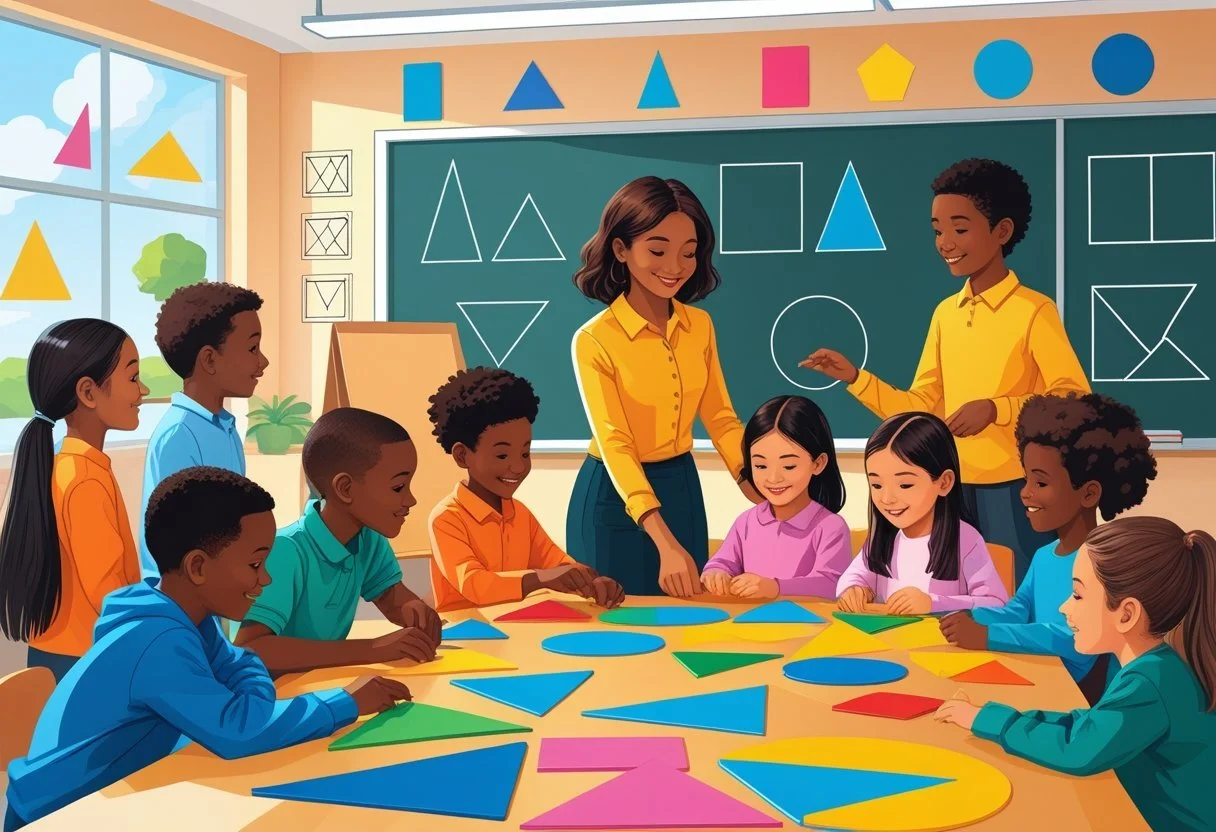
Puzzles also support the development of spatial reasoning, which is essential for grasping more advanced math concepts later on. By working through different puzzle types, students can build confidence and enjoy math in a less stressful environment. This approach links abstract geometry ideas to real-world experiences through creative play and exploration.
Teachers and parents can use a variety of puzzles to meet different learning needs and encourage collaboration. This makes puzzles a versatile tool for both classroom and home learning, helping students build a strong foundation in geometry.
Key Takeways
Puzzles promote critical thinking and hands-on learning in geometry.
Spatial reasoning skills improve through engaging puzzle activities.
Puzzles can be adapted to fit different learning styles and environments.
The Role of Puzzles in Teaching Geometry
Puzzles help students understand geometry by making abstract ideas clear and hands-on. They encourage critical thinking and keep students interested in learning. Using puzzles changes how students work with shapes, space, and logic.
Benefits of Using Puzzles for Learning
Puzzles build spatial skills by requiring students to manipulate shapes and see relationships between parts. This hands-on approach helps students grasp geometry concepts like angles, symmetry, and area more easily.
Students also develop logical thinking since many puzzles require step-by-step problem solving. This skill is useful for understanding proofs and reasoning in geometry classes.
Another benefit is that puzzles give immediate feedback. Students can see if their solution works, which helps them learn from mistakes. This makes learning more active compared to just listening or reading.
Motivating Student Engagement Through Games
Games and puzzles add a fun element to geometry lessons. This can increase student motivation and reduce math anxiety. When students enjoy the activity, they spend more time practicing and exploring ideas.
Using puzzles also creates a sense of challenge and curiosity. Students want to solve the problem and feel rewarded when they do. This keeps them focused during lessons.
Teachers can use puzzles as group activities, encouraging collaboration. Working in teams helps build communication skills and allows students to learn from each other.
Comparing Puzzles to Traditional Methods
Traditional geometry teaching often relies on lectures and textbooks. This can be passive and less engaging for many students. Puzzles offer a more interactive and hands-on experience.
While lectures explain rules and formulas, puzzles let students apply these ideas. This makes abstract concepts more concrete.
Traditional methods may focus on memorizing, but puzzles promote critical thinking and creativity. Students explore multiple solutions rather than just one correct answer.
In summary, puzzles provide an active learning process that supports deeper understanding compared to some conventional approaches.
Fundamental Geometric Shapes Through Puzzles
Puzzles help learners understand key geometric shapes by making abstract concepts visible and hands-on. They highlight shape types, properties, and differences between shapes that are flat or solid. Using puzzles, students can easily identify, analyze, and compare a variety of geometric forms.
Identifying 2D and 3D Shapes
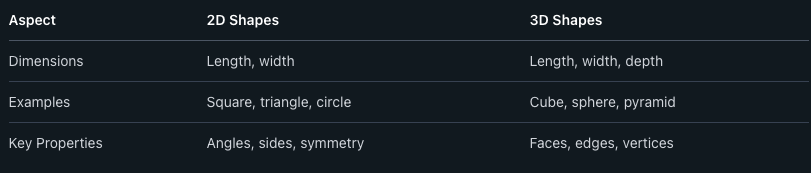
Puzzles often start with simple flat shapes like squares, triangles, and circles. These 2D shapes have length and width but no depth. Sorting puzzles and tangrams help students recognize these shapes by their sides, angles, and how they fit together.
Three-dimensional shapes such as cubes, spheres, and pyramids appear in puzzles where pieces build or represent solid objects. These take space and have volume. Using 3D puzzle pieces helps learners see how these shapes look from different angles and how faces, edges, and vertices connect.
Recognizing Properties of Geometric Forms
Through puzzles, students explore properties such as angles, side lengths, and symmetry. For example, angle puzzles focus on right, acute, and obtuse angles by matching shapes with labeled sides.
Congruence and symmetry puzzles teach how shapes can be similar or mirror images. This hands-on approach reinforces understanding of geometric rules, like opposite sides being equal in rectangles or the equal edges of a cube.
Distinguishing Between Flat and Solid Figures
It is important for students to tell apart flat (2D) and solid (3D) shapes. Puzzles that separate pieces into categories allow learners to sort polygons like pentagons and hexagons from solids like cones and cylinders.
Flat shapes lie on a single plane and are easy to trace or draw. Solid figures have height, width, and depth. Working with both types hands-on gives a clear sense of dimensionality, helping students understand how shapes exist in the world around them.
Types of Geometry Puzzles and Their Applications
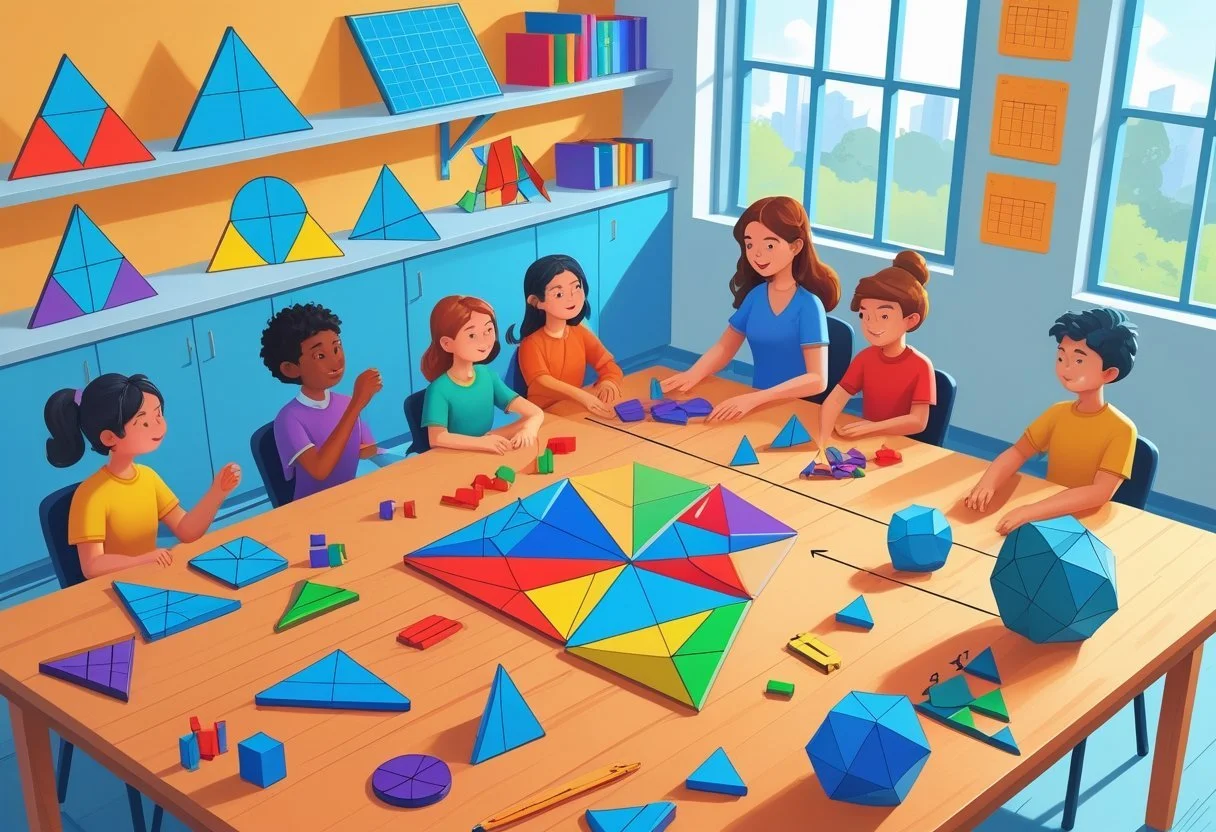
Geometry puzzles help teach important concepts like shape recognition, spatial reasoning, and geometric relationships. They encourage hands-on learning by allowing students to explore shapes, angles, and arrangements directly. Different puzzle types serve specific roles in building these skills.
Tangram Puzzles for Shape Construction
Tangram puzzles use seven flat pieces called tans, which include triangles, a square, and a parallelogram. Students rearrange these to form various shapes, animals, or objects. This activity teaches how simple shapes combine to create complex figures.
Working with tangrams improves understanding of congruency, symmetry, and area. It enhances spatial visualization by requiring learners to rotate and flip pieces. Tangrams also encourage problem solving as students figure out how pieces fit together without gaps or overlaps.
Teachers often use tangrams as a way to explain basic geometric shapes like triangles and squares while also strengthening students’ ability to recognize patterns and transformations.
Jigsaw Puzzles in Geometry Instruction
Jigsaw puzzles offer a practical way to explore geometric properties by having students assemble pieces into a larger whole. Each piece often represents part of a geometric shape or combination of shapes.
These puzzles improve visual-spatial skills and help learners understand how shapes connect to form patterns. They also promote patience and attention to detail as students must match edges and angles carefully.
In geometry, jigsaw puzzles can focus on concepts like angle types, polygon sides, and tiling. Large-scale puzzles encourage collaboration, making them useful for group activities that build teamwork alongside geometry knowledge.
Shape Sorting and Matching Games
Shape sorting involves classifying geometric shapes by their properties, such as the number of sides or types of angles. Matching games pair shapes based on similarity or congruence.
These games sharpen the ability to identify and compare geometric figures quickly. They focus on concepts like recognizing polygons, classifying triangles or quadrilaterals, and sorting shapes by size or orientation.
Shape sorting and matching are effective for reinforcing vocabulary and definitions in a low-pressure setting. They help students build a mental catalog of geometric shapes, which supports further study and problem solving in geometry.
Exploring Spatial Reasoning Skills
Spatial reasoning involves understanding the position, shape, and movement of objects in space. It helps students make sense of how shapes fit together and changes in orientation. The skills to see patterns and solve problems make spatial reasoning key to learning geometry.
Developing Visual Perception
Visual perception is the ability to recognize and interpret shapes and their relationships. Puzzles help by encouraging students to notice details such as size, shape, angle, and symmetry. This practice strengthens their ability to visualize different perspectives and predict outcomes.
Using puzzles with pieces of various shapes allows learners to see how parts fit into a whole. This supports their understanding of properties like congruence and rotation. Over time, students improve at mentally manipulating shapes, which is essential for geometry.
Enhancing Problem-Solving Abilities
Spatial reasoning tasks also improve problem-solving skills. When children work with puzzles, they practice breaking down complex shapes into simpler parts. This helps them approach geometry problems step-by-step.
Puzzles promote critical thinking by requiring students to test ideas and adjust strategies. They learn to predict connections and spot patterns, which increases accuracy and speed in solving geometry questions. Working through puzzles also builds patience and focus, needed for tackling tougher math concepts.
Hands-On Activities With Geometric Puzzles
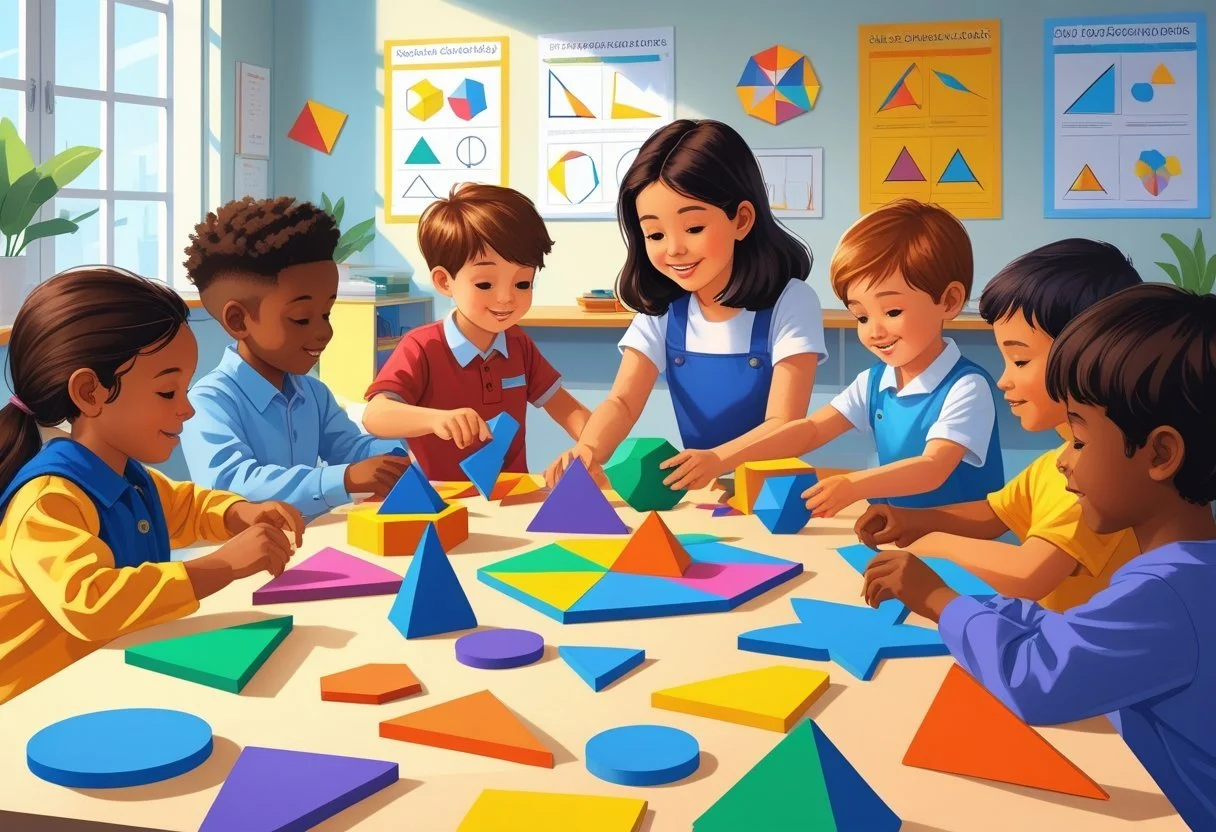
Using geometric puzzles helps students actively learn about shapes, angles, and spatial relationships. These activities give learners a clear way to explore geometry by touching and manipulating puzzle pieces. Different types of puzzles, including Montessori tools and DIY projects, provide hands-on practice. Teachers can also use interactive strategies to encourage teamwork and problem-solving.
Using Montessori Shape Puzzles
Montessori shape puzzles typically feature wooden pieces cut into basic geometric shapes like squares, triangles, circles, and rectangles. These puzzles help students recognize shapes by feel and sight while discovering how shapes fit together.
Children improve their fine motor skills as they place pieces in the correct slots. The simplicity of these puzzles makes them ideal for younger students learning shape names and properties. Teachers often use these puzzles to introduce the idea of shapes having sides, angles, and vertices.
Montessori puzzles can also include more complex forms like polygons and 3D shapes, helping learners recognize attributes such as edges and faces. Using these tools provides a hands-on foundation for understanding geometry basics.
DIY Geometry Puzzle Ideas
Teachers and parents can create simple geometry puzzles using paper, cardboard, or foam. For example, cutting large cardstock into polygons and asking students to match equal shapes or find angles creates an engaging activity.
Another idea is to design puzzles where students must assemble shapes to form larger figures, like combining triangles to make a hexagon. Color-coding the pieces can help learners visually group similar shapes.
Using rulers and protractors, students can create puzzles that involve measuring angles or sides to fit pieces correctly. DIY puzzles encourage creativity while reinforcing geometric concepts such as congruence, symmetry, and spatial reasoning.
Interactive Classroom Strategies
In the classroom, teachers can turn geometric puzzles into collaborative challenges. Grouping students to solve large-scale puzzles encourages communication and shared problem-solving.
Using puzzle games with shapes and coordinates, students explore graphing by plotting points to form figures. This makes the connection between algebra and geometry clearer.
Teachers often provide measurement tools so students can verify side lengths and angles during activities, combining hands-on learning with accuracy.
Regularly integrating puzzles in lessons develops critical thinking and helps students see practical uses for geometry beyond textbooks.
Integrating Language and Vocabulary Development
Language plays a key role in learning geometry through puzzles. Building students' understanding of geometry terms helps them describe shapes and solve problems more easily. Expanding their vocabulary around shapes makes their thinking clearer and more precise.
Teaching Geometry Terminology With Puzzles
Using puzzles introduces terms like vertex, edge, angle, and face in a hands-on way. When students fit puzzle pieces together, they see these parts in real objects. Teachers can highlight these words as students work, helping the words connect to the shapes.
Repetition is important. Puzzles allow learners to hear and use geometry words repeatedly. For example, while assembling a puzzle of polygons, students identify and name triangles, squares, and hexagons.
In addition, puzzles can focus on properties of shapes, such as parallel sides or right angles. Teachers can guide discussions around these terms, reinforcing vocabulary through active involvement rather than passive reading.
Expanding Shape-Related Vocabulary
Beyond basic shape names, puzzles help students learn descriptive words like curved, symmetrical, regular, and irregular. These terms help describe how shapes look and behave.
Activities that mix poetry or riddles about shapes, alongside puzzle solving, deepen vocabulary. Puzzles also teach comparative words like larger than or smaller than when pieces vary in size.
A simple list of useful vocabulary can be shown next to puzzle activities:
Polygon
Quadrilateral
Acute angle
Obtuse angle
Congruent
Symmetry
Using these words frequently with puzzles lets students recognize and use them in math discussions confidently. This makes geometry concepts clearer and more accessible.
Assessment and Progress Tracking With Puzzles
Effective use of puzzles in geometry teaching requires clear ways to measure student progress. It also needs flexible strategies to adjust the difficulty to fit different learning levels.
Monitoring Student Understanding
Teachers can track understanding by observing how students solve puzzles. Key points to watch include how well they use geometric terms, recognize shapes, and apply rules.
Progress tracking tools often record which puzzles students complete and the time they take. This data helps spot areas of strength and topics needing more practice.
Using checklists or simple rubrics can guide teachers in assessing skills like spatial reasoning or angle identification during puzzle activities. These tools offer quick, reliable feedback on student progress.
Adapting Puzzle Difficulty For Learners
Adjusting puzzle difficulty ensures learners stay challenged but not overwhelmed. Start with simple shape recognition puzzles before moving to complex problems involving transformations and proofs.
Teachers can increase difficulty by introducing more pieces, adding time limits, or requiring explanations of solutions. These changes encourage deeper thinking.
Grouping puzzles by skill levels or using interactive tools allows personalized learning. It also supports learners who need extra help and those ready for advanced challenges.
Example:
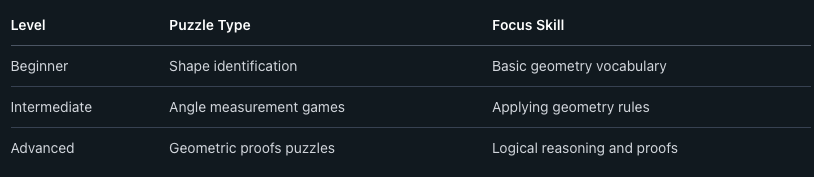
Adapting Geometry Puzzles for Diverse Learners
Geometry puzzles can be changed to fit learners’ needs by using clear steps and offering different ways to solve problems. These changes help younger children build basic skills and support students with learning differences to engage fully.
Strategies for Early Childhood Education
For young children, puzzles should use simple shapes and familiar objects. Visual aids like bright colors and large pieces help keep their attention.
Hands-on materials, such as blocks or drawing tools, allow children to explore shapes physically. This promotes understanding through touch and movement.
Tasks should have clear, short instructions. Breaking puzzles into small steps helps avoid frustration and builds confidence.
Repetition of basic shapes and patterns over time strengthens recognition and memory. Children can practice sorting, matching, or grouping shapes in playful ways.
Supporting Special Educational Needs
Students with special needs benefit from tailored puzzles that include multisensory elements. Using tactile pieces, sounds, or verbal prompts can make puzzles more accessible.
Visual supports like diagrams or graphic organizers help clarify instructions and steps.
Allowing different ways to solve puzzles respects varied learning styles. For example, some may use visual tools while others may verbalize or physically arrange pieces.
Providing frequent, positive feedback keeps students motivated and focused on progress.
Pace should be flexible, letting learners work at a comfortable speed without pressure. This encourages deeper understanding and reduces anxiety.
Frequently Asked Questions
Puzzles can serve different roles in teaching geometry, from introducing shapes to improving problem-solving skills. Their use varies depending on the type of puzzle, student age, and learning goals.
What are the most effective puzzle types for introducing geometric concepts to students?
Shape recognition puzzles and angle mazes work well for beginners. They focus on basic properties like sides, angles, and symmetry.
Manipulatives like tangrams and pattern blocks also help by giving students hands-on experience with shapes.
How can puzzles help in developing spatial reasoning skills in geometry?
Puzzles that require arranging pieces or finding paths encourage students to visualize spatial relationships.
This builds skills needed to understand rotations, reflections, and three-dimensional shapes.
What age group benefits the most from using puzzles to learn basic geometry?
Young children from about 5 to 10 years old gain a lot from simple shape and pattern puzzles.
Older students can handle more complex puzzles that involve logic and multiple steps, helping deepen their understanding.
Can puzzles be used to teach both two-dimensional and three-dimensional geometric shapes?
Yes. Flat puzzles focus on 2D shapes like triangles and squares, while 3D puzzles use cubes, pyramids, and other solids.
Using both types strengthens students' overall grasp of geometry concepts.
How does the complexity of a puzzle impact a student's understanding of geometric principles?
Simple puzzles introduce facts and definitions clearly, making them easier to absorb.
More complex puzzles require higher-order thinking, helping students apply principles and make connections between ideas.
In what ways can interactive puzzles enhance classroom engagement in geometry lessons?
Interactive puzzles encourage active participation, reducing boredom during lessons.
They allow immediate feedback and often promote collaboration, which supports learning through discussion and teamwork.